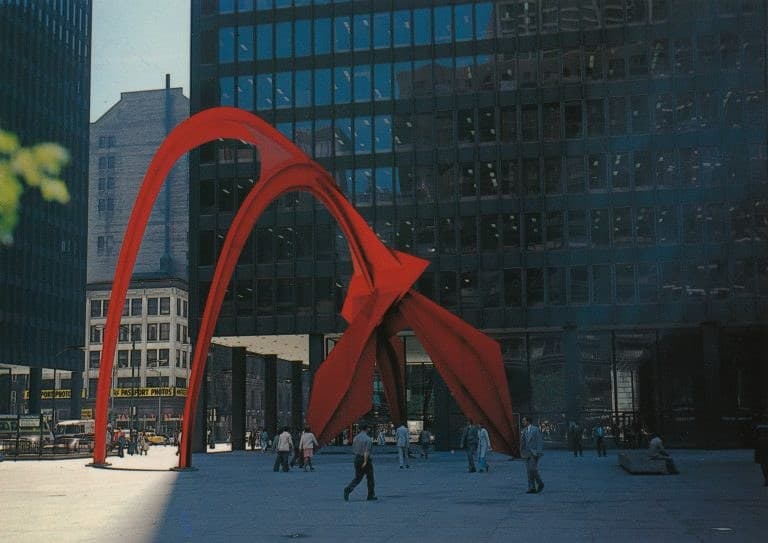
Flamingo
The 53-foot vermilion stabile arching over Chicago's Federal Center Plaza — Calder's answer to the black steel and glass of Mies van der Rohe's federal buildings, unveiled in 1974.
- 1973; unveiled 1974
- Painted steel, 53 feet tall
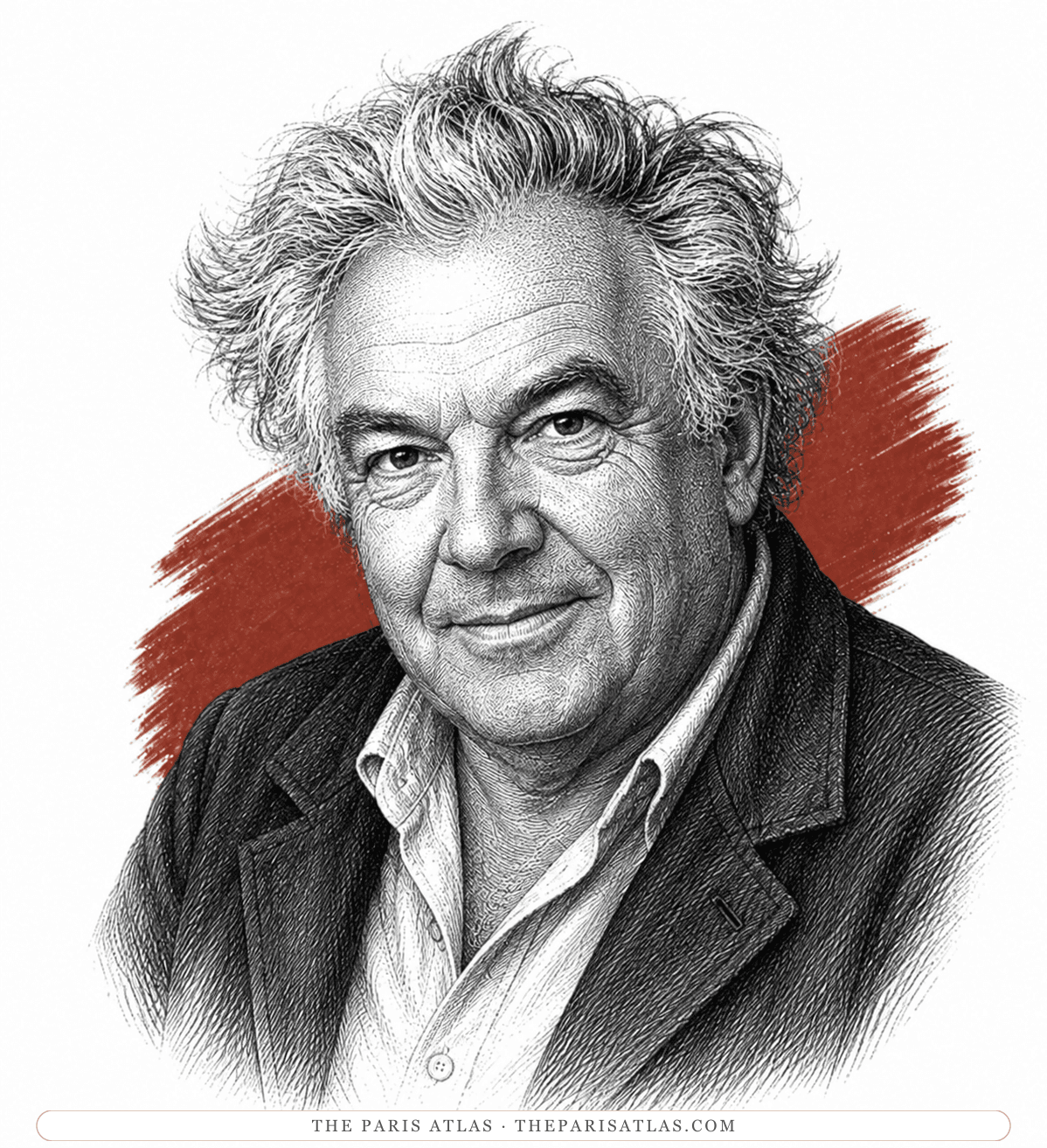
About Alexander Calder
Vermilion against black glass
The U.S. General Services Administration commissioned Flamingo under its Art in Architecture program, and the stabile was unveiled in Federal Center Plaza in 1974. Fifty-three feet of steel painted Calder's own vermilion — a red he used so often it is called Calder red — arch over the plaza between Ludwig Mies van der Rohe's black federal towers.
The contrast is the design: curved legs against straight mullions, red against black, an organic arch you can walk under set in a right-angled plaza. Calder attended the unveiling in a city that declared the day in his honour.
Close reading
Reading the work, detail by detail
The sculpture's red curves interrupt a city of dark rectangular windows. These views examine its open arches, overlapping plates, and relationship to people crossing the plaza.
1.The outer arch
The continuous curve cuts across many identical windows. Against that measured background, a single bent line can organize an enormous area of the plaza.
2.The inner opening
The opening lets the city remain visible through the sculpture. Its shape changes the background into a framed view rather than simply blocking it.
3.Plates crossing
Broad planes meet the slender arches in sharp corners. The darker faces at their junction make the sculpture's thickness and changing orientation easier to see.
4.Feet on the paving
The towering curves arrive at surprisingly small points on the ground. These slim contacts help the great mass look poised above the walkers.
5.People below
The figures provide a direct measure of scale. Their routes also show the sculpture functioning as part of an everyday passage through the plaza.
6.Red against the grid
The strong color separates the sculpture from its surroundings before its outline is fully understood. Curves and diagonals then disturb the building's repeated vertical and horizontal divisions.
Where to see it
A viewing location has not yet been listed for this work.
Frequently asked questions
Where is Calder's Flamingo?
In Federal Center Plaza, Chicago, at Dearborn and Adams Streets, surrounded by the dark Mies van der Rohe federal buildings it was designed to answer.
How tall is Flamingo?
Fifty-three feet — about sixteen metres — of painted steel, engineered so visitors can walk beneath its arches.
Why is Flamingo red?
The colour is Calder's signature vermilion, often called Calder red, chosen to burn against the black steel and glass around the plaza.
Who commissioned Flamingo?
The U.S. General Services Administration, under the federal Art in Architecture program; it was unveiled in 1974.
Is Flamingo a mobile?
No — it is a stabile, Calder's word (coined by Jean Arp) for the standing, non-moving counterpart of the mobile. Flamingo is among the largest he made.
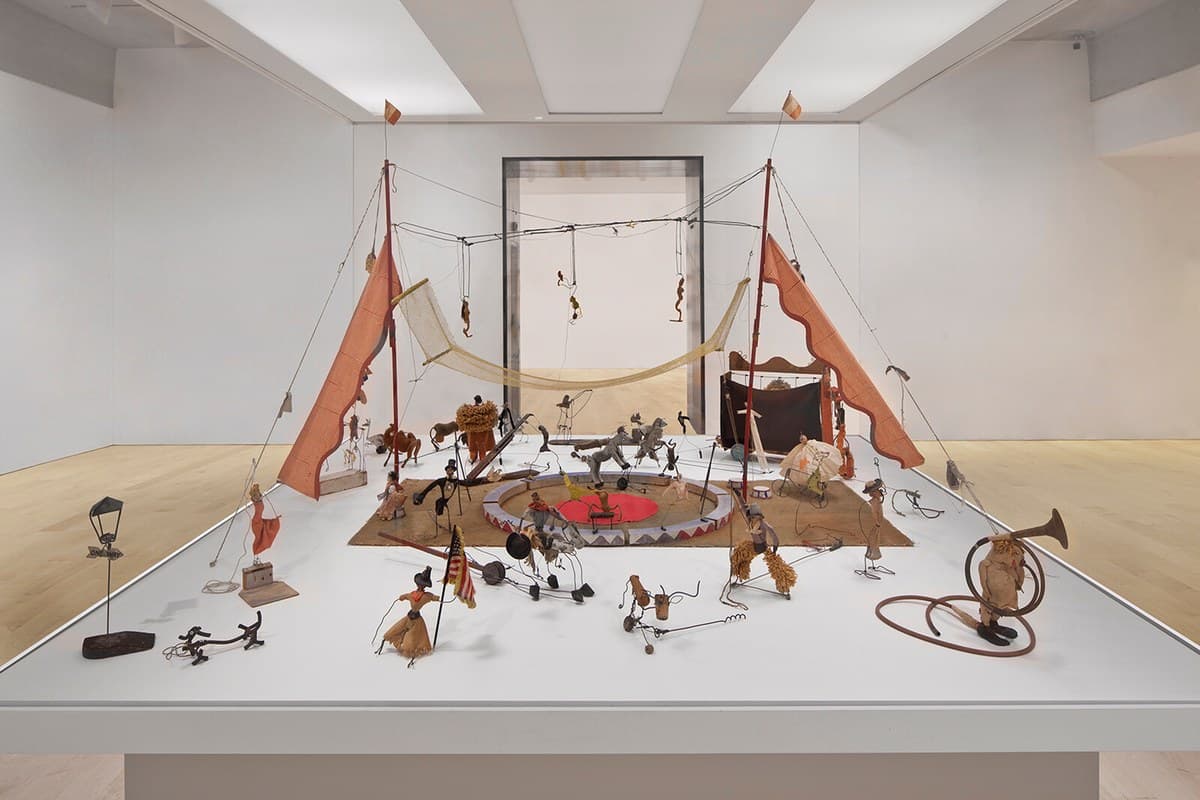
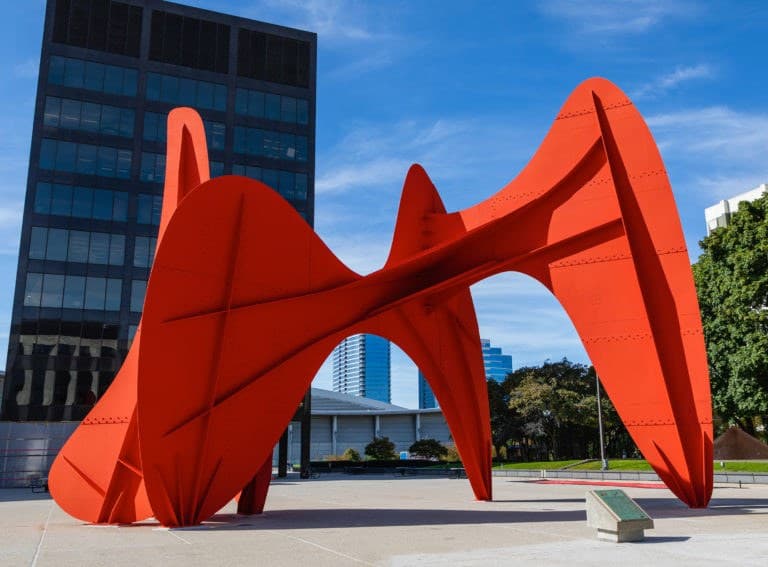
More by Alexander Calder
If you like Alexander Calder
Explore sculptors from the same movements and circles.

Arman
French-American artist, lifelong friend of Yves Klein, and a founder of New Realism.
View artist
Jean Arp
Strasbourg-born sculptor and poet — Hans in German, Jean in French, both all his life — who co-founded Dada at the Cabaret Voltaire in 1916, composed collages by dropping torn paper 'according to the laws of chance', and settled at Meudon outside Paris in a house his wife Sophie Taeuber-Arp designed.
View artist
Frédéric Auguste Bartholdi
Frédéric Auguste Bartholdi was a French sculptor best known for designing the Statue of Liberty, dedicated in New York Harbor in 1886. Born in Colmar and based in Paris, he created public monuments that gave visible form to ideas of freedom, resistance and national memory. His other major works include the Lion of Belfort and the fountain in Lyon's Place des Terreaux.
View artist
References
The sources below include collection records, catalogues, scholarly research, and primary materials that informed this page. They document Flamingo, its making, and its place in cultural history.


1Flamingo (1973) — catalogue entry
WebsiteCalder FoundationUsed forWeb source consulted for documented facts and historical context presented on the Flamingo page.
2Flamingo (sculpture)
WebsiteWikipediaUsed forWeb source consulted for documented facts and historical context presented on the Flamingo page.
3Alexander Calder's 1974 Flamingo sculpture, Federal Center Plaza
WebsiteLibrary of CongressUsed forWeb source consulted for documented facts and historical context presented on the Flamingo page.
4Introduction to Alexander Calder
WebsiteCalder FoundationUsed forWeb source consulted for documented facts and historical context presented on the Flamingo page.
These references provide the documented foundation for this work's history and interpretation. Claim-level citations remain attached to the specific claims they support.
 Explore more resources