Lobster Trap and Fish Tail
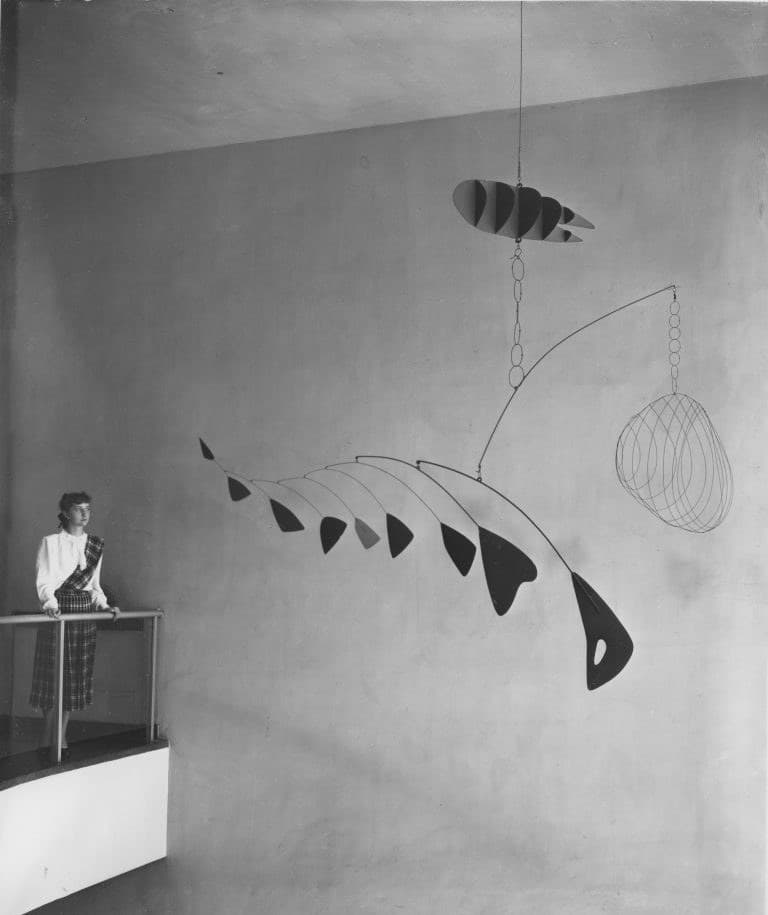
Calder's 1939 mobile for MoMA's stairwell: a wire lobster trap and a school of aluminum fins balancing overhead — one of the earliest full statements of the hanging mobile.
- 1939
- Painted steel wire and sheet aluminum, about 260 × 290 cm
About Alexander Calder

Made for a stairwell
The Museum of Modern Art commissioned the mobile in 1939 for the main stairwell of its new building, and Calder fabricated it that year at his Roxbury, Connecticut farmhouse. It hangs about two and a half metres tall and nearly three metres across.
The title names what the balancing act suggests. A wire cage like a lobster trap hangs at one end, a school of flat aluminum fins like a fish's tail at the other, and the whole set drifts with the air of the stairwell.
The mobile arrives in public
Coming eight years after Marcel Duchamp coined the word, this was one of the first mobiles made for permanent public display. It is among the earliest to show the full grammar: asymmetric balance, natural imagery abstracted to silhouette, and air as the motor. It has hung at MoMA for most of the museum's history.
Close reading
Reading the work, detail by detail
The photograph catches the mobile in one temporary arrangement. These details distinguish solid shapes from wire outlines and show how the hanging parts depend on one another.
1.The upper cluster
The overlapping plates create a dense mass above a much more open lower structure. Their alternating light and dark faces suggest shapes turning through space.
2.The chain of loops
The loops make the connection visible without filling much space. They allow the eye to trace how the lower assembly hangs from the compact form above.
3.The wire trap
The trap encloses space with almost no solid surface. Its overlapping curves gain volume from their changing intervals and from the pale wall seen through them.
4.The branching tail
Each branch carries a different shape at a different distance from the support. The repeated arrangement makes balance visible as a sequence of unequal relationships.
5.The pierced end
The hole puts a pocket of empty space inside the mobile's darkest form. It repeats, on a smaller scale, the open construction of the wire trap.
6.A person for scale
Her presence shows how far the mobile extends beyond the scale of a small ornament. The nearby railing also establishes the open architectural space in which the pieces hang.
Where to see it
A viewing location has not yet been listed for this work.
Frequently asked questions
Who commissioned Lobster Trap and Fish Tail?
The Museum of Modern Art in New York, in 1939, for the main stairwell of its new building. Calder made the mobile at his farmhouse in Roxbury, Connecticut.
What does Lobster Trap and Fish Tail depict?
Exactly what the title says, abstracted: a wire cage like a lobster trap on one side of the balance, and a run of flat aluminum fins like a fish's tail on the other.
How does the mobile move?
By air alone. The parts hang in asymmetric balance from curving steel wires, so ordinary drafts turn and dip the elements without motors.
How big is Lobster Trap and Fish Tail?
About 260 centimetres high by 290 centimetres across — sized to command a stairwell from above.
Where can I see Lobster Trap and Fish Tail?
At the Museum of Modern Art in New York, hanging in the stairwell setting it was commissioned for in 1939.
More by Alexander Calder
If you like Alexander Calder
Explore sculptors from the same movements and circles.
Arman
French-American artist, lifelong friend of Yves Klein, and a founder of New Realism.
View artist
Jean Arp
Strasbourg-born sculptor and poet — Hans in German, Jean in French, both all his life — who co-founded Dada at the Cabaret Voltaire in 1916, composed collages by dropping torn paper 'according to the laws of chance', and settled at Meudon outside Paris in a house his wife Sophie Taeuber-Arp designed.
View artist
Frédéric Auguste Bartholdi
Frédéric Auguste Bartholdi was a French sculptor best known for designing the Statue of Liberty, dedicated in New York Harbor in 1886. Born in Colmar and based in Paris, he created public monuments that gave visible form to ideas of freedom, resistance and national memory. His other major works include the Lion of Belfort and the fountain in Lyon's Place des Terreaux.
View artist
References
The sources below include collection records, catalogues, scholarly research, and primary materials that informed this page. They document Lobster Trap and Fish Tail, its making, and its place in cultural history.


1Alexander Calder, Lobster Trap and Fish Tail — collection page
WebsiteThe Museum of Modern ArtUsed forWeb source consulted for documented facts and historical context presented on the Lobster Trap and Fish Tail page.
2Lobster Trap and Fish Tail (1939) — catalogue entry
WebsiteCalder FoundationUsed forWeb source consulted for documented facts and historical context presented on the Lobster Trap and Fish Tail page.
3Lobster Trap and Fish Tail
WebsiteWikipediaUsed forWeb source consulted for documented facts and historical context presented on the Lobster Trap and Fish Tail page.
4Introduction to Alexander Calder
WebsiteCalder FoundationUsed forWeb source consulted for documented facts and historical context presented on the Lobster Trap and Fish Tail page.
These references provide the documented foundation for this work's history and interpretation. Claim-level citations remain attached to the specific claims they support.
 Explore more resources