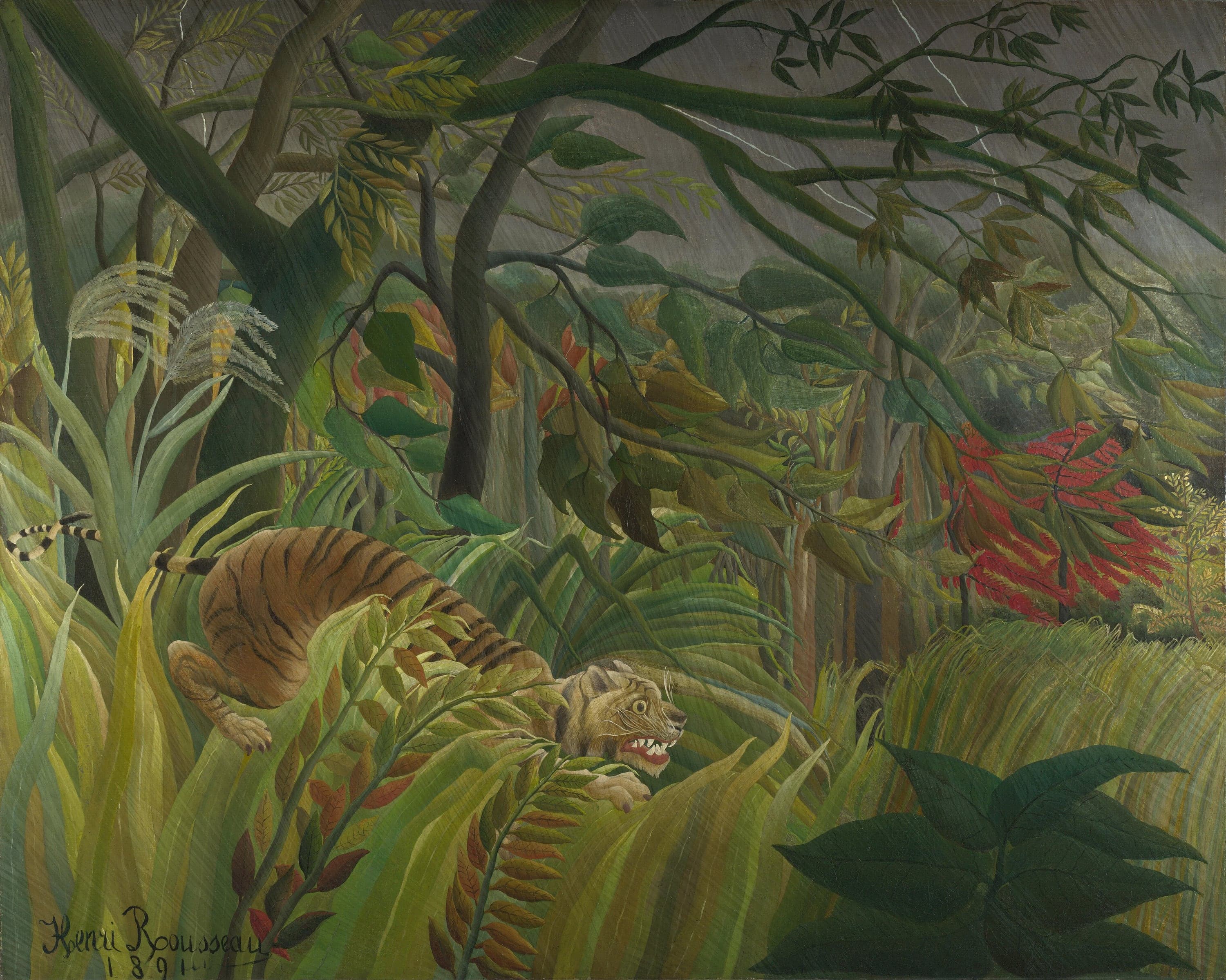
Tiger in a Tropical Storm (Surprised!)
A tiger crouches in tall grass with its teeth bared and its eyes wide, while lightning cracks across a slate-grey sky. Henri Rousseau showed the picture at the Salon des Indépendants in Paris in 1891 under the title Surpris!, and it was the first of the roughly twenty jungle paintings he went on to make. He had never left France. The National Gallery in London bought it in 1972 and displays it as Surprised!
- 1891
- Oil on canvas (unlined)
- The National Gallery, LondonLondon, United Kingdom
About Henri Rousseau
What the painting shows
The tiger fills the middle of the canvas, crouched low with its haunches raised and one back leg folded under it. Its mouth is open on a row of white triangular teeth, its eyes bulge yellow, and its whiskers stand out stiffly in every direction. The black-and-orange tail curls away behind it through pale feathery grasses. A front paw reaches out below the chin, splayed and clawed.
Rousseau built the setting in three bands. The top is stormy sky, crossed by white zigzag lightning: two bolts run down to the right in the upper right quarter, and a third shows faintly in the upper left corner. The middle band is vegetation, including two tall beige plumes of pampas grass behind the tiger and, at the far right, a scarlet tree that supplies the one blast of strong color. The bottom band is a thicket of long pointed leaves that the National Gallery compares to agave or snake plant, with a big dark rubber plant at the lower right.
Everything leans. The National Gallery's description has the storm blowing in from the left, and the boughs, grasses and plumes all bend to the right with it. The tiger does not stand on anything: it appears to balance its weight on the stalks rather than on the ground.
How the rain got onto the canvas
There are no raindrops in the picture. Rousseau finished the jungle and the tiger first, then covered the entire painted surface with a mesh of diagonal, semi-transparent silver-grey stripes to stand for tropical rain. The National Gallery notes that those stripes echo the tiger's own stripes and the long blades of the leaves, so the weather and the animal are drawn in the same marks. Tate, which borrowed the painting in 2005, describes the same effect as a white and grey glazing laid over the whole surface.
The National Gallery links the method to Japanese woodblock prints. It names one in particular: Sudden Shower over Shin-Ōhashi Bridge and Atake, which Utagawa Hiroshige published in 1857. The Gallery also records two working habits behind the picture. Rousseau completed the canvas section by section rather than all at once. He used a pantograph, a mechanical enlarger that let him trace the outline of a projected image straight onto the canvas.
The canvas was reworked. Above the tall grasses on the right there are darkened patches that the National Gallery suggests are the remains of prey Rousseau later painted out.
The first critic to take him seriously
The Salon des Indépendants had no jury and gave no prizes, which is why an unschooled customs clerk could hang there at all. Rousseau showed the painting at the 1891 Salon as Surpris!, and it drew the first serious critical notice of his career. The notice came from Félix Vallotton, a Swiss painter and printmaker then twenty-five years old, writing in the Gazette de Lausanne on 25 March 1891.
Vallotton reported that crowds gathered in front of Rousseau's entries and laughed at them, and that the picture flattened everything hung near it. Then he made the judgment that has followed the painting ever since.
“His tiger surprising a prey is worth seeing; it is the alpha or the omega of painting, and so disconcerting that the most deeply rooted convictions pull up short and hesitate before so much self-assurance and so much childlike naiveté.”
Vallotton closed by saying he had a sincere esteem for such efforts and preferred them a hundred times over to the deplorable mistakes hanging nearby. His phrase for the tiger is worth reading exactly: the French is l'alpha ou l'oméga de la peinture, the beginning or the end of painting, and he does not say which. The National Gallery's own page attributes the review to a Swiss journal without naming it; the Fondation Félix Vallotton, which published his collected criticism in 2012, places it in the Gazette de Lausanne on that date.
Vallotton also describes the tiger as surprising a prey, in a review written when the paint was months old. That is evidence for the animal the National Gallery believes was painted out of the right-hand grasses.
A jungle assembled in Paris
Rousseau told people he had seen tropical forests while serving with a French expeditionary force in Mexico in the early 1860s. The National Gallery states plainly that the claim had no basis: he spent four years in the army from 1863 and never left France. Guillaume Apollinaire repeated the Mexico story, and Tate records that Rousseau eventually admitted he had traveled no further than the glass houses of the Jardin des Plantes.
That is where the plants come from. The Jardin des Plantes was free to enter and Rousseau went often. Its collection mixed ordinary house plants with tropical species, which is why the foliage here shifts between the two without apology. The gardens were run by the natural history museum. Its Zoology Galleries had opened for the 1889 Paris World Fair with a large display of stuffed animals posed as though alive. The same grounds held a run-down zoo that kept lions, tigers and jaguars.
The tiger itself is a composite, in the National Gallery's account, of stuffed specimens, zoological and magazine illustrations, and the domestic cat. The Gallery adds that Rousseau may also have known tigers painted by Eugène Delacroix and Jean-Léon Gérôme. Tate goes further and names a Delacroix pastel of a tiger fighting a lion as the direct source, which is a firmer claim than the Gallery is willing to make.
Lost for a generation, then bought for London
The painting disappeared from view after Rousseau died in 1910. The National Gallery's provenance note, citing the researcher Henry Certigny, says it was not found again until around 1925, by which time it was going under the title Orage dans la Forêt, Storm in the Forest. Rousseau had listed it in a memorandum of his own career dated 10 July 1895 under yet another title, Tigre poursuivant des Explorateurs, a tiger chasing explorers.
It surfaced at the Marie Harriman Gallery in New York in the winter of 1931. Georges Bernheim lent it to the Kunsthalle Basel in 1933 under the title Paysage exotique. In 1934 Henry Clifford of Radnor, near Philadelphia, bought it through the Valentine Gallery. The National Gallery bought it from Clifford in 1972 with the aid of a substantial donation from Walter H. Annenberg, and it became NG6421.
Close reading
Reading the work, detail by detail
Rousseau painted the rain last, as a mesh of diagonal silver-grey stripes laid over the finished picture, so every close view here carries it. Start with the tiger, then work out to the weather, the plants and the signature.
1.The face is doing several things at once
The mouth is open on white triangular teeth and red gums, the eyes are round and yellow, and the whiskers point up and out rather than lying flat. The National Gallery's audio description calls the effect cartoon-like. Red appears in the gums and almost nowhere else nearby, which pulls the eye to the head first.
2.The tiger is not standing on anything
The paw is spread over the leaves with no ground under it. The National Gallery attributes this to Rousseau's use of a pantograph, a mechanical enlarger for tracing a projected outline onto canvas, which let him place the animal accurately without settling it into the space around it.
3.The tail keeps going after the body stops
The banded tail runs left out of the tiger's body and through the pampas grass, reaching almost to the edge of the canvas. Its stripes match the rain stripes and the long leaves. Rousseau uses the same mark for an animal, a plant and the weather.
4.Lightning, and the rain drawn across it
Two white zigzag bolts run down to the right here, and a third is faintly visible in the upper left corner of the painting. The fine diagonal lines crossing the grey are the rain, painted over the whole surface once everything else was done. The National Gallery compares the method to Utagawa Hiroshige's Sudden Shower over Shin-Ōhashi Bridge and Atake of 1857.
5.The one strong color in the picture
A scarlet tree stands at the right edge, the only large area of warm color away from the tiger's gums. The National Gallery's description calls it a swamp cypress. Below and to its left are the darkened patches the Gallery believes are traces of prey that Rousseau painted out.
6.Signed at the bottom left, dated underneath
The name is written large in flowing black script, with 1891 beneath it. Rousseau was forty-six and still working as a toll collector for the city of Paris when he signed it. He retired to paint full time two years later.
Timeline
1891
Painted, signed and dated lower left, and shown that spring at the Salon des Indépendants in Paris as Surpris! — Rousseau's first jungle painting.
1891
Félix Vallotton reviews it in the Gazette de Lausanne on 25 March, calling the tiger the alpha or the omega of painting.
1895
Rousseau lists the picture in a memorandum of his career dated 10 July, under the title Tigre poursuivant des Explorateurs.
c. 1925
Rediscovered after years out of sight, now carrying the title Orage dans la Forêt.
1931
Exhibited at the Marie Harriman Gallery, New York, in January and February.
1933
Shown at the Kunsthalle Basel as Paysage exotique, lent by Georges Bernheim.
1934
Bought through the Valentine Gallery by Henry Clifford of Radnor, near Philadelphia.
1972
Bought by the National Gallery, London, with a substantial donation from Walter H. Annenberg, as NG6421.
2005–06
Opens Tate Modern's Henri Rousseau: Jungles in Paris, the first British exhibition of his work in eighty years, which travels to the Grand Palais in Paris and the National Gallery of Art in Washington.
2010
Lent to the Fondation Beyeler in Riehen, near Basel, for its Henri Rousseau exhibition.
Where to see it
The National Gallery, London
Trafalgar Square, London WC2N 5DN, United Kingdom
The National Gallery lists the painting in Room 45. Rooms change, so check the collection page before a visit.
Plan your visit on the museum’s official website (opens in a new tab)Frequently asked questions
Where is Tiger in a Tropical Storm?
The National Gallery in London, which lists it in Room 45 under the inventory number NG6421. The Gallery bought it in 1972 from the collector Henry Clifford, with a substantial donation from Walter H. Annenberg. Check the Gallery's website before traveling, since rooms change.
Why does the National Gallery call it Surprised!?
Because that is the painting's title. Rousseau exhibited it in 1891 as Surpris!, and the Gallery uses the English form of that word alone. Tiger in a Tropical Storm is the longer descriptive title used by Tate and in general use, which is why the two names travel together.
Did Henri Rousseau ever see a jungle?
No. The National Gallery states that Rousseau never left France and that his claim to have served with a French expeditionary force in Mexico had no basis. The plants come from the Jardin des Plantes in Paris, a free botanical garden he visited often, and the tiger from stuffed specimens, illustrations and the domestic cat.
How did Rousseau paint the rain?
He painted it last, over everything else. Once the jungle and the tiger were finished he covered the whole surface with a mesh of diagonal, semi-transparent silver-grey stripes. The National Gallery compares the method to Japanese woodblock prints, naming Utagawa Hiroshige's Sudden Shower over Shin-Ōhashi Bridge and Atake of 1857.
What is the tiger attacking?
Nothing that is still visible. The National Gallery reports that Rousseau reworked the canvas, and that darkened patches above the tall grasses on the right may be the traces of prey he painted out. Félix Vallotton's review of 1891 describes the animal as a tiger surprising a prey, which suggests something was there when the picture was first shown.
How big is Tiger in a Tropical Storm?
129.8 by 161.9 centimetres, in oil on an unlined canvas. The National Gallery publishes the size in centimetres only. It hangs in a seventeenth-century Genoese frame.
What did critics say about it in 1891?
One critic took it seriously and the crowd laughed. Félix Vallotton wrote in the Gazette de Lausanne that visitors gathered in front of Rousseau's entries to laugh, that the picture crushed everything hung beside it, and that the tiger was the alpha or the omega of painting. He was the first critic to single Rousseau out.
More by Henri Rousseau
If you like Henri Rousseau
Explore painters from the same movements and circles.

Tarsila do Amaral
Brazilian painter who spent the 1920s moving between São Paulo and Paris, studied Cubism under André Lhote, Albert Gleizes and Fernand Léger, and used what she learned to paint Brazilian towns, railways, plants and bodies. Her 1928 painting Abaporu prompted the manifesto that gave the Anthropophagic movement its name.
View artist
Arman
French-American artist, lifelong friend of Yves Klein, and a founder of New Realism.
View artist
Jean Arp
Strasbourg-born sculptor and poet — Hans in German, Jean in French, both all his life — who co-founded Dada at the Cabaret Voltaire in 1916, composed collages by dropping torn paper 'according to the laws of chance', and settled at Meudon outside Paris in a house his wife Sophie Taeuber-Arp designed.
View artist
References
The sources below include collection records, catalogues, scholarly research, and primary materials that informed this page. They document Tiger in a Tropical Storm (Surprised!), its making, and its place in cultural history.


1Henri Rousseau, 'Surprised!', 1891 (NG6421)
WebsiteNational Gallery, LondonUsed forThe holding museum's catalogue entry: the identifying facts, the provenance chain, the account of the rain glaze and the pantograph, and the statement that Rousseau never left France.

2Félix Vallotton (1865–1925). Critique d'art
EssaysFondation Félix Vallotton and Institut suisse pour l'étude de l'art, 2012Used forThe collected art criticism of Félix Vallotton, which dates his review of the painting to the Gazette de Lausanne of 25 March 1891 and prints its French text.
3Henri Rousseau: Jungles in Paris — poster pack for teachers
Exhibition catalogueTate, 2005Used forTate's close study of the painting for the 2005 exhibition: the white and grey glazing read as rain, the plant identifications, and Rousseau's admission about the glass houses of the Jardin des Plantes.
4Henri Rousseau: Jungles in Paris — press release
WebsiteTate, 2005Used forTate's announcement of the 2005–06 exhibition, which opened with this painting and then traveled to Paris and Washington.
5Henri Rousseau: Jungles in Paris
WebsiteTate Modern, 2005Used forTate Modern's exhibition record, giving the dates and the scale of the 2005–06 show.
These references provide the documented foundation for this work's history and interpretation. Claim-level citations remain attached to the specific claims they support.
 Explore more resources