The Paris AtlasCharting the artists, works, and places worth returning to.
  • Painter
· French · 1844–1910

Henri Rousseau

The self-taught 'Douanier' feted by Picasso's circle at the 1908 Bateau-Lavoir banquet; he painted Apollinaire and Marie Laurencin as The Muse Inspiring the Poet, and nine of his canvases hang in the Orangerie.

In images

Details

Lived
1844–1910
Born
21 May 1844
Birthplace
Laval, France
Birth name
Henri Julien Félix Rousseau
Died
2 September 1910 · aged 66
Place of death
Paris
Nationality
French
Profession
Painter
Major works
Tiger in a Tropical Storm, The Sleeping Gypsy, The Hungry Lion Throws Itself on the Antelope, The Snake Charmer, The Dream
Married
Clémence Boitard · married 1868 until her death in 1888Josephine Noury · married 1899
Roles
Painter

About Henri Rousseau

Self-taught French painter of the jungle, known as Le Douanier

Henri Rousseau was a French painter, born in Laval on 21 May 1844, who worked most of his life as a Paris toll collector and taught himself to paint on the side. His nickname, Le Douanier, the customs officer, came from that day job. He took up painting seriously in his forties and retired at forty-nine to do it full time. His dense, dreamlike jungle scenes, Tiger in a Tropical Storm, The Sleeping Gypsy, The Dream, are now among the best-loved images in modern art.

He was laughed at for most of his life. Critics called his flat, frontal, wrong-perspectived pictures childish, and he never won the conventional Salon acceptance he longed for. But the young avant-garde saw what the critics missed: in 1908 Pablo Picasso threw a banquet in his honour at the Bateau-Lavoir, and Rousseau's directness, learned from no academy, helped free the next generations of painters from academic illusion.

He never left France and never saw a jungle; the foliage came from the Paris botanical gardens and the animals from its natural-history museum and children's books. He died of gangrene at the Necker Hospital in Paris on 2 September 1910, aged 66, with seven friends at his grave, and was recognised as a self-taught master within a year of his death.

Laval, the army, and the customs post, 1844–1885

Henri Julien Félix Rousseau was born in Laval, in western France, on 21 May 1844, the son of a tinsmith. When his father fell into debt and lost the family house, the boy became a boarder at the town's high school, where he was middling at most subjects but won prizes for drawing and music. He worked briefly for a lawyer, ran into trouble over a small perjury, and, as he put it, sought refuge in the army, serving four years from 1863.[1]

His father's death took him to Paris in 1868 to support his widowed mother on a government salary. He married Clémence Boitard that year, and in 1871 became a collector of the octroi, the tax on goods entering the city, the modest civil-service post that gave him his lifelong nickname, Le Douanier. He and Clémence had six children, most of whom died young; she died in 1888, and he married Josephine Noury in 1899.

The jungles that never left Paris, 1886–1907

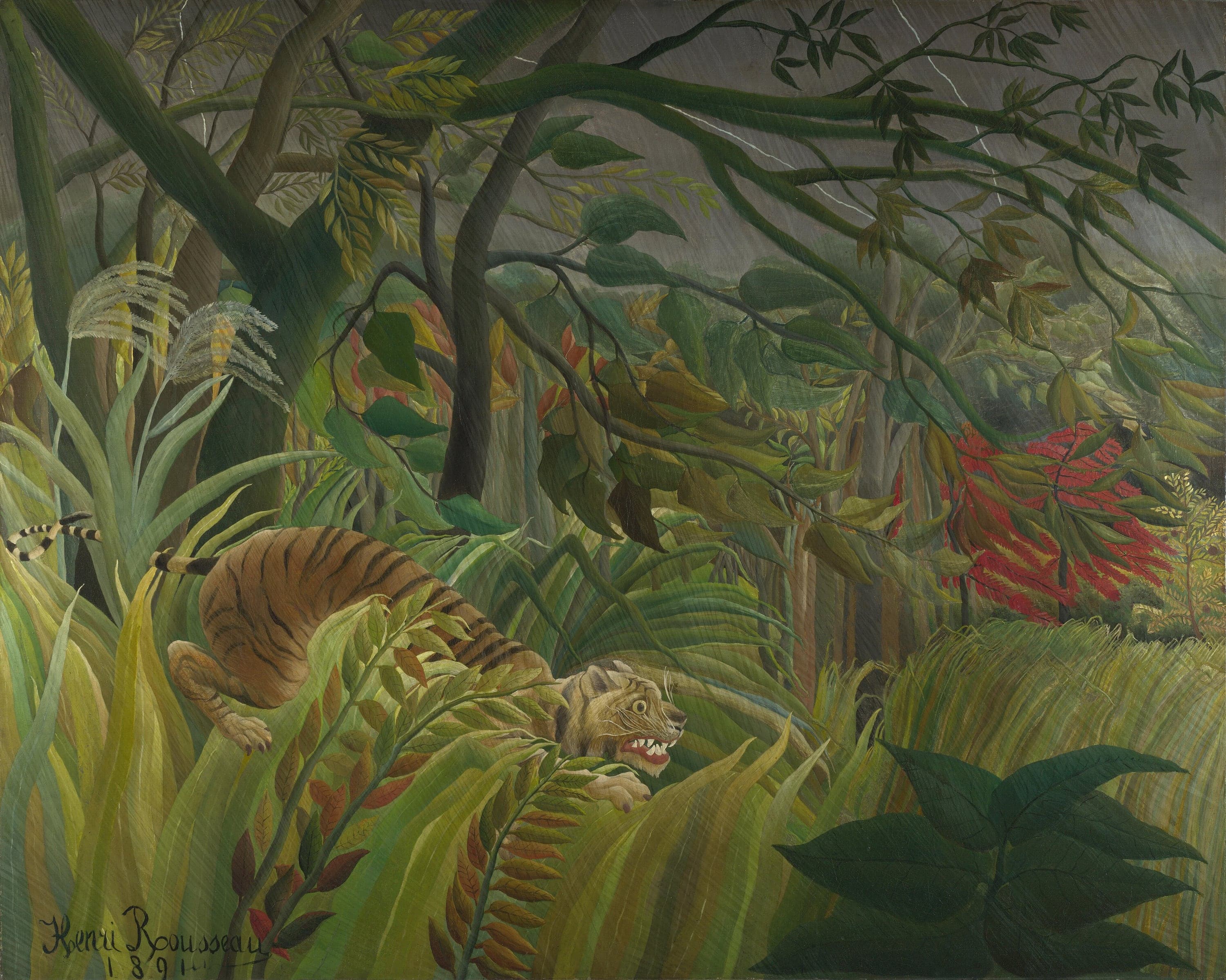
From 1886 Rousseau showed every year at the Salon des Indépendants, the jury-free exhibition where an amateur could hang beside anyone. Tiger in a Tropical Storm (Surprised!), his first jungle scene, appeared in 1891 and drew his first real review, from the young painter Félix Vallotton, who called the surprised tiger the alpha and omega of painting. At forty-nine, in 1893, he took early retirement on a small pension, moved to a Montparnasse studio, and painted full time, tutoring children and taking odd jobs to fill the gap.

The jungles were pure invention. Rousseau never left France. He told the critic Arsène Alexandre that his tropics came from the glass houses of the Jardin des Plantes, where the strange plants made him feel he had entered a dream. The animals came from the natural-history museum's taxidermy and from children's book illustrations. The masterpieces accumulated quietly. The Sleeping Gypsy came in 1897. The Hungry Lion Throws Itself on the Antelope (1905) hung near Matisse and the young painters just being called the Fauves. The Snake Charmer (1907) was commissioned by the mother of the painter Robert Delaunay.[1]

The banquet, and the last paintings, 1908–1910

In 1908 Pablo Picasso found a Rousseau being sold cheap in the street as a canvas to paint over, recognised its power, and sought the old man out. That year he staged a half-serious, half-burlesque banquet in Rousseau's honour at his Bateau-Lavoir studio in Montmartre, with Guillaume Apollinaire presiding and Georges Braque, Marie Laurencin, Max Jacob, Juan Gris, and Leo and Gertrude Stein among the guests. Le Banquet Rousseau became one of the legendary evenings of modern art, retold for generations. Rousseau answered the tribute in paint, twice picturing Apollinaire with Laurencin as his muse in The Muse Inspiring the Poet.[2]

Rousseau, La Carriole du père Junier (1908), now in the Musée de l'Orangerie, Paris. (Henri Rousseau (Musée de l'Orangerie), via Wikimedia Commons · Public domain)

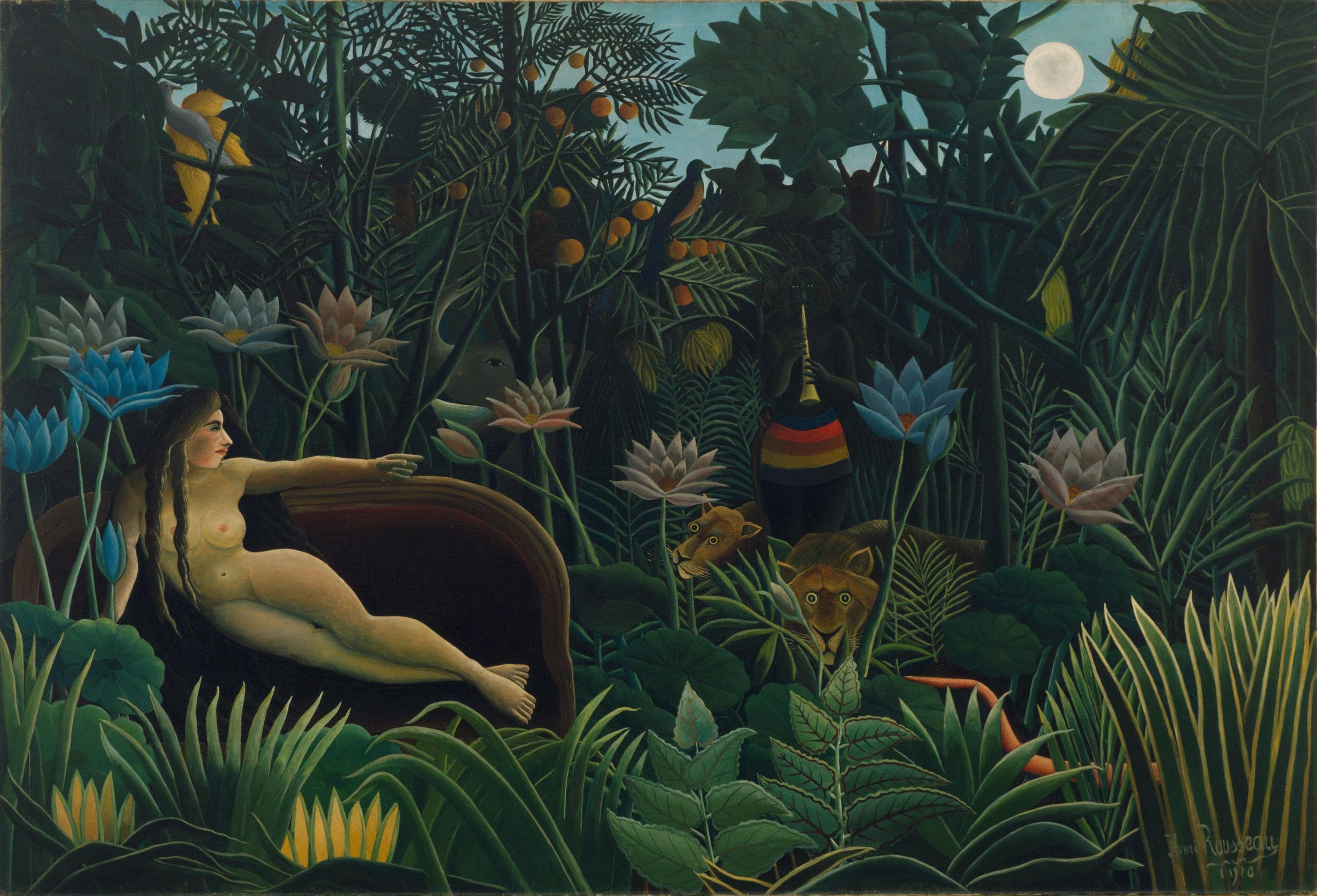
The last works are the summit. Tropical Forest with Monkeys and The Dream, both 1910, gather every jungle motif into their most assured form. The Dream, a nude reclining on a red sofa among the vines, was his final Salon des Indépendants entry, in March 1910. That same month an infection took hold in his leg. Admitted to the Necker Hospital in Paris, where a son had earlier died, he was found to have gangrene, and after an operation he died of a blood clot on 2 September 1910, aged 66.[1]

The grave, and the epitaph

Seven friends stood at his burial: the painters Paul Signac and Manuel Ortíz de Zárate, Robert and Sonia Delaunay, the sculptor Constantin Brâncuși, his landlord Armand Queval, and Guillaume Apollinaire. Apollinaire wrote the epitaph that Brâncuși carved into the stone. It addresses Rousseau directly, promising to bring brushes, paint and canvas so that he could spend his sacred leisure painting in the light and truth of heaven, duty free at last for a customs man.[3]

How Rousseau painted

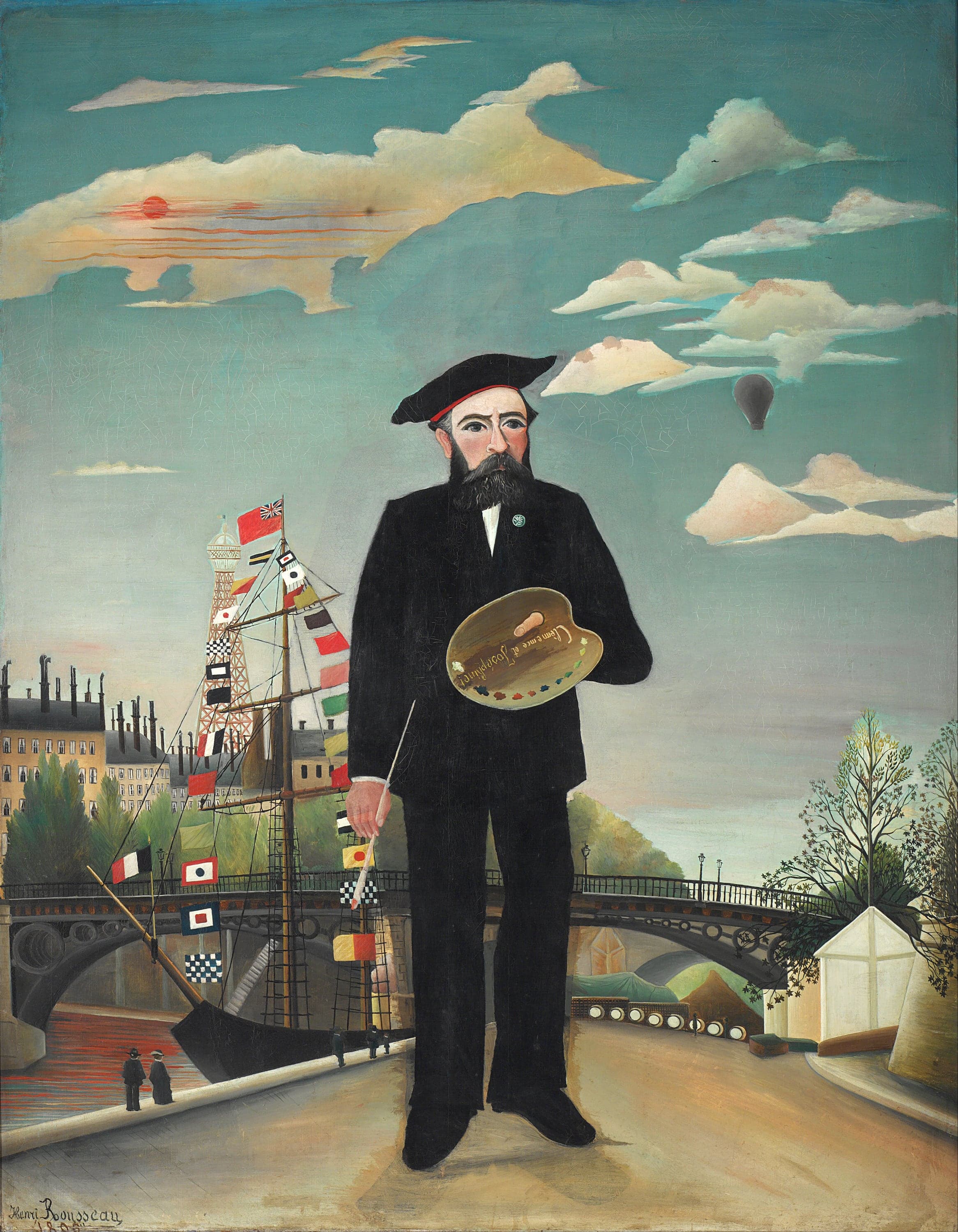
Rousseau had no academic training and claimed nature as his only teacher, though he admitted a little advice from two Salon painters. He built pictures by outline and flat colour, layering leaf over leaf until a canvas held dozens of distinct greens. He set his figures frontally and at odd scale, in a shadowless clarity that read to critics as a child's drawing and to later painters as radical honesty. He also claimed to have invented the portrait-landscape, starting from a real Paris view and setting a person before it, as in Myself, Portrait-Landscape (1890).

The famous jungles are assemblages, not observations. Hothouse plants, museum taxidermy, and picture-book animals combine into a wholly imagined wilderness. Its menace, a lion over an antelope, a tiger in the storm, is oddly gentle, its beasts often nearly human. The effect that looks naïve is in fact carefully engineered, which is why the work rewards the close looking its first audiences refused it.

Reception and influence

The reversal was fast and total. Ridiculed in his lifetime, Rousseau was given a retrospective at the Salon des Indépendants in 1911, the year after his death, and shown at the first Blaue Reiter exhibition. The dealer Wilhelm Uhde promoted him, and naïve art became a recognised category largely in his wake. His flat, concentrated forms fed Picasso, Fernand Léger, Jean Metzinger, Max Beckmann and the Surrealists.

The paintings now hang in the Museum of Modern Art, the Musée d'Orsay, the Orangerie, the Barnes Foundation and the National Gallery in London. The jungles have soaked into popular culture too, from the poems of Wallace Stevens and Sylvia Plath to animated films. Major exhibitions in 1984, 2005 and 2015, and a Barnes and Orangerie show in 2025–26, have steadily replaced the myth of the oblivious naïf with the record of a deliberate, single-minded artist.

Life events

  1. 1844

    Born in Laval, western France, on 21 May, the son of a tinsmith.

    — Henri Rousseau

  2. 1863

    Enters four years of army service after a brush with the law.

    — Henri Rousseau

  3. 1871

    Becomes a Paris octroi tax collector, the post that gives him the nickname Le Douanier.

    — Henri Rousseau

  4. 1886

    Begins exhibiting yearly at the jury-free Salon des Indépendants.

    — Henri Rousseau

  5. 1891

    Tiger in a Tropical Storm, his first jungle scene, earns his first serious review, from Félix Vallotton.

    — Henri Rousseau

  6. 1893

    Retires at forty-nine on a small pension to paint full time, moving to a Montparnasse studio.

    — Henri Rousseau

  7. 1897

    Paints The Sleeping Gypsy, now in the Museum of Modern Art.

    — Henri Rousseau

  8. 1905

    The Hungry Lion Throws Itself on the Antelope hangs near Matisse at the first showing of the Fauves.

    — Henri Rousseau

  9. 1908

    Picasso stages the celebrated Banquet Rousseau at the Bateau-Lavoir in Montmartre.

    Henri Rousseau, La Carriole du père Junier, 1908 (Musée de l'Orangerie) — a painting Paul Guillaume prized. (Henri Rousseau (Musée de l'Orangerie), via Wikimedia Commons)

    — Henri Rousseau

  10. 1910

    Exhibits The Dream in March; admitted to the Necker Hospital with gangrene, he dies of a blood clot on 2 September, aged 66.

    — Henri Rousseau

  11. 1911

    A retrospective at the Salon des Indépendants, a year after his death, begins his rapid rehabilitation.

    — Henri Rousseau

Art Depicting Henri Rousseau

Works with Henri as their subject.

Henri Rousseau paints himself full length in a black suit and beret, holding a palette lettered in gold and a thin brush, standing far taller than the Seine quay, arched bridge, flag-covered sailing ship and Eiffel Tower behind him, with a balloon in a green-blue sky

Artwork reproduction

Painting

Myself: Portrait-Landscape

Henri Rousseau · 1890 · Oil on canvas

Henri Rousseau paints himself full length in a black suit and beret, holding a palette and a brush, standing on a Paris quay so large that the bridge and the boats behind him reach only to his knees. The Eiffel Tower, then one year old, shows through a ship's rigging on the left, and a balloon floats in the sky on the right. He showed it at the Salon des Indépendants in 1890, seventeen years before he claimed in a letter to have invented the kind of picture it is.
National Gallery Prague

Henri Rousseau, Myself: Portrait-Landscape, 1890. National Gallery Prague. Image: public domain.

Selected works

Cataloged from the holding institutions' records. Reproductions appear only where the rights are verified.

Paintings

Henri Rousseau paints himself full length in a black suit and beret, holding a palette lettered in gold and a thin brush, standing far taller than the Seine quay, arched bridge, flag-covered sailing ship and Eiffel Tower behind him, with a balloon in a green-blue sky

Artwork reproduction

Painting

Myself: Portrait-Landscape

1890 · Oil on canvas

Henri Rousseau paints himself full length in a black suit and beret, holding a palette and a brush, standing on a Paris quay so large that the bridge and the boats behind him reach only to his knees. The Eiffel Tower, then one year old, shows through a ship's rigging on the left, and a balloon floats in the sky on the right. He showed it at the Salon des Indépendants in 1890, seventeen years before he claimed in a letter to have invented the kind of picture it is.
National Gallery Prague

Henri Rousseau, Myself: Portrait-Landscape, 1890. National Gallery Prague. Image: public domain.

A naked woman with long dark hair reclines on a dark red sofa at the left of a moonlit jungle, one arm stretched out toward a dark figure in a striped wrap playing a pipe, with a lion and lioness, an elephant, birds and huge pink and blue lotus flowers among the leaves

Artwork reproduction

Painting

The Dream

1910 · Oil on canvas

A naked woman lies on a dark red sofa in a moonlit jungle, one arm stretched out toward a piper standing among the leaves. Around them are a lion and a lioness, an elephant, a snake, two birds and a monkey, with flowers the size of heads cut open to show their centers. Henri Rousseau finished it in March 1910 and it was his only entry at the Salon des Indépendants that spring. He died six months later. The Museum of Modern Art in New York has owned it since 1954.

The Museum of Modern Art

Henri Rousseau, The Dream, 1910. The Museum of Modern Art. Image: public domain.

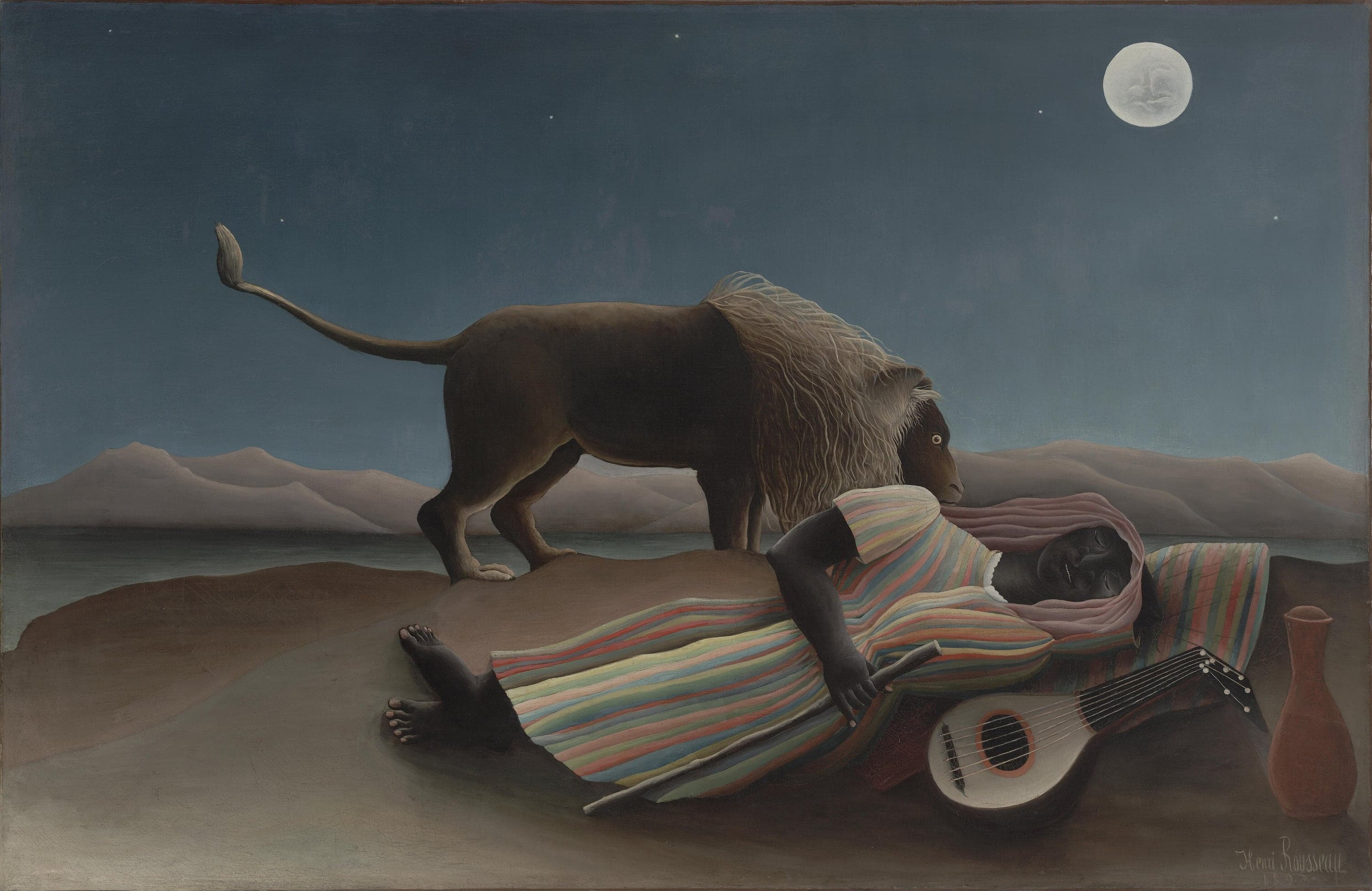
A woman in a robe striped in coral, cream, blue and green sleeps on bare ground beside a mandolin and a rust-colored jar, while a brown lion with a pale mane stands over her and smells her, under a white full moon in a dark blue sky

Artwork reproduction

Painting

The Sleeping Gypsy

1897 · Oil on canvas

A woman in a striped robe sleeps on bare ground with a mandolin and a water jar beside her, and a lion stands over her without touching her. A full moon hangs at the upper right and pale hills close the horizon. Henri Rousseau painted it in 1897 and offered it the next year to Laval, the town where he was born, which turned it down. The Museum of Modern Art in New York has owned it since 1939.

The Museum of Modern Art

Henri Rousseau, The Sleeping Gypsy, 1897. The Museum of Modern Art. Image: public domain.

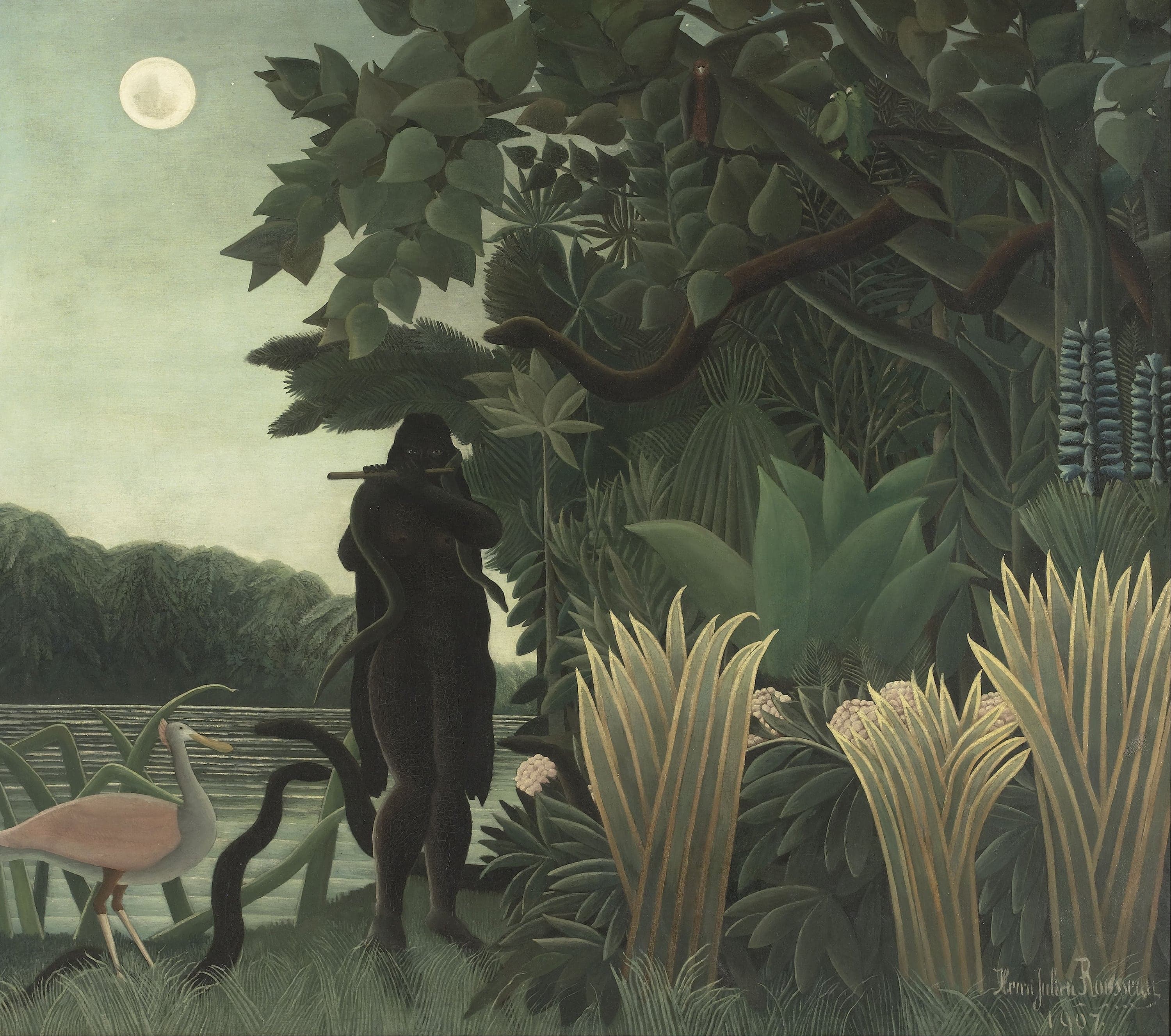
A nude woman painted as a near-black silhouette stands at a riverbank playing a wooden pipe, a snake across her shoulders and another curling up from the grass, with a full moon in a pale grey-green sky and a pink spoonbill wading at the left

Artwork reproduction

Painting

The Snake Charmer

1907 · Oil on canvas

A dark, almost black figure stands at the edge of a river playing a wooden pipe, with a snake across her shoulders and another rising from the grass at her feet. A full moon hangs in a pale grey-green sky and a pink spoonbill wades at the left. Henri Rousseau painted it in 1907 on commission from Berthe Delaunay, the mother of the painter Robert Delaunay, and showed it that autumn at the Salon d'Automne. It is at the Musée d'Orsay in Paris.

Musée d'Orsay

Henri Rousseau, The Snake Charmer, 1907. Musée d'Orsay. Image: public domain.

A tiger crouches in tall pale-green grass with its mouth open on white teeth, its yellow eyes wide and its whiskers bristling, while white lightning cracks across a slate-grey sky and bent branches and a scarlet tree fill the jungle behind it

Artwork reproduction

Painting

Tiger in a Tropical Storm (Surprised!)

1891 · Oil on canvas (unlined)

A tiger crouches in tall grass with its teeth bared and its eyes wide, while lightning cracks across a slate-grey sky. Henri Rousseau showed the picture at the Salon des Indépendants in Paris in 1891 under the title Surpris!, and it was the first of the roughly twenty jungle paintings he went on to make. He had never left France. The National Gallery in London bought it in 1972 and displays it as Surprised!

The National Gallery, London

Henri Rousseau, Tiger in a Tropical Storm (Surprised!), 1891. The National Gallery, London. Image: public domain.

People Henri Rousseau Knew

Relationships with other people, with sources for each connection.

Illustrated portrait of Guillaume Apollinaire

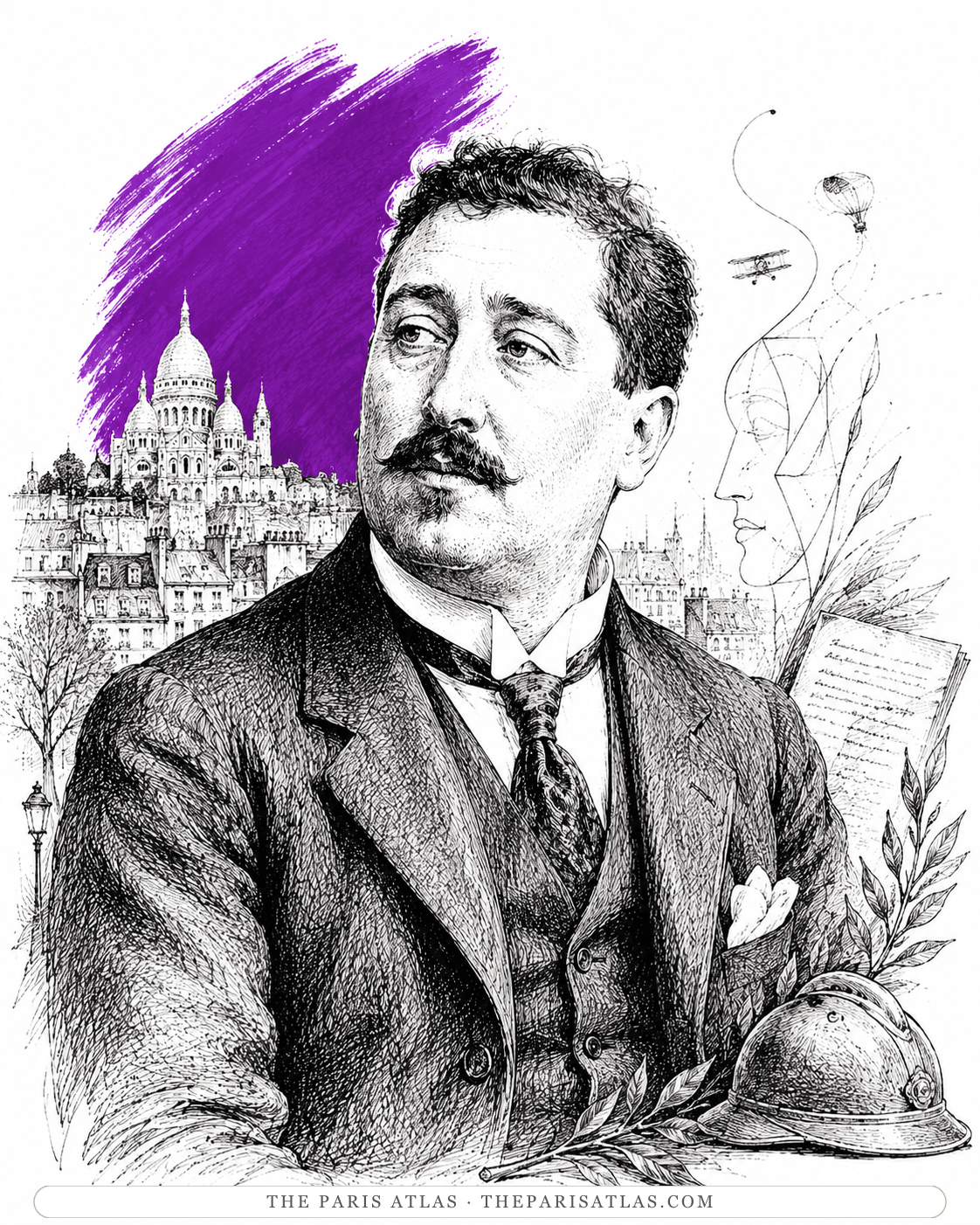
Guillaume Apollinaire

  • Poet
  • Critic

Met · 1908

Apollinaire presided at the 1908 Bateau-Lavoir banquet for Rousseau, and the painter answered in kind: The Muse Inspiring the Poet, painted twice in 1909, shows Apollinaire with Marie Laurencin as his muse.

— Gertrude Stein, The Autobiography of Alice B. Toklas (1933); Marie Laurencin — AWARE: Archives of Women Artists, Research and Exhibitions

Illustrated portrait of Pablo Picasso

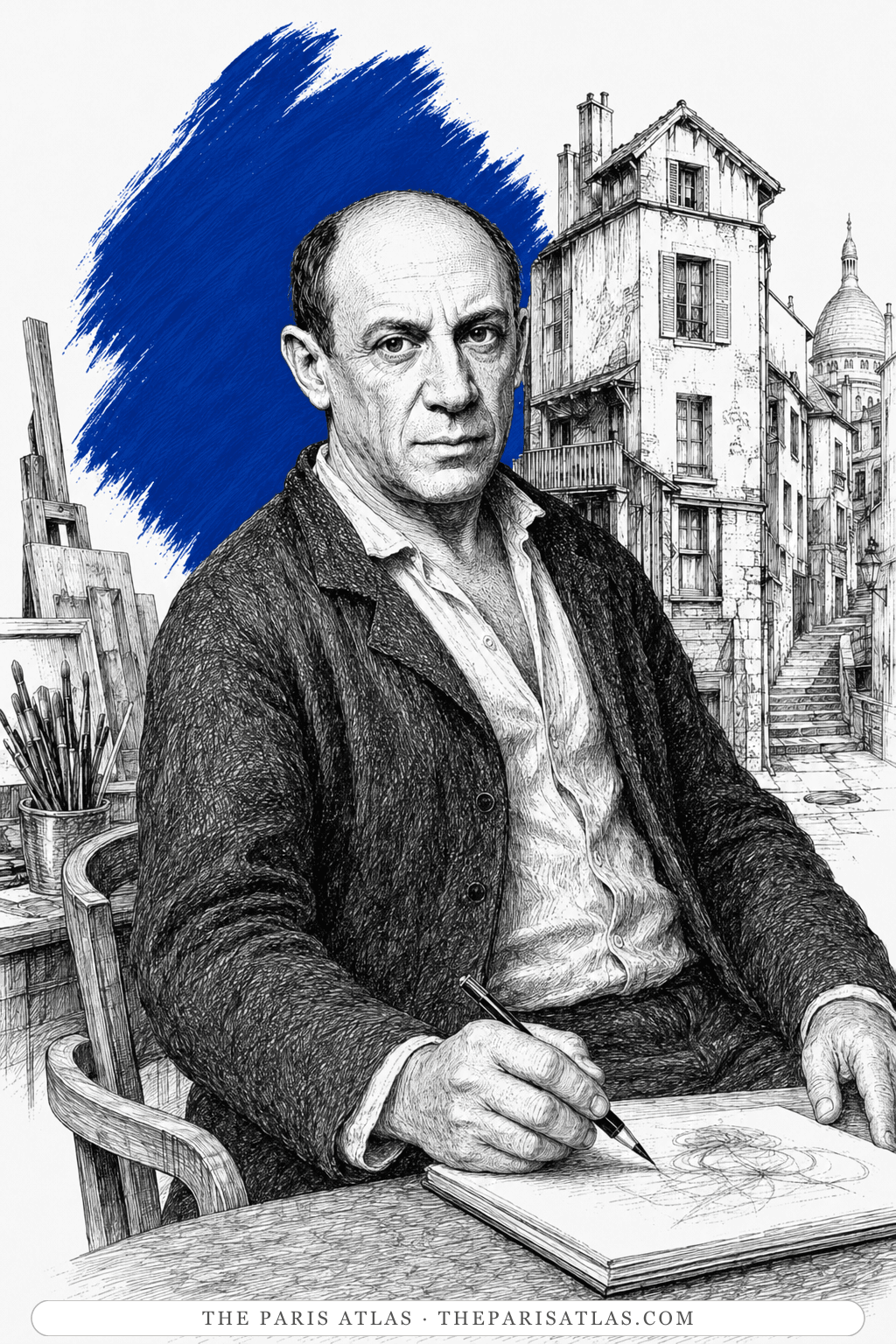
Pablo Picasso

  • Painter
  • Sculptor

Met · 1908

The 1908 banquet in Picasso's Bateau-Lavoir studio honored the old painter, with Apollinaire presiding — the evening the Autobiography of Alice B. Toklas made famous.

— Gertrude Stein, The Autobiography of Alice B. Toklas (1933)

Who Henri Rousseau Inspired

People who found inspiration in Henri Rousseau’s work.

Illustrated portrait of Pablo Picasso

Pablo Picasso

Picasso bought a Rousseau canvas being sold on the street to be painted over, recognised its power at once, and threw the famous 1908 banquet in his Bateau-Lavoir studio in the older painter's honour. Rousseau's flat, frontal, unschooled directness fed the avant-garde's turn away from academic illusion, and he is counted among the naïve painters who freed Picasso's generation.

— Henri Rousseau

Questions about Henri Rousseau

Who was Henri Rousseau?

Henri Rousseau (1844–1910) was a self-taught French painter, famous for lush, dreamlike jungle scenes such as Tiger in a Tropical Storm, The Sleeping Gypsy and The Dream. He worked most of his life as a Paris toll collector, which earned him the nickname Le Douanier, the customs officer, and painted seriously only from his forties. Ridiculed in his lifetime for his flat, untrained style, he was recognised soon after his death as a founder of naïve art and a major influence on the modern avant-garde.

Why is Rousseau called Le Douanier?

Le Douanier means the customs officer, a gently teasing reference to his day job. From 1871 Rousseau worked as a collector of the octroi, the tax levied on goods entering Paris, a modest municipal post he held for over two decades while painting in his spare time. He never actually held the rank of douanier, but the nickname stuck, and Apollinaire even played on it in the epitaph he wrote for Rousseau's grave, wishing the dead painter's luggage through the gates of heaven duty free.

Did Rousseau ever visit a jungle?

No. Rousseau never left France and never saw a tropical forest. His jungles were built from the hothouses and gardens of the Jardin des Plantes in Paris, the stuffed animals of its natural-history museum, illustrated children's books, and the stories of soldiers who had served in Mexico. He told a critic that walking into the glass houses of exotic plants felt like entering a dream, and that dream, not any real place, is what the paintings show.

What was the Banquet Rousseau?

A celebrated party Pablo Picasso threw in Rousseau's honour in 1908 at his Bateau-Lavoir studio in Montmartre. Picasso had bought a Rousseau canvas cheaply off the street and recognised its power. The half-serious, half-mock-heroic banquet that followed drew Apollinaire, Marie Laurencin, Max Jacob, Juan Gris and Gertrude and Leo Stein. It became one of the legendary social events of modern art, the moment the avant-garde adopted the old customs man as one of its own.

How did Henri Rousseau die?

Of gangrene, in Paris, on 2 September 1910, at the age of 66. An infection took hold in his leg in the spring, and in August he was admitted to the Necker Hospital, where a son of his had earlier died. Gangrene was found, and he died of a blood clot after an operation. Seven friends stood at his grave, among them Paul Signac, Constantin Brâncuși, Robert and Sonia Delaunay and Guillaume Apollinaire, who wrote his epitaph.

Where can you see Rousseau's paintings?

The Museum of Modern Art in New York holds The Sleeping Gypsy and The Dream. The Musée d'Orsay in Paris has The Snake Charmer, and the Musée de l'Orangerie a group including La Carriole du père Junier. Tiger in a Tropical Storm hangs in the National Gallery, London. Other major works are in the Barnes Foundation, the National Gallery of Art in Washington and the Metropolitan Museum of Art, and his jungles feature in regular exhibitions worldwide.

Connections and Sources

Henri Rousseau’s connections to people, places, and works, with the sources behind each one.

Met · 1908

Guillaume Apollinaire

Apollinaire presided at the 1908 Bateau-Lavoir banquet for Rousseau, and the painter answered in kind: The Muse Inspiring the Poet, painted twice in 1909, shows Apollinaire with Marie Laurencin as his muse.

— Gertrude Stein, The Autobiography of Alice B. Toklas (1933); Marie Laurencin — AWARE: Archives of Women Artists, Research and Exhibitions

Met · 1908

Pablo Picasso

The 1908 banquet in Picasso's Bateau-Lavoir studio honored the old painter, with Apollinaire presiding — the evening the Autobiography of Alice B. Toklas made famous.

— Gertrude Stein, The Autobiography of Alice B. Toklas (1933)

Influenced

Pablo Picasso

Picasso bought a Rousseau canvas being sold on the street to be painted over, recognised its power at once, and threw the famous 1908 banquet in his Bateau-Lavoir studio in the older painter's honour. Rousseau's flat, frontal, unschooled directness fed the avant-garde's turn away from academic illusion, and he is counted among the naïve painters who freed Picasso's generation.

— Henri Rousseau

Depicted in

Myself: Portrait-Landscape

Moi-même, portrait-paysage is Henri Rousseau's self-portrait, painted in 1890 and shown that year at the Salon des Indépendants. He stands full length in a black suit and beret on a Paris quay, holding a palette lettered with the names of his two wives, Clémence and Joséphine. The National Gallery Prague, which has owned it since 1923, calls it Rousseau's self-portrait.

— International Customs Day: Customs Official Rousseau; Henri Rousseau: Jungles in Paris — poster pack for teachers (2005)

References

References

The sources below include biographies, scholarly essays, interviews, and primary materials that informed this page. They reflect both the historical record and ongoing critical conversations about Henri Rousseau and their work.

  1. 1abcHenri Rousseau

    Website
    The Museum of Modern Art
    Used for

    The Museum of Modern Art's artist record, which holds The Sleeping Gypsy and The Dream.

    View source
  2. 2↑The Autobiography of Alice B. Toklas

    Memoir
    Gertrude Stein, 1933
    Used for

    First-person evidence and historical context used in preparing the Henri Rousseau page.

  3. 3↑Marie Laurencin — AWARE: Archives of Women Artists, Research and Exhibitions

    Website
    Archives of Women Artists, Research and Exhibitions
    Used for

    Web source consulted for documented facts and historical context presented on the Henri Rousseau page.

    View source
  4. 4Henri Rousseau, 'Surprised!', 1891 (NG6421)

    Website
    National Gallery, London
    Used for

    The National Gallery's catalogue entry for Surprised!, the first of Rousseau's twenty or so jungle paintings. It states that he never left France, that his claim to have served with a French expeditionary force in Mexico had no basis, that he spent four years in the army from 1863, and that the plants are a mixture of house plants and tropical varieties he had seen at the Jardin des Plantes.

    View source
  1. 5Henri Rousseau: Jungles in Paris

    Website
    Tate Modern, 2005
    Used for

    Tate Modern's record of its 2005–06 Rousseau exhibition: the customs official who was self-taught and took up painting full time only in retirement, the jungles built from the zoo, the botanical gardens, postcards and books, and the championing of his work by Picasso and by the Surrealists René Magritte and Max Ernst.

    View source
  2. 6Henri Rousseau

    Biography
    Eugène Figuière, 1911
    Used for

    Wilhelm Uhde's book on Rousseau, published in Paris in 1911, the year after the painter's death, by a dealer who had known him. Catalogued by the Bibliothèque nationale de France.

    View source
  3. 7Henri Rousseau

    Website
    Wikipedia
    Used for

    Reference article cross-checked for the biography, the jungle sources, the 1908 banquet, the death, and the grave.

    View source
i
Why these sources are here

These references anchor the page in the documented record and in the scholarly conversations around Henri Rousseau. Every claim on this page traces back to one or more of the works listed here.

Explore more resources