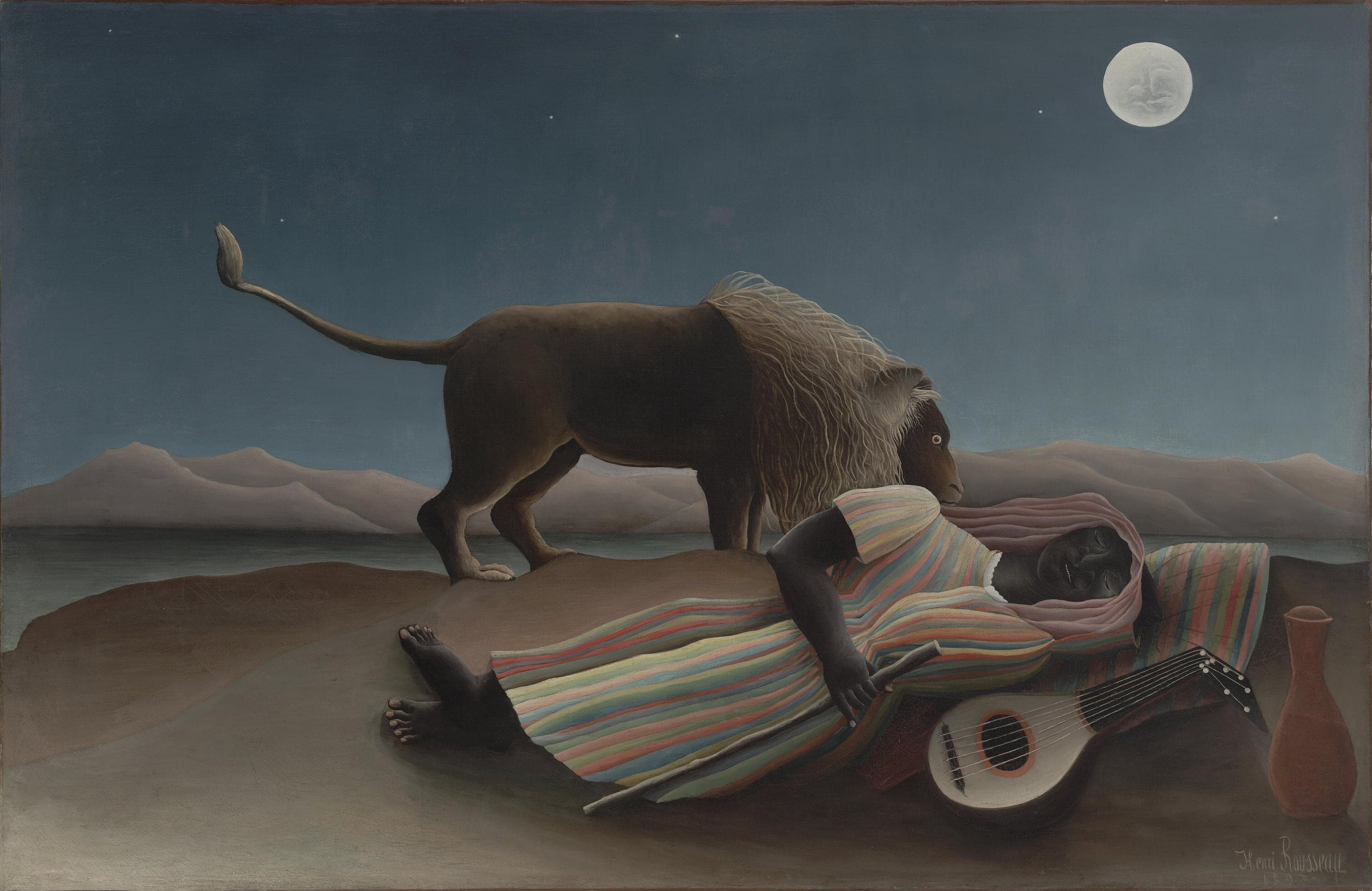
The Sleeping Gypsy
A woman in a striped robe sleeps on bare ground with a mandolin and a water jar beside her, and a lion stands over her without touching her. A full moon hangs at the upper right and pale hills close the horizon. Henri Rousseau painted it in 1897 and offered it the next year to Laval, the town where he was born, which turned it down. The Museum of Modern Art in New York has owned it since 1939.
- 1897
- Oil on canvas
- The Museum of Modern ArtNew York, United States
About Henri Rousseau
What the painting shows
The sleeper lies along the lower right of the canvas, parallel to the picture surface, her head to the right. Her robe is banded in coral, cream, pale blue, sage, yellow, pink and teal, each stripe outlined in a fine dark line that follows the shape of her body. Her head is wrapped in a rose-pink cloth and a small white ruffled collar shows at her throat. Her eyes are closed and a thin line of teeth is visible. Her bare feet point left, out of the frame.
Three objects lie with her. A mandolin rests on the sand near her hip, its cream soundboard carrying an oval sound hole ringed in orange, six strings and a pegbox angled up to the right. A rust-colored jar with a narrow neck stands at the right edge. A pale wooden staff runs diagonally across the sand to her hand.
The lion stands behind and above her, dark brown with a long pale mane drawn as separate combed strands. One eye is visible, wide open, amber with a dark round pupil. Its muzzle points down toward her shoulder. Its tail rises in a diagonal to the upper left and ends in a pale erect tuft, alone against the sky.
Behind them the ground gives way to a flat band of still greenish water, visible between the lion's legs, then to rounded mauve-grey hills. The sky above is dark slate blue and holds six small white stars and a white moon with a face modeled faintly into it.
The letter to Laval
In July 1898 Rousseau wrote to the mayor of Laval, the town in western France where he was born, and offered the town the painting. He described the picture himself in the letter, and his description is the closest thing there is to a caption written by the artist.
“A wandering Negress, a mandolin player, lies with her jar beside her (a vase with drinking water), overcome by fatigue in a deep sleep. A lion chances to pass by, picks up her scent yet does not devour her. There is a moonlight effect, very poetic. The scene is set in a completely arid desert. The gypsy is dressed in oriental costume.”
Laval said no. The price Rousseau asked is reported two different ways, and the two accounts are far apart. Daniel Catton Rich, writing the Museum of Modern Art's Rousseau catalogue in 1942, put it at two or three hundred francs. Artnet News, reporting on the letter in 2025, puts it at between 1,800 and 2,000 francs, which would have been close to what a successful academic painter charged. Rousseau wrote that he hoped the town might own a souvenir of one of its children.
What Rousseau was working from
Daniel Catton Rich argued in 1942 that Rousseau meant the picture as a naturalistic work, and that he was trying to rival Jean-Léon Gérôme, the academic painter known for African subjects with wild animals in bare landscape. Rich points to two Gérôme canvases in particular: The Caravan, in which a tiger watches a desert party from a rise, and The Two Majesties, whose lion he calls curiously like the beast in Rousseau's picture.
There is a Paris source for the lion as well. Artnet News identifies it as one of the cast-bronze lions made by Henri Alfred Jacquemart and installed in the 1850s above a fountain near the entrance to the Jardin des Plantes. In the bronze the animal lowers its head toward a foot protruding from sand. Rousseau keeps the pose, the lowered head and the raised tail, and drops the modeled muscle and the thick mane of the bronze.
Rich also noticed where the picture points forward rather than back. The mandolin and the jar lying together on the sand, he wrote, suggest the still lifes Pablo Picasso and Georges Braque painted later.
Out of sight, then in the Quinn sale
The painting went missing for a quarter of a century. The Museum of Modern Art's provenance record has it in a private collection in Paris belonging to a charcoal merchant until early 1924, when the critic Louis Vauxcelles acquired it. By February 1924 it was with the dealer Daniel-Henry Kahnweiler at the Galerie Simon, and on 16 February 1924 the New York collector John Quinn bought it through Henri-Pierre Roché. Quinn died that July.
His estate sold it at the Hôtel Drouot in Paris on 28 October 1926. The sale put the picture in front of Paris for the first time in nearly thirty years. Jean Cocteau wrote a prose poem about it for the sale catalogue, calling it the unmoving hub, the fixed point, the sleep of all sleep. The American critic Henry McBride wrote that it could be interpreted variously and that all the interpretations would be correct.
Rich records the consequence in his 1942 catalogue: the picture's trance-like character foretold Surrealism, and it was at its most influential after the 1926 showing. He notes that Giorgio de Chirico's Lion and Gladiators of 1927 comes directly from it. Cocteau's reading, that the lion and the landscape are the sleeper's dream rather than things actually present, struck Rich as more typical of 1926 than of Rousseau's own method in 1897.
How New York got it
Henri Bing bought it at the Drouot sale in 1926 and sold it the same year to Madame E. Rockstuhl of Küssnacht am Rigi, near Lucerne. It stayed in Switzerland for thirteen years. In December 1939 Mrs. Simon Guggenheim bought it from her and gave it to the Museum of Modern Art, where it is accession 646.1939.
The museum announced the gift on 22 January 1940. Its director, Alfred H. Barr, Jr., called the painting one of the great masterpieces of modern times and said that Rousseau had painted larger canvases but that this one was unique in the concentrated power of its composition. Barr also made a point about its audience: the picture interested lovers of old masters, abstract painters, the Surrealists and the general public alike.
It went on show four days later in an exhibition called Modern Masters and has been one of the museum's signature paintings since. In 1985 the museum mounted a full Rousseau retrospective with the Réunion des musées nationaux and described The Sleeping Gypsy and The Dream as the two most important paintings of Rousseau's career.
Close reading
Reading the work, detail by detail
Almost everything in this picture is a flat, clean shape with a hard edge, and the few places Rousseau lets himself add texture are worth finding. Start with the two heads, then the objects lying on the sand.
1.The lion is looking, not lunging
One eye is visible, amber with a round black pupil, and it is wide open. The muzzle points down toward the sleeper's shoulder. Rousseau told the mayor of Laval in 1898 that the lion picks up her scent and does not devour her, and the painted animal does exactly that and no more.
2.The mane is combed strand by strand
The mane is built from dozens of separate pale strands, each drawn as its own line, all combed the same way. It is one of only two places in the painting where Rousseau allows a worked surface. The other is the sleeper's striped robe.
3.The tail against an empty sky
The tail leaves the body and rises alone into the sky, ending in a stiff cream tuft. Nothing else occupies that part of the canvas, so the shape reads on its own. It is the one line in the picture that suggests the animal is alert rather than calm.
4.Asleep, with her teeth showing
Her eyes are closed and a thin line of white teeth shows between her lips. A rose-pink cloth wraps her head and a small ruffled white collar sits at her throat. Rousseau's own description called her a wandering mandolin player in oriental dress, overcome by fatigue.
5.The mandolin and the jar
The instrument is drawn with care: an oval sound hole ringed in orange, six strings, a pegbox angled up to the right. The rust-colored water jar stands beyond it at the canvas edge. Daniel Catton Rich pointed out in 1942 that an instrument and a vessel lying together like this is the subject Pablo Picasso and Georges Braque would take up later.
6.Bare feet, and the stripes that turn with the body
Her feet are bare and her toes splayed. The stripes of the robe bend as they cross her, so the flat bands of color double as the only modeling of the body underneath. The pale staff running across the sand ends under her hand further to the right.
Timeline
1897
Painted and shown at the Salon des Indépendants in Paris as La Bohémienne endormie.
1898
In July, Rousseau offers the painting to the town of Laval, where he was born, describing it in a letter to the mayor. The town declines.
1924
Acquired in the early part of the year by the critic Louis Vauxcelles from a Paris charcoal merchant, then passed to Daniel-Henry Kahnweiler's Galerie Simon and, on 16 February, to the New York collector John Quinn.
1926
Sold from John Quinn's estate at the Hôtel Drouot in Paris on 28 October. Jean Cocteau writes a prose poem about it for the sale catalogue.
1926
Bought at the Drouot sale by Henri Bing and sold on to Madame E. Rockstuhl of Küssnacht am Rigi, Switzerland.
1939
Bought from Madame Rockstuhl by Mrs. Simon Guggenheim and given to the Museum of Modern Art on 8 December, as accession 646.1939.
1940
Announced on 22 January and shown from 26 January in the Museum of Modern Art's Modern Masters exhibition.
1942
Anchors the Museum of Modern Art's Henri Rousseau exhibition, catalogued by Daniel Catton Rich.
1985
Shown in the Museum of Modern Art's Rousseau retrospective, organized with the Réunion des musées nationaux.
Where to see it
The Museum of Modern Art
11 West 53 Street, New York, NY 10019, United States
The Museum of Modern Art lists the painting on Floor 5, in the Alfred H. Barr, Jr. Galleries. Check the collection page before a visit.
Plan your visit on the museum’s official website (opens in a new tab)Frequently asked questions
Where is The Sleeping Gypsy?
The Museum of Modern Art in New York, which lists it on Floor 5 in the Alfred H. Barr, Jr. Galleries as accession 646.1939. Mrs. Simon Guggenheim bought it in Switzerland and gave it to the museum in December 1939.
What is the lion doing in The Sleeping Gypsy?
Smelling her, and not attacking. Rousseau said so himself in a letter of July 1898 to the mayor of Laval: a lion chances to pass by, picks up her scent, and does not devour her. The animal stands over the sleeper with its head lowered and its tail raised.
Did Rousseau try to sell The Sleeping Gypsy to his home town?
Yes, and the town refused. In July 1898 he wrote to the mayor of Laval offering the picture, so that the town might own a souvenir of one of its children. Accounts of the price differ sharply: the Museum of Modern Art's 1942 catalogue says two or three hundred francs, while Artnet News reports 1,800 to 2,000.
Who rediscovered The Sleeping Gypsy?
The critic Louis Vauxcelles, in early 1924. The Museum of Modern Art's provenance record has the painting sitting in the collection of a Paris charcoal merchant until then. Within weeks it reached the dealer Daniel-Henry Kahnweiler and then the New York collector John Quinn.
Why do the Surrealists matter to this painting?
Because they adopted it after it resurfaced. When John Quinn's collection was sold in Paris in 1926, Jean Cocteau wrote a prose poem about the picture for the catalogue and suggested the lion and the landscape were the sleeper's dream rather than things really present. Daniel Catton Rich wrote in 1942 that the painting's trance-like character foretold Surrealism and that Giorgio de Chirico's Lion and Gladiators of 1927 comes directly from it.
How big is The Sleeping Gypsy?
129.5 by 200.7 centimetres, which the Museum of Modern Art states as 51 inches by 6 feet 7 inches. It is oil on canvas.
Was the figure painted from a model?
There is no record of one. Rousseau describes the subject in his 1898 letter as a wandering mandolin player in oriental dress, asleep in an arid desert, and gives no sitter. The lion has a documented Paris source: Artnet News identifies it as a bronze by Henri Alfred Jacquemart installed near the entrance to the Jardin des Plantes in the 1850s.
More by Henri Rousseau
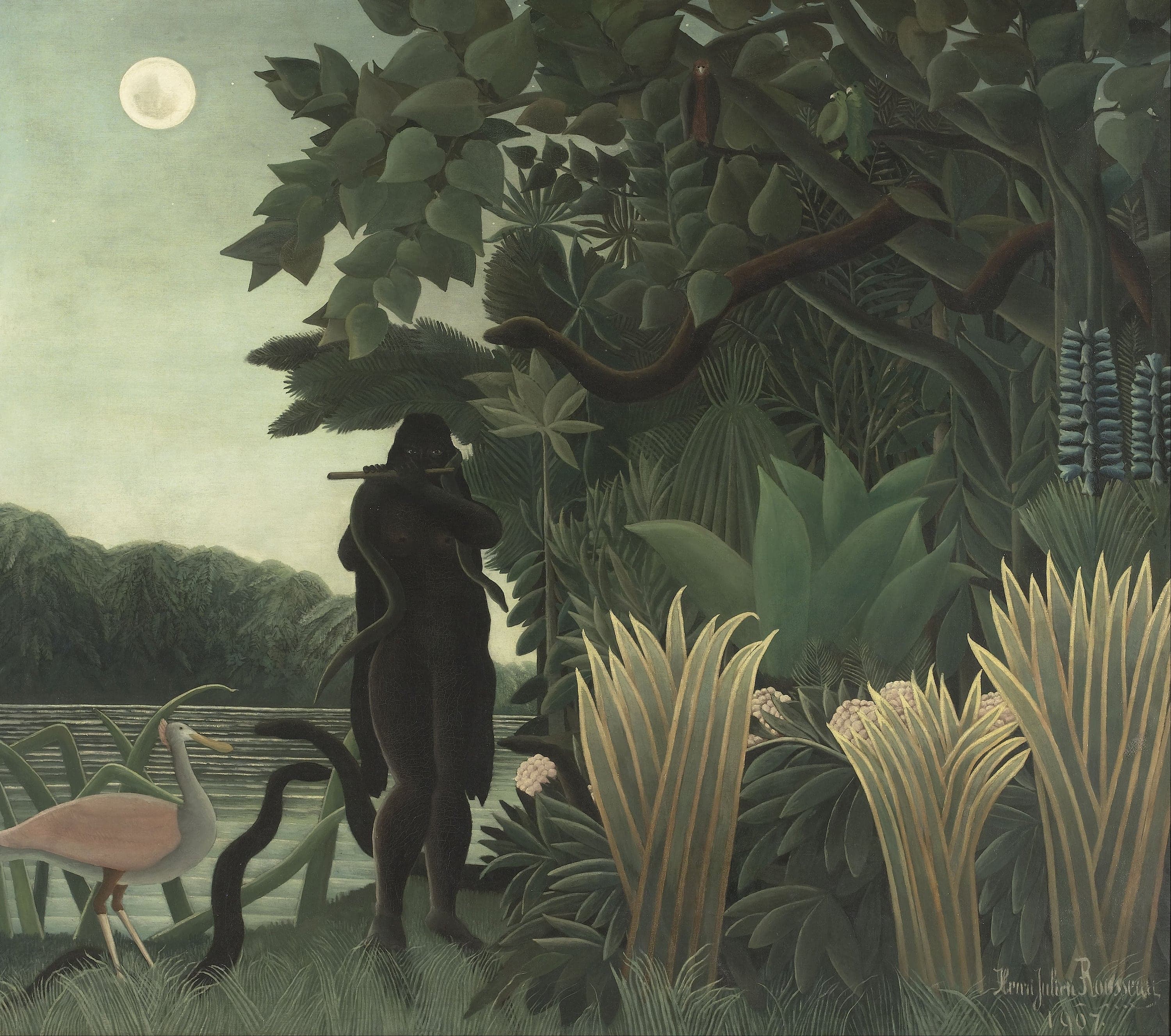
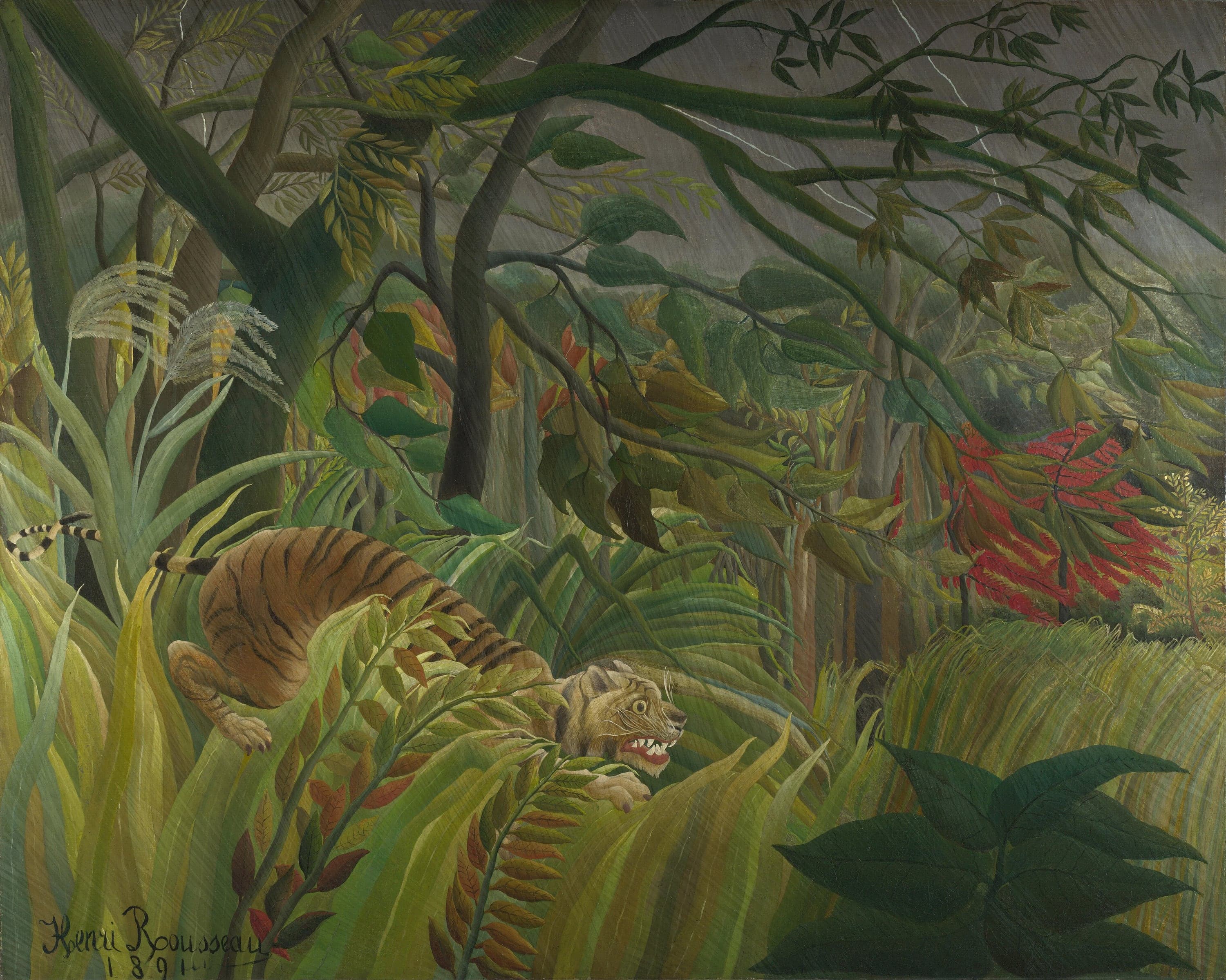
If you like Henri Rousseau
Explore painters from the same movements and circles.
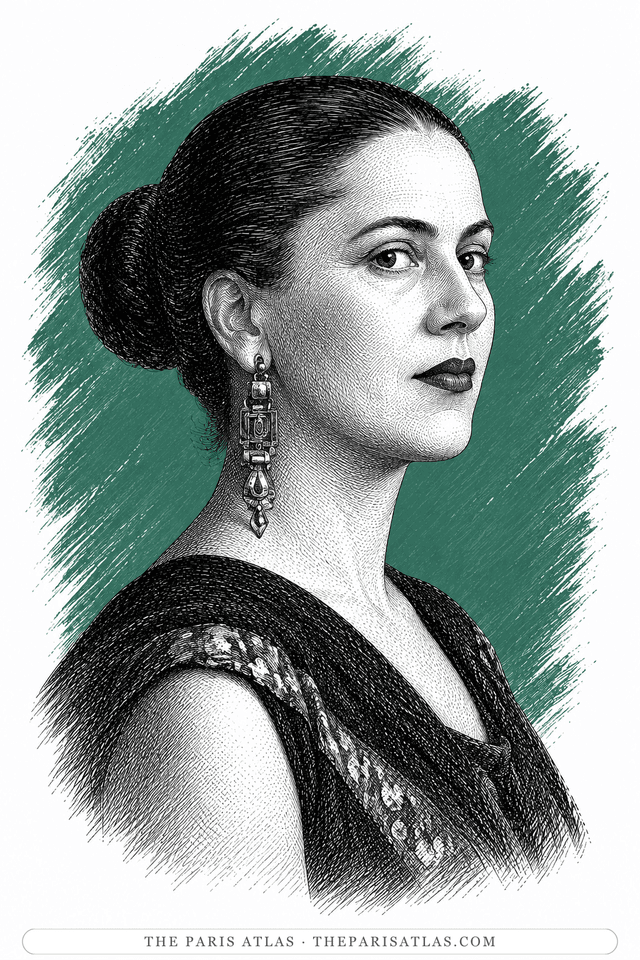
Tarsila do Amaral
Brazilian painter who spent the 1920s moving between São Paulo and Paris, studied Cubism under André Lhote, Albert Gleizes and Fernand Léger, and used what she learned to paint Brazilian towns, railways, plants and bodies. Her 1928 painting Abaporu prompted the manifesto that gave the Anthropophagic movement its name.
View artist
Arman
French-American artist, lifelong friend of Yves Klein, and a founder of New Realism.
View artist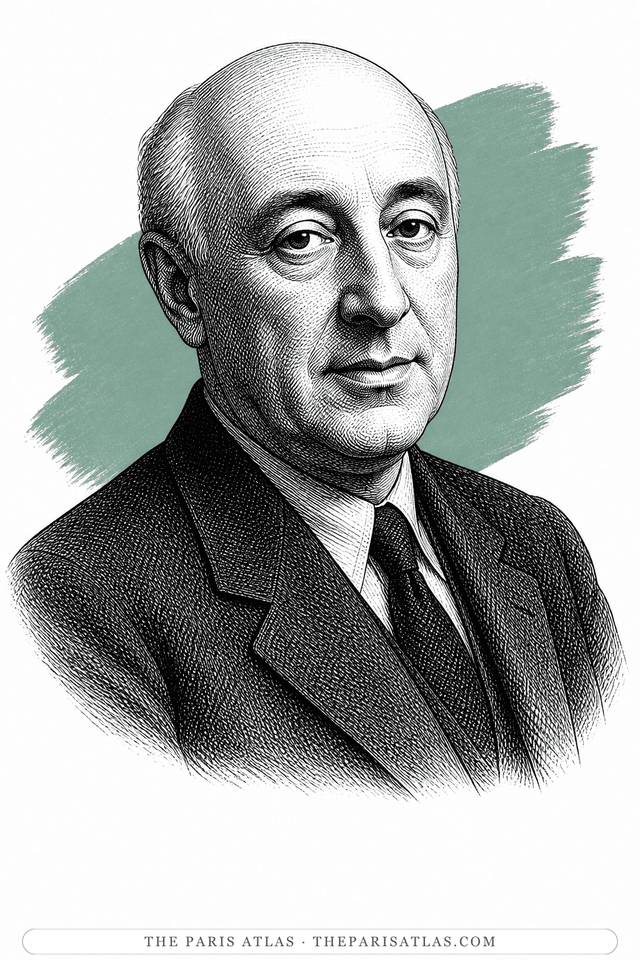
Jean Arp
Strasbourg-born sculptor and poet — Hans in German, Jean in French, both all his life — who co-founded Dada at the Cabaret Voltaire in 1916, composed collages by dropping torn paper 'according to the laws of chance', and settled at Meudon outside Paris in a house his wife Sophie Taeuber-Arp designed.
View artist
References
The sources below include collection records, catalogues, scholarly research, and primary materials that informed this page. They document The Sleeping Gypsy, its making, and its place in cultural history.


1Henri Rousseau, The Sleeping Gypsy, 1897
WebsiteThe Museum of Modern ArtUsed forThe holding museum's catalogue entry: the identifying facts, the credit line, the gallery, and the full chain of ownership from the charcoal merchant in Paris to the gift of 1939.

2Henri Rousseau
Exhibition catalogueThe Museum of Modern Art, New York, 1942Used forDaniel Catton Rich's 1942 catalogue for the Museum of Modern Art: the argument that Rousseau was rivalling Jean-Léon Gérôme, the Laval price, and the account of the 1926 Quinn sale and its effect on the Surrealists.
3The Museum of Modern Art acquires two important paintings
ArchiveThe Museum of Modern Art press archive, 1940Used forThe museum's press release of January 1940 announcing the gift, with Alfred H. Barr, Jr.'s statement about the painting.
4Henri Rousseau's Sleeping Gypsy: a new interpretation
PeriodicalTheArticleUsed forJeffrey Meyers's essay on the painting, which prints a full translation of Rousseau's July 1898 letter to the mayor of Laval and of Jean Cocteau's 1926 preface.
5Untangling the myths behind an eccentric masterpiece by Henri Rousseau
PeriodicalArtnet News, 2025Used forArtnet News on the painting's persistent myths, source of the higher reading of the Laval price and of the Jacquemart bronze lion at the Jardin des Plantes.
6Landmark survey of the paintings of Henri Rousseau to be exhibited at The Museum of Modern Art
ArchiveThe Museum of Modern Art press archive, 1985Used forThe museum's announcement of its 1985 Rousseau retrospective, which called this painting and The Dream the two most important of his career.
These references provide the documented foundation for this work's history and interpretation. Claim-level citations remain attached to the specific claims they support.
 Explore more resources