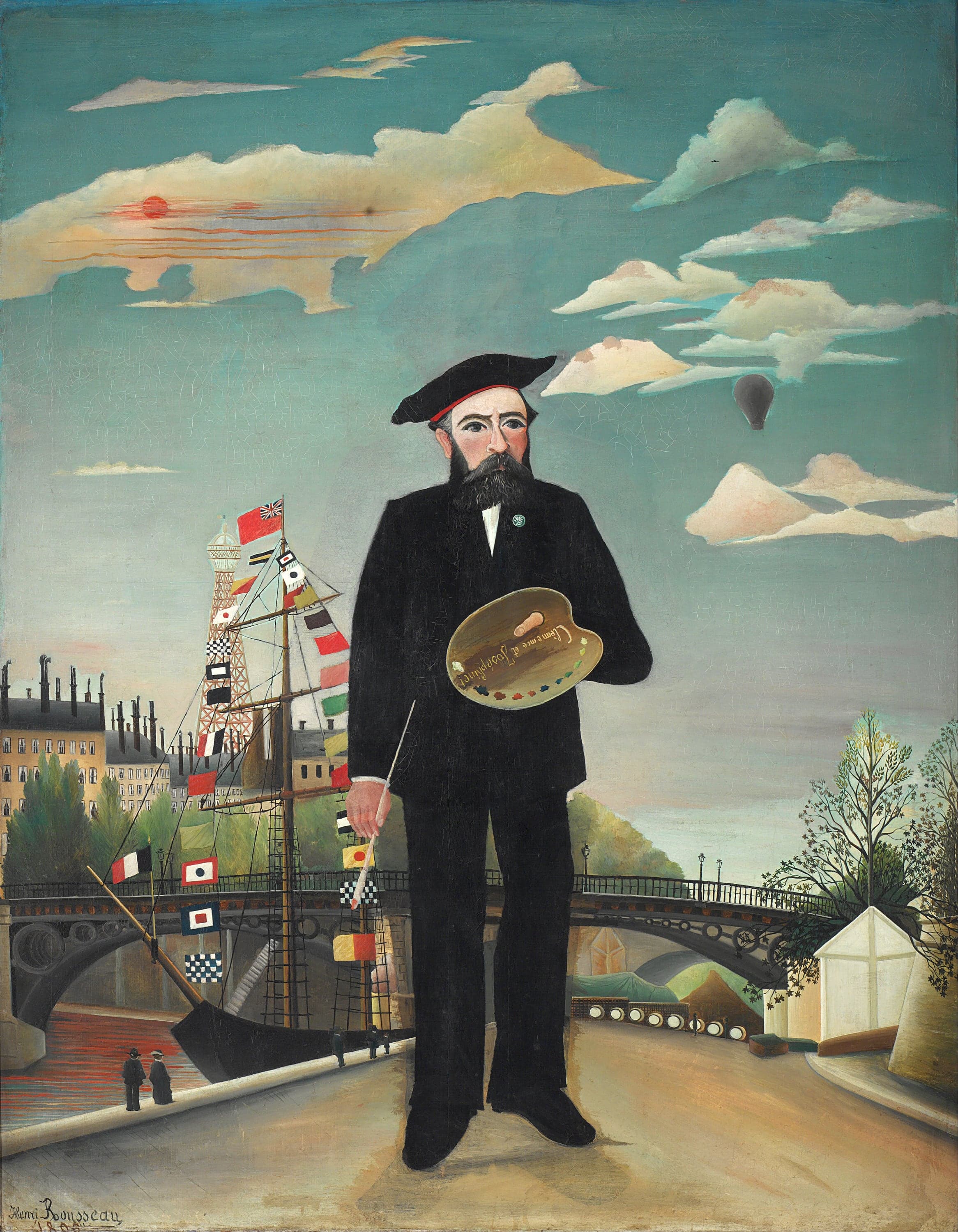
Henri Rousseau paints himself full length in a black suit and beret, holding a palette and a brush, standing on a Paris quay so large that the bridge and the boats behind him reach only to his knees. The Eiffel Tower, then one year old, shows through a ship's rigging on the left, and a balloon floats in the sky on the right. He showed it at the Salon des Indépendants in 1890, seventeen years before he claimed in a letter to have invented the kind of picture it is.
Rousseau stands in the middle of the canvas in a black suit, white shirt and black beret with a red inner band. He has a full dark beard and a heavy moustache. His left hand holds a palette against his chest; his right holds a thin brush at his side. He looks straight out.
The scale is the first thing to take in. He is roughly as tall as the whole middle distance, which holds a moored sailing ship dressed overall with signal flags, a low arched bridge across the Seine, a barge, quayside trees and buildings. Two tiny figures stroll on the quay at the lower left, and they come up to about his shins.
Two things in the sky date the picture. A grey balloon floats at the upper right. Behind the ship's rigging on the left stands the Eiffel Tower, which had opened in 1889, the year before. Tate notes that the only artist to paint the Eiffel Tower before Rousseau was Georges Seurat.
The flags are worth a second look. Tate observes that many of them are Rousseau's own invention, but that a French tricolor and a Union Jack can be made out among them. Factory chimneys stand along the left bank and a pale sun shows through a band of cloud at the upper left.
The two names on the palette
The palette carries lettering in gold across its upper face. It reads Clémence et Joséphine, the names of Rousseau's two wives. Clémence Boitard married him in 1868 and died in 1888. Joséphine Noury married him in 1899, nine years after this picture was painted, which means one of the two names was added to the canvas later.
The lapel carries a later addition as well. A small pale rosette sits on his left lapel. Tate identifies it as the Palmes académiques and dates its addition to 1905, and explains how Rousseau came by the honor: it was awarded to him in error, because he was the wrong Rousseau. He kept it and painted it on.
Le Journal des Arts reports a third alteration, on a different scale. Rousseau may have reworked the painting after the Salon des Indépendants to make his own figure smaller, possibly in response to criticism of the size of the man.
The genre he said he invented
The subtitle portrait-paysage, portrait-landscape, is the point of the picture. The idea is that the sitter and the place are given equal weight: a real, identifiable view, with a person standing in front of it at a scale the view cannot support.
Rousseau claimed the form as his own invention, but not in 1890. The Musée de l'Orangerie dates the claim to a letter of 1907, seventeen years after he painted this, and describes him as making it mischievously. Tate is careful in the same way and calls it a genre the artist claimed to have invented.
What he was claiming in 1890 was simpler and more direct. Tate reads the picture as Rousseau proclaiming his ambitions as a professional artist three years before he left the customs service, using a full-length format generally reserved for pre-eminent members of society. He was forty-six and still collecting tolls on goods entering Paris.
How it got to Prague
The painting went to Czechoslovakia in 1923. The National Gallery Prague's own account is that the Czechoslovak government bought several works at an exhibition of French art held in Prague that year, this self-portrait among them. The museum names the man who chose it: Vincenc Kramář, then director of the Picture Gallery of the Society of Patriotic Friends of the Arts.
Kramář was responsible for old art and spent state funds on modern art, and the museum records that colleagues criticized him for it. The painting sat in the depository for the next five years before it was hung.
It has traveled since. It was in Tate Modern's Henri Rousseau: Jungles in Paris in 2005 and in the tour that took that show to the Grand Palais in Paris and the National Gallery of Art in Washington. In 2026 it was the first object in the Musée de l'Orangerie's Henri Rousseau, l'ambition de la peinture. The National Gallery Prague shows it in its permanent display, 1796–1918: Art of the Long Century.
Close reading
Reading the work, detail by detail
Rousseau put himself at the scale of the subject rather than the scale of the view, so the man and the city behind him never quite agree. The close views take the figure first, then the Paris he is standing in front of.
1.Beret, beard, and a level stare
The beret has a red band showing under its edge, and the beard and moustache are painted hair by hair against a flat black suit. He looks straight out rather than at the view behind him. He was forty-six here and still working as a toll collector for the city of Paris.
2.Two wives written on the palette
Gold script across the palette reads Clémence et Joséphine. Clémence Boitard married him in 1868 and died in 1888; Joséphine Noury married him in 1899. The picture is dated 1890, which means the second name went on nine years or more after the rest of the canvas.
3.A decoration awarded to the wrong man
The small rosette on his lapel is the Palmes académiques. Tate reports that it was awarded to Rousseau in error, the intended recipient being a different Rousseau, and that he added it to this canvas in 1905. He had finished the painting fifteen years earlier.
4.The Eiffel Tower, one year old, behind the rigging
The tower stands behind the ship's mast and is partly screened by rigging and flags. It had opened in 1889 for the Paris World Fair, the year before Rousseau painted it. Tate notes that the only artist to put the Eiffel Tower in a painting before him was Georges Seurat.
5.A balloon in the clear half of the sky
The balloon sits alone in the right half of the sky, where there is nothing else to look at. Rousseau paints it small and hard-edged, the same way he paints the flags. It gives the picture a second piece of modern Paris to set against the tower on the other side.
6.Two people on the quay, and the signature
Two figures stand on the quay at about the height of Rousseau's shins. They are painted at the scale the bridge and the boats belong to, which is what makes the size of the man behind them impossible. His signature and the date sit in the corner just below.
The Eiffel Tower opens for the Paris World Fair. Rousseau puts it in the painting the following year, behind a ship's rigging.
1890
Painted, signed and dated at the lower left, and shown at the Salon des Indépendants in Paris.
1899
Rousseau marries Joséphine Noury, the second of the two names lettered on the painted palette.
1905
Tate dates the addition of the Palmes académiques rosette on his lapel to this year. The honor had been awarded to him by mistake, the recipient intended being a different Rousseau.
1907
In a letter, Rousseau claims to have invented a new genre, the portrait-paysage, seventeen years after painting this example of it.
1923
Bought for Czechoslovakia at an exhibition of French art in Prague, on the decision of Vincenc Kramář, then director of the Picture Gallery of the Society of Patriotic Friends of the Arts.
1923–28
Stays in the depository for five years after the purchase, according to the National Gallery Prague, while colleagues criticize Kramář for spending old-art funds on modern painting.
2005–06
Lent to Tate Modern for Henri Rousseau: Jungles in Paris, which travels to the Grand Palais in Paris and the National Gallery of Art in Washington.
2026
Opens the Musée de l'Orangerie's Henri Rousseau, l'ambition de la peinture as the first object in the exhibition, from 25 March to 20 July.
Where to see it
National Gallery Prague
Prague, Czech Republic
A public viewing address has not yet been confirmed for this holding.
The National Gallery Prague shows the painting in its permanent display 1796–1918: Art of the Long Century.
Frequently asked questions
Where is Myself: Portrait-Landscape?
The National Gallery Prague, which shows it in its permanent display 1796–1918: Art of the Long Century. The Czechoslovak government bought the painting in Prague in 1923 and it has been in the national collection since.
What is written on the palette in Rousseau's self-portrait?
Clémence et Joséphine, the names of his two wives, lettered in gold across the palette's upper face. Clémence Boitard married him in 1868 and died in 1888; Joséphine Noury married him in 1899. Since the painting is dated 1890, the second name cannot have been there from the start.
What is a portrait-landscape?
A picture that gives the sitter and the setting equal standing, with a real view behind a figure painted at a scale the view will not carry. Rousseau claimed in a letter of 1907 to have invented the form, which the Musée de l'Orangerie describes as a mischievous claim. Tate treats it the same way, as a claim rather than a fact.
Which Paris landmarks are in the painting?
The Eiffel Tower and a hot-air balloon, and the Seine with a bridge and a moored ship. Tate places the setting at the Port of Saint-Nicolas and points out that the only artist to paint the Eiffel Tower before Rousseau was Georges Seurat. The tower was one year old when he painted it.
What is the medal on Rousseau's lapel?
The Palmes académiques, a French award for services to education and culture. Tate reports that it was given to him in error, because the intended recipient was a different Rousseau, and that he painted it onto his lapel in 1905, fifteen years after finishing the picture.
Why is Rousseau so much bigger than everything behind him?
Because he painted himself at the scale of the subject rather than the scale of the view. Tate reads the full-length format as Rousseau claiming the standing of a professional artist three years before he left his job as a Paris toll collector. Le Journal des Arts reports that he may afterwards have reduced the figure in response to criticism of its size.
How big is Myself: Portrait-Landscape?
146 by 113 centimetres, in oil on canvas, according to the Musée de l'Orangerie. It is an upright canvas, taller than it is wide.
In the atlas
What the graph records about this work — every claim carries its citation.
Moi-même, portrait-paysage is Henri Rousseau's self-portrait, painted in 1890 and shown that year at the Salon des Indépendants. He stands full length in a black suit and beret on a Paris quay, holding a palette lettered with the names of his two wives, Clémence and Joséphine. The National Gallery Prague, which has owned it since 1923, calls it Rousseau's self-portrait.
— International Customs Day: Customs Official Rousseau; Henri Rousseau: Jungles in Paris — poster pack for teachers (2005)
Explore painters from the same movements and circles.
Tarsila do Amaral
Brazilian painter who spent the 1920s moving between São Paulo and Paris, studied Cubism under André Lhote, Albert Gleizes and Fernand Léger, and used what she learned to paint Brazilian towns, railways, plants and bodies. Her 1928 painting Abaporu prompted the manifesto that gave the Anthropophagic movement its name.
Strasbourg-born sculptor and poet — Hans in German, Jean in French, both all his life — who co-founded Dada at the Cabaret Voltaire in 1916, composed collages by dropping torn paper 'according to the laws of chance', and settled at Meudon outside Paris in a house his wife Sophie Taeuber-Arp designed.
The sources below include collection records, catalogues, scholarly research, and primary materials that informed this page. They document Myself: Portrait-Landscape, its making, and its place in cultural history.
1International Customs Day: Customs Official Rousseau
Website
National Gallery Prague
Used for
The holding museum's account of how the painting reached Prague: the 1923 purchase by the Czechoslovak government, Vincenc Kramář's decision, and the five years in the depository.
2Henri Rousseau, l'ambition de la peinture — programme de salle
Exhibition catalogue
Musée de l'Orangerie, 2026
Used for
The Musée de l'Orangerie's room guide for its 2026 Rousseau exhibition, source of the dimensions and of the 1907 letter in which Rousseau claimed the portrait-paysage as his invention.
3Henri Rousseau: Jungles in Paris — poster pack for teachers
Exhibition catalogue
Tate, 2005
Used for
Tate's study of the painting: the names of the two wives on the palette, the Palmes académiques added in 1905, the setting at the Port of Saint-Nicolas, the invented flags, and the Seurat comparison.
These references provide the documented foundation for this work's history and interpretation. Claim-level citations remain attached to the specific claims they support.

 View source