Painting · Fauvism
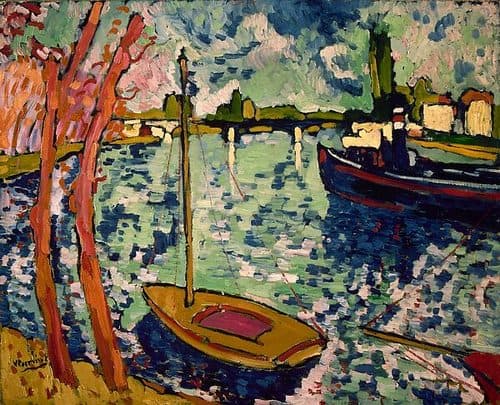
The Seine at Chatou
A riverside landscape painted with forceful brushwork and vivid reds, blues, and greens.
Self-taught French painter whose intense colour and forceful brushwork around Chatou made him one of Fauvism’s central figures.
Maurice de Vlaminck was born in Paris in 1876 to a Flemish father and a French mother. He grew up in a musical household, moved to Chatou at sixteen, and supported his young family as a professional cyclist and itinerant violinist before painting became his full-time work. The Musée d’Orsay also records his work as a watercolourist, draughtsman, illustrator, printmaker, and writer.[1]
Vlaminck was largely self-taught. In 1900 he shared a studio on the Île de Chatou with André Derain. The vivid colour and bold brushwork that Vlaminck and Derain developed there became associated with the School of Chatou. Their local subject matter—the Seine, the village, bridges, trees, and boats—gave the emerging language of Fauvism a setting just west of Paris.[2]
The Metropolitan Museum of Art identifies Vlaminck as a major Fauve whose intense colour matched his exuberant temperament. After seeing the Van Gogh retrospective at the Salon des Indépendants in spring 1905 and the paintings Matisse and Derain made at Collioure, he pushed decisively toward the Fauvist style. The Musée d’Orsay records his participation in the Salon d’Automne and Salon des Indépendants that year.[3]
Early in 1906 the dealer Ambroise Vollard bought Vlaminck’s existing stock, allowing him to devote himself fully to painting. He spent that summer working in and around Chatou. In The Seine at Chatou, primary colours applied in daubs and swirls transform the familiar river landscape into a direct, physical expression of paint.[4]
Born in Paris to a Flemish father and a French mother.
Moves to Chatou at sixteen; later works as a cyclist and itinerant violinist.
Shares a studio on the Île de Chatou with André Derain.
Embraces the Fauvist style and participates in the Salon d’Automne and Salon des Indépendants.
Ambroise Vollard buys his stock; Vlaminck paints The Seine at Chatou during the summer.
Dies in Rueil-la-Gadelière, France.
Painting · Fauvism
A riverside landscape painted with forceful brushwork and vivid reds, blues, and greens.
Art movement · c. 1905–1908
A principal Fauve whose intense colour and bold brushwork developed around Chatou, where he shared a studio with André Derain from 1900.
Maurice de Vlaminck was a self-taught French painter and one of the principal Fauves, known for intense colour and bold, undisguised brushwork.
They shared a studio on the Île de Chatou from 1900, and their work there became associated with the School of Chatou.
The Met connects Vlaminck’s move toward Fauvism to the 1905 Van Gogh retrospective and describes the visible brushwork of his 1906 landscapes as an emulation of Van Gogh’s late expressive style.
He supported his family by working as a professional cyclist and itinerant violinist. Ambroise Vollard’s purchase of his stock in early 1906 enabled him to paint full time.
He was born in Paris in 1876 and died in Rueil-la-Gadelière in 1958.
Associated with
A principal Fauve whose intense colour and bold brushwork developed around Chatou, where he shared a studio with André Derain from 1900.
The sources below include biographies, scholarly essays, interviews, and primary materials that informed this page. They reflect both the historical record and ongoing critical conversations about Maurice de Vlaminck and their work.

Web source consulted for documented facts and historical context presented on the Maurice de Vlaminck page.
Web source consulted for documented facts and historical context presented on the Maurice de Vlaminck page.
Web source consulted for documented facts and historical context presented on the Maurice de Vlaminck page.
Web source consulted for documented facts and historical context presented on the Maurice de Vlaminck page.
These references anchor the page in the documented record and in the scholarly conversations around Maurice de Vlaminck. Every claim on this page traces back to one or more of the works listed here.
 Explore more resources