Painting
The Ecumenical Council
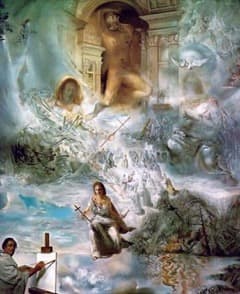
Dalí's three-metre canvas combines the Trinity, Gala as Saint Helena, Pope John XXIII, a Catalan landscape and a self-portrait modelled on Velázquez.
- c. 1960
- Oil on canvas
About Salvador Dalí
A route through Dalí's work
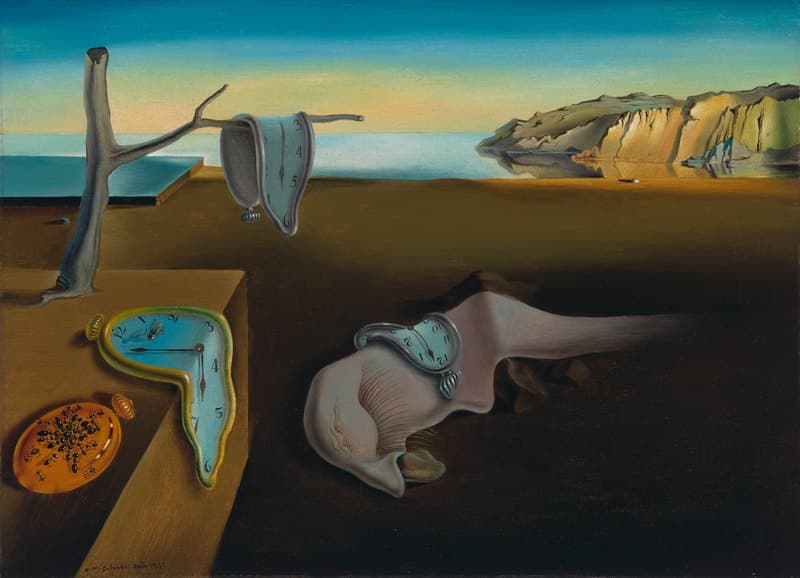
To measure the distance between Dalí's early Surrealism and this vast religious history painting, begin with The Persistence of Memory. The precise illusionism remains, while the scale, theology, and public ambition change completely.
What the painting shows
The canvas rises three metres. Across its upper half, loosely painted clouds, bodies and architectural fragments form an immense vision of the Trinity. Gala appears below as Saint Helena, holding the cross associated with the saint's discovery of the True Cross.[1]
At lower left, Dalí paints himself before a blank canvas with palette and brush in hand. A Catalan coast opens through the scene, while the coronation of Pope John XXIII appears in the upper right. The picture moves between sharply described figures and passages where bodies dissolve into light and paint.[1]
Why it is called The Ecumenical Council
The Dalí Museum states that the painting honors Pope John XXIII for trying to unite the Christian churches through an ecumenical council. The pope announced what became the Second Vatican Council in 1959. Dalí completed this canvas around 1960, two years before the council opened.[1]
The title therefore belongs to a contemporary Catholic event rather than to a timeless biblical scene. Dalí combines the pope's modern initiative with the Trinity, Saint Helena and his own public claim to renew religious painting.
Gala as Saint Helena
William Jeffett's study of Dalí and the Spanish Baroque identifies Gala as Saint Helena, the saint traditionally credited with finding the True Cross. Dalí repeatedly used Gala as the model for both the Virgin Mary and Saint Helena during this period.[2]
Her role differs from the direct portrait of Galarina or Galatea of the Spheres. She is now an actor inside a sacred history, joining the personal figure at the centre of Dalí's life to the history of the cross represented above her.
Dalí painting himself as Velázquez
Dalí's self-portrait at the lower left refers to Diego Velázquez in Las Meninas: both artists stand beside a large canvas, hold palette and brush, and look outward toward the viewer. The Ecumenical Council was completed in 1960, the tricentenary of Velázquez's death, when Spain held major commemorations of the painter.[2]
Jeffett interprets the blank canvas as a surface on which the religious mystery is being inscribed. By adopting Velázquez's position, Dalí also stakes a claim for his own place in the long history of Spanish painting. That claim is an art-historical interpretation, supported by the clear compositional quotation.[2]
The coronation made with an octopus
The coronation of Pope John XXIII in the upper-right corner began with a direct print. The Dalí Museum records that Dalí dipped an octopus into paint and pressed its tentacles against the canvas, then developed the resulting marks into the scene.[1]
This experiment complicates any simple account of a return to old-master technique. The painting invokes Velázquez and Catholic history while also using chance impressions and an animal body as a tool.
A late form of nuclear mysticism
The Ecumenical Council belongs to the monumental religious and historical paintings that followed Dalí's nuclear-mystical turn. The work no longer illustrates atomic particles as plainly as Galatea of the Spheres, but it keeps the period's effort to unite matter, spirit, science and traditional imagery.
Its shifting degrees of finish matter. Precisely modelled figures coexist with broad, translucent passages and bodies that appear to form and disperse. Instead of building order from isolated spheres or cubes, Dalí makes a religious vision emerge from unstable paint.
How it relates to Surrealism
The painting is not a product of Dalí's central Surrealist decade. Its scale, Catholic subject and historical references belong to his later development. Yet it retains the Surrealist habit of bringing incompatible realities into one convincing space: current church politics, Catalan geography, Christian figures, an old-master self-portrait and an octopus print.
That continuity helps explain why the work still looks recognizably Dalinian even when its aims differ sharply from The Persistence of Memory.
From Carstairs to the Dalí Museum
The canvas was the first work listed in Dalí's exhibition at the Carstairs Gallery in New York from December 1960 to January 1961. It later belonged to the collectors A. Reynolds and Eleanor Reese Morse, whose collection became the foundation of the Dalí Museum. In 2012 the museum included The Ecumenical Council in a public conservation project with three other monumental canvases. Conservators cleaned and re-stretched the paintings.[3][4]
Why The Ecumenical Council matters
The painting is a summary of Dalí's late ambitions. He addresses a contemporary pope, places Gala within sacred history, cites Velázquez, joins Catalonia to a universal religious vision and uses experimental handling on the scale of a museum mural.
It also resists the idea that Gala's importance ended with portraiture. She remains structurally central in one of Dalí's largest works, no longer only as his muse or model but as the saint through whom the history of the cross enters the composition.
Close reading
Reading the work, detail by detail
The immense canvas crowds Catholic doctrine, self-portraiture, Gala, and Dalí's nuclear imagery into one ascending space. Close views help separate the registers before seeing how insistently they overlap.
1.The heavenly figures are built from light and fracture
Bodies emerge from pale openings and dissolve again at their edges. Dalí gives traditional sacred figures the unstable materiality of his atomic period: revelation arrives as matter in the act of forming.
2.Gala and the painter remain at the threshold
The contemporary figures ground the vision as witnesses and makers. Their smaller scale does not exclude them from the sacred scene; it identifies the act of painting as the route into it.
3.A colossal foot makes scale unstable
The isolated foot is too large for the nearby bodies and too solid for the vaporous setting. It makes the picture's space impossible to measure—the devotional equivalent of a Surrealist scale shock.
4.The painter faces a sharply defined canvas
At the lower corner, the painter and easel are described with firmer edges than much of the surrounding vision. The pale canvas presents a simple rectangle amid clouds and broken forms. This small area gives the viewer a recognizable act of making within the much larger painted spectacle.
5.Architectural lines remain behind the upper figure
Straight divisions remain visible through the luminous passages behind the upper body. Their regular spacing contrasts with the surrounding clouds and scattered forms. Even where the picture seems to open into limitless light, these lines preserve the suggestion of a built setting with edges and repeated intervals.
6.The lower rocks give the light a solid edge
Jagged dark rocks interrupt the pale lower atmosphere, then reappear in broken reflections below. The reflected shapes are less firmly bounded than the rocks themselves. That difference lets the eye identify water without a continuous shoreline and gives the painting's lower corner a tangible change of surface.
Timeline
c. 1960
Dalí completes the monumental canvas and includes Gala within its religious composition.
1960–61
Shown at the Carstairs Gallery in New York as the first work in Dalí's exhibition.
2012
Cleaned and re-stretched during the Dalí Museum's public conservation project for four monumental canvases.
Where to see it
The Dalí Museum, St. Petersburg, Florida
One Dalí Boulevard, St. Petersburg, FL 33701, United States
Displays and loans can change. Check whether this work is on view before making a special trip.
Plan your visit on the museum’s official website (opens in a new tab)Frequently asked questions
What is The Ecumenical Council about?
It honors Pope John XXIII's effort to unite Christian churches while combining the Trinity, Gala as Saint Helena, a Catalan landscape and Dalí's self-portrait as a modern Velázquez.
Who is the woman in the painting?
Gala Dalí, represented as Saint Helena, the saint traditionally associated with discovering the True Cross.
Why did Dalí paint himself in the corner?
His pose with palette, brush and a large canvas refers to Velázquez in Las Meninas. The self-portrait links Dalí's religious vision to the history and authority of Spanish painting.
Did Dalí really use an octopus to make part of it?
Yes. The Dalí Museum says he pressed paint-covered octopus tentacles onto the upper-right portion of the canvas and developed the marks into a coronation scene for Pope John XXIII.
Is The Ecumenical Council a Surrealist painting?
It belongs to Dalí's later nuclear-mystical period rather than his central Surrealist decade. It retains Surrealist conjunctions and experimental technique while serving a Catholic and historical subject.
How large is The Ecumenical Council?
It measures 300 by 254 centimetres: three metres high and more than two and a half metres wide.
Where is The Ecumenical Council?
The Dalí Museum in St. Petersburg, Florida. It came through the collection of A. Reynolds and Eleanor Reese Morse.
In the atlas
More by Salvador Dalí
Painting · Nuclear mysticismChrist of Saint John of the CrossPainting · Nuclear mysticismCrucifixion (Corpus Hypercubus)Painting · Return to classicismGalarinaPainting · Nuclear mysticismGalatea in CreationPainting · Nuclear mysticismGalatea of the SpheresPainting · Nuclear mysticismLeda AtomicaSculpture · SurrealismLobster TelephonePainting · SurrealismPortrait of Gala with Two Chops Balanced on Her ShoulderPainting · SurrealismThe Great MasturbatorPainting · Nuclear mysticismThe Madonna of PortlligatPainting · Nuclear mysticismThe Meditative RosePainting · SurrealismThe Persistence of MemoryPainting · Nuclear mysticismThe Sacrament of the Last SupperFilm · SurrealismUn Chien AndalouPainting · SurrealismMetamorphosis of NarcissusPainting · SurrealismSwans Reflecting ElephantsPainting · SurrealismThe Burning GiraffePainting · Nuclear mysticismThe Disintegration of the Persistence of MemoryPainting · Late double-image paintingThe Hallucinogenic Toreador
If you like Salvador Dalí
Explore painters from the same movements and circles.
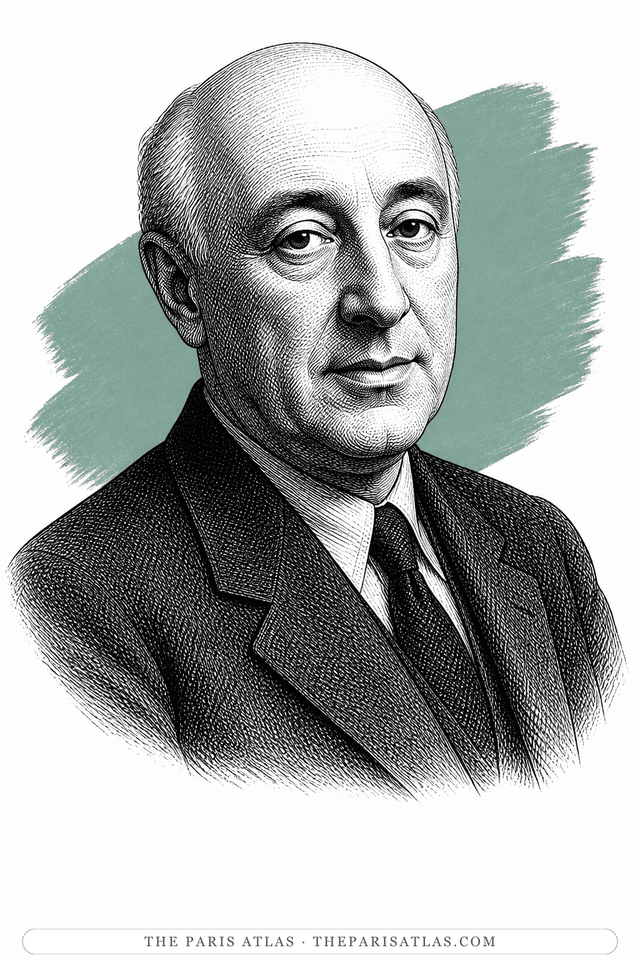
Jean Arp
Strasbourg-born sculptor and poet — Hans in German, Jean in French, both all his life — who co-founded Dada at the Cabaret Voltaire in 1916, composed collages by dropping torn paper 'according to the laws of chance', and settled at Meudon outside Paris in a house his wife Sophie Taeuber-Arp designed.
View artist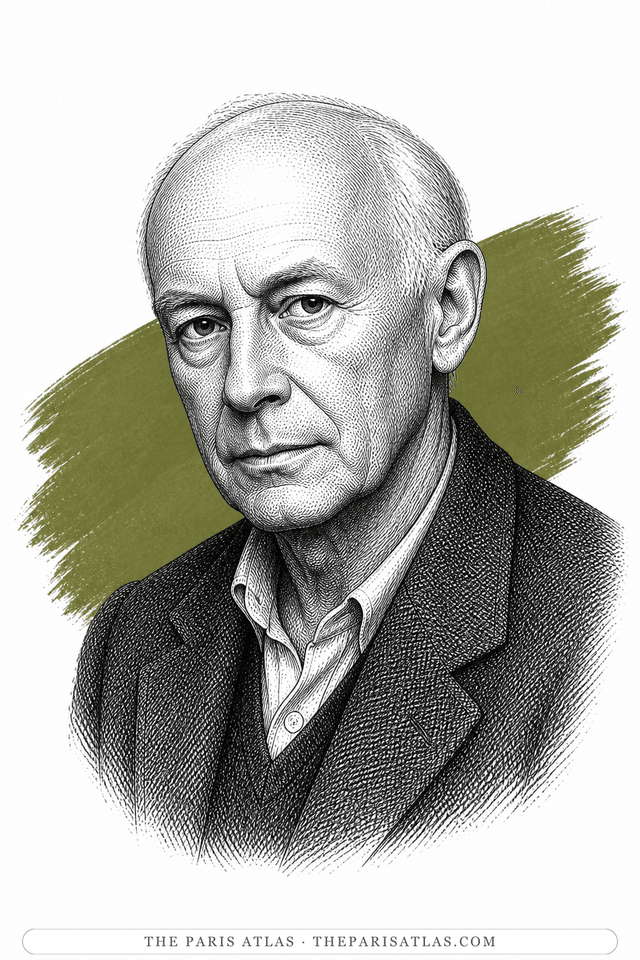
Henri Cartier-Bresson
French photographer who turned a pocket-sized 35mm camera into an instrument of split-second composition — the idea the world knows as 'the decisive moment'. He trained as a painter, was taken prisoner in 1940 and escaped on his third try, photographed the Liberation of Paris in August 1944, co-founded the photographer-owned agency Magnum Photos in 1947, gave up reporting for drawing in the 1970s, and left Paris a foundation in the Marais that deliberately hangs no permanent display of his own pictures.
View artist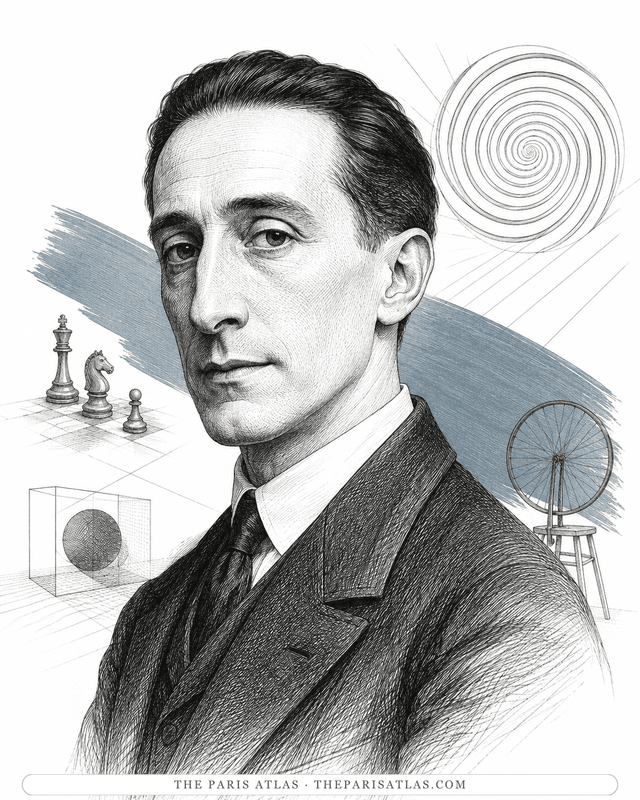
Marcel Duchamp
The century's quietest revolutionary — readymades, the abandonment of painting, chess on a Paris rooftop in Entr'acte, and one anemic film of spinning puns signed Rrose Sélavy.
View artist
References
References
The sources below include collection records, catalogues, scholarly research, and primary materials that informed this page. They document The Ecumenical Council, its making, and its place in cultural history.


3↑Fundació Gala-Salvador Dalí — catalogue raisonné of paintings
WebsiteUsed forWeb source consulted for documented facts and historical context presented on the The Ecumenical Council page.
4↑Stripped Bare + Bathed: The Preservation of Dalí's Masterworks
WebsiteThe Dalí Museum, St. Petersburg, Florida, 2012Used forWeb source consulted for documented facts and historical context presented on the The Ecumenical Council page.
5Gala Dalí library guide — The Dalí Museum, St. Petersburg
WebsiteUsed forWeb source consulted for documented facts and historical context presented on the The Ecumenical Council page.

6L'Annuncio, 1960 — study for The Ecumenical Council
Official recordVatican MuseumsUsed forOfficial record used to verify names, dates, institutional details, or other factual information on this page.
i
Why these sources are here
These references provide the documented foundation for this work's history and interpretation. Claim-level citations remain attached to the specific claims they support.
 Explore more resources