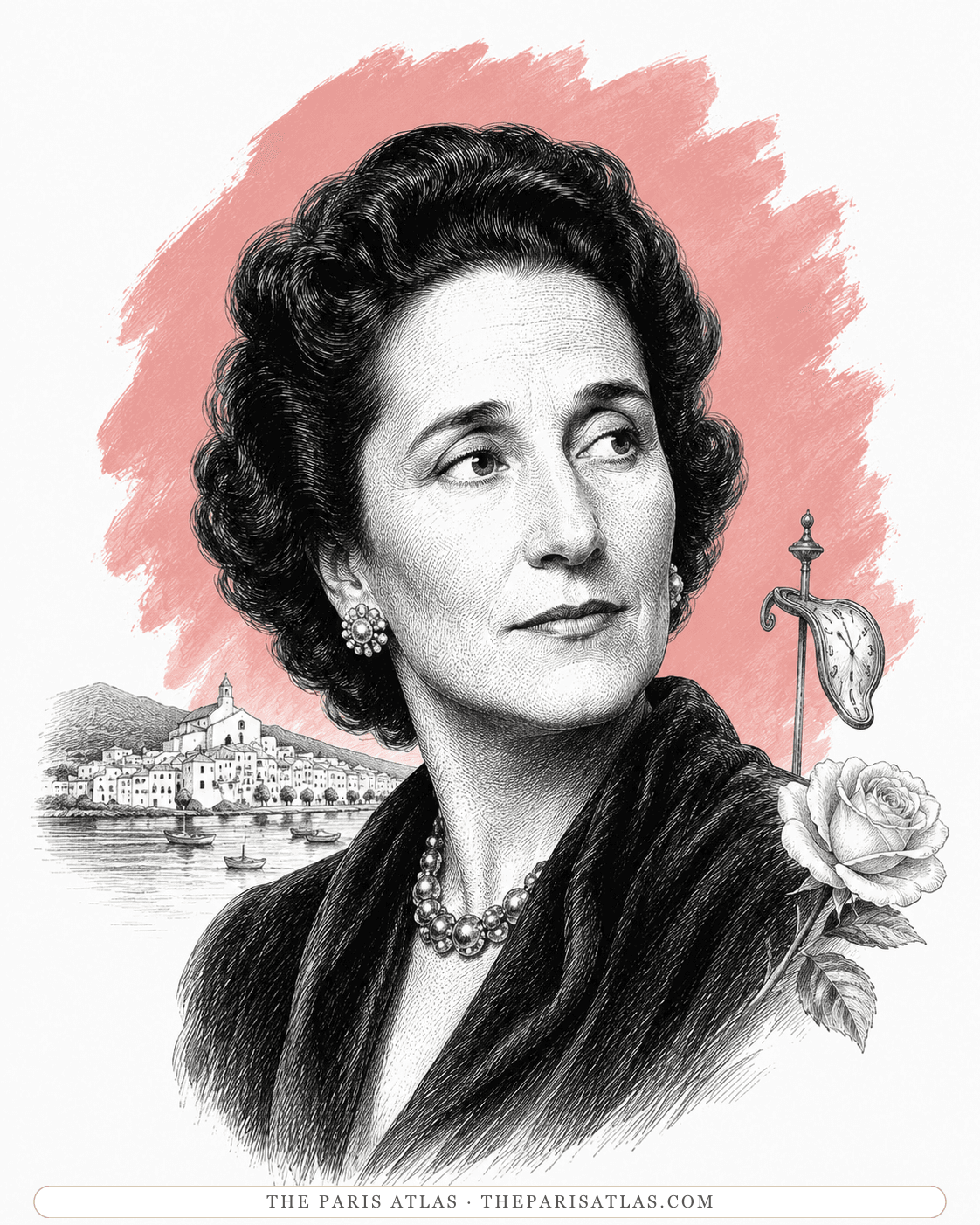
Depicts · 1950
Gala Dalí
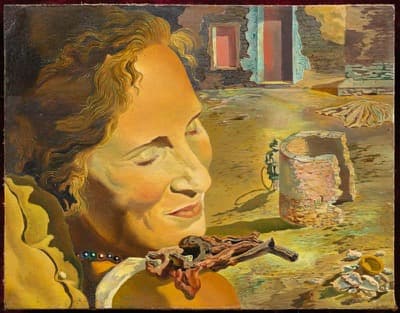
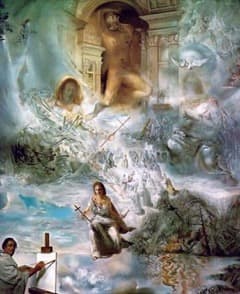
Gala is the central Madonna figure in the large 1950 version of Dalí's painting.
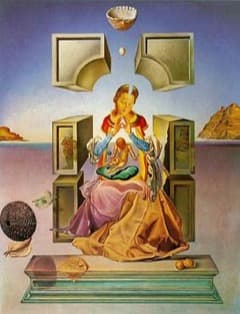
Gala appears as the Virgin Mary in Dalí's monumental 1950 fusion of Renaissance altarpiece, atomic disintegration and the landscape of Portlligat.
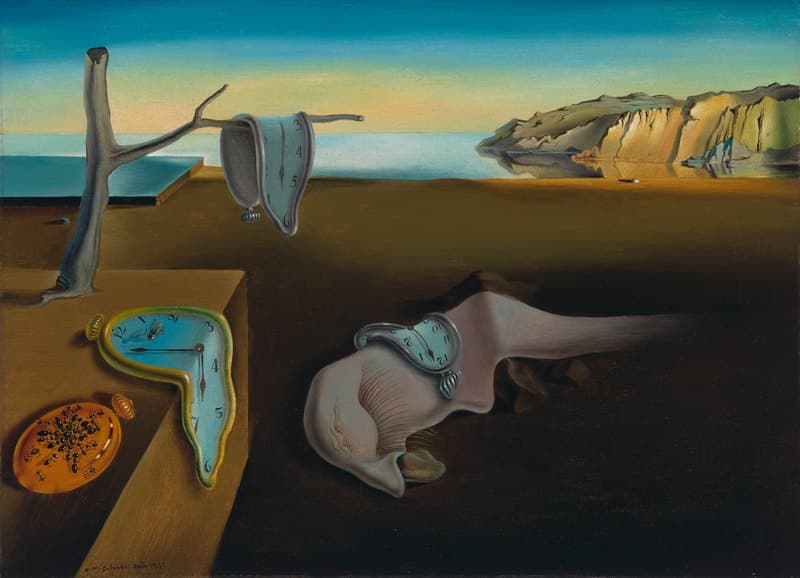
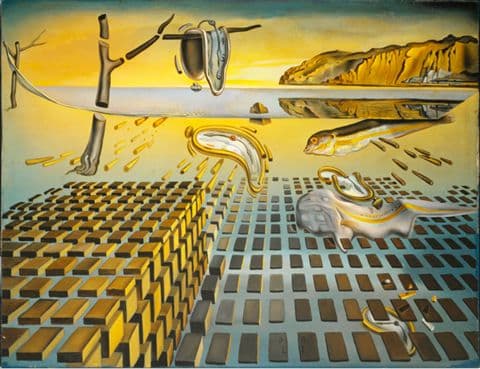
The coast behind this religious image is also the physical ground of The Persistence of Memory. Comparing them shows Dalí reusing Portlligat's rocks, water, and light while moving from Surrealist dream imagery into nuclear mysticism.
Gala sits frontally as the Virgin Mary, holding the Christ Child on her lap. Both bodies contain rectangular openings. A basket of bread occupies the opening in the child's chest, while Portlligat's sea and horizon remain visible through Gala's body.
The pair sit inside an arch that is itself broken into suspended blocks. Above them an egg hangs from a shell. Curtains, fish, flowers, fruit, vessels and geometric objects appear around the central group, but many do not rest on any surface. The whole structure opens onto the Catalan coast.
Dalí painted a smaller first version in 1949 and showed it to Pope Pius XII. In 1950 he made this much larger canvas, measuring more than 2.75 metres high. The Fundació identifies Gala as the model and preserves a preparatory photograph of her posing.
The second painting expands the architecture, symbols and coastal setting into the scale of an altarpiece. Dalí signed and dated it “SALVADOR DALI / Gala 1950,” again placing Gala's name inside his public authorship.
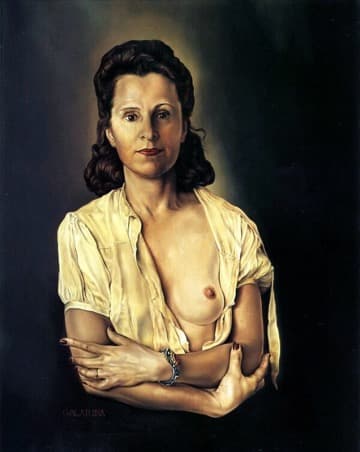
Earlier portraits presented Gala as lover, fashionable woman or psychologically charged object of desire. Here Dalí gives her the pose and authority of the Virgin Mary. A divorced Russian woman from the Surrealist circle becomes the central sacred figure in a work offered as a renewal of religious painting.
That transformation belongs to Dalí's private mythology as much as to Catholic iconography. Gala is recognizable rather than generalized. Her face and body anchor the religious subject in the artist's closest personal relationship.
The painting is a key work of Dalí's nuclear mysticism, the program in which he combined Catholic subjects, Renaissance models and ideas drawn from atomic physics. The rectangular openings and floating objects visualize matter as discontinuous: a body or building remains legible even when it is pierced and separated into parts.
Dalí's response to Hiroshima and Nagasaki was idiosyncratic rather than scientific. He turned the atom into a reason to rethink solidity, weight and spiritual presence. In this painting, emptiness does not destroy the Madonna and Child; it becomes part of how they are represented.
The frontal revelation between parted curtains recalls Raphael's Sistine Madonna. The suspended egg beneath a shell refers more specifically to Piero della Francesca's Montefeltro Altarpiece. Dalí also adopted the blue and gilded tones associated with Renaissance religious painting and the imposing scale of an altarpiece.
These references were programmatic. Dalí argued that modern artists had abandoned religious subjects because their technique could not rival Renaissance painting. The Madonna of Portlligat was his answer: an old subject rebuilt with precise illusion, impossible space and twentieth-century science.
The Fundació's close study identifies a dense group of objects, some traditional and some specifically Dalinian:
Dalí did not leave one stable dictionary assigning a single meaning to every object. The bread and Renaissance references are directly documented. Tighter readings of the flowers, fruit and vessels should remain proposals rather than certainties.
Infrared study has revealed construction lines radiating from the bread at the centre. It functions as a principal vanishing point, but the painting also uses alternative vanishing points around the pedestal and its objects. The result is a space that initially looks orderly and then refuses to behave as one coherent room. Accelerated perspective changes the scale of forms to heighten the drama, turning traditional perspective into a tool for producing unreal architecture.[1]
Dalí painted the large version in his studio at Portlligat, and the sea, rocks and light outside that studio became the painting's setting. The location is not incidental scenery. It makes a universal Christian subject depend on the particular coast where Dalí and Gala lived and worked.[2]
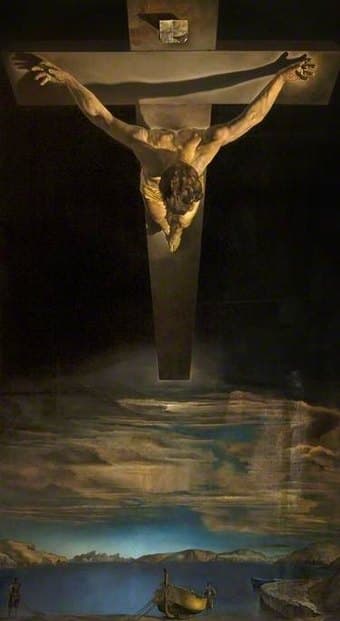
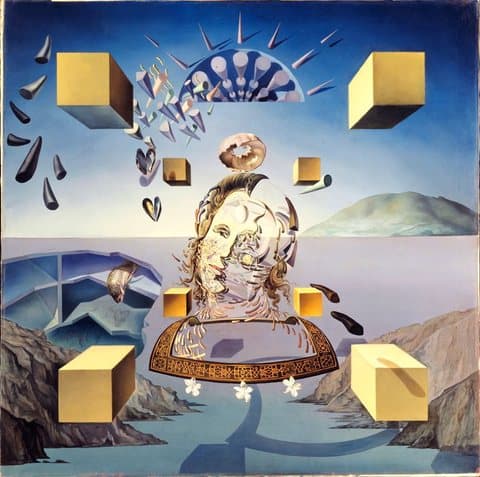
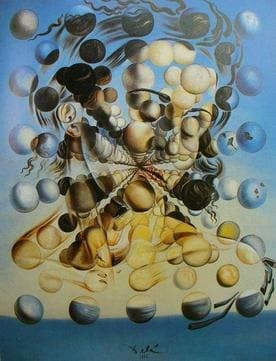
The landscape also connects this religious canvas with earlier Surrealist works such as The Persistence of Memory and later atomic portraits such as Galatea of the Spheres. Portlligat remained the physical ground beneath each change of style.[3]
The large version was presented at the Carstairs Gallery in New York in 1950 and travelled widely. Its exhibition history includes the first Hispano-American Art Biennial in Madrid and Barcelona and a display in the war-damaged Palazzo Reale in Milan.[4]
The painting eventually entered the Fukuoka Art Museum in Japan. It returned temporarily to Figueres for the Fundació's 2025–26 exhibition The Madonna of Portlligat: An Oneiric Explosion, then went back to Fukuoka in March 2026.[5]
Few paintings show Dalí's postwar ambitions so completely. The work makes Gala a Madonna, Portlligat a sacred landscape, Renaissance perspective a source of controlled instability and atomic theory a visual language for spiritual presence. It is a hinge rather than a simple departure from Surrealism: Dalí retains levitation, dream space and irrational conjunction, but redirects them toward classicism and Catholic imagery.[2]
Close reading
Dalí rebuilds a Renaissance Madonna as a structure with gaps, suspended objects, and a Catalan horizon. The details show a sacred image made porous without losing its frontal authority.
1.Mother and child are joined by an opening
The figures occupy a traditional central pose, but rectangular voids pass through their bodies. The openings do not simply wound them; they frame smaller images and light, turning absence into part of the sacred architecture.
2.Bread sits inside the body as image and sacrament
The loaf is painted with domestic specificity and placed at the composition's Eucharistic center. Dalí makes theological symbolism tangible by giving it the weight and texture of an ordinary object.
3.Architecture comes apart around a calm horizon
Fragments hang in measured intervals while the distant sea remains level and still. The contrast lets cosmic disassembly occur without chaos. Port Lligat supplies the unbroken line beneath the vision.
4.The shell and egg extend the central axis
A small egg hangs between the shell and the open architectural form beneath it. Its position continues the vertical line through mother and child, but the surrounding air leaves it visibly unsupported. The tiny oval creates a pause between the larger forms arranged above and below it.
5.A dark round form interrupts the pale space
The dark rounded form sits apart from the central figure, with a pale fragment immediately beneath it. Its dense, mottled surface contrasts with the smooth sky and water behind it. The object breaks the painting's nearly symmetrical arrangement and draws attention toward the otherwise open space at the left.
6.Small objects occupy a broad green ledge
The ledge stretches almost from side to side, its horizontal moldings firmly closing the foreground. Small rounded objects interrupt the otherwise straight upper edge. Below the suspended figures and broken architecture, this long, carefully shaded support gives the composition a comparatively stable base.
1949
Dalí paints the first, smaller version and presents it to Pope Pius XII.
1950
Completes the large second version with Gala as the central figure.
1950–51
Presented at the Carstairs Gallery in New York as a major statement of Dalí's new mystical painting.
1951–52
Included in the first Hispano-American Art Biennial in Madrid and Barcelona.
2025–26
Returns from Fukuoka to Figueres for the Fundació's one-work exhibition The Madonna of Portlligat: An Oneiric Explosion.
2026
Returns to the Fukuoka Art Museum after the Figueres exhibition.
Fukuoka Art Museum, Japan
1-6 Ohori Koen, Chuo-ku, Fukuoka 810-0051, Japan
Displays and loans can change. Check whether this work is on view before making a special trip.
Plan your visit on the museum’s official website (opens in a new tab)Gala Dalí. Salvador Dalí used his wife, manager and principal model as the Virgin Mary in both the 1949 and 1950 versions.
They visualize Dalí's nuclear-mystical idea that matter is discontinuous. Gala and the Christ Child remain recognizable even though open space passes through their bodies.
The basket and loaf inside the Christ Child form the Eucharistic core of the painting. Dalí explicitly described the bread as the vital and mystical centre of his weightless Madonna.
It refers to the suspended egg in Piero della Francesca's Montefeltro Altarpiece, one of Dalí's Renaissance sources. The egg also carries broad associations of birth and perfection.
Yes. Dalí painted a smaller version in 1949 and showed it to Pope Pius XII. He completed the much larger version discussed here in 1950.
Dalí's postwar fusion of Catholic themes, Renaissance classicism and ideas taken from atomic physics. In this painting, floating objects and open bodies turn the discontinuity of matter into religious imagery.
The 1950 version belongs to the Fukuoka Art Museum in Japan. It was temporarily shown at the Dalí Theatre-Museum in Figueres in 2025–26 before returning to Fukuoka.
Depicts · 1950
Gala is the central Madonna figure in the large 1950 version of Dalí's painting.
Explore painters from the same movements and circles.
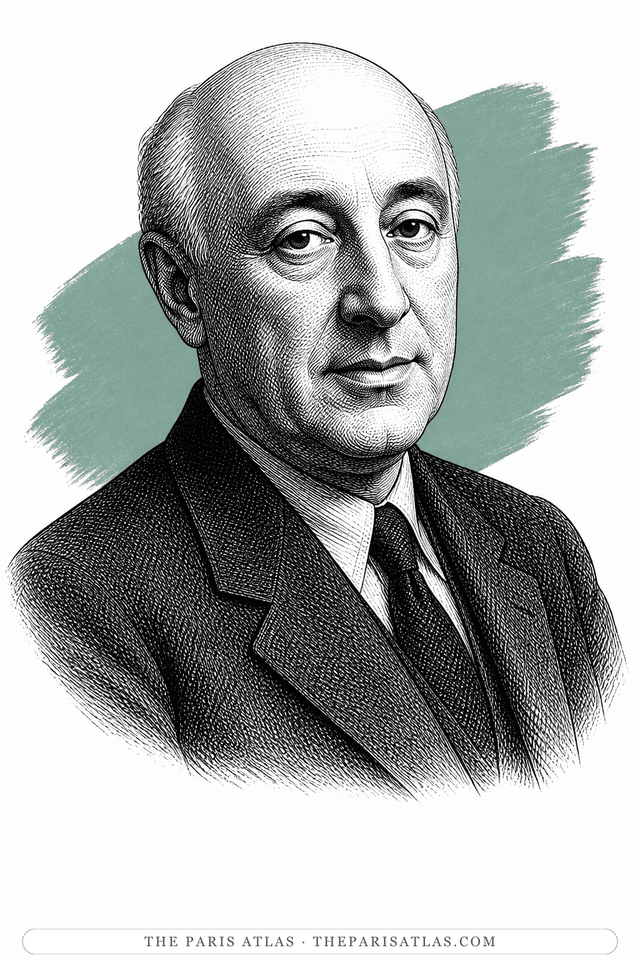
Strasbourg-born sculptor and poet — Hans in German, Jean in French, both all his life — who co-founded Dada at the Cabaret Voltaire in 1916, composed collages by dropping torn paper 'according to the laws of chance', and settled at Meudon outside Paris in a house his wife Sophie Taeuber-Arp designed.
View artist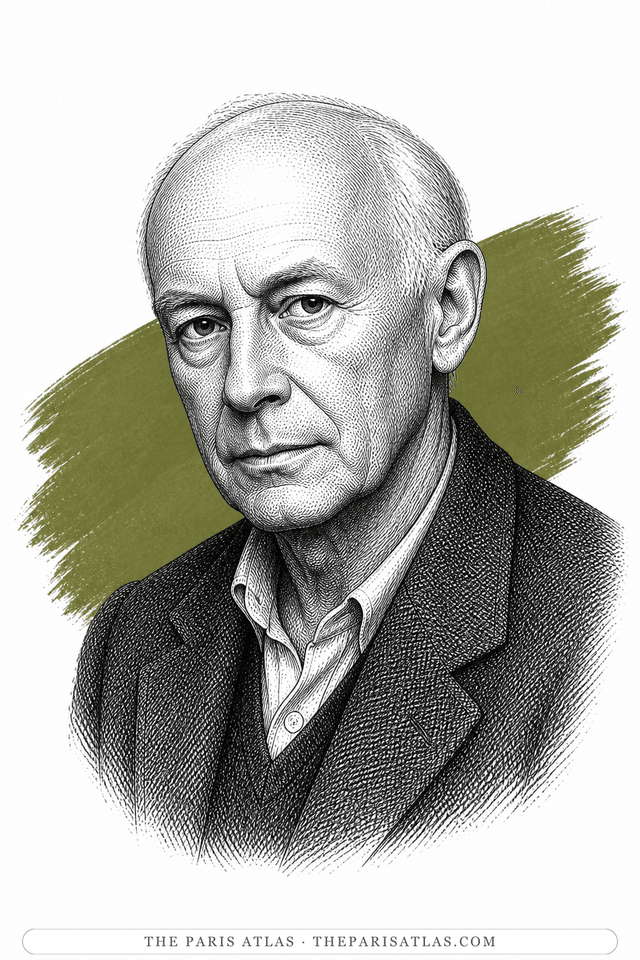
French photographer who turned a pocket-sized 35mm camera into an instrument of split-second composition — the idea the world knows as 'the decisive moment'. He trained as a painter, was taken prisoner in 1940 and escaped on his third try, photographed the Liberation of Paris in August 1944, co-founded the photographer-owned agency Magnum Photos in 1947, gave up reporting for drawing in the 1970s, and left Paris a foundation in the Marais that deliberately hangs no permanent display of his own pictures.
View artist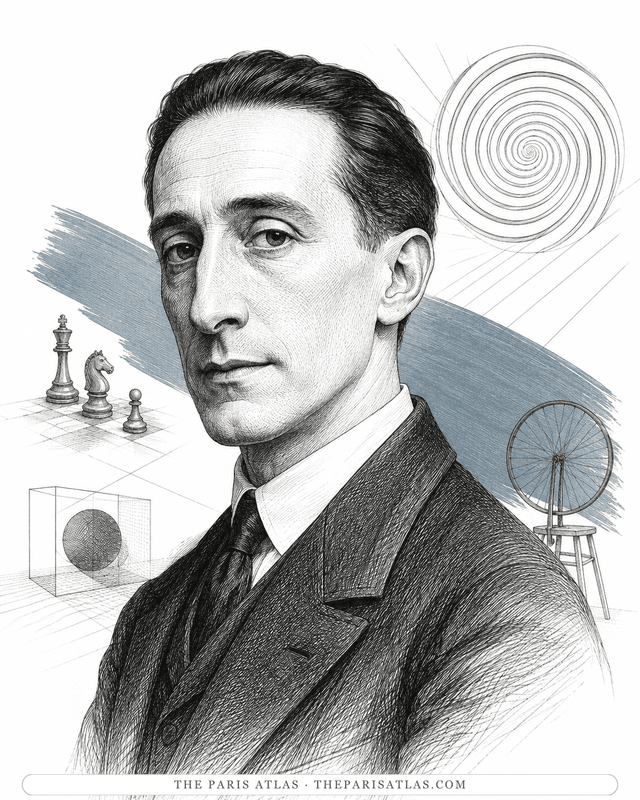
The century's quietest revolutionary — readymades, the abandonment of painting, chess on a Paris rooftop in Entr'acte, and one anemic film of spinning puns signed Rrose Sélavy.
View artistThe sources below include collection records, catalogues, scholarly research, and primary materials that informed this page. They document The Madonna of Portlligat, its making, and its place in cultural history.


Web source consulted for documented facts and historical context presented on the The Madonna of Portlligat page.
Web source consulted for documented facts and historical context presented on the The Madonna of Portlligat page.
Web source consulted for documented facts and historical context presented on the The Madonna of Portlligat page.
Web source consulted for documented facts and historical context presented on the The Madonna of Portlligat page.
These references provide the documented foundation for this work's history and interpretation. Claim-level citations remain attached to the specific claims they support.
 Explore more resources