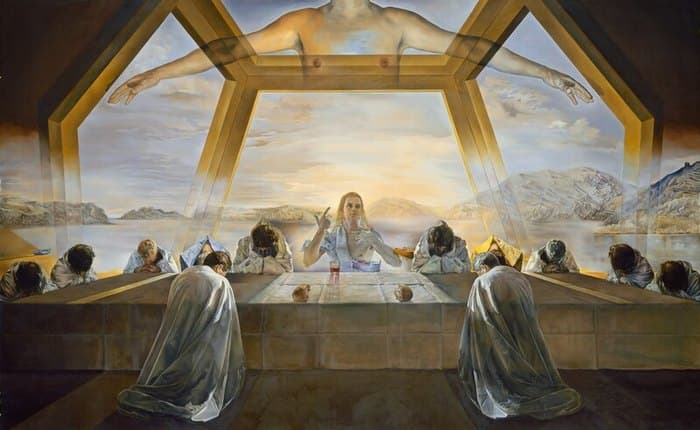
The Sacrament of the Last Supper
Dalí's nine-foot-wide 1955 meditation on the Eucharist, with a transparent Christ, twelve bowed participants, bread and wine inside a dodecahedral space overlooking Port Lligat. It joins Renaissance symmetry, Catholic ritual, and nuclear mysticism.
- 1955
- Oil on canvas
About Salvador Dalí
A route through Dalí's work
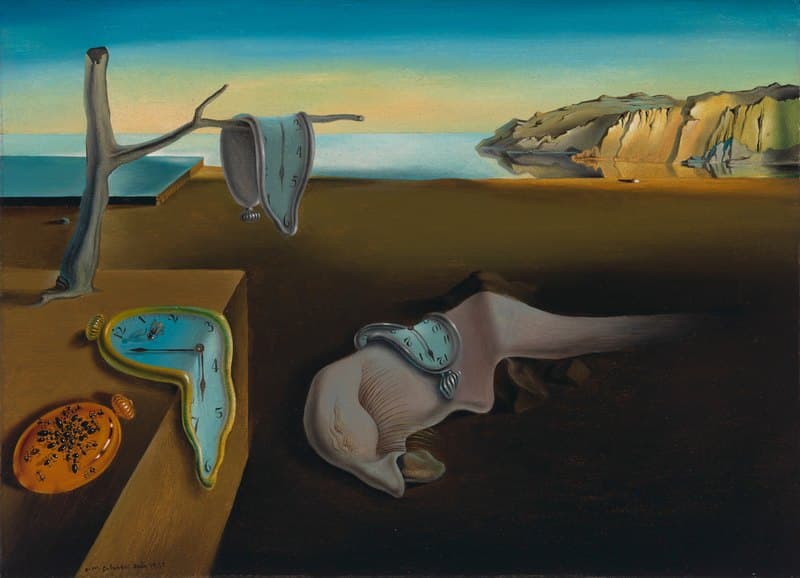
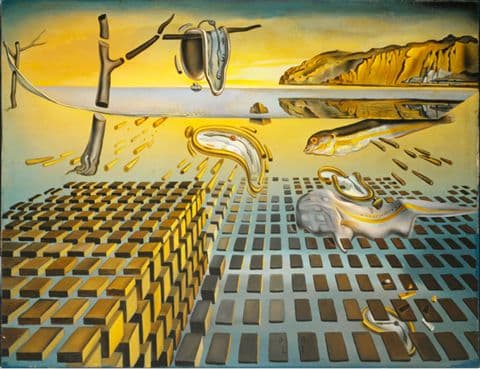
For the small early Surrealist painting against which this large religious canvas is often measured, see The Persistence of Memory. The comparison reveals how Dalí kept his polished illusionism while replacing private dream symbols with a public Christian subject.
What the painting shows
Christ sits at the center of a long white table. One hand touches his chest while the other points upward. His outlined body is partly transparent, allowing the landscape to remain visible through him. Twelve men kneel or sit around the table with bowed heads and praying hands. Most wear white, while two wear blue and yellow.[1]
Broken bread and a glass of red wine sit near Christ. Above the scene, a youthful male torso extends both arms. Golden pentagonal structures suggest a transparent dodecahedral enclosure, while the bay and rocks of Port Lligat stretch across the background.[1]
A Eucharist rather than a historical meal
The National Gallery of Art interprets the picture as a symbolic presentation of the Eucharist, not a reconstruction of the biblical meal. The bowed men are idealized participants rather than individualized apostles, and the setting is neither ancient Jerusalem nor the “large upper room” described in scripture.[1]
Bread and wine provide the most tangible signs of Christ's physical presence. Christ himself is transparent, while the landscape and tabletop remain materially clear. Dalí used that contrast to move between body, sacrament, and vision.[1]
The geometry of twelve
The enclosure is based on a dodecahedron, a solid with twelve pentagonal faces. Dalí linked the number to the twelve apostles, hours of the day, months of the year, and signs of the zodiac. In ancient philosophy the form was associated with the heavens or cosmos.[1]
The entire composition uses elaborate symmetry and mathematical ratios. Figures repeat across Christ's central axis, and the table recedes sharply toward the landscape. Geometry is Dalí's proposed structure for cosmic order rather than a decoration around the sacred scene.[1]
Old masters and the Catalan coast
Dalí cited Francisco de Zurbarán as a source. The brilliant whites, kneeling figures, and precise enamel-like finish recall that seventeenth-century Spanish painter. The clear division between foreground ritual and background landscape also draws on High Renaissance composition.[1]
Port Lligat is rendered more straightforwardly than in Dalí's earlier Surrealist paintings. The same rocks that once supplied fantastic forms now anchor a religious tableau in the view from the artist's home.[1]
Nuclear mysticism on a public scale
Dalí completed the work during the period he called nuclear mysticism, when he joined Catholic belief, classical art, mathematics, and the language of atomic physics. The transparent bodies and suspended geometric structure suggest matter that is no longer continuous or fully solid.[2][1]
The painting is almost nine feet wide and organized for immediate public impact. Its accessibility separates it from the ambiguous dream imagery on which Dalí's Surrealist reputation had been built — the melting watches of The Persistence of Memory above all — even as its spatial logic remains impossible.[1]
The unresolved figure above
The bare torso above Christ is not identified by an inscription or fixed iconographic attribute. It may suggest a resurrected or cosmic Christ, but there are no nail holes or side wound. The National Gallery therefore treats that reading as a possibility rather than a certainty.[1]
Its scale and outstretched arms extend Christ's gesture across the upper field. The omission of the head prevents it from becoming a second portrait and keeps the figure between body, architecture, and divine presence.
Gala's name on the tablecloth
Dalí signed the lower-right tablecloth “Gala Salvador Dali 1955.” Gala is not identified as one of the figures, but her name is materially present in the authorship mark. The signature belongs to Dalí's established practice of joining her name to his.[1]
Chester Dale, and the gift to the nation
The American collector Chester Dale bought the finished painting through Carstairs Gallery in February 1956. The National Gallery says Dale reputedly suggested the subject, but the documentary record supports purchase rather than a formal commission.[1]
Dale sent the painting directly to the National Gallery, where it was first shown on the day before Easter in 1956. More than seven thousand visitors came on the first day. It entered the collection permanently as Dale's 1963 gift.[1]
Why the painting matters
The Sacrament of the Last Supper is a major example of Dalí's later attempt to rebuild sacred painting through modern science and public spectacle. Its meaning is carried by relationships among transparent flesh, solid bread and wine, mathematical order, and a recognizable home landscape.
Its divided reception is also instructive. The painting became immediately popular with museum visitors while critics and theologians argued over its devotion, theatricality, and classicism. That conflict is central to understanding late Dalí rather than a distraction from it.
Close reading
Reading the work, detail by detail
Dalí submits the Last Supper to strict symmetry, transparent architecture, and the light of Port Lligat. The close views show devotion presented as a system of correspondences.
1.Christ is the still point of the symmetry
Head, hands, neckline, and horizon align on the central axis. Christ's transparency lets the landscape pass through him, so physical presence and immaterial light occupy the same place.
2.The apostles repeat rather than individualize
Heads and folded bodies echo across the axis, subordinating personality to ritual order. Their bowed poses make the table a calm horizontal base beneath the rising figure of Christ.
3.The room is a transparent sacred solid
The polygonal enclosure recedes with mathematical precision while remaining visually open to sea and sky. Dalí replaces the upper room with a cosmic diagram: geometry is not decoration around the event but its proposed order.
4.A second body spans the space above the meal
The upper body is cut off by the top of the painting while its arms spread behind the enclosure. Its enormous size does not match the scale of the diners and table below. The transparent architecture allows this second scale to occupy the same light-filled space as the meal.
5.A bowed figure brings the fabric close
The nearest figure presents a back and a bowed head rather than a face. Long folds in the pale cloth direct the eye downward toward the floor, then turn around the seated body. This close, substantial drapery gives the foreground weight against the more transparent forms beyond the table.
6.The table's few objects interrupt its symmetry
The table offers broad, nearly empty areas around the bread and glass. Small shadows give these objects a physical presence within the bright surface. Their modest scale invites a closer look after the large architectural lines, returning attention from the enclosure to the material things shared at the meal.
Timeline
1955
Dalí painted his Last Supper, Christ and the apostles set inside a transparent dodecahedron over the bay of Port Lligat.
1955
Dalí completed the nine-foot-wide painting after about nine months of work.
February 1956
Chester Dale purchased it from Dalí through Carstairs Gallery.
31 March 1956
First shown at the National Gallery of Art the day before Easter. More than seven thousand visitors came on its first day.
1963
It entered the Gallery's collection permanently through the Chester Dale bequest.
Where to see it
National Gallery of Art, Washington
Constitution Avenue NW, between 4th and 6th Streets, Washington, DC 20565, United States
The West Building entrance is at 6th Street; the East Building entrance is at 4th Street. Check the museum’s current display information for the work’s building and gallery.
Plan your visit on the museum’s official website (opens in a new tab)Frequently asked questions
What is The Sacrament of the Last Supper?
A 1955 painting by Salvador Dalí of a transparent Christ and twelve bowed participants at a table inside a dodecahedral space overlooking Port Lligat. It presents the Eucharist symbolically rather than reconstructing the historical meal.
What is the geometric shape around the scene?
A dodecahedron, a solid with twelve pentagonal faces. Dalí connected twelve to the apostles, months, hours, and zodiac. The form gives mathematical order to the painting's idea of a cosmic sacrament.
Who is the figure with outstretched arms at the top?
A large youthful male torso with outstretched arms. It may suggest a resurrected or cosmic Christ, but the absence of nail holes, a side wound, and a head leaves that interpretation uncertain.
How does it relate to Dalí's earlier Surrealism?
By the 1950s Dalí called his program nuclear mysticism, combining Catholic subjects with classical art, physics, and geometry. The painting leaves his earlier Freudian dream imagery behind but retains an impossible space and suspended forms.
How did it reach the National Gallery of Art?
Chester Dale bought it through Carstairs Gallery in February 1956 and sent it directly to the National Gallery. The museum says he reputedly suggested the subject, but does not document a formal commission. It became a permanent gift in 1963.
Why are the figures not individualized apostles?
Dalí presented idealized participants in a sacramental ritual. Their repeated, symmetrical postures direct attention toward Christ, bread, wine, and the geometry rather than toward separate biblical personalities.
What does the signature say?
“Gala Salvador Dali 1955,” written on the lower-right tablecloth. Gala is not identified as a figure in the scene, but her name is included in Dalí's authorship mark.
Where is it now?
The National Gallery of Art, Washington, accession 1963.10.115, in the Chester Dale Collection.
More by Salvador Dalí
If you like Salvador Dalí
Explore painters from the same movements and circles.
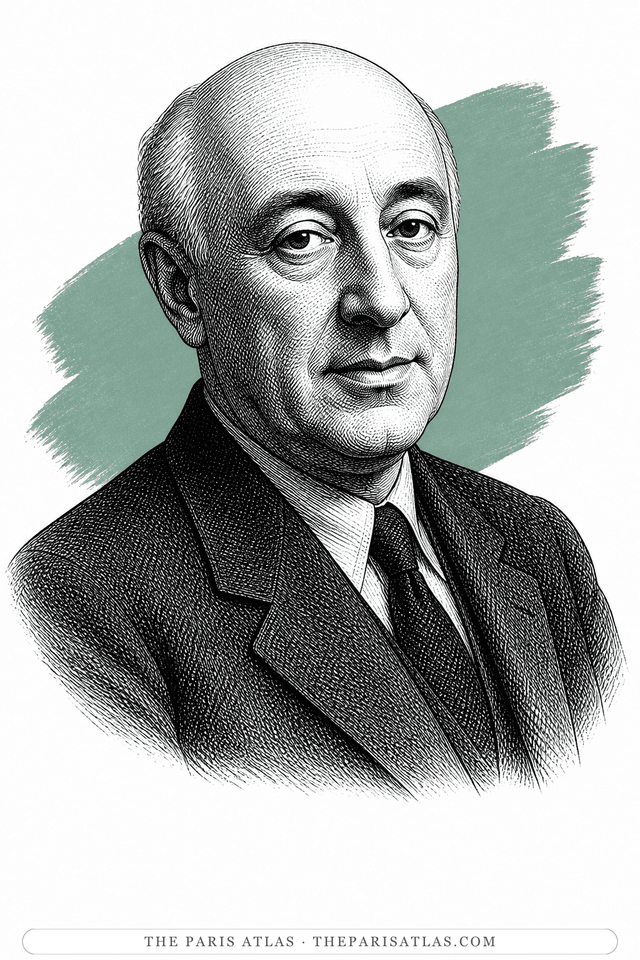
Jean Arp
Strasbourg-born sculptor and poet — Hans in German, Jean in French, both all his life — who co-founded Dada at the Cabaret Voltaire in 1916, composed collages by dropping torn paper 'according to the laws of chance', and settled at Meudon outside Paris in a house his wife Sophie Taeuber-Arp designed.
View artist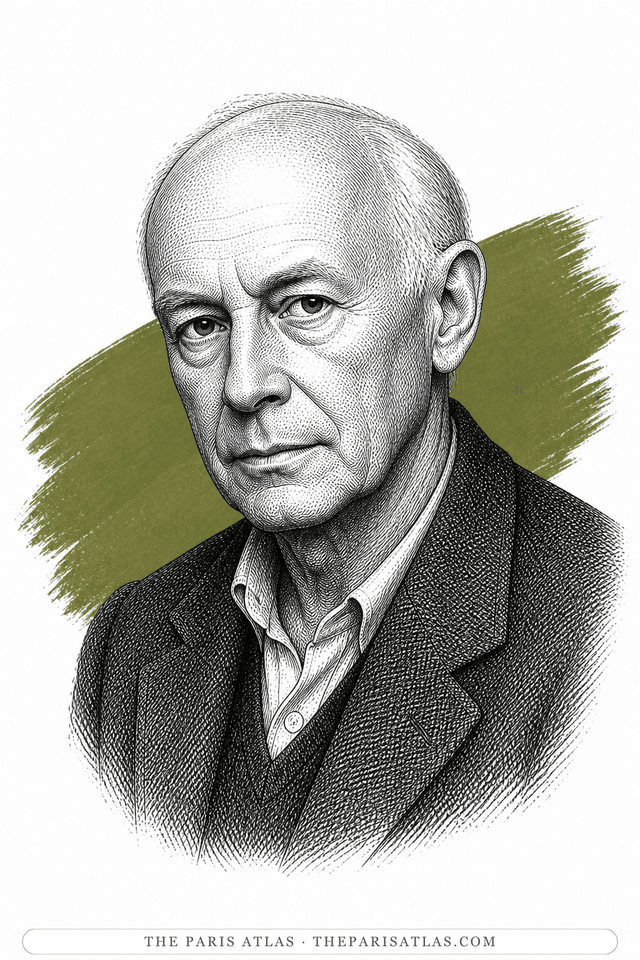
Henri Cartier-Bresson
French photographer who turned a pocket-sized 35mm camera into an instrument of split-second composition — the idea the world knows as 'the decisive moment'. He trained as a painter, was taken prisoner in 1940 and escaped on his third try, photographed the Liberation of Paris in August 1944, co-founded the photographer-owned agency Magnum Photos in 1947, gave up reporting for drawing in the 1970s, and left Paris a foundation in the Marais that deliberately hangs no permanent display of his own pictures.
View artist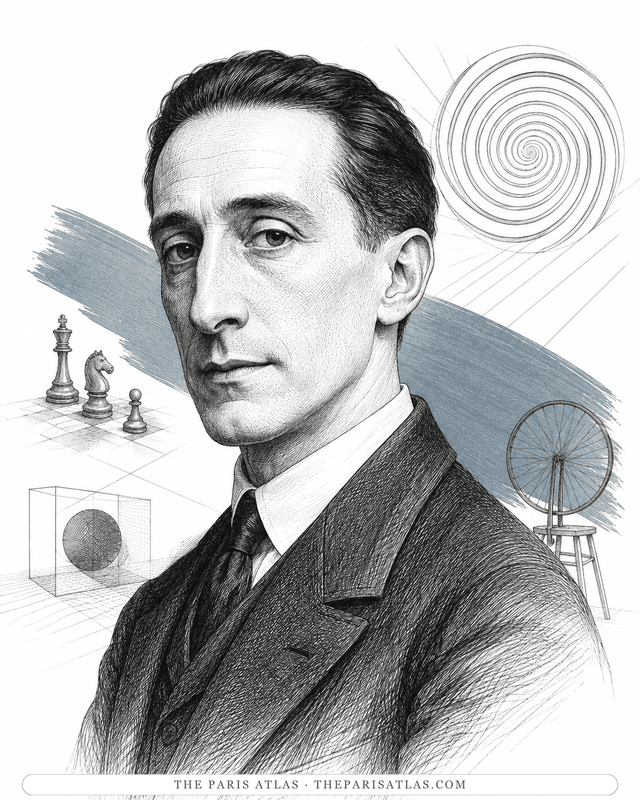
Marcel Duchamp
The century's quietest revolutionary — readymades, the abandonment of painting, chess on a Paris rooftop in Entr'acte, and one anemic film of spinning puns signed Rrose Sélavy.
View artist
References
The sources below include collection records, catalogues, scholarly research, and primary materials that informed this page. They document The Sacrament of the Last Supper, its making, and its place in cultural history.


2↑Salvador Dalí and Science
WebsiteCentre for Dalinian Studies, Fundació Gala-Salvador Dalí, 2000Used forWeb source consulted for documented facts and historical context presented on the The Sacrament of the Last Supper page.
3National Gallery of Art, Washington — collection records
WebsiteUsed forWeb source consulted for documented facts and historical context presented on the The Sacrament of the Last Supper page.
4Fundació Gala-Salvador Dalí — catalogue raisonné of paintings
WebsiteUsed forWeb source consulted for documented facts and historical context presented on the The Sacrament of the Last Supper page.
These references provide the documented foundation for this work's history and interpretation. Claim-level citations remain attached to the specific claims they support.
 Explore more resources