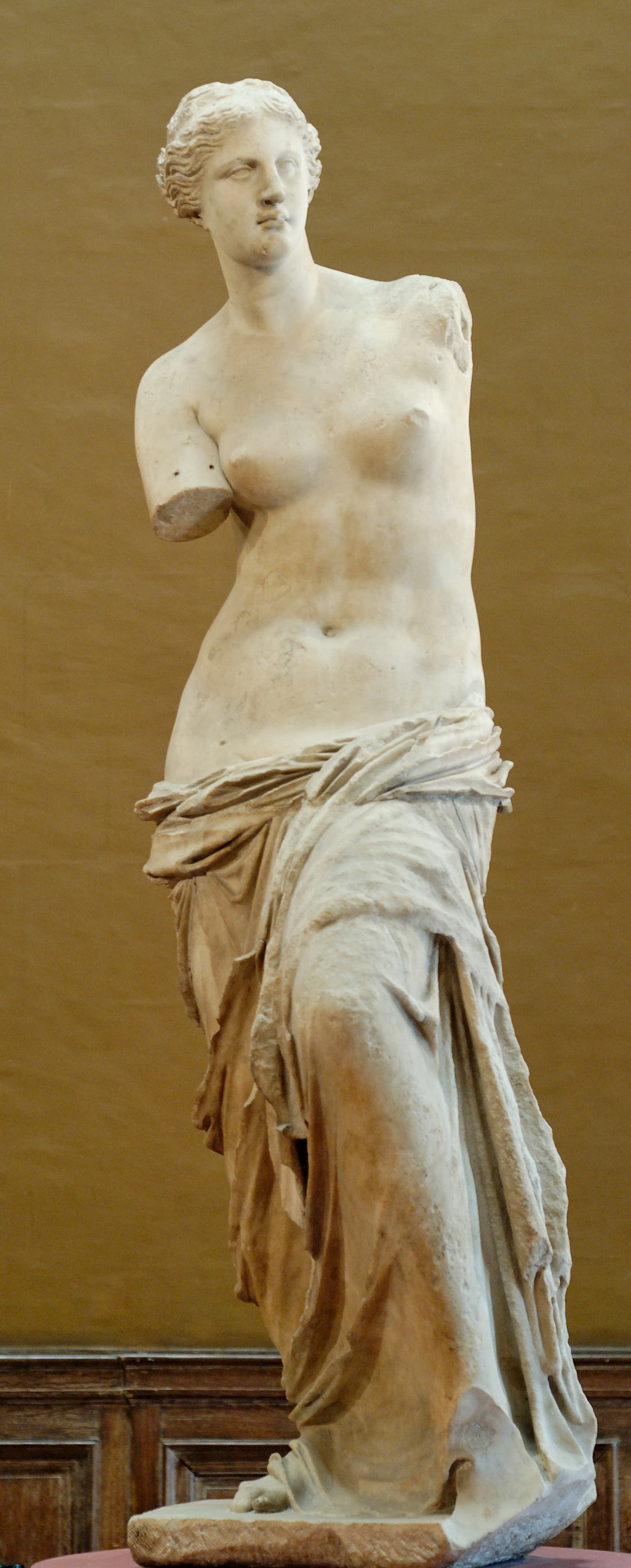
Venus de Milo
by
A Greek marble statue of a half-draped woman, almost certainly the goddess Aphrodite, carved on the island of Melos in the second century BC and dug up there by a farmer in 1820. Both arms were already missing when she was found. She reached Paris the following year as a royal gift, and the Louvre has shown her ever since — one of the most recognised objects in the world, and still unattributed.
- Third quarter of the 2nd century BC
- Parian marble (lychnites)
What you are actually looking at
A woman carved from white marble, a little over two metres tall, standing with her weight on her right leg. She is bare from the waist up. A heavy cloth — a himation, the large rectangular wrap of the Greek world — has slipped to her hips and is caught there, apparently by nothing but the turn of her body. Her hair is drawn back in a band and knotted into a chignon at the nape.
Both arms are gone. So is her left foot, and most of the right arm. Her nose is damaged and the back of the statue is chipped. None of this was done for effect: it is simply what survived roughly two thousand years in the ground on a Greek island.
She is almost universally called Venus, which is the Roman name. If the identification is right, the Greeks who carved her would have called her Aphrodite — the goddess of love and desire, one of the twelve major gods of the Greek pantheon.
Why nobody is certain who she is
Greek statues are usually identified by what they hold. A trident means the sea; a bow means the hunt; an apple would point to the judgement of Paris, and so to Aphrodite. This statue holds nothing, because she has no hands to hold it with — and that single accident is the reason her identity has been argued over for two centuries.
The two serious candidates have been Aphrodite and Amphitrite, a sea goddess who was worshipped on Melos, the island where the statue was found. The Louvre's account of the argument gives the deciding weight to the jewellery she once wore — the statue was originally fitted with metal ornaments, now lost, whose fixing holes remain — and concludes that this "tipped the scales in favour of Aphrodite".
It is worth being clear that this is a judgement, not a certainty. The statue is named for a goddess by inference from her drapery, her jewellery and where she stood, not because anyone found a label.
Found in a field in 1820
The statue came out of the ground on Melos — Milos in modern Greek, Milo in the Italian form that gave her the name — in 1820. The island was then part of the Ottoman Empire, and the find was made by a local man working his land.
French naval officers were on the island and recognised what had been dug up. The statue was bought almost immediately by the Marquis de Rivière, the French ambassador to the Ottoman court, who presented it to King Louis XVIII. The king gave it to the Louvre in March 1821. In the museum's records the entry is a donation from the Marquis de Rivière, and it carries the inventory number Ma 399.
A separate block of marble, inscribed with the name of a sculptor from Antioch on the Meander, was reported as having been found with her. It then vanished, and the Louvre's catalogue entry today names no artist at all. The most famous Greek statue in Paris is anonymous, and the one piece of evidence that might have fixed her authorship and date went missing in the first years after the discovery.
How an unattributed statue became the most famous in the Louvre
Her fame is not purely a matter of quality, and the timing is part of the story. Napoleon had stripped Italy of antiquities; after his defeat in 1815 France had to give many of them back. The Louvre had lost the celebrated ancient nudes it had been showing, and a spectacular Greek marble arriving in 1821 filled a gap the museum badly needed filled.
She went on show in the Galerie des Antiques, the palace's hall of ancient sculpture, and was moved several times over the following century. The Louvre eventually returned her to the room where she was first displayed, where — in the museum's own phrase — she now "has pride of place, standing almost alone in the middle of the exhibition space".
The missing arms turned out to be an asset rather than a defect. Because nobody knows what she was doing, every generation has been free to decide. She has been imagined holding an apple, a shield, a mirror, a length of drapery. The blank has kept her interesting in a way a complete statue would not have been.
Seeing her
She stands in Room 345 of the Sully wing, on Level 0, among the classical and Hellenistic Greek sculpture — a different wing from the Mona Lisa and the Winged Victory, both of which are in Denon. Nothing extra is needed to see her beyond ordinary museum admission.
She is worth walking around, which is not true of every famous object in the building. The drapery is fully carved at the back, and the statue was made in two large blocks joined at the hips — a seam you can find if you look for it.
Close reading
Reading the work, detail by detail
The Venus de Milo is familiar as a silhouette, but its surfaces preserve a carefully balanced body, slipping drapery, and visible damage. The details separate what the ancient sculptor designed from what the statue's later history removed.
1.The torso turns against the weight-bearing leg
Shoulders, waist, and hips rotate in slightly different directions. That counter-movement keeps the standing figure active and helps the heavy marble appear balanced rather than rigid.
2.The drapery appears always on the verge of falling
Thick folds catch at the hips while dropping diagonally toward the legs. Cloth and body pull in opposite directions, creating the tension that holds the lower half together.
3.The breaks remove the attributes that could name her
The damaged shoulders are now part of the statue's worldwide image. More importantly, the missing hands cannot hold an apple, shield, or other attribute, leaving the figure's precise identity unresolved.
4.The small turned head counters the body's larger twist
The head turns with restraint while shoulders, waist, and hips shift below. This quieter movement prevents the pose from reading as one exaggerated spiral.
5.The arm breaks remain part of how the sculpture is read
Missing arms deny the gestures and attributes that might securely identify the goddess. The fractures are damage, but they now shape every modern attempt to imagine the original pose.
6.Deep and shallow cuts distinguish cloth from skin
Sharp channels create dark gaps in the cloth while the torso remains broadly smooth. Differences in carving make one block of marble produce contrasting textures and weights.
Timeline
c. 150–125 BC
The statue is carved from Parian marble, in the Hellenistic period of Greek art.
1820
She is dug up on the island of Melos, already missing both arms. French naval officers on the island recognise the find.
1821
Bought by the Marquis de Rivière, the French ambassador, and presented to Louis XVIII, who gives her to the Louvre in March.
2026
On display in Room 345 of the Sully wing, standing almost alone in the room where she was first shown.
Where to see it
A viewing location has not yet been listed for this work.
Frequently asked questions
What is the Venus de Milo?
An ancient Greek marble statue of a half-draped woman, generally identified as the goddess Aphrodite, carved in the third quarter of the second century BC. It is 204 cm tall, made of Parian marble, and has been in the Musée du Louvre in Paris since 1821.
Why does the Venus de Milo have no arms?
They were already missing when she was found in 1820. There is no evidence they were removed deliberately or lost in transit — the statue simply came out of the ground incomplete, along with her left foot and part of her right arm. What the arms were doing is unknown, which is a large part of why the statue has stayed famous.
Where was the Venus de Milo found?
On Melos, a Greek island in the Aegean, in 1820. The Italian form of the island's name, Milo, is where the statue's name comes from — it simply means the Venus from Melos.
Who made the Venus de Milo?
Nobody knows. An inscribed block naming a sculptor from Antioch on the Meander was reported with the find and then lost, and the Louvre's catalogue entry names no artist. The attribution is argued over but not settled.
Is she Aphrodite or someone else?
Probably Aphrodite, the Greek goddess of love, but it is an inference rather than a fact. The main rival identification is Amphitrite, a sea goddess worshipped on Melos itself. The Louvre says the jewellery the statue once wore tipped the argument towards Aphrodite.
Where is the Venus de Milo in the Louvre?
Room 345 in the Sully wing, on Level 0, in the Greek classical and Hellenistic galleries. She is in a different wing from the Mona Lisa and the Winged Victory of Samothrace, which are both in Denon. Check the museum's live gallery schedule before visiting, since rooms close for maintenance.
How big is the Venus de Milo?
204 centimetres tall, or just under six feet nine inches — slightly larger than life size. She is carved from Parian marble, the fine white marble quarried on the island of Paros, in two blocks joined at the hips.
References
The sources below include collection records, catalogues, scholarly research, and primary materials that informed this page. They document Venus de Milo, its making, and its place in cultural history.


1Vénus de Milo — catalogue entry (Ma 399)
WebsiteMusée du Louvre, Département des Antiquités grecques, étrusques et romaines, 2026Used forThe museum's catalogue record: inventory number, date, marble, 204 cm height, findspot, the 1821 donation, and the current room.
2Ideal Greek Beauty: the Venus de Milo and the Galerie des Antiques
WebsiteMusée du Louvre, 2026Used forThe Louvre's own account of the identification argument and of how the statue has been displayed in the palace.
3A Welcome Newcomer to the Louvre: the Venus de Milo
WebsiteMusée du LouvreUsed forThe Louvre's masterpiece trail explains the 1820 discovery, 1821 donation, missing attributes and immediate museum reception.

4The Venus of Milo — Masterpieces of Greek Sculpture
EssaysCambridge University PressUsed forThe Cambridge scholarly chapter provides an independent art-historical analysis of the sculpture and its place in Greek art.
These references provide the documented foundation for this work's history and interpretation. Claim-level citations remain attached to the specific claims they support.
 Explore more resources