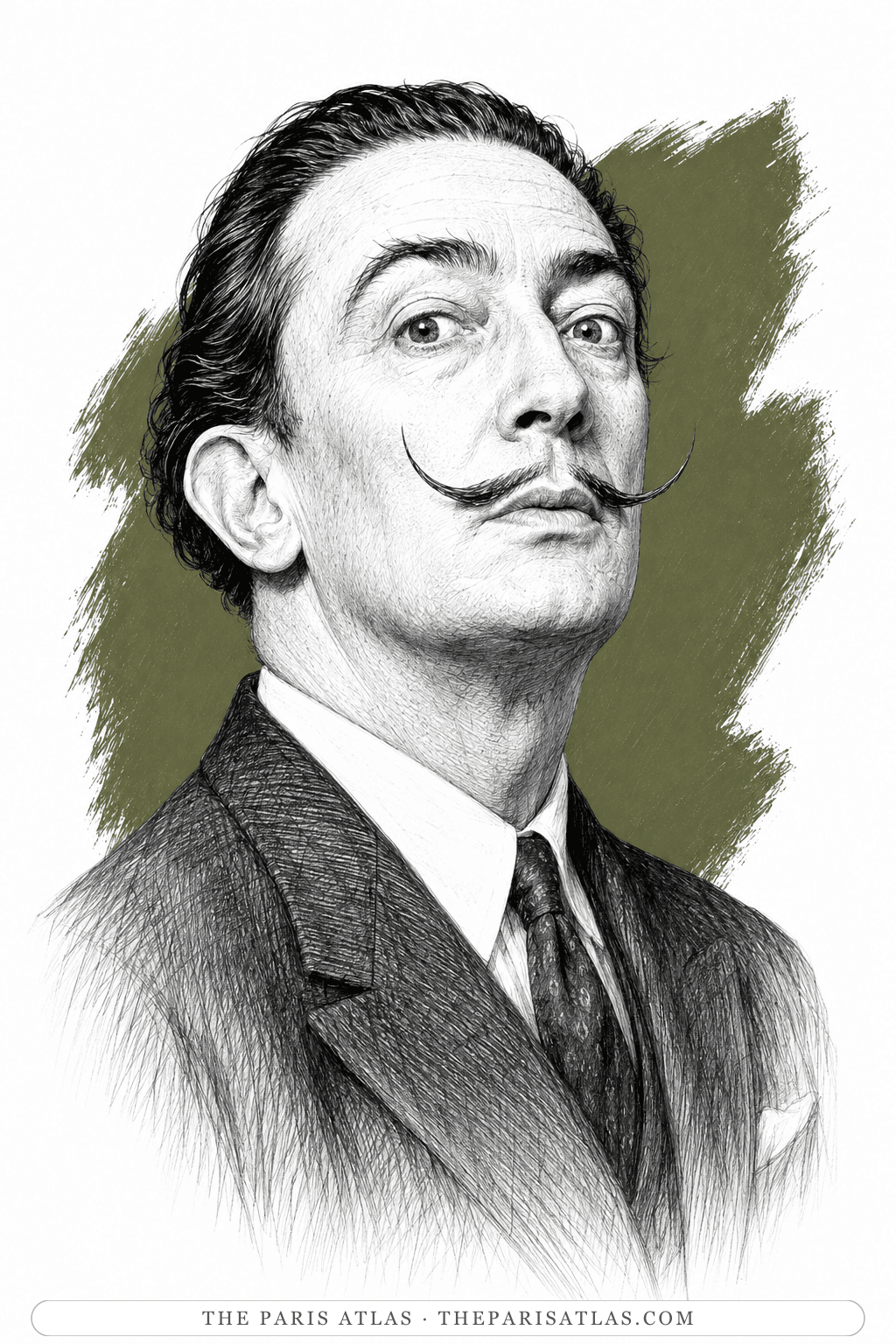
Salvador Dalí
The subject of "Benefit of Clergy", the essay a publisher cut out of a printed book. Orwell reviews the painter's autobiography, states what he thinks of the incidents in it, states that its author can draw better than almost anyone attacking him, and refuses to let either judgement dispose of the other.
"At seven," Dalí writes in the first paragraph of his book, "I wanted to be Napoleon. And my ambition has been growing steadily ever since." Orwell takes the line as worded to startle but substantially true, and builds his whole explanation on it: a gift for drawing, an atrocious egoism, and shock as the shortest route from the first to the second.
The book

At a glance
- The subject of "Benefit of Clergy: Some Notes on Salvador Dalí", the seventh of the ten essays
- 1944
- Dalí's recently published autobiography, 400 quarto pages, illustrated; Orwell names it only as his Life
- The Saturday Book for 1944, from which it was cut out of every copy before sale
- A draughtsman of very exceptional gifts; and a diseased intelligence whose book, he says, stinks
- Diagnosis rather than denunciation, and explicitly not suppression
- 120–129
Who they are in the book
Spoiler-free"Benefit of Clergy: Some Notes on Salvador Dalí" is a review of the Spanish painter's autobiography, published in New York in 1942 and referred to by George Orwell simply as Dalí's Life. It is four hundred quarto pages long and illustrated throughout with reproductions of the Surrealist paintings, and Orwell begins by warning the reader what kind of document it is. Some of the incidents in it are flatly incredible, others rearranged and romanticised, and the ordinariness of daily life has been cut out of it entirely. Dalí is narcissistic by his own diagnosis, and the book, Orwell writes, is a strip-tease act conducted in pink limelight. He then says that this does not matter much for his purpose. Which episodes are true and which imagined hardly signifies; the point is that these are the things Salvador Dalí would have liked to do.
What follows is a list, and it is the part of the essay people remember. At six, in the excitement over the appearance of Halley's comet, Dalí describes catching sight of his three-year-old sister crawling through a doorway, stopping, and kicking her in the head as though it had been a ball, then running on carried away with what he calls a delirious joy. A year earlier he had thrown another small boy off a suspension bridge. At twenty-nine, by his own account, he knocked a girl down and trampled her until she had to be pulled bleeding out of his reach. At about five he kept a dying bat in a tin pail, found it the next morning covered in ants, and bit it almost in half with the ants still on it. As an adolescent he kept a girl who had fallen in love with him in a state of humiliation for five years, told her repeatedly that he would leave her at the end of them, and did. These are Orwell's summaries of Dalí's own tellings, and Orwell keeps the attribution visible throughout.
The pictures get the same treatment. Orwell picks out the necrophilia: the dead donkeys putrefying on grand pianos in the film Un Chien Andalou, whose eye sockets Dalí describes enlarging with scissors, and the faked photograph captioned "Mannequin rotting in a taxicab", over which Dalí notes that the snails crawling on the body are the edible Burgundy kind. He adds a footnote about L'Âge d'Or, which Dalí mentions without describing, quoting Henry Miller's account of what was in it. He also tracks the war years: no side taken in the Spanish Civil War, a turn towards the aristocracy and wealthy patrons including the Vicomte de Noailles, whom Dalí calls his Maecenas, a flight from France to Spain and then to America, and an ending in respectability, marriage and reconciliation with the Catholic Church.
Then the essay turns. Against all of it, Orwell writes, has to be set the fact that Dalí is a draughtsman of very exceptional gifts and, judging by the minuteness and sureness of the drawings, a very hard worker. He is an exhibitionist and a careerist, but he is not a fraud, and he has fifty times more talent than most of the people who would denounce his morals and jeer at his paintings. Both sets of facts are true at once, and Orwell says a reader ought to be able to hold them in one head. The rest of the essay is about why almost nobody does. On one side stands the art-hating Englishman who will grant Dalí nothing at all. On the other stands the admirer who treats any moral objection as proof that you lack an aesthetic sense.
His own proposal is diagnosis rather than denunciation, and he offers one clue he thinks he can follow. Underneath the Surrealism, Dalí keeps reverting to an over-ornate Edwardian style of drawing. Orwell chases the resemblance through the marginal illustrations until he places it: an expensively produced English edition of Anatole France from about 1914, with the same ornamental chapter headings, the same candle with picturesque gouts of wax. Take away the skulls, ants, lobsters and telephones, he writes, and you are back in the world of Barrie and Rackham. He notices the same thing in the anecdotes, which reminded him of Harry Graham's Ruthless Rhymes for Heartless Homes, popular around 1912. The conclusion he draws is that a man whose real gift is for detailed academic drawing, and who intends to be Napoleon, has one escape available: into wickedness.
How Salvador Dalí Is Portrayed
- The book he is reviewingDalí's autobiography, four hundred quarto pages, with reproductions of the Surrealist paintings running all the way through it. Orwell calls it, as a record of fantasy and of the perversion of instinct made possible by the machine age, a book of great value. He also calls it a book that stinks.
- How Orwell frames the anecdotesHe states at the outset that he cannot tell which episodes are true and does not need to. Some are flatly incredible and others rearranged; what matters for his argument is that these are the things Dalí wanted to be known for having done. Every incident in the essay is attributed to Dalí's own telling.
- The incidentsThe kick in the head delivered to a three-year-old sister during the excitement over Halley's comet. A small boy thrown off a suspension bridge the year before that. A girl knocked down and trampled at twenty-nine until she had to be pulled bleeding away. A dying bat covered in ants, bitten almost in half.
- The five-year planAs an adolescent he kept a girl who was in love with him excited and refused, for the pleasure of her humiliation and the power it gave him. He called it his five-year plan, told her throughout that he would desert her at the end of it, and did.
- GalaAt their first meeting he was tempted to push her off a precipice. After the first kiss he demanded she tell him what she wanted done to her; her answer was that she wanted him to kill her. Orwell notes that this disappointed him, being what he had wanted to do anyway, and that he considered and rejected the bell tower of Toledo cathedral.
- The picturesSexual symbols repeated to the point of trademark, an excretory motif, and above all the necrophilia: skulls, dead animals, an exhumed corpse, the rotting donkeys on the pianos. Dalí's own description of hacking out the donkeys' eye sockets with scissors is quoted at length.
- The war and afterOrwell's summary of the last chapters: no side taken in the Spanish Civil War, a search for somewhere with good cooking and a quick way out, a flight from Bordeaux to Spain during the Battle of France, then America. The story ends, he writes, in a blaze of respectability, with a devoted husband, reconciled to the Church, and making a good deal of money.
- The draughtsmanSet against all of the above, in Orwell's words: very exceptional gifts, and the minuteness and sureness of the drawings prove a hard worker. "He is an exhibitionist and a careerist, but he is not a fraud." He has fifty times more talent, Orwell adds, than most of the people who denounce his morals.
- The Edwardian clueThe one piece of explanation Orwell thinks he can supply. Dalí's non-Surrealist drawing reverts to an ornate style Orwell finally traces to a large vulgar edition of Anatole France published around 1914, and the anecdotes to a book of comic verse popular in 1912. Picturesqueness, he writes, keeps breaking in.
- What Orwell will not doAsk for a ban. He states directly that neither the autobiography nor the pictures ought to be suppressed, that it is doubtful policy to suppress anything, and that the fantasies probably cast useful light on the decay of capitalist civilisation. What is wanted is not denunciation but an answer to why.
If you like Critical Essays


If you like George Orwell
Explore authors with a similar voice, perspective, and influence.
Henry Miller
The Brooklyn dropout who arrived in Paris broke at thirty-eight and wrote the exuberant, banned books that ended American censorship.
View author
Louis-Ferdinand Céline
The doctor of the Paris slums who wrote the century's blackest, funniest novel — and changed the sound of French prose.
View author
Simone de Beauvoir
French writer and philosopher whose novels, memoirs, and social analysis examined freedom, gender, responsibility, aging, and the material conditions that shape a life.
View author