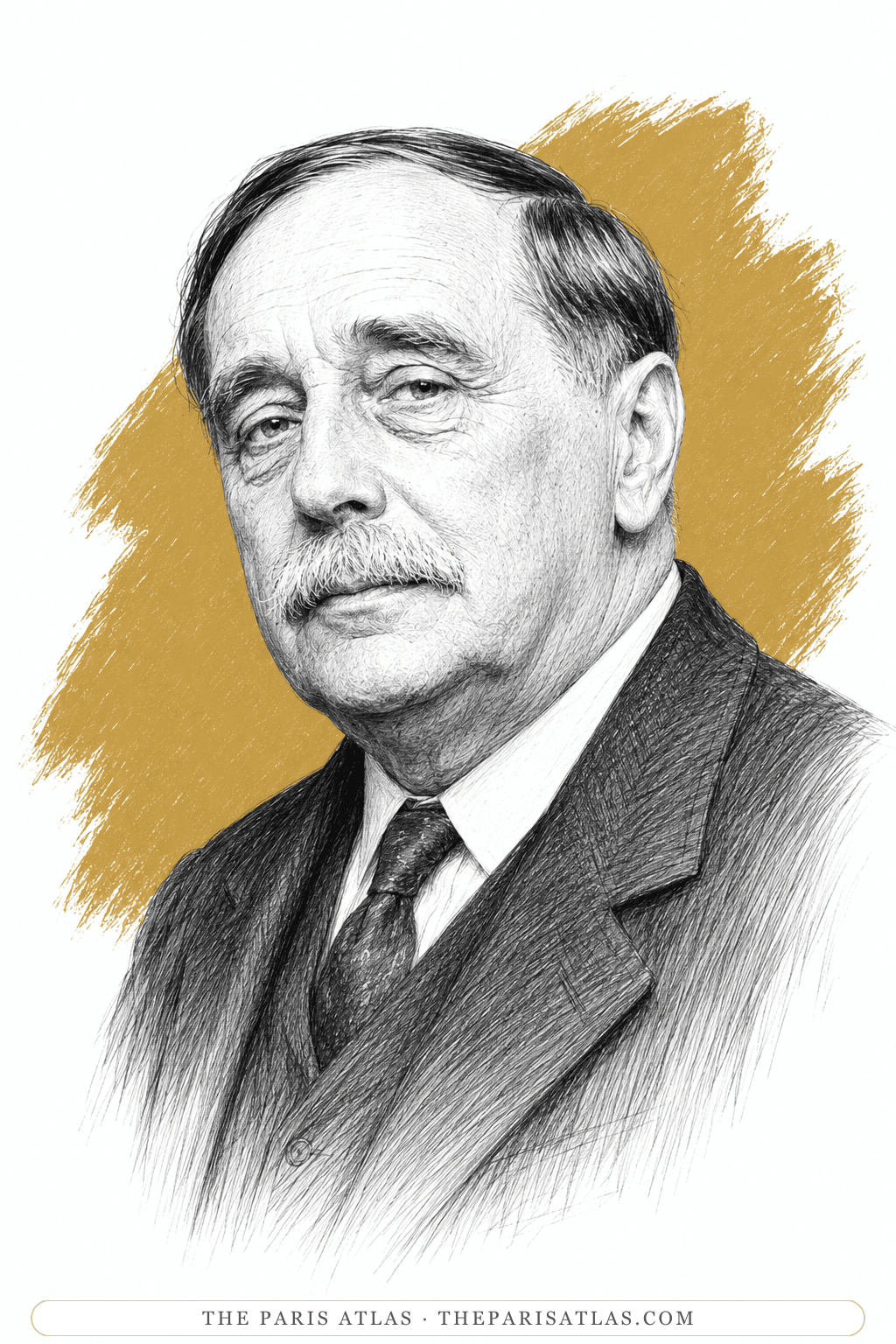
H. G. Wells
The subject of a short 1941 essay that opens by quoting Wells's own predictions that the German army was largely a phantom, and then argues that the writer who taught a generation to expect the future cannot see this one.
The World State, in Orwell's account, preached almost without interruption for forty years and now with federal control of air power added. What Orwell says Wells cannot supply is the answer to how anyone is to get it, since not one of the five great military powers would submit to it.
The book

At a glance
- The subject of "Wells, Hitler and the World State", the third essay
- 1941
- Guide to the New World, a collection of Wells's newspaper articles
- Horizon
- 83–88
Who they are in the book
Spoiler-free"Wells, Hitler and the World State" opens with three quotations and no attribution. German air power largely spent, its first-rate men dead or worn out. Behind Hitler nothing but a waiting phantom that does not exist to the extent claimed. George Orwell then names the source: newspaper articles by H. G. Wells written at the beginning of 1941 and reprinted as Guide to the New World. Since they were written, he notes, the German army had overrun the Balkans, reconquered Cyrenaica and invaded Russia.
The essay is not a gloat. Orwell's account of Wells's failure is a description of a habit of mind that had once been right. Wells belongs to the non-military middle class; the thunder of guns leaves him cold, and his early books carry a running propaganda against horses. For forty years his work has turned on one antithesis: science, order, progress, aeroplanes, steel and concrete on one side, and war, nationalism, religion, monarchy, peasants, poets and horses on the other, with history as a series of victories won by the scientific man over the romantic one. Hitler, in that scheme, has to be an absurdity and a ghost from the past.
What breaks the scheme, Orwell argues, is that science and common sense are not the same thing. Modern Germany is far more scientific than England and far more barbarous; the order, the planning, the state encouragement of science, the steel and the concrete are all there, in the service of ideas appropriate to the Stone Age. Then comes the part that reads like an apology. Orwell asks whether it is not a sort of parricide for a man of thirty-eight to find fault with Wells, and answers that thinking people born about 1900 are in some sense Wells's own creation, and that discovering him as a boy in the nineteen-hundreds was a wonderful experience. The one-sidedness that made him seem an inspired prophet is what makes him inadequate now.
How H. G. Wells Is Portrayed
- The quotationsOrwell opens with three passages predicting that the German army is a bogey with inadequate guns and wilting discipline, and only then reveals that they are Wells's, from Guide to the New World, written at the beginning of 1941.
- The standing antithesisScience, order, progress, internationalism, aeroplanes, steel, concrete and hygiene against war, nationalism, religion, monarchy, peasants, Greek professors, poets and horses. Orwell finds it in nearly every book Wells has written in forty years, in novels, Utopias, essays, films and pamphlets alike.
- The horsesOrwell's example of the temperament underneath the argument. Wells has an invincible hatred of the fighting, hunting, swashbuckling side of life, symbolised in the early books by a violent propaganda against horses; the principal villain of the Outline of History is Napoleon.
- Wells against ChurchillOrwell revives a controversy from the time of the Russian Revolution in which Wells accused Churchill of merely fearing an era of common sense in which flag-wavers would have no place. Orwell's verdict is that Churchill's estimate of the Bolsheviks was nearer the mark.
- What a boy found in himThe essay's most generous page. In a world of pedants, clergymen and golfers, with employers telling you to get on or get out, here was a man who could tell you about the inhabitants of the planets and knew the future would not be what respectable people imagined.
- The verdictThat the same singleness of mind is now the disqualification. Orwell suggests Kipling as the corrective, since Kipling was not deaf to the evil voices of power, and closes on the line that Wells is too sane to understand the modern world.
If you like Critical Essays


If you like George Orwell
Explore authors with a similar voice, perspective, and influence.

Henry Miller
The Brooklyn dropout who arrived in Paris broke at thirty-eight and wrote the exuberant, banned books that ended American censorship.
View author
Louis-Ferdinand Céline
The doctor of the Paris slums who wrote the century's blackest, funniest novel — and changed the sound of French prose.
View author
Simone de Beauvoir
French writer and philosopher whose novels, memoirs, and social analysis examined freedom, gender, responsibility, aging, and the material conditions that shape a life.
View author