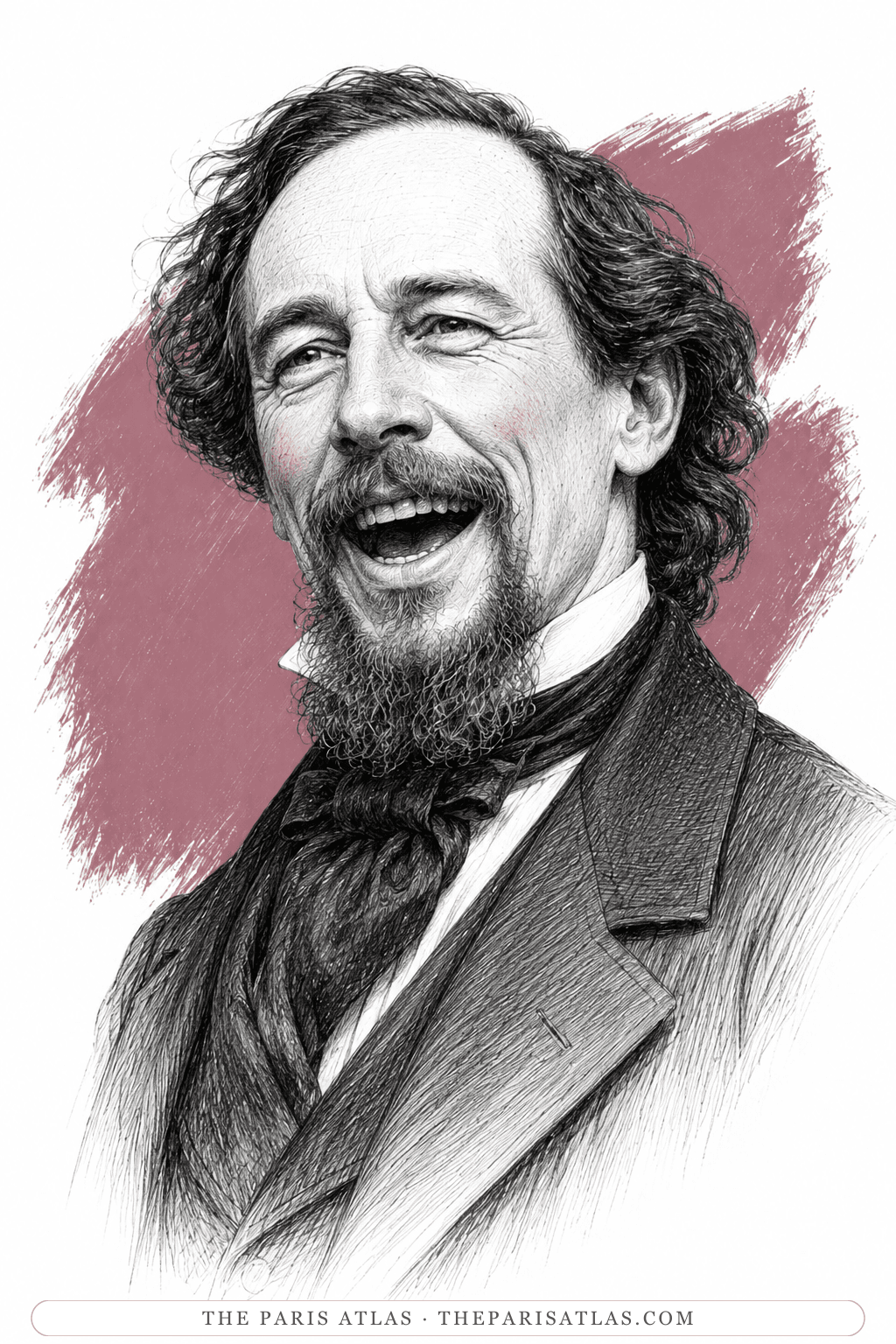
Charles Dickens
The subject of the book's longest essay, fifty pages of it, dated 1939. Orwell's question is not whether Dickens is good but where he stood: everyone from Chesterton to the Marxists had claimed him, and Orwell wants to know how a writer can attack every English institution and be adopted by all of them.
In Orwell's reading, what Dickens wants is decency from the people in charge rather than a different arrangement of society. He attacks the law, Parliament and the schools without ever saying what should replace them, and his remedy in book after book is a rich man who behaves well.
The book

At a glance
- The subject of "Charles Dickens", the opening essay and by far the longest
- 1939
- Orwell's collection Inside the Whale, 1940; reprinted here unchanged apart from footnotes
- 7–56
- That Dickens belongs to any one side: Chesterton's, the Marxists', or the institutions he attacked
- A moral critic rather than a political one, whose native generosity of mind is the secret of his popularity
Who they are in the book
Spoiler-free"Charles Dickens" opens with the sentence that gives the essay its problem: Dickens is one of those writers who are well worth stealing. George Orwell lists the thefts. G. K. Chesterton had credited him with his own medievalism; the Marxist writer T. A. Jackson had made spirited efforts to turn him into a bloodthirsty revolutionary; the Marxist claims him as almost a Marxist and the Catholic as almost a Catholic. Against all of them Orwell sets Lenin, who according to Krupskaya walked out in the middle of a dramatised Cricket on the Hearth, finding the middle-class sentimentality intolerable, and judges that the likelier verdict of the three.
The method is to say what Dickens was not. He was not a proletarian writer: his real subject is the London commercial bourgeoisie and its hangers-on, he has one industrial worker in the whole body of work, and the three working-class characters an ordinary reader can name are a burglar, a valet and a drunken midwife. He was not a revolutionary either, though he was certainly subversive. Nowhere does he attack private property or suggest the economic system is wrong as a system. His criticism, Orwell concludes, is almost exclusively moral, and the message, put baldly, is an enormous platitude: if men would behave decently the world would be decent.
From that follows the figure Orwell calls the Good Rich Man: Pickwick, the Cheerybles, old Chuzzlewit, Scrooge, all handing out guineas and trotting about raising wages. Orwell tracks the character's decline through the middle books, where he shrinks from a merchant to a rentier who can no longer put everything right, and then his full return as Boffin in Our Mutual Friend. Dickens's thoughts, he says, seem to have come full circle.
The second half is about the writing rather than the politics, and it is more admiring than the first half prepares you for. Dickens is a writer whose parts are greater than his wholes: all fragments, all details, rotten architecture but wonderful gargoyles. The detail is what breaks the novels and what saves them. Orwell ends by describing the face he sees behind the page, which he says is not quite the face in the photographs: a man of about forty with a small beard and a high colour, laughing with a touch of anger in it, generously angry, hated with equal hatred by all the smelly little orthodoxies contending for our souls.
How Charles Dickens Is Portrayed
- Well worth stealingThe opening claim, and the essay's whole occasion: Chesterton claimed Dickens for medievalism, T. A. Jackson for revolution, the Marxist and the Catholic each for being "almost" one of them. Orwell notes that even the burial in Westminster Abbey was a species of theft.
- Not a proletarian writerHis subject is the London commercial bourgeoisie: lawyers, clerks, tradesmen, innkeepers, servants. There is no agricultural worker anywhere in the books and exactly one industrial worker. The proletarian characters readers remember are a burglar, a valet and a drunken midwife.
- Moral, not structuralOrwell can find no passage anywhere suggesting the economic system is wrong as a system, and no attack on private property. He notes that Macaulay is said to have refused to review Hard Times for its sullen Socialism, and that there is not a Socialist line in it.
- The Good Rich ManPickwick, the Cheerybles, old Chuzzlewit, Scrooge. The superhumanly kind old gentleman who trots about raising wages and getting debtors out of jail. Orwell observes that anyone that anxious to give money away would never have made it, and traces the figure's demotion to a rentier and then its full return as Boffin.
- The blacking factoryDavid Copperfield washing bottles at Murdstone & Grinby's is Dickens at ten, in Warren's blacking factory in the Strand, a memory so bitter he hid it from his wife for years. Orwell's point is what the passage does not say: that no child should be put there, only that this child should not have been.
- Horror of the mobBarnaby Rudge, whose ringleaders Dickens first intended to make three escaped lunatics, and the revolutionary chapters of A Tale of Two Cities. Orwell reads the riot scenes as evidence of how deeply Dickens had brooded on the subject, since he had never seen anything like them.
- Rotten architecture, wonderful gargoylesThe verdict on the craft. The unnecessary detail wrecks the plots and makes the books. Murdstone's four thousand double-Gloucester cheeses is too human a touch for Murdstone, and Orwell says the unity suffers every time the note is struck, and that it does not much matter.
- The face behind the pageThe essay's last paragraph, and one of Orwell's best-known: not the face of the photographs but the face the writer ought to have. A man of about forty, laughing with a touch of anger and no malignity, always fighting something and not frightened. Generously angry.
If you like Critical Essays


If you like George Orwell
Explore authors with a similar voice, perspective, and influence.

Henry Miller
The Brooklyn dropout who arrived in Paris broke at thirty-eight and wrote the exuberant, banned books that ended American censorship.
View author
Louis-Ferdinand Céline
The doctor of the Paris slums who wrote the century's blackest, funniest novel — and changed the sound of French prose.
View author
Simone de Beauvoir
French writer and philosopher whose novels, memoirs, and social analysis examined freedom, gender, responsibility, aging, and the material conditions that shape a life.
View author