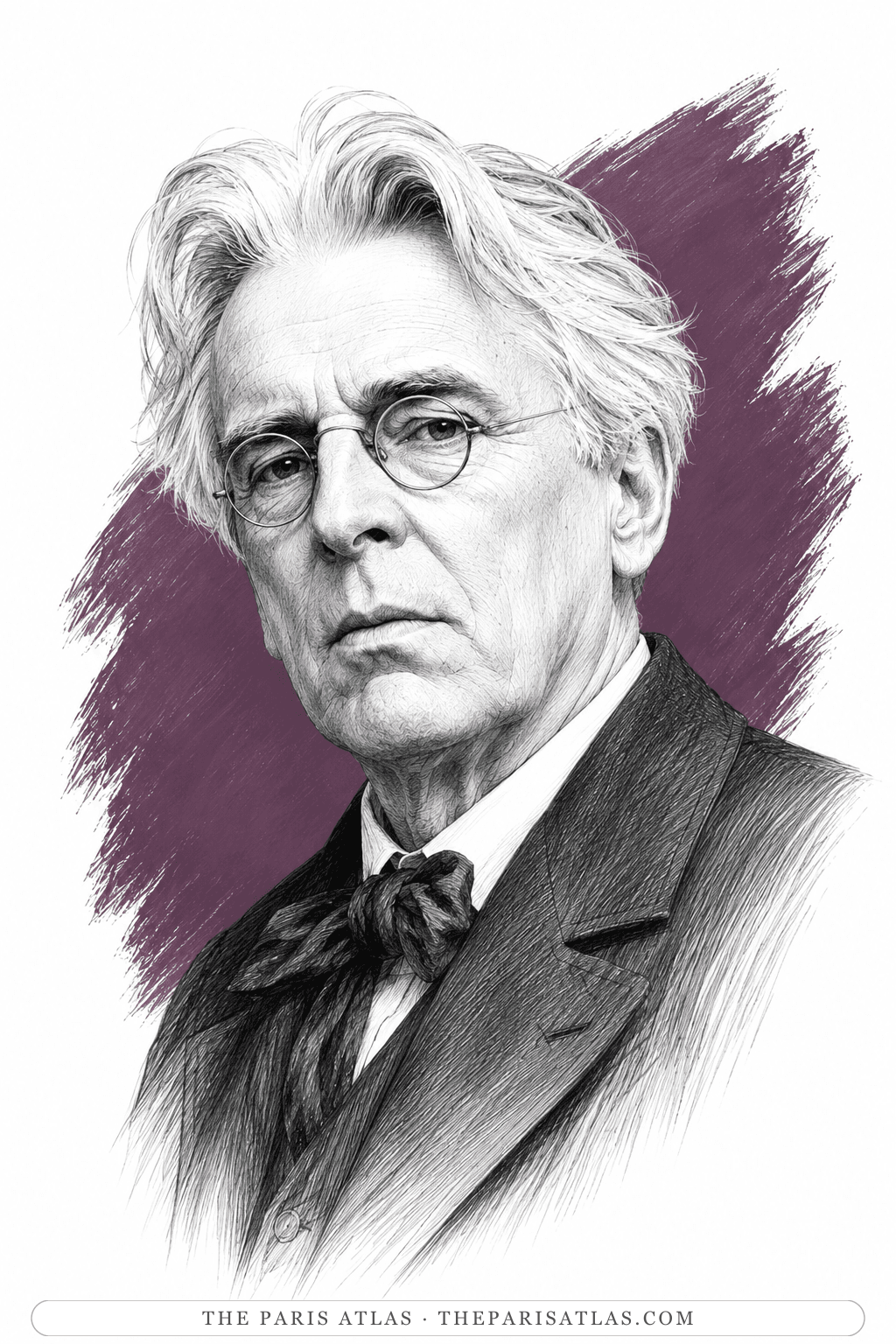
W. B. Yeats
The subject of the book's shortest author essay, written as a review of a study by V. K. Narayana Menon. Orwell follows the Great Wheels and the phases of the moon straight into the politics, and says the connection is not an eccentricity to be laughed away.
In Orwell's reading Yeats wants the modern world undone: a return to the Bronze Age or the Middle Ages, an aristocratic order, an end to the idea of human equality. Orwell adds that the yearning was sincere even if some of it came from Yeats's position as an impoverished offshoot of the aristocracy.
The book

At a glance
- The subject of "W. B. Yeats", the sixth essay and the shortest
- 1943
- The Development of William Butler Yeats by V. K. Narayana Menon (Oliver & Boyd)
- Horizon
- 114–119
Who they are in the book
Spoiler-free"W. B. Yeats" is a review of The Development of William Butler Yeats by V. K. Narayana Menon, published by Oliver & Boyd, and George Orwell uses it to press a question Marxist criticism had not answered: why a book's subject matter can be explained in sociological terms and its texture cannot. In Yeats's case he thinks there must be a connection between the wayward, tortured style and what he calls a rather sinister vision of life, and he goes looking for it.
On the style he is blunt and then generous. The artificiality gets accepted as Irishism, but one seldom finds six consecutive lines without an archaism or an affected turn of speech, and a single unnecessary word will import a feeling of affectation into an otherwise good poem. Yet Yeats gets away with it, and the straining after effect produces phrases like the chill, footless years and the mackerel-crowded seas, which Orwell says overwhelm a reader like a girl's face seen across a room.
The politics is where the essay lands. Menon's book brings Orwell to the passage in which Yeats describes the civilisation he hopes for: hierarchical in every detail, great wealth everywhere in a few men's hands, inequality made law. Orwell's reading is that the merely political Fascist always claims to be fighting for justice, and that Yeats, being a poet, sees at a glance that it means injustice and welcomes it for that reason. What Yeats does not see is that the new order will not be run by noblemen with Van Dyck faces. Orwell then offers two guesses at why hatred of democracy and a taste for crystal-gazing travel together: a cyclical universe makes progress impossible, and occultism assumes that knowledge belongs to a small circle of initiates.
How W. B. Yeats Is Portrayed
- The occasionA review of The Development of William Butler Yeats by V. K. Narayana Menon (Oliver & Boyd, eight and sixpence). Orwell calls it a very short book and asks Menon to write a second one beginning where it stops.
- The styleQuaintness, archaism, an affected turn of speech every few lines, all of it usually excused as Irishism. Orwell notes that Yeats is an exception to the rule that poets do not use poetical language, and that a squashy vulgar word like "loveliness" does not spoil a wonderful passage.
- The systemGreat Wheels, gyres, cycles of the moon, reincarnation, disembodied spirits, astrology. Orwell will not laugh at the mystical beliefs, on the grounds that some degree of belief in magic is close to universal, and will not write them off as unimportant eccentricities either.
- The politicsOrwell quotes Yeats on the aristocratic civilisation he hopes for, with great wealth in a few men's hands and an inequality made law, and says the innocence of the statement is as interesting as its snobbishness: it names in one phrase the thing Fascist propaganda exists to cover up.
- Two guesses at the linkFirst, a universe moving on a wheel makes progress impossible and puts the lower orders back in their place. Second, occultism assumes knowledge is secret and belongs to initiates, which suits anyone who dreads universal suffrage and popular education.
- Praise of ignoranceOrwell reads the Fool in The Hour-Glass as a Chestertonian figure, the natural-born innocent wiser than the wise man, and objects that if a village idiot is genuinely wiser than a philosopher it would have been better if the alphabet had never been invented.
- What the essay asks forThat the relationship between Fascism and the literary intelligentsia be investigated properly, with Yeats as a starting point, by someone who can approach a poet as a poet and still take his beliefs seriously.
If you like Critical Essays


If you like George Orwell
Explore authors with a similar voice, perspective, and influence.

Henry Miller
The Brooklyn dropout who arrived in Paris broke at thirty-eight and wrote the exuberant, banned books that ended American censorship.
View author
Louis-Ferdinand Céline
The doctor of the Paris slums who wrote the century's blackest, funniest novel — and changed the sound of French prose.
View author
Simone de Beauvoir
French writer and philosopher whose novels, memoirs, and social analysis examined freedom, gender, responsibility, aging, and the material conditions that shape a life.
View author