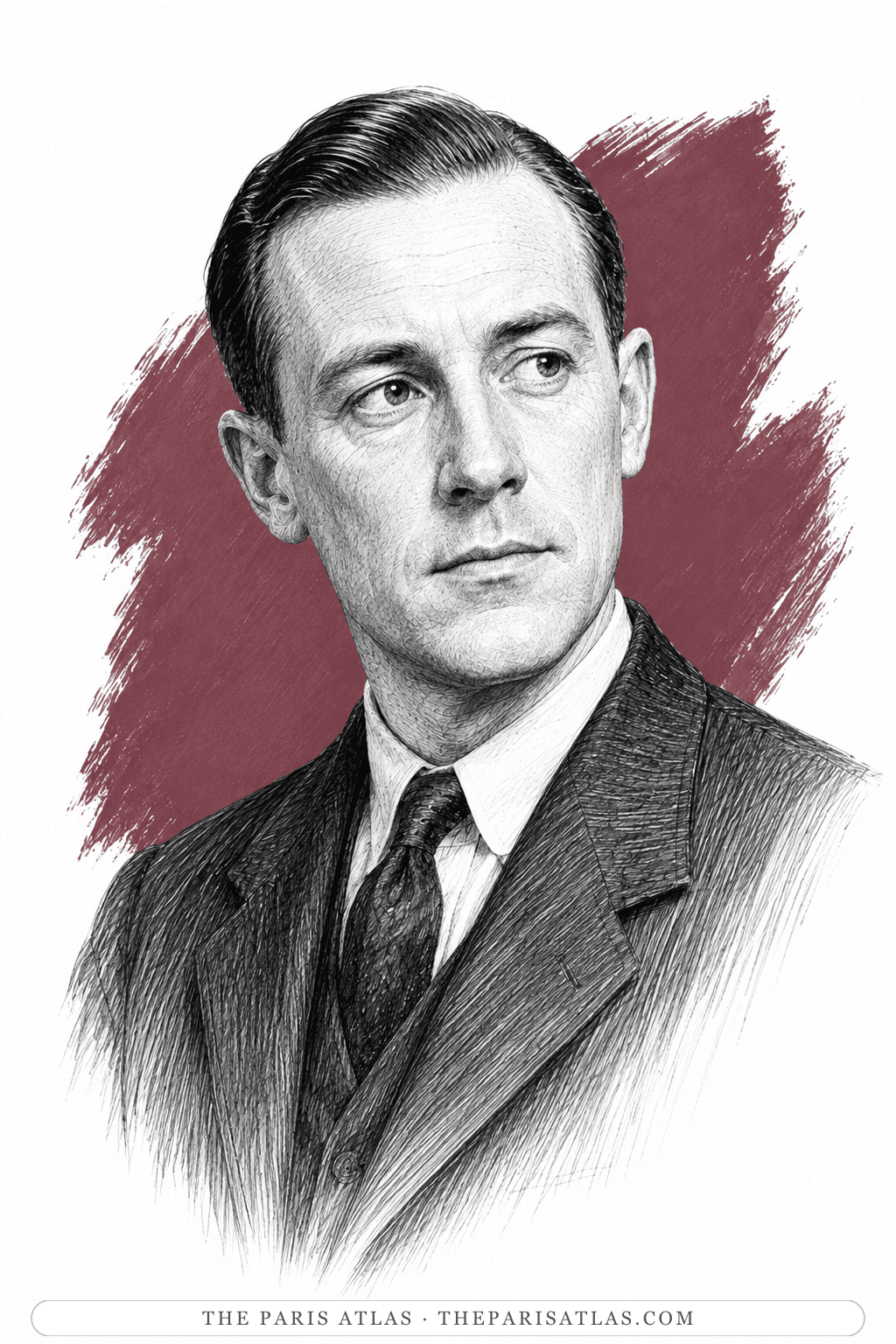
James Hadley Chase
The English author of No Orchids for Miss Blandish (1939), the gangster novel Orwell sets against the Raffles stories in "Raffles and Miss Blandish". Orwell calls the writing brilliant and the book's success a bad sign.
Orwell reads the whole book as driven by one thing. Ultimately only one motive is at work throughout the story: the pursuit of power. Affection, friendship, good nature and ordinary politeness do not enter it, and neither, to any great extent, does normal sexuality.
The book

At a glance
- The modern half of "Raffles and Miss Blandish", the ninth essay
- 1944
- No Orchids for Miss Blandish (1939); Orwell also discusses He Won't Need It Now
- Horizon, and the New York monthly Politics
- 142–155
Who they are in the book
Spoiler-freeJames Hadley Chase published No Orchids for Miss Blandish in 1939, and it had its greatest vogue in 1940, during the Battle of Britain and the blitz. George Orwell uses it as the modern half of a comparison, with E. W. Hornung's Raffles stories of around 1900 as the other, and his interest is in the distance between them.
He summarises the plot without softening it. Miss Blandish, a millionaire's daughter, is kidnapped; a better-organised gang takes her from the first one and extracts half a million dollars from her father. A young gangster named Slim, whose pleasure is driving knives into people and who graduated by cutting up living animals with rusty scissors, is impotent, and his mother, who is the real brains of the gang, keeps Miss Blandish in custody until he has managed to rape her, which after much persuasion and a flogging with rubber hose he does. A private detective and the police destroy the gang by bribery and torture; Slim is killed after a final rape; and Miss Blandish throws herself from a skyscraper window rather than be returned to her family.
Orwell's judgements are separated carefully. The book is not the work of an illiterate hack but a brilliant piece of writing, with hardly a wasted word, written entirely in the American language by an Englishman who Orwell believes had never been to the United States. It is not pornography either: the emphasis falls on cruelty rather than pleasure, and the real high spots are cruelties done by men to other men. What it is, he says, is a daydream appropriate to a totalitarian age, in which torture, secret prisons, execution without trial and falsified records are normal and morally neutral, and the only operating principle is that might is right. The detective is nearly as much a rogue as the gangsters, and if a reader sides with the police it is only because the law is the bigger racket.
How James Hadley Chase Is Portrayed
- The bookNo Orchids for Miss Blandish, published 1939, most popular in 1940, still running as a play afterwards. Half a million copies sold, according to its publishers. Many readers assumed it was an American book reissued in England.
- What is in itOrwell counts: eight full-dress murders, an unassessable number of casual killings, an exhumation with a reminder of the stench, the flogging of Miss Blandish, a woman tortured with cigarette ends, and a third-degree scene he calls of unheard-of cruelty.
- Not pornographyAn explicit distinction. Unlike most books dealing in sexual sadism it lays the emphasis on the cruelty rather than the pleasure, and the scenes of cruelty to women are comparatively perfunctory. The set pieces are men destroying other men.
- Written in AmericanNarration as well as dialogue, by an Englishman who, Orwell believes, had never set foot in the United States, in what he calls a complete mental transference to the American underworld. Chase can count on hundreds of thousands of English readers who need no glossary for it.
- The borrowingThe central story closely resembles William Faulkner's Sanctuary, but Orwell says Chase took only the plot and that the mental atmospheres are unalike. He has been called Faulkner for the masses; Orwell suggests Carlyle for the masses is more accurate.
- The doctrineWhat Orwell means by "realism": the belief that might is right. He traces it through Edgar Wallace's bully-worship of Scotland Yard and out into politics, and argues that the cult of power tends to get mixed up with a love of cruelty for its own sake.
- How it was withdrawnNot by public protest. There was none. The book was taken out of circulation only retrospectively, after a later work brought Chase's books to the attention of the authorities.
If you like Critical Essays


If you like George Orwell
Explore authors with a similar voice, perspective, and influence.
Henry Miller
The Brooklyn dropout who arrived in Paris broke at thirty-eight and wrote the exuberant, banned books that ended American censorship.
View author
Louis-Ferdinand Céline
The doctor of the Paris slums who wrote the century's blackest, funniest novel — and changed the sound of French prose.
View author
Simone de Beauvoir
French writer and philosopher whose novels, memoirs, and social analysis examined freedom, gender, responsibility, aging, and the material conditions that shape a life.
View author