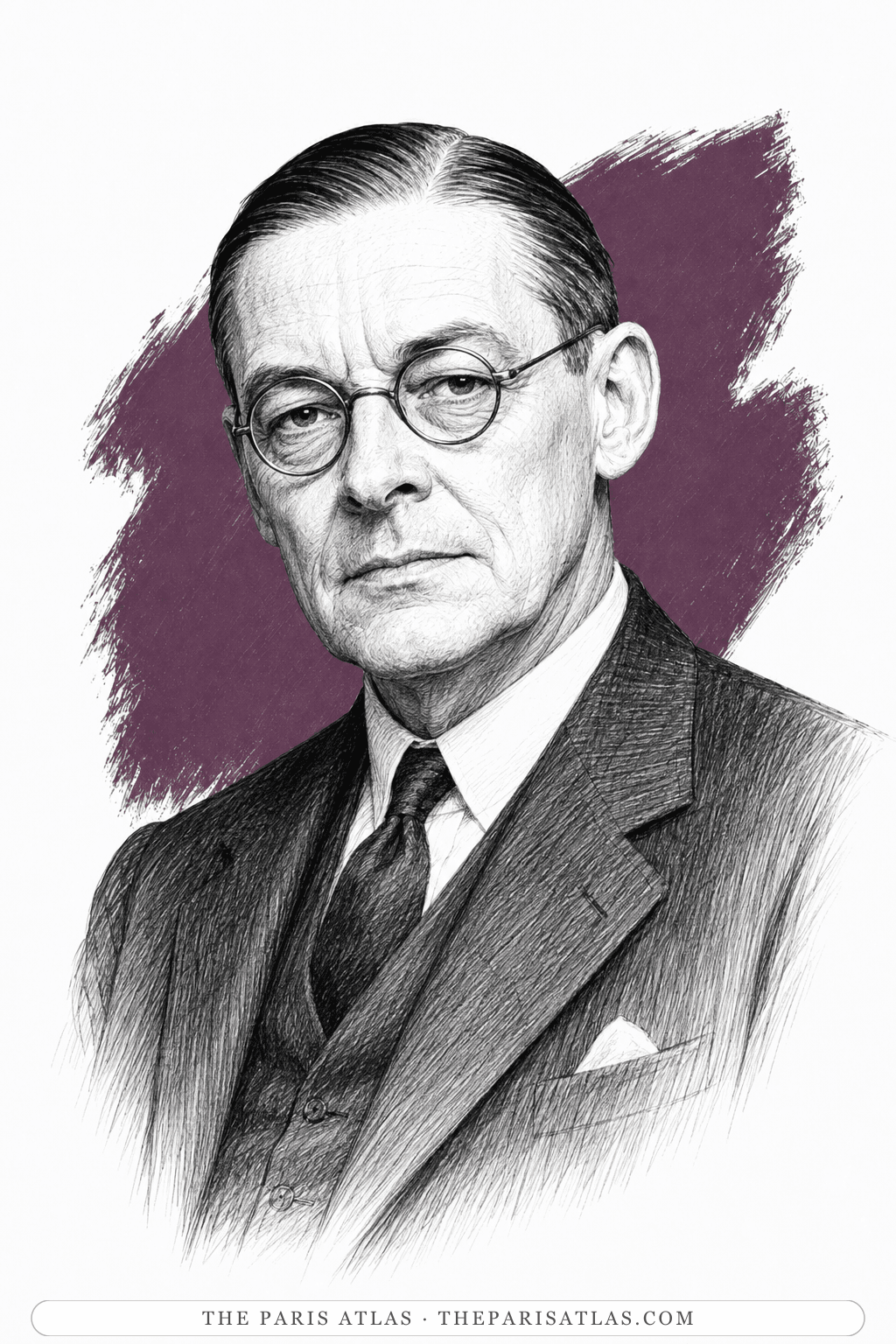
T. S. Eliot
The poet and Faber editor whose selection A Choice of Kipling's Verse prompted the Kipling essay. Orwell's complaint is that Eliot is too much on the defensive to say plainly whether any of it is good, and that his formula, of great verse some of which cannot be told from poetry, would have been more useful if he had named the poems he meant.
In Orwell's account Eliot wants to rescue Kipling's reputation without conceding anything to the people who despise him, and pays for it by defending positions that cannot be held. What Orwell says is missing is the plain sentence about whether the verse is any good.
The book

At a glance
- Argued with throughout "Rudyard Kipling", the fifth essay, and named in three others
- A Choice of Kipling's Verse, made by T. S. Eliot (Faber & Faber, 8s. 6d.)
- That he is too much on the defensive to say plainly whether any of it is good
- Great verse, some of which cannot be told apart from poetry
- The good bad poem, offered rather than juggling with the words verse and poetry
- Director of Faber and Faber, which had turned down Down and Out in Paris and London in 1932 and Animal Farm in 1944
- 100, 104, 110 and 112 in the Kipling essay; also 116, 118, 124 and 130
Who they are in the book
Spoiler-freeT. S. Eliot is never the subject of an essay in this book, and he is the first person named in one. "Rudyard Kipling" is a review of A Choice of Kipling's Verse, which Eliot selected and prefaced for Faber & Faber, and George Orwell's opening sentence is that it was a pity Mr. Eliot should be so much on the defensive in the long essay with which he prefaces it. Every later mention of Eliot in that essay is a disagreement with the preface.
The disagreement is about honesty rather than about Kipling. Orwell's charge is that Eliot, in answering the shallow and familiar accusation that Kipling was a Fascist, falls into the opposite error of defending him where he is not defensible, and that whenever an aesthetic judgment is called for he is too much on the defensive to speak plainly. Orwell's own method is to make the case against Kipling first, in the opening paragraph, and then argue from underneath it.
Eliot's name appears in three of the other essays as well, always as a fixed point rather than a target: quoted on Yeats, listed among the modern writers the philistines have turned on, and named among the foreigners who dominated English literature in the first half of the century. He was also, when this book appeared, a director of the firm that had turned Orwell down twice.
How T. S. Eliot Is Portrayed
- The first sentence is about himThe Kipling essay opens on Eliot, not on Kipling: it was a pity Mr. Eliot should be so much on the defensive in the long essay prefacing the selection. Orwell immediately allows that it could not be avoided, because a legend put about by two sets of people who have not read Kipling has to be cleared away before anyone can discuss him at all.
- The book he madeGiven in a footnote on the first page: A Choice of Kipling's Verse, made by T. S. Eliot, published by Faber & Faber at eight shillings and sixpence.
- Defending him where he is not defensibleOrwell's central complaint. Eliot never satisfactorily explains why Kipling survives while the enlightened people who despised him are forgotten, because in answering the charge that Kipling was a Fascist he defends him on ground that cannot be held. Orwell's alternative is to grant the charge sheet in full first.
- Unpopular views in a popular styleEliot's formula for what is held against Kipling, quoted and then dismantled. Orwell answers that it narrows the issue by assuming unpopular means unpopular with the intelligentsia, when in fact the mass of the people were anti-militarist, bored by the Empire, and never accepted Kipling's message either.
- Verse, poetry, and the poems he would not nameEliot calls Kipling's metrical work verse rather than poetry, then calls it great verse, then defines a great verse-writer as one who has produced work of which we cannot say whether it is verse or poetry. Orwell's response is that Kipling was then a versifier who occasionally wrote poems, and it was a pity Eliot did not say which ones.
- Editing him is the confessionOrwell's one concession to Eliot. Kipling's poems had travelled out past the reading public and into the music halls, and Eliot nonetheless thought it worth while to edit him, confessing to a taste which others share but are not always honest enough to mention. Orwell then admits the same taste in himself.
- Named in three of the other essaysV. K. Narayana Menon's study of Yeats, reviewed here, repeats Eliot's claim that Yeats had the longest period of development of any poet who ever lived, and notes that Pound and perhaps Eliot approved the stand Yeats finally took. The Dalí essay lists Eliot with Joyce, Proust and Lawrence among the writers the renewed highbrow-baiting has come for. The Koestler essay opens by naming him among the foreigners who dominated English literature in the century so far.
If you like Critical Essays


If you like George Orwell
Explore authors with a similar voice, perspective, and influence.

Henry Miller
The Brooklyn dropout who arrived in Paris broke at thirty-eight and wrote the exuberant, banned books that ended American censorship.
View author
Louis-Ferdinand Céline
The doctor of the Paris slums who wrote the century's blackest, funniest novel — and changed the sound of French prose.
View author
Simone de Beauvoir
French writer and philosopher whose novels, memoirs, and social analysis examined freedom, gender, responsibility, aging, and the material conditions that shape a life.
View author