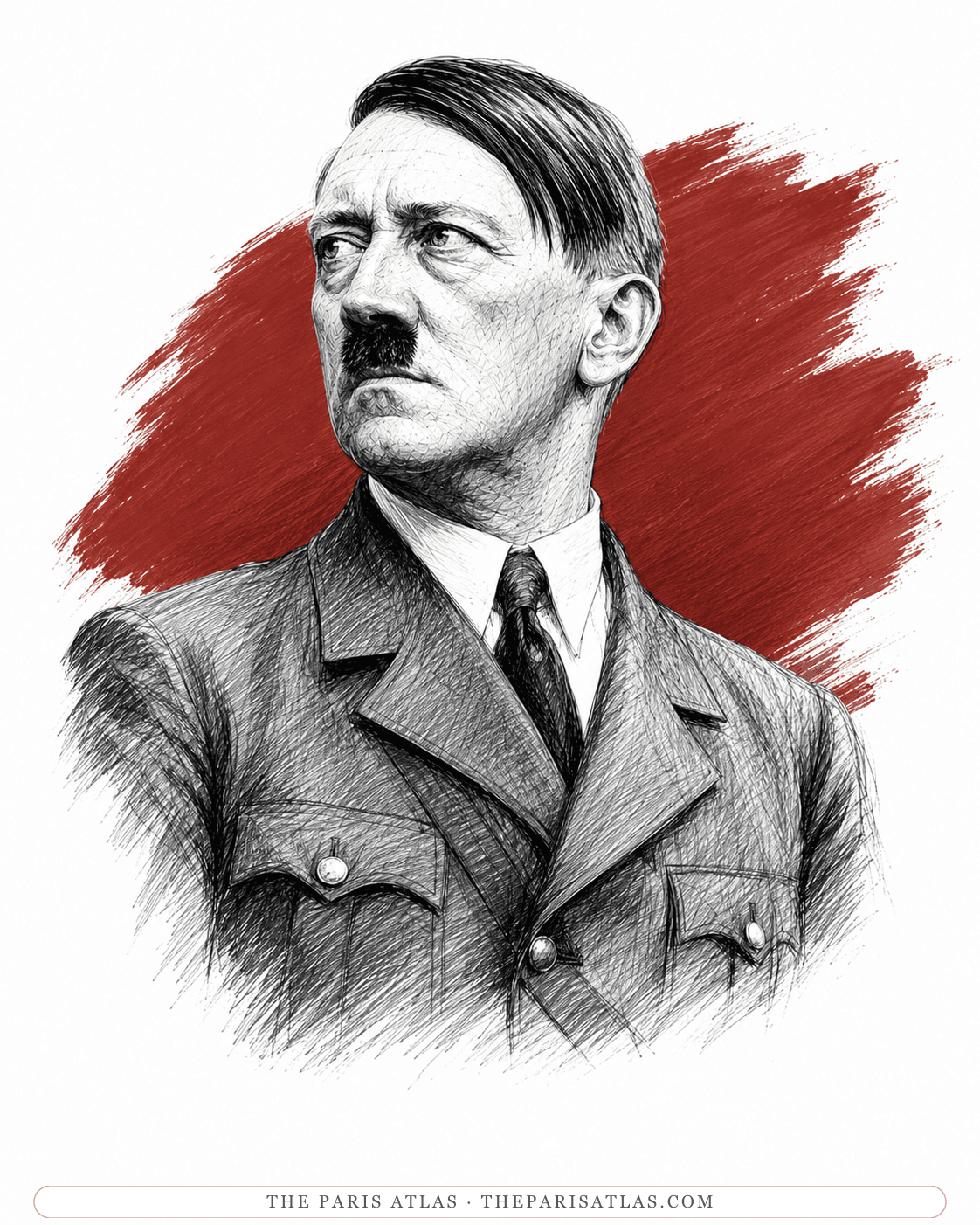
Adolf Hitler
The subject of the argument inside "Wells, Hitler and the World State", in which George Orwell attacks H. G. Wells for underestimating him. Orwell's charge is that English intellectuals had spent ten years insisting he was a figure out of comic opera, and that Wells still thought the German army a phantom in 1941.
The book

At a glance
- The subject of the argument in "Wells, Hitler and the World State", the third essay
- 1941
- Guide to the New World, H. G. Wells's newspaper articles of early 1941
- Horizon
- 83–88
- A waiting phantom that does not exist to the extent claimed
- A criminal lunatic with an army of millions of men
- "Charles Dickens", "Boys' Weeklies", "The Art of Donald McGill", "Rudyard Kipling", "Arthur Koestler" and "Raffles and Miss Blandish", briefly in each
Who they are in the book
Spoiler-freeAdolf Hitler led the Nazi Party and, from 1933, Germany. No essay in this collection is about him. One of them is an argument about how badly he had been read. "Wells, Hitler and the World State", dated 1941, is George Orwell's review of Guide to the New World, a set of newspaper articles by the English novelist H. G. Wells. Orwell opens with three quotations and no attribution: German air power largely spent and its first-rate men mostly dead or worn out, and behind "that screaming little defective in Berlin" nothing but a waiting phantom that does not exist to the extent claimed. Then he names the source and lists what had happened since the articles were written. The German army had overrun the Balkans, reconquered Cyrenaica, could march through Turkey or Spain when it suited, and had undertaken the invasion of Russia.
Orwell's own description is one sentence, and he offers it as the fact Wells's argument has to get past. Hitler is a criminal lunatic, he writes, and Hitler has an army of millions of men, aeroplanes in thousands, tanks in tens of thousands. For his sake a great nation had been willing to overwork itself for six years and then fight for two more, while for the commonsense world-view Wells was recommending hardly a human creature would shed a pint of blood. Before anyone can talk about world reconstruction, or even about peace, Orwell says, Hitler has to be eliminated. He extends the charge past Wells to the English intelligentsia generally: for ten years they had kept it up that Hitler was a figure out of comic opera, and only in the English-speaking countries was it fashionable to believe, right up to the outbreak of war, that he was an unimportant lunatic and the German tanks made of cardboard.
The diagnosis of Wells is that a lifelong habit of thought stands between him and an understanding of Hitler's power. For forty years Wells had written the same antithesis, with science, order, progress and internationalism on one side and war, nationalism, religion, monarchy, peasants, poets and horses on the other, and history a series of victories won by the scientific man over the romantic one. In that scheme Hitler is all the war-lords and witch doctors of history rolled into one, and therefore an absurdity, a ghost from the past, a creature doomed to disappear almost immediately. What breaks the scheme, Orwell argues, is that science and common sense are not the same thing. Modern Germany is far more scientific than England and far more barbarous, and much of what Wells had imagined and worked for is physically there in it: the order, the planning, the state encouragement of science, the steel, the concrete, the aeroplanes, all of it serving ideas Orwell calls appropriate to the Stone Age. He ends by proposing Rudyard Kipling as the corrective, on the grounds that Kipling was not deaf to the evil voices of power and would have understood the appeal of Hitler, and of Stalin too.
Elsewhere in the collection Hitler appears briefly, and almost always as a date. "Charles Dickens" notes that the "Jew joke" was endemic in English literature until the rise of Hitler and does not appear in Dickens. "The Art of Donald McGill" records that the anti-Jewish postcard disappeared abruptly soon after Hitler came to power, and describes one card, not McGill's, showing Hitler bending down to pick a flower under the caption "What would you do, chums?". "Boys' Weeklies" quotes a set of comic lyrics printed in the Gem in April 1939, ending with a note to Adolf Hitler that reads "Don't disturb!", which Orwell says is probably that paper's earliest mention of him.
How Adolf Hitler Is Portrayed
- What Wells had writtenThe three quotations Orwell prints unattributed at the head of the essay: the German air power largely spent, its first-rate men mostly dead or disheartened or worn out, and behind "that screaming little defective in Berlin" a waiting phantom that does not exist to the extent claimed. They come from H. G. Wells's Guide to the New World, written at the beginning of 1941.
- What had happened sinceOrwell's reply, in one sentence. The German army had overrun the Balkans, reconquered Cyrenaica, could march through Turkey or Spain at such time as suited it, and had undertaken the invasion of Russia. He adds that the German general staff would not have begun that campaign without feeling fairly certain of finishing it in three months.
- Orwell's own description"Hitler is a criminal lunatic, and Hitler has an army of millions of men, aeroplanes in thousands, tanks in tens of thousands." He sets it against the World State and the Sankey Declaration and says that before anyone can talk of world reconstruction, or even of peace, Hitler has to be eliminated.
- The figure out of comic operaThe charge Orwell lays on the English intelligentsia: for ten dreadful years they had kept it up that Hitler was not worth taking seriously, and only in the English-speaking countries was it fashionable to believe, right up to the outbreak of war, that he was an unimportant lunatic and the German tanks made of cardboard. People who called him Antichrist, Orwell writes, were nearer an understanding of the truth.
- Why Wells cannot see himIn Orwell's reading, Hitler has to be an absurdity for Wells's whole scheme to stand. Wells takes him for all the war-lords and witch doctors in history rolled into one, and therefore for a ghost from the past doomed to disappear almost immediately. Treachery and defeatism apart, Hitler cannot be a danger, because the alternative would contradict the world-view Wells's books are built on.
- Science on the side of superstitionOrwell's correction, and the sentence the essay turns on. Modern Germany is far more scientific than England and far more barbarous. The order, the planning, the state encouragement of science, the steel, the concrete and the aeroplanes are all there, in the service of ideas appropriate to the Stone Age.
- Where else he turns upAs a date, mostly. "Charles Dickens" dates the disappearance of the "Jew joke" from English literature to the rise of Hitler; "The Art of Donald McGill" dates the disappearance of the anti-Jewish postcard to soon after he came to power; "Boys' Weeklies" quotes a Gem lyric of April 1939 that Orwell calls probably the paper's first mention of him.
If you like Critical Essays


If you like George Orwell
Explore authors with a similar voice, perspective, and influence.

Henry Miller
The Brooklyn dropout who arrived in Paris broke at thirty-eight and wrote the exuberant, banned books that ended American censorship.
View author
Louis-Ferdinand Céline
The doctor of the Paris slums who wrote the century's blackest, funniest novel — and changed the sound of French prose.
View author
Simone de Beauvoir
French writer and philosopher whose novels, memoirs, and social analysis examined freedom, gender, responsibility, aging, and the material conditions that shape a life.
View author