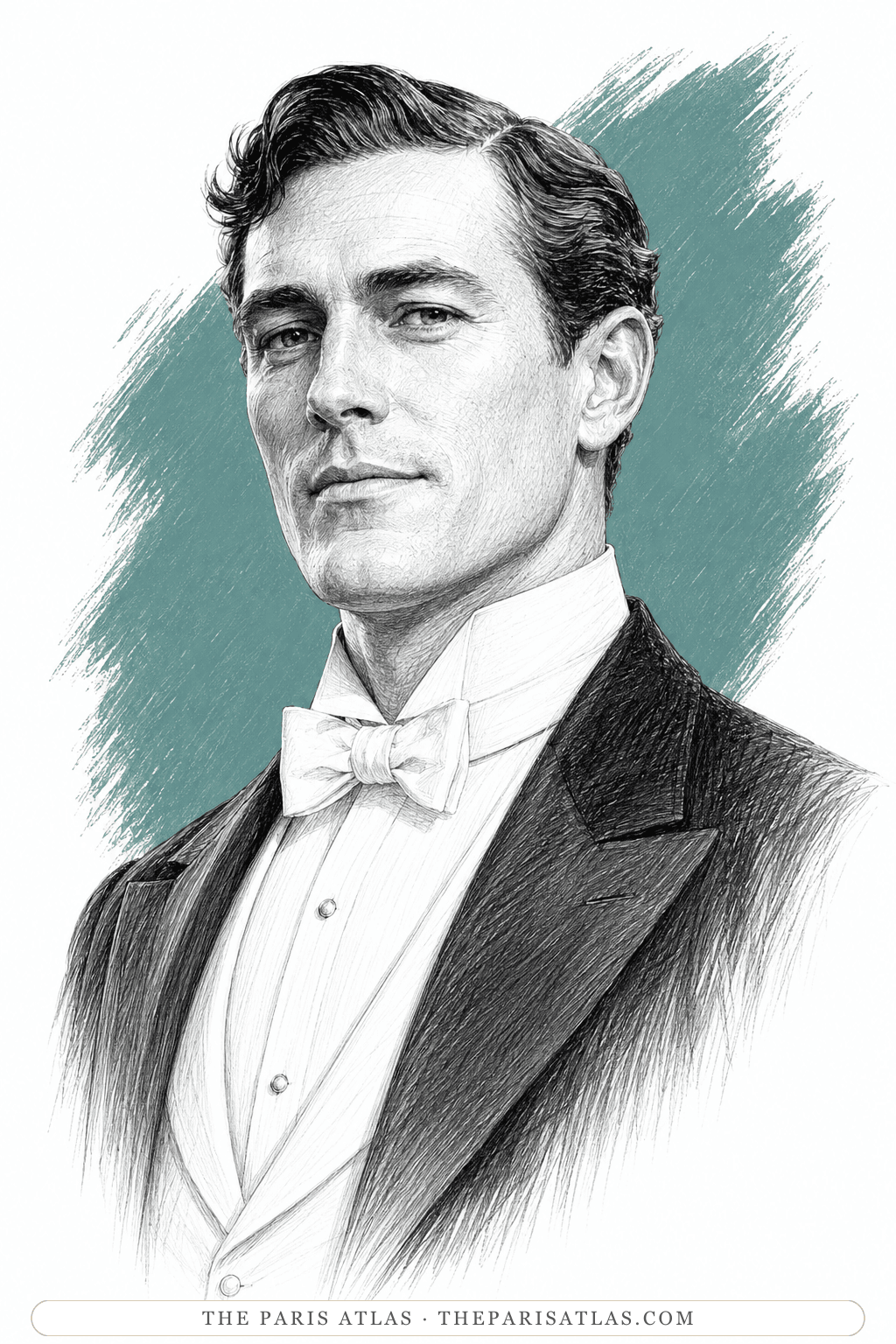
A. J. Raffles
A fictional character: the amateur cracksman invented by the novelist E. W. Hornung around 1900, and the older half of the comparison in "Raffles and Miss Blandish". Orwell uses him to show what a crime story looked like when its readers still had rules.
To get away with enough, once, to settle down inside the society he steals from. "We were in Society but not of it," he tells Bunny, and Orwell notes that both of them accept its values without question and would stay in it for good given a big enough haul.
The book

At a glance
- The 1900 half of "Raffles and Miss Blandish", the ninth essay
- Invented by the novelist E. W. Hornung
- Raffles, A Thief in the Night and Mr. Justice Raffles, the last of which Orwell calls a failure
- "Not done"
- 142–155
Who they are in the book
Spoiler-freeRaffles is a character in E. W. Hornung's crime stories, not a real person, and George Orwell notes that nearly half a century after his first appearance very few readers would need telling who he was: he played cricket for England, kept bachelor chambers in the Albany, and burgled the Mayfair houses he was also invited into as a guest.
The drama, in Orwell's reading, is entirely social. Raffles is presented not as an honest man gone astray but as a public-school man gone astray, and his remorse is almost purely social too. He has disgraced the old school, forfeited his amateur status, become a cad. Neither he nor Bunny appears to feel strongly that stealing is wrong in itself. Orwell tests the point by imagining the same story about a plumber or a greengrocer, and finds nothing dramatic left in it.
Cricket is what makes it work. It is the game in which form counts for more than success and an amateur can beat a professional, and its rules are written so that interpreting them is partly an ethical business, since bodyline bowling broke no rule and was simply not cricket. Making his burglar a cricketer, Orwell argues, gave Hornung the sharpest moral contrast he could imagine. What Raffles has instead of a moral code is a set of reflexes: tap the one marked sport, or pal, or king and country, and the reaction is predictable. Orwell's summary of the whole ethic is the phrase "not done", and his verdict is that the line it draws between good and evil is as senseless as a Polynesian taboo and has the same advantage, which is that everyone accepts it.
How A. J. Raffles Is Portrayed
- Who he isThe amateur cracksman of E. W. Hornung's stories: cricketer for England, chambers in the Albany, burglar of the Mayfair houses that invite him to dinner. A magistrate, Orwell notes, had recently called a prisoner a Raffles in real life.
- A gentleman, not a sinnerThe distinction the books keep making. His remorse is social. He has disgraced the old school and lost the right to decent society. He once justifies himself with the remark that the distribution of property is all wrong anyway, and that is the whole of the political content.
- Why cricketBecause it values form above success, allows an amateur to beat a professional, and has rules whose interpretation is an ethical matter. Orwell reads Hornung's choice as the sharpest moral contrast available to him rather than a convenient disguise.
- The rules he keepsHe will burgle a house where he is staying but only rob a fellow guest, never the host. He avoids violence, prefers to work unarmed, treats friendship as sacred, and takes extra risks for sportsmanship. He is also intensely patriotic, and posts the Queen a gold cup stolen from the British Museum for the Diamond Jubilee.
- The scale of the crimesPetty by modern standards, in Orwell's judgement. Four hundred pounds' worth of jewellery is an excellent haul, the stories carry very few corpses and hardly any blood, and there is no sadism and no sex crime anywhere in them.
- The 1945 footnoteOrwell corrects himself in a dated note: Raffles does kill one man and is more or less consciously responsible for two more deaths. All three are foreigners who have behaved reprehensibly. He also contemplates murdering a blackmailer, which crime stories conventionally treat as not counting.
Orwell gives away the end of the Raffles books in his second page, on the grounds that a practised reader would foresee it from the start. In the eyes of Bunny and of his creator alike, Orwell says, this cancels his crimes.
If you like Critical Essays


If you like George Orwell
Explore authors with a similar voice, perspective, and influence.

Henry Miller
The Brooklyn dropout who arrived in Paris broke at thirty-eight and wrote the exuberant, banned books that ended American censorship.
View author
Louis-Ferdinand Céline
The doctor of the Paris slums who wrote the century's blackest, funniest novel — and changed the sound of French prose.
View author
Simone de Beauvoir
French writer and philosopher whose novels, memoirs, and social analysis examined freedom, gender, responsibility, aging, and the material conditions that shape a life.
View author