American-born British poet and critic (1888–1965) who wrote The Waste Land. He edited the quarterly review The Criterion for seventeen years and sat on the board of Faber and Faber for forty, where the manuscripts he turned down included George Orwell's Animal Farm.
Thomas Stearns Eliot was born in St. Louis, Missouri, in 1888, settled in England in 1914, and took British citizenship in 1927. He is best known for The Waste Land, published in 1922, and for Four Quartets, completed in 1943. He was awarded the Order of Merit in January 1948 and the Nobel Prize in Literature that December.
He was never a full-time poet. From March 1917 he worked in the Colonial and Foreign Department of Lloyds Bank in London, and from April 1925 he sat on the board of the publishing house that became Faber and Faber, where he stayed for forty years. Between 1922 and 1939 he also edited The Criterion, the quarterly review that carried The Waste Land in its first issue. Most of his working life was spent reading other people's manuscripts.
Paris enters the record twice. Eliot spent the academic year 1910–11 there as a graduate student and came away with "The Love Song of J. Alfred Prufrock" in his notebook. He returned in January 1922 to work through the draft of The Waste Land with Ezra Pound.
The Paris year, 1910–1911
Eliot arrived in Paris in October 1910, aged twenty-two, with a Harvard BA and MA behind him, and enrolled at the Sorbonne. His French tutor was Henri-Alban Fournier, then writing a column for Paris-Journal and at work on a novel. Fournier published it in 1913 as Alain-Fournier, under the title Le Grand Meaulnes, and was killed in the first months of the First World War.[1]
In the Left Bank pension where he lodged, Eliot met a French medical student named Jean Verdenal. Verdenal died in 1915. Eliot's first book, Prufrock and Other Observations, published in London in June 1917, carries a two-line dedication: To Jean Verdenal 1889–1915.[2]
He left Europe the following summer, having finished "The Love Song of J. Alfred Prufrock" in Munich in 1911. The poem then sat in his notebook for four years, until Ezra Pound sent it to Harriet Monroe's magazine Poetry, which printed it in June 1915.[3]
The Waste Land
In September 1921 Eliot stopped work with what was described at the time as a nervous breakdown. He recovered first at Margate and then at Lausanne, and it was in Switzerland that he finished a draft of The Waste Land.
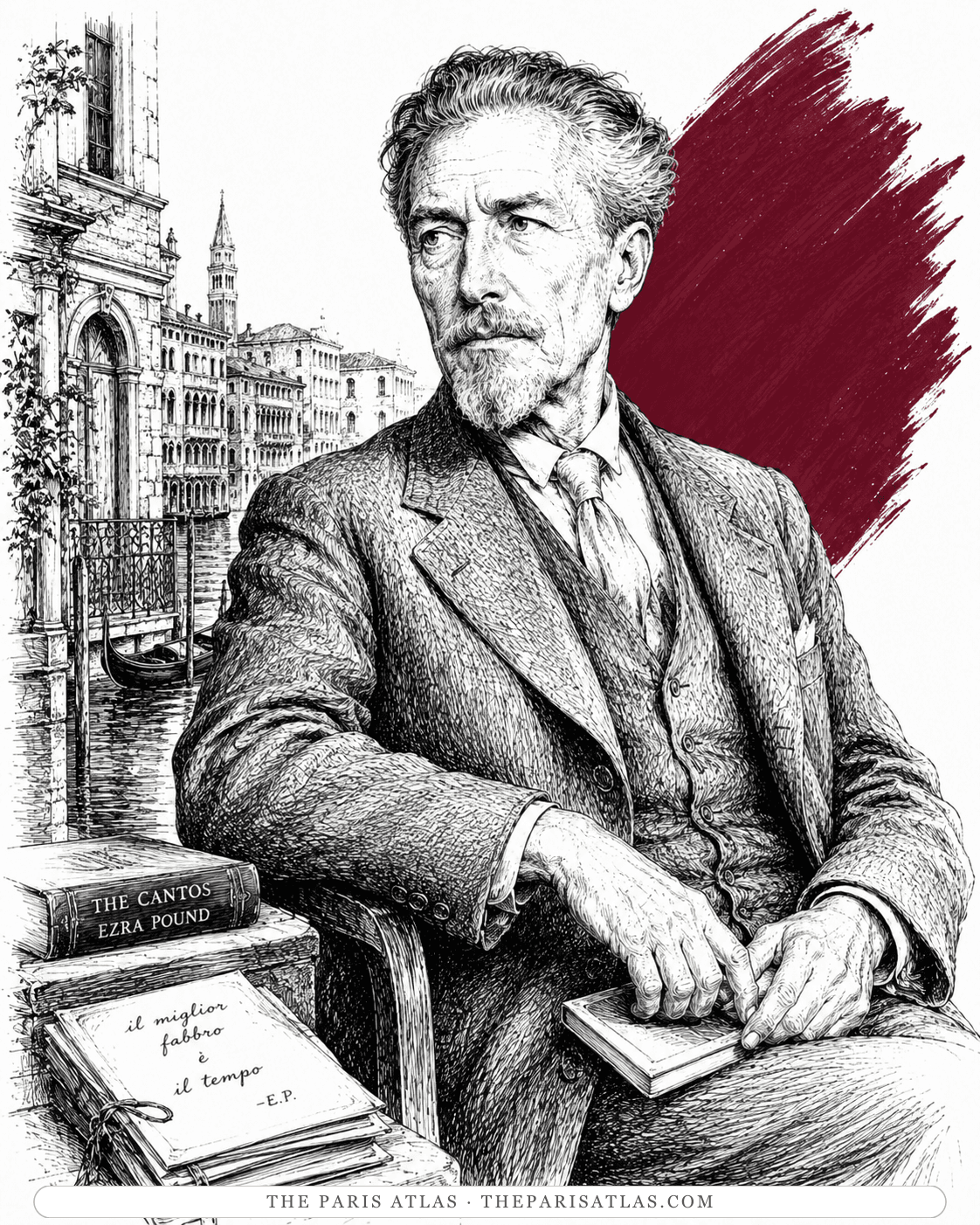
On the way home in January 1922 he stopped in Paris, where he and Pound went through the draft together and Pound made the cuts that produced the poem as it stands. Eliot acknowledged the debt on the dedication page, in three words taken from Dante: il miglior fabbro, the better craftsman.[4]
Eliot in 1923, the year after The Waste Land appeared. Photographed by Lady Ottoline Morrell. (Lady Ottoline Morrell / National Portrait Gallery, London (Ax141430) · Public domain)
The poem appeared in October 1922, in the first issue of The Criterion. Eliot founded the review with money from Lady Rothermere and edited it for seventeen years, closing it in January 1939 with a note called "Last Words".[1]
The bank, then the publishing house
Eliot took the job at Lloyds Bank in March 1917 and held it for eight years. Ezra Pound spent much of 1922 trying to get him out of it through Bel Esprit, a subscription scheme meant to guarantee him a private income so that he could write full time. It never raised enough. Ernest Hemingway describes the attempt, and Pound's part in it, in A Moveable Feast.[1]
In April 1925 he was invited onto the board of Faber & Gwyer, which agreed at the same time to take on the cost of The Criterion. The firm became Faber and Faber in 1929, and Eliot remained a director until his death. He built its poetry list, and he also wrote the letters that turned other people's books away. Four of those refusals are still quoted.
W. H. Auden's poems, September 1927. Returned with the note that none of the enclosed was quite right, and an invitation to call in whenever Auden was next in London. Faber published Auden's Poems three years later, and around twenty of his collections in all.
Down and Out in Paris and London, February 1932. Returned to Eric Blair as of very great interest but too short, and too loosely constructed, because the French and English halves had very little connecting them. Victor Gollancz published it the following January, under the name George Orwell.
Ulysses, April 1932. Declined for British publication on legal advice that prosecution was certain and that the firm's chairman risked six months in gaol. The Bodley Head brought it out in Britain in 1934. Faber was already printing instalments of James Joyce's "Work in Progress", which became Finnegans Wake in 1939.
Animal Farm, July 1944. Refused on political grounds, with two directors in agreement. Secker & Warburg published it in August 1945.
We agree that it is a distinguished piece of writing; that the fable is very skilfully handled, and that the narrative keeps one's interest on its own plane — and that is something very few authors have achieved since Gulliver.[5]
The rest of the letter explains the refusal. Britain was allied with the Soviet Union, and Eliot wrote that the firm had no conviction this was the right point of view from which to criticise the political situation at the present time. He then made a second objection, about the fable itself: the pigs are the cleverest animals on the farm and the best qualified to run it, so someone might argue that what was wanted was not more communism but more public-spirited pigs. He closed by saying he was sorry, because whoever published the book would have first sight of everything Orwell wrote next.[6]
Orwell on Eliot, Eliot on Kipling
The traffic ran both ways. Eliot selected and introduced A Choice of Kipling's Verse for Faber, and Orwell reviewed it in Horizon in 1942. That review, collected in Critical Essays, is where the phrase "good bad poem" comes from, and it argues with Eliot's introduction as much as it argues about Kipling.
Orwell's complaint is stated in the first sentence: it was a pity Eliot should be so much on the defensive. Eliot had called Kipling's work great verse rather than poetry, and defined a great verse-writer as one who has written some things you cannot tell apart from poetry. Orwell's answer is that if such poems exist Eliot should have named them.[7]
After the poems
Eliot was received into the Church of England in June 1927 after a private baptism, and was accepted as a British citizen that November. The work that followed is more openly religious: Ash-Wednesday in 1930, the pageant The Rock in 1934, and Murder in the Cathedral, the verse play about the killing of Thomas Becket, which opened at Canterbury in June 1935. He went on writing plays for the rest of his life, four more of them, ending with The Elder Statesman in 1959.[8]
Four Quartets, four long poems written over seven years, was published complete in May 1943. Five years later the Nobel Prize in Literature went to Eliot for what the citation called his outstanding, pioneer contribution to present-day poetry.[9][10]
The book that reached the largest audience was none of these. Old Possum's Book of Practical Cats, a set of light verses published in October 1939, became Andrew Lloyd Webber's musical Cats in 1981.
Vivienne and Valerie
Eliot married Vivienne Haigh-Wood in June 1915, three months after meeting her. His own health broke down in 1921 and hers was poor for years. From 1933 he began arranging a legal separation. In July 1938 she was committed to Northumberland House, a private asylum near Finsbury Park, and she was still there when she died of a heart attack in January 1947, aged fifty-eight.
In January 1957 he married Valerie Fletcher. The ceremony was private and began at a quarter past six in the morning. He died at home in Kensington on 4 January 1965, aged seventy-six.[1]
Life events
1888
Born in St. Louis, Missouri, on 26 September.
— T. S. Eliot – Facts, Nobel Prize in Literature 1948
1906–1910
Harvard: a BA in 1909 and an MA in 1910, with graduate work in philosophy.
— T. S. Eliot: the life, with timeline
1910–1911
The Paris year. He studies at the Sorbonne, lodges in a Left Bank pension with the medical student Jean Verdenal, and leaves the following summer with "The Love Song of J. Alfred Prufrock" written.
— T. S. Eliot: the life, with timeline; Time Present: The Newsletter of the T. S. Eliot Society, No. 73 (2011)
1914
Reaches England in August on a travelling fellowship to Merton College, Oxford, and meets Ezra Pound in September.
— T. S. Eliot: the life, with timeline
1915
"Prufrock" appears in Poetry in June. He marries Vivienne Haigh-Wood the same month.
— T. S. Eliot: the life, with timeline
1917
Joins the Colonial and Foreign Department of Lloyds Bank in March; Prufrock and Other Observations is published in June.
— T. S. Eliot: the life, with timeline
1921–1922
Signed off work in September 1921; finishes a draft of The Waste Land at Lausanne, then works on it with Pound in Paris the following January.
— T. S. Eliot: the life, with timeline
1922
The first issue of The Criterion appears in October with The Waste Land at its centre.
T. S. Eliot in 1923, the year after The Waste Land appeared. Photographed one Sunday afternoon by Lady Ottoline Morrell, whose snapshots of her Garsington visitors are the main photographic record of the group. (Lady Ottoline Morrell / National Portrait Gallery, London (Ax141430))
— T. S. Eliot: the life, with timeline
1925
Invited onto the board of Faber & Gwyer, which becomes Faber and Faber in 1929. He is a director for the next forty years.
— T. S. Eliot: the life, with timeline
1927
Received into the Church of England in June; accepted as a British citizen in November.
— T. S. Eliot: the life, with timeline; T. S. Eliot – Facts, Nobel Prize in Literature 1948
1932
Turns down the manuscript of Down and Out in Paris and London in February, and Ulysses for British publication in April.
— Toby Faber, A Legendary Publishing House's Most Infamous Rejection Letters (2019)
1935
Murder in the Cathedral opens at Canterbury in June, and the plays become a second career.
— T. S. Eliot: the life, with timeline; T. S. Eliot – Biographical, Nobel Prize in Literature 1948
1939
The Criterion closes in January. Old Possum's Book of Practical Cats is published in October.
— T. S. Eliot: the life, with timeline
1943
Four Quartets is published complete in May.
— T. S. Eliot: the life, with timeline
1944
Rejects Animal Farm for Faber and Faber on 13 July, calling it a distinguished piece of writing.
— Toby Faber, A Legendary Publishing House's Most Infamous Rejection Letters (2019); Josh Jones, T. S. Eliot, as Faber & Faber Editor, Rejects George Orwell's "Trotskyite" Novel Animal Farm (1944) (2013)
1947
Vivienne Haigh-Wood dies of a heart attack in January, aged fifty-eight, after nine years at Northumberland House.
— T. S. Eliot: the life, with timeline
1948
Awarded the Order of Merit in January and the Nobel Prize in Literature in December.
— T. S. Eliot: the life, with timeline; T. S. Eliot – Facts, Nobel Prize in Literature 1948
1957
Marries Valerie Fletcher in January, in a private ceremony that begins at a quarter past six in the morning.
— T. S. Eliot: the life, with timeline
1965
Dies at home in Kensington on 4 January, aged seventy-six.
— T. S. Eliot: the life, with timeline; T. S. Eliot – Facts, Nobel Prize in Literature 1948
T. S. Eliot quotes
Verbatim, as recorded by the witnesses of the era — sources on every quotation.
“
April is the cruellest month, breeding / Lilacs out of the dead land, mixing / Memory and desire, stirring / Dull roots with spring rain.
— T. S. Eliot, The Waste Land (1922)
“
This is the way the world ends / This is the way the world ends / This is the way the world ends / Not with a bang but a whimper.
— T. S. Eliot, “The Hollow Men,” in Poems 1909–1925 (1925)
“
For I have known them all already, known them all: / Have known the evenings, mornings, afternoons, / I have measured out my life with coffee spoons
— J. Alfred Prufrock · T. S. Eliot, “The Love Song of J. Alfred Prufrock,” in Prufrock and Other Observations (1917)
How T. S. Eliot appears in its pages: The poet and Faber editor whose selection A Choice of Kipling's Verse prompted the Kipling essay. Orwell's complaint is that Eliot is too much on the defensive to say plainly whether any of it is good, and that his formula, of great verse some of which cannot be told from poetry, would have been more useful if he had named the poems he meant.
They met in London in September 1914, a month after Eliot reached England. Pound sent "The Love Song of J. Alfred Prufrock" to Harriet Monroe's Poetry, which printed it the following June — Eliot's first appearance in a magazine of any standing.
— T. S. Eliot: the life, with timeline, Timeline, 1914 and 1915
Collaborated with · 1922-01
Eliot finished a draft of The Waste Land at Lausanne in late 1921 and stopped in Paris on the way home in January 1922, where he and Pound worked the poem into the shape it was published in. The printed dedication, il miglior fabbro, is Eliot's acknowledgement of the cutting.
— T. S. Eliot: the life, with timeline, Timeline, September 1921 and January 1922
Author and editor. Emily Coleman pressed the manuscript of Nightwood on Eliot, who took it to the Faber board; he and Coleman cut material running from single words to passages three pages long, and Faber published the book in 1936. Eliot wrote the introduction carried by the American edition of 1937.
— Nightwood: The Original Version and Related Drafts, edited by Cheryl J. Plumb — edition note; About Djuna Barnes — Djuna Barnes in Special Collections; Gaby Wood, 'Are ya still alive, Djuna?' — on Phillip Herring, Djuna: The Life and Work of Djuna Barnes, London Review of Books 18:13, 4 July 1996 (1996)
They met in London in November 1918, when Eliot was working at Lloyds Bank and the Woolfs were printing books by hand at Hogarth House in Richmond. The friendship became a publishing relationship: the Hogarth Press, the house Virginia and Leonard Woolf founded in 1917, printed Eliot's poems and remained one of the two publishers, with Faber, through which his early work reached English readers. Tate names Eliot, with E. M. Forster, as the writer the Hogarth list is remembered for.
— Bloomsbury (art term); Hermione Lee, Virginia Woolf (1996)
Who Inspired T. S. Eliot
People whose work inspired T. S. Eliot. They did not necessarily meet or know one another.
The debt is printed in The Sacred Wood (1920). Its opening essay, The Perfect Critic, takes its epigraph from Lettres à l'Amazone; in the same essay Eliot writes that "Of all modern critics, perhaps Remy de Gourmont had most of the general intelligence of Aristotle", and a few pages later calls him "the critical consciousness of a generation". In the essay on Philip Massinger, in the same volume, Eliot introduces him as "the great critic" and quotes Le Problème du style on Flaubert emptying his personality into his books, which is the position Eliot argues in his own name in Tradition and the Individual Talent. The start year is the book's; Eliot had been reading Gourmont for several years before it, but the citations are what is documented.
— T. S. Eliot, The Sacred Wood: Essays on Poetry and Criticism (1920); Remy de Gourmont, Lettres à l'Amazone (1914)
T. S. Eliot’s Places
The cataloged places connected to T. S. Eliot — through the books, and through the documented record.
Places you can enter today appear first, followed by addresses to see from outside and sites that have vanished.
Eliot read the typescript as a director of Faber and Faber and turned it down on 13 July 1944, with a second director in agreement. He called it a distinguished piece of writing and said the firm had no conviction that this was the right point of view from which to criticise the political situation at the time. Secker & Warburg published the book in August 1945.
— Toby Faber, A Legendary Publishing House's Most Infamous Rejection Letters (2019), T. S. Eliot to George Orwell, 13 July 1944; Josh Jones, T. S. Eliot, as Faber & Faber Editor, Rejects George Orwell's "Trotskyite" Novel Animal Farm (1944) (2013), Full text of the letter of 13 July 1944
Eliot read the manuscript for Faber and Faber and returned it on 19 February 1932, writing to Eric Blair that it was of very great interest but too short, and too loosely constructed, because the French and English halves had very little connecting them. Victor Gollancz published the book in January 1933, under the name George Orwell.
— Toby Faber, A Legendary Publishing House's Most Infamous Rejection Letters (2019), T. S. Eliot to Eric Blair (George Orwell), 19 February 1932
An American-born British poet, critic and publisher (1888–1965). He wrote The Waste Land and Four Quartets, edited the quarterly review The Criterion from 1922 to 1939, and was a director of the publishing house Faber and Faber from 1925 until he died.
What is T. S. Eliot best known for?
The Waste Land, published in 1922. His other major works are Prufrock and Other Observations (1917), Ash-Wednesday (1930), the verse play Murder in the Cathedral (1935), Old Possum's Book of Practical Cats (1939) and Four Quartets (1943).
Was T. S. Eliot American or British?
Both, in sequence. He was born in St. Louis, Missouri, in 1888 and educated at Harvard, settled in England in 1914, and was accepted as a British citizen in November 1927, the same year he was received into the Church of England.
Did T. S. Eliot live in Paris?
For one academic year. He arrived in October 1910 as a graduate student, studied at the Sorbonne, lodged in a Left Bank pension, and left the following summer with "The Love Song of J. Alfred Prufrock" written. He returned in January 1922 to work through the draft of The Waste Land with Ezra Pound.
Why did T. S. Eliot reject Animal Farm?
On political grounds. Writing to George Orwell on 13 July 1944 as a director of Faber and Faber, he called the book a distinguished piece of writing but said the firm had no conviction that this was the right point of view from which to criticise the political situation at the time. Britain was then allied with the Soviet Union. He added that the pigs were the cleverest animals on the farm and the best qualified to run it, so what the argument called for might be not less communism but more public-spirited pigs.
Did T. S. Eliot edit The Waste Land with Ezra Pound?
Pound edited it. Eliot finished a draft at Lausanne in late 1921 and the two went through it in Paris in January 1922, where Pound made the cuts that produced the published poem. Eliot's printed dedication, il miglior fabbro, means the better craftsman.
Is the musical Cats based on a T. S. Eliot book?
Yes. Andrew Lloyd Webber set the light verses in Old Possum's Book of Practical Cats, which Eliot published in October 1939, and the musical opened in London in 1981.
When and where did T. S. Eliot die?
He died at home in Kensington, London, on 4 January 1965, aged seventy-six.
Connections and Sources
T. S. Eliot’s connections to people, places, and works, with the sources behind each one.
They met in London in September 1914, a month after Eliot reached England. Pound sent "The Love Song of J. Alfred Prufrock" to Harriet Monroe's Poetry, which printed it the following June — Eliot's first appearance in a magazine of any standing.
— T. S. Eliot: the life, with timeline, Timeline, 1914 and 1915
The Library of Congress guide counts Eliot among the writers Barney acted as hostess to, and Berthe Cleyrergue names him among the guests at the Fridays. Neither source dates the visits, and other accounts describe him as an occasional caller rather than a regular.
— Natalie Clifford Barney — French Women & Feminists in History: A Resource Guide; Gregory Stephenson, Conversations with Berthe Cleyrergue, Housekeeper to the Legendary Amazon, Nathalie Clifford Barney (2014)
Eliot read the typescript as a director of Faber and Faber and turned it down on 13 July 1944, with a second director in agreement. He called it a distinguished piece of writing and said the firm had no conviction that this was the right point of view from which to criticise the political situation at the time. Secker & Warburg published the book in August 1945.
— Toby Faber, A Legendary Publishing House's Most Infamous Rejection Letters (2019), T. S. Eliot to George Orwell, 13 July 1944; Josh Jones, T. S. Eliot, as Faber & Faber Editor, Rejects George Orwell's "Trotskyite" Novel Animal Farm (1944) (2013), Full text of the letter of 13 July 1944
The Kipling essay is a review of A Choice of Kipling's Verse, which Eliot selected and introduced for Faber & Faber, and Orwell argues with his introduction from the first sentence onward. Eliot is named again in three of the other essays.
— George Orwell, Critical Essays (1946), "Rudyard Kipling", pp. 100–113; also pp. 116, 118, 124, 130
Eliot read the manuscript for Faber and Faber and returned it on 19 February 1932, writing to Eric Blair that it was of very great interest but too short, and too loosely constructed, because the French and English halves had very little connecting them. Victor Gollancz published the book in January 1933, under the name George Orwell.
— Toby Faber, A Legendary Publishing House's Most Infamous Rejection Letters (2019), T. S. Eliot to Eric Blair (George Orwell), 19 February 1932
Eliot finished a draft of The Waste Land at Lausanne in late 1921 and stopped in Paris on the way home in January 1922, where he and Pound worked the poem into the shape it was published in. The printed dedication, il miglior fabbro, is Eliot's acknowledgement of the cutting.
— T. S. Eliot: the life, with timeline, Timeline, September 1921 and January 1922
Author and editor. Emily Coleman pressed the manuscript of Nightwood on Eliot, who took it to the Faber board; he and Coleman cut material running from single words to passages three pages long, and Faber published the book in 1936. Eliot wrote the introduction carried by the American edition of 1937.
— Nightwood: The Original Version and Related Drafts, edited by Cheryl J. Plumb — edition note; About Djuna Barnes — Djuna Barnes in Special Collections; Gaby Wood, 'Are ya still alive, Djuna?' — on Phillip Herring, Djuna: The Life and Work of Djuna Barnes, London Review of Books 18:13, 4 July 1996 (1996)
The debt is printed in The Sacred Wood (1920). Its opening essay, The Perfect Critic, takes its epigraph from Lettres à l'Amazone; in the same essay Eliot writes that "Of all modern critics, perhaps Remy de Gourmont had most of the general intelligence of Aristotle", and a few pages later calls him "the critical consciousness of a generation". In the essay on Philip Massinger, in the same volume, Eliot introduces him as "the great critic" and quotes Le Problème du style on Flaubert emptying his personality into his books, which is the position Eliot argues in his own name in Tradition and the Individual Talent. The start year is the book's; Eliot had been reading Gourmont for several years before it, but the citations are what is documented.
— T. S. Eliot, The Sacred Wood: Essays on Poetry and Criticism (1920); Remy de Gourmont, Lettres à l'Amazone (1914)
They met in London in November 1918, when Eliot was working at Lloyds Bank and the Woolfs were printing books by hand at Hogarth House in Richmond. The friendship became a publishing relationship: the Hogarth Press, the house Virginia and Leonard Woolf founded in 1917, printed Eliot's poems and remained one of the two publishers, with Faber, through which his early work reached English readers. Tate names Eliot, with E. M. Forster, as the writer the Hogarth list is remembered for.
— Bloomsbury (art term); Hermione Lee, Virginia Woolf (1996)
References
References
The sources below include biographies, scholarly essays, interviews, and primary materials that informed this page. They reflect both the historical record and ongoing critical conversations about T. S. Eliot and their work.
These references anchor the page in the documented record and in the scholarly conversations around T. S. Eliot. Every claim on this page traces back to one or more of the works listed here.








 View source