The Paris AtlasCharting the artists, works, and places worth returning to.
  • Author
  • Critic
  • Publisher
· English · 1882–1941

Virginia Woolf

English novelist of Mrs Dalloway and To the Lighthouse, and one half of the Hogarth Press, the hand-press publishing house she ran with her husband Leonard. She never lived in Paris and never claimed to; she crossed to France as a traveller from 1907 onward, and in September 1928 spent a week there with the writer Vita Sackville-West, her lover — the only time the two of them went abroad together on their own. The Paris that changed her work came to her instead — carried into two London galleries by her friend Roger Fry in 1910 and 1912.

Details

Lived
1882–1941
Born
25 January 1882
Birthplace
22 Hyde Park Gate, Kensington, London
Birth name
Adeline Virginia Stephen
Died
28 March 1941 · aged 59
Place of death
Rodmell, Sussex
Nationality
English
Profession
Novelist, essayist and publisher
Major works
Mrs Dalloway, To the Lighthouse, Orlando, A Room of One's Own, The Waves
Married
Leonard Woolf · 1912–1941
Roles
AuthorCriticPublisher
Also known as
Adeline Virginia Stephen · Virginia Stephen

About Virginia Woolf

Virginia Woolf was born Adeline Virginia Stephen in London in 1882 and became one of the most inventive novelists in English. Her method was to write from inside people's heads: not what a character does over a lifetime, but what passes through the mind in an hour — memory, half-thought, the noise of a street — which is the technique critics call stream of consciousness. Mrs Dalloway (1925) and To the Lighthouse (1927) are the two novels that made the reputation, and A Room of One's Own (1929) is the essay that made her an argument as well as an author.

Paris was not her city, and this page does not pretend otherwise. She had no Paris address, no French circle, no café she is remembered in. What she had were crossings — from 1907 into the late 1930s, sometimes for a night on the way to somewhere else, once for a week in Burgundy with Vita Sackville-West, the aristocratic novelist and poet who was her lover and the model for her novel Orlando. The real Paris event of her life happened in London. In November 1910 her friend the painter and critic Roger Fry hung an exhibition called Manet and the Post-Impressionists at the Grafton Galleries in Mayfair — Édouard Manet, Paul Cézanne, Paul Gauguin, Vincent van Gogh — and put French painting in front of a London public that had never seen it. Woolf later dated the change in human character to that winter.

She was also a publisher. In 1917 she and her husband Leonard Woolf bought a small hand printing press, partly as therapy for her, and set it up in their house in Richmond, on the western edge of London. The Hogarth Press printed its early books by hand on the dining-room table and by 1922 was a business; it published the poet T. S. Eliot and the novelist E. M. Forster, and it published every book Virginia Woolf wrote after 1917.

The crossings

Virginia Stephen — she did not become Virginia Woolf until she married in 1912 — grew up at 22 Hyde Park Gate in Kensington, west London, in a large, formal, unhappy Victorian household. Her father, Leslie Stephen, was a critic and mountaineer who edited the Dictionary of National Biography, the vast reference work of British lives; her mother, Julia, died when Virginia was thirteen. When Leslie Stephen died in 1904 the four Stephen children sold the Kensington house and moved to 46 Gordon Square in Bloomsbury, the district of garden squares behind the British Museum, and it was there that the friendships now called the Bloomsbury Group began — the writers, painters and thinkers who met in one another's houses over the next thirty years, among them her sister the painter Vanessa Bell, the critic Clive Bell, the painter Duncan Grant, the critic Roger Fry, the biographer Lytton Strachey, the economist John Maynard Keynes, and Leonard Woolf, whom she married in 1912.

France entered her life shortly afterwards and stayed at the edge of it. Her first substantial Paris journey was in 1907, when she was twenty-five, the year her sister Vanessa married the art critic Clive Bell; she went with her brother Adrian, and the letters she sent home from it are the first of a long run of French letters. She crossed again and again over the next thirty years — on the way to Spain in 1923, on a long motoring holiday through Europe in 1935, on the last continental journey she and Leonard made in the summer of 1939, weeks before the Second World War closed the route. Not one of these visits made her a Paris writer. They made her a very good English traveller, which is a different and honest thing to be.

The Paris that mattered to Woolf was brought to her. Roger Fry, an English painter and art critic who had run the paintings department at the Metropolitan Museum of Art in New York, spent the autumn of 1910 gathering pictures in France and hung them at the Grafton Galleries in London that November under a title he had invented for the occasion: Manet and the Post-Impressionists. Post-Impressionism is his word, coined for that show, and it is still the standard label for the generation of French painters who came after the Impressionists — Cézanne, Gauguin, Van Gogh and Georges Seurat — and who cared less about catching daylight than about structure, flat colour and feeling. Alongside them Fry hung younger men still working in Paris, Henri Matisse and Pablo Picasso among them.

London was appalled. Newspaper critics called the pictures the work of madmen and of children; the show was a scandal in the way that only an exhibition of unfamiliar painting can be. It was also, for the writers and painters around Woolf, a permission slip. If a painter could break the surface of a picture and still tell the truth, a novelist could break the surface of a sentence. Fry followed it in 1912 with a Second Post-Impressionist Exhibition at the same gallery, this time with an English room, and by then Woolf's sister Vanessa Bell and the painter Duncan Grant were painting in ways nobody in England had been painting in 1909.

Woolf turned that winter into a joke and a manifesto at the same time. In her 1924 essay Mr Bennett and Mrs Brown — an attack on the older novelist Arnold Bennett and his generation, who she said described a character from the outside — her house, her income, her furniture — and never got inside her head; Mrs Brown is Woolf's imagined ordinary woman in a railway carriage, the person she thought fiction had failed to render — she wrote that on or about December 1910 human character changed. The sentence is usually read as a private nod to Fry's exhibition, which had opened the month before, and it has been quoted ever since as the moment English modernism dates itself from. Her circle's French appetite was not confined to paint: Clive Bell published Art in 1914 arguing that what matters in a picture is its shapes and relations rather than its subject; Fry opened the Omega Workshops in 1913 to put modern design into furniture and fabric; and Woolf herself said her writing owed debts to Marcel Proust, the French novelist of memory, and to the composer Igor Stravinsky. When Fry died in 1934 Woolf wrote his biography, published by the Hogarth Press in 1940 — the last book to appear in her lifetime; only the novel Between the Acts, finished just before her death, came out after it.

A week in France with Vita Sackville-West

Vita Sackville-West was a novelist, poet and garden-maker, born into the Sackville family at Knole, an enormous house in Kent that she loved and could not inherit, because the estate passed only to male heirs. She and Woolf met in 1922 and became lovers; the affair cooled into a friendship that lasted until Woolf's death. Out of it came Orlando (1928), a novel whose hero lives four centuries and changes sex halfway through, drawn openly from Vita's life and from her family's house — Vita's son Nigel Nicolson called it the longest love letter in literature.

In late September 1928 the two women went abroad together, alone, for the only time: about a week in France, travelling south into Burgundy, the wine country south-east of Paris, and stopping at the small towns of Saulieu and Vezelay. Orlando was days from publication, and Woolf wrote home to Leonard almost daily. The journey has become one of the fixed points of her biography, partly because so little else in her French travelling has a shape you can tell as a story, and partly because the letters are funny — two famous writers in provincial hotels, worrying about the food.

Mrs Dalloway and To the Lighthouse

Mrs Dalloway, published in 1925, takes place on a single day in June 1923 in London. Clarissa Dalloway, the wife of a Member of Parliament, walks out in the morning to buy flowers for a party she is giving that evening; the novel follows her through the day and ends at the party. Running beside her, never meeting her, is Septimus Warren Smith, a young veteran of the First World War whose mind has not survived it — he is suffering what the period called shell shock — and who is being handled badly by his doctors. He kills himself; the news reaches Clarissa's party. The book's method is to move in and out of people's thoughts and backwards and forwards in time as they walk the same streets, so that a whole life keeps surfacing inside an ordinary morning.

To the Lighthouse (1927) is built in three unequal parts. In the first, a large family and their guests spend a day at a holiday house by the sea, and a small boy is promised a sailing trip to a lighthouse that the weather cancels. In the short middle section the house stands empty for ten years while the war passes and, in a few lines set off in brackets, the mother dies, a son is killed and a daughter dies in childbirth. In the third part the survivors return and the boy, now grown, finally makes the crossing, while the painter Lily Briscoe finishes the picture she has been failing to finish since part one. The family is a version of Woolf's own — the mother is Julia Stephen, the summers are the summers of her childhood in Cornwall — and the middle section is one of the strangest pieces of writing of the century: a book that hands ten years and three deaths to an empty house.

A Room of One's Own followed in 1929, worked up from two lectures given to women students at Cambridge. Its argument is material rather than mystical: a woman needs money and a private room in order to write, and Woolf puts the figure at five hundred pounds a year — a private income, enough at the time to live on without taking work. The essay asks why the historical record holds so few women writers and answers with an invention: Judith Shakespeare, a sister given the same gifts as her brother, who is kept from school, married off, and dead by her own hand before she can write a line. The reason, Woolf argues, was never talent. It was the absence of an income and of a door that shuts.

The Hogarth Press

In 1917 the Woolfs bought a small hand printing press and a case of type, meaning to take up printing as a hobby and as an occupation that might steady Virginia's health, which had already broken down several times. They installed it at Hogarth House in Richmond, the suburb on the Thames west of London that gave the press its name, and set and printed the first books themselves. By about 1922 the hobby had become a business, and it was the business that made Woolf unusual among novelists of her generation: she was her own publisher, answerable to no editor and no house style, and she said herself that it was the only way she could write exactly what she wanted.

The list was better than a hobby press has any right to be. The Hogarth Press published T. S. Eliot, the American-born poet then working in a London bank, and the novelist E. M. Forster; it was the English publisher of Sigmund Freud, the founder of psychoanalysis; and it published everything Woolf wrote from 1917 onwards. The press also turned down one of the great books of the century: the typescript of Ulysses — the novel by the Irish writer James Joyce that follows one Dublin day through the minds of its characters, and that no established publisher would touch on grounds of obscenity — reached the Woolfs in 1918, and they declined it — the machine they had was too small to set a book that size, and Virginia disliked what she read.

Rodmell, and 28 March 1941

In 1919 the Woolfs bought Monk's House, a small weather-boarded cottage in the village of Rodmell, in the chalk hills of the Sussex downs about fifty miles south of London, for what Leonard described as the shape and fertility and wildness of its garden. Virginia wrote in a lodge at the bottom of it, and most of her major books were finished there. After their London house was bombed in 1940 it became their permanent home. It belongs to the National Trust today and can be visited.

Woolf had suffered severe mental illness since her teens, in episodes that today would be described as bipolar disorder, and she had attempted suicide before. In the spring of 1941, with the war going badly, the London house destroyed and another breakdown beginning, she wrote a letter to Leonard saying she was certain she was going mad again and could not go through it a second time. On the morning of 28 March 1941 she put a stone in her coat pocket and walked into the River Ouse near Rodmell. She was fifty-nine. Her body was found three weeks later, and Leonard buried her ashes under an elm in the garden at Monk's House.

The papers survived, in quantity, and they are the reason so much of her daily life can be dated: the diaries and letters she kept from girlhood, the manuscript drafts, the Monk's House papers. They are divided today between the University of Sussex, which holds Virginia and Leonard Woolf's archives at The Keep, the archive centre in Brighton where they can be consulted; the British Library; and the Mortimer Rare Book Collection at Smith College in Massachusetts, which holds original papers and drafts. Her published Diary, in five volumes, and her Letters, in six, remain the fullest record any twentieth-century English novelist left of an ordinary working week.

Life events

  1. 1882

    Born Adeline Virginia Stephen on 25 January at 22 Hyde Park Gate, Kensington, London, daughter of the critic Leslie Stephen.

    Virginia Woolf: a biography; Virginia Woolf's London

  2. 1904

    Her father dies; the Stephen children leave Kensington for 46 Gordon Square in Bloomsbury, and the circle later called the Bloomsbury Group begins.

    Virginia Woolf's London; Bloomsbury (art term)

  3. 1907

    Her first substantial journey to Paris, with her brother Adrian, in the year her sister Vanessa married the critic Clive Bell.

    Hermione Lee, Virginia Woolf (1996)

  4. 1910

    Roger Fry opens Manet and the Post-Impressionists at the Grafton Galleries in London in November, coining the term Post-Impressionism and putting French painting in front of a scandalised English public. Woolf's 1924 essay Mr Bennett and Mrs Brown dates the change in human character to that winter.

    Post-Impressionism (art term); Bloomsbury (art term); Virginia Woolf, Mr Bennett and Mrs Brown (1924)

  5. 1912

    Marries Leonard Woolf; Fry mounts a Second Post-Impressionist Exhibition at the same gallery.

    Virginia Woolf: a biography; Post-Impressionism (art term)

  6. 1917

    The Woolfs buy a small hand printing press and found the Hogarth Press at Hogarth House in Richmond.

    Virginia Woolf: a biography

  7. 1919

    They buy Monk's House at Rodmell in Sussex, where she writes in a garden lodge.

    Virginia Woolf: a biography; Monk's House, Rodmell

  8. 1922

    The Hogarth Press becomes a business; its list comes to include T. S. Eliot and E. M. Forster. Woolf meets Vita Sackville-West.

    Virginia Woolf: a biography; Bloomsbury (art term)

  9. 1925

    Mrs Dalloway: one day in June 1923 in London, Clarissa Dalloway and Septimus Warren Smith.

    Mrs Dalloway

  10. 1927

    To the Lighthouse, whose empty middle section hands ten years and three deaths to an unoccupied house.

    Virginia Woolf

  11. 1928

    A week in France with Vita Sackville-West in late September — Burgundy, Saulieu, Vezelay — the only time the two travelled abroad alone together; Orlando is published in October.

    Virginia Woolf, edited by Nigel Nicolson and Joanne Trautmann, The Letters of Virginia Woolf, Volume III: 1923-1928 (1977); Virginia Woolf, edited by Anne Olivier Bell, The Diary of Virginia Woolf, Volume III: 1925-1930 (1980); Virginia Woolf: a biography

  12. 1929

    A Room of One's Own, worked up from two lectures to women students at Cambridge and published by the Hogarth Press.

    A Room of One's Own

  13. 1940

    Publishes Roger Fry: A Biography, her life of the man who brought Paris painting to London.

    Hermione Lee, Virginia Woolf (1996)

  14. 1941

    Dies on 28 March, drowned in the River Ouse near Rodmell, after a breakdown she wrote to Leonard she could not survive a second time.

    Hermione Lee, Virginia Woolf (1996)

People they knew

Documented connections — every one carries its source.

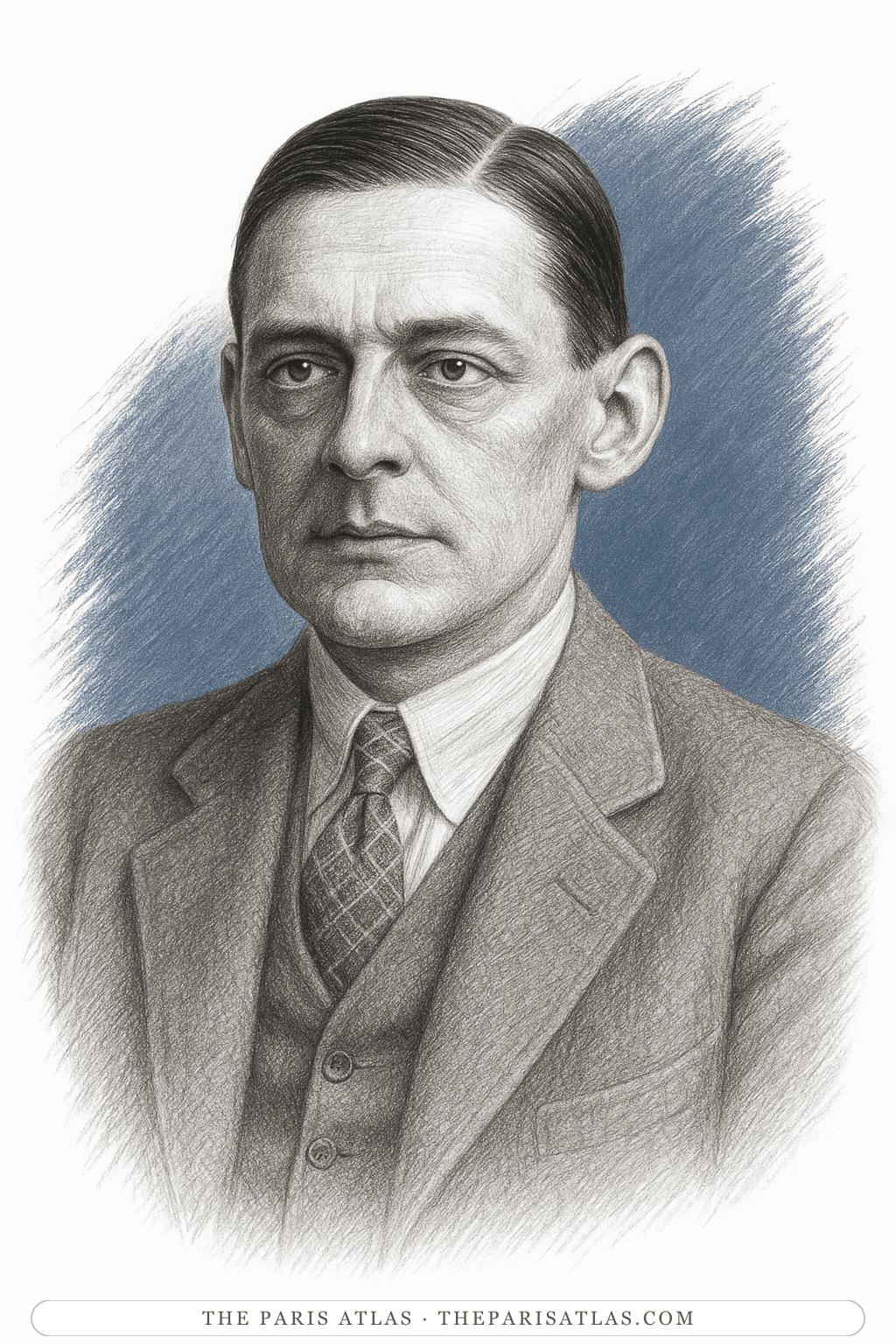
Illustrated portrait of T. S. Eliot

T. S. Eliot

  • Poet
  • Critic
  • Editor
  • +2

Met · 1918

They met in London in November 1918, when Eliot was working at Lloyds Bank and the Woolfs were printing books by hand at Hogarth House in Richmond. The friendship became a publishing relationship: the Hogarth Press, the house Virginia and Leonard Woolf founded in 1917, printed Eliot's poems and remained one of the two publishers, with Faber, through which his early work reached English readers. Tate names Eliot, with E. M. Forster, as the writer the Hogarth list is remembered for.

Bloomsbury (art term); Hermione Lee, Virginia Woolf (1996)

Questions about Virginia Woolf

Did Virginia Woolf live in Paris?

No. She had no Paris address and no French literary circle. She was a repeat visitor rather than a resident: her first substantial Paris journey was in 1907, with her brother Adrian, and she went back through the following three decades — on the way to Spain in 1923, on a long European motoring holiday in 1935, and on the last continental trip she and Leonard made in the summer of 1939. The Paris that shaped her work reached her in London instead, through Roger Fry's exhibitions of French painting in 1910 and 1912.

What did Roger Fry's Post-Impressionist exhibitions do?

They put modern French painting in front of the English for the first time. Fry, a painter and critic, gathered pictures in France and hung them at the Grafton Galleries in London in November 1910 under a title he invented — Manet and the Post-Impressionists — which is where the word Post-Impressionism comes from. Manet, Cezanne, Gauguin and Van Gogh were on the walls, with younger Paris painters including Matisse and Picasso. The press called it the work of madmen; Woolf's circle took it as permission to break the surface of their own art, and a second exhibition followed in 1912.

What is Mrs Dalloway about?

A single day in June 1923 in London. Clarissa Dalloway, a politician's wife, goes out in the morning to buy flowers for a party she is giving that night, and the novel follows her thoughts, and other people's, until the party. In a parallel story that never quite touches hers, Septimus Warren Smith, a shell-shocked veteran of the First World War, is failed by his doctors and kills himself; the news arrives at the party. The novel's whole technique is to move in and out of minds, and backwards and forwards in time, while the characters walk the same few streets.

What is To the Lighthouse about?

A family holiday, an empty house, and a return. In the first part the Ramsay family and their guests spend a day by the sea and a promised sailing trip to a lighthouse is cancelled by the weather. In a short middle part the house stands empty for ten years, and in a few bracketed lines the mother dies, a son is killed in the war and a daughter dies in childbirth. In the third part the survivors come back, the trip is finally made, and the painter Lily Briscoe finishes her picture. The family is drawn from Woolf's own, and the holiday summers from her childhood in Cornwall.

What was the Hogarth Press?

The publishing house Virginia and Leonard Woolf founded in 1917, after buying a small hand printing press to use as a hobby and as therapy for Virginia's health. They set and printed the first books themselves at Hogarth House in Richmond, west London, and by about 1922 it had become a real business. It published T. S. Eliot and E. M. Forster, it was Freud's English publisher, and it printed every book Virginia Woolf wrote after 1917 — which meant she never had to submit a manuscript to anyone.

Were Virginia Woolf and Vita Sackville-West lovers?

Yes. Vita Sackville-West was a novelist, poet and gardener, born into the Sackville family at Knole in Kent. She and Woolf met in 1922, and their affair ran through the mid-1920s before settling into a friendship that lasted until Woolf's death. Woolf's novel Orlando (1928), whose hero lives four hundred years and changes sex partway through, is drawn from Vita's life and family; Vita's son Nigel Nicolson called it the longest love letter in literature. In late September 1928 the two spent about a week travelling in France together, the only time they went abroad alone.

How did Virginia Woolf die?

She drowned herself in the River Ouse near her house at Rodmell in Sussex on 28 March 1941, aged fifty-nine, weighting her coat pocket with a stone. She had been severely mentally ill in episodes since her teens and had attempted suicide before; she left a letter for Leonard saying she was certain she was going mad again and could not go through it another time. Her body was found three weeks later, and her ashes were buried in the garden at Monk's House.

Where are Virginia Woolf's manuscripts and papers?

Split across three main places. The University of Sussex holds the Virginia and Leonard Woolf archives, consultable at The Keep in Brighton; the British Library holds manuscripts and correspondence; and the Mortimer Rare Book Collection at Smith College in Massachusetts holds original papers and drafts. Her diaries and letters have also been published in full — five volumes of Diary, six of Letters — which is why so much of her daily life can be dated to the afternoon.

Sourced claims

Every connection the graph holds for Virginia, with the evidence behind it.

Met · 1918

T. S. Eliot

They met in London in November 1918, when Eliot was working at Lloyds Bank and the Woolfs were printing books by hand at Hogarth House in Richmond. The friendship became a publishing relationship: the Hogarth Press, the house Virginia and Leonard Woolf founded in 1917, printed Eliot's poems and remained one of the two publishers, with Faber, through which his early work reached English readers. Tate names Eliot, with E. M. Forster, as the writer the Hogarth list is remembered for.

Bloomsbury (art term); Hermione Lee, Virginia Woolf (1996)

References

References

The sources below include biographies, scholarly essays, interviews, and primary materials that informed this page. They reflect both the historical record and ongoing critical conversations about Virginia Woolf and their work.

  1. 1Virginia Woolf

    British Library

    The British Library's summary of her life, method and major books.

    View source
  2. 2Mrs Dalloway

    British Library

    The British Library on the novel's single June day, Clarissa and Septimus.

    View source
  3. 3A Room of One's Own

    British Library

    The British Library on the 1929 essay, its origin in lectures and the five hundred pounds a year.

    View source
  4. 4Virginia Woolf's London

    British Library

    The British Library on her London addresses and the geography of Mrs Dalloway.

    View source
  5. 5Post-Impressionism (art term)

    Tate

    Tate on Roger Fry coining the term for the 1910 Grafton Galleries exhibition.

    View source
  6. 6Bloomsbury (art term)

    Tate

    Tate on the Bloomsbury Group, its members, and the Hogarth Press list.

    View source
  7. 7Virginia Woolf: a biography

    The Virginia Woolf Society of Great Britain

    The Virginia Woolf Society of Great Britain's chronological life, including the 1917 hand press and Monk's House.

    View source
  1. 8Monk's House, Rodmell

    National Trust

    The National Trust on the Rodmell house and the garden writing lodge.

    View source
  2. 9Heritage Collections (formerly Special Collections)

    University of Sussex Library

    Sussex's Heritage Collections, which hold the Virginia and Leonard Woolf archives.

    View source
  3. 10Special Collections: the Mortimer Rare Book Collection

    Smith College Libraries

    Smith College's Mortimer Rare Book Collection, which holds original Woolf papers and drafts.

    View source
  4. 11Mr Bennett and Mrs Brown

    The Hogarth Press, London, 1924

    The essay carrying the sentence about December 1910.

  5. 12The Diary of Virginia Woolf, Volume III: 1925-1930

    The Hogarth Press, London, 1980

    Her own diary for the Orlando and Sackville-West years.

  6. 13The Letters of Virginia Woolf, Volume III: 1923-1928

    The Hogarth Press, London, 1977

    The letters covering the 1928 French week.

  7. 14Virginia Woolf

    Chatto & Windus, London, 1996

    The standard modern biography, used for the travel record and the last months.

i
Why these sources are here

These references anchor the page in the documented record and in the scholarly conversations around Virginia Woolf. Every claim on this page traces back to one or more of the works listed here.

Explore more resources
Browse all authors