
To the Lighthouse
Woolf's previous novel also moves between several minds and uses a short middle section to pass over years and deaths.
Read our takeThe Waves
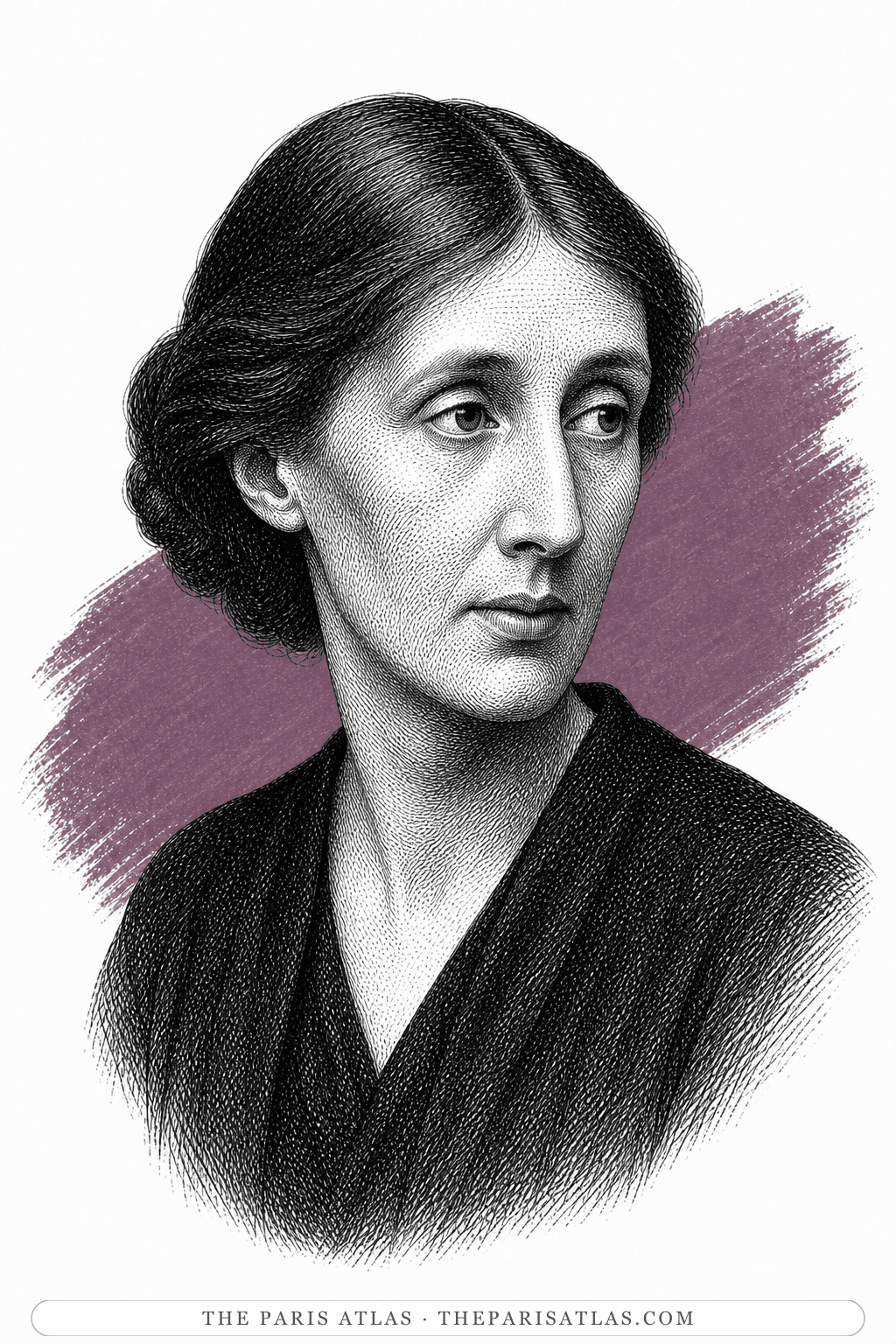
Virginia Woolf
Virginia Woolf's novel of six friends who speak in turn from childhood to old age, while the sun crosses one day over the sea.
The Waves follows six friends, Bernard, Susan, Rhoda, Neville, Jinny and Louis, from the nursery to old age. Nobody tells their story from outside. Each friend speaks in turn, in long passages of thought. Each of the nine sections opens with a short passage about a house and a beach at one moment of a single day, from before sunrise to after dark.[1] A seventh friend, Percival, never speaks, and his early death in India marks all their lives. The Hogarth Press published the novel in London on 8 October 1931. Harcourt, Brace published it in New York on 22 October.[2]
The book opens before dawn. The sea is the same colour as the sky, and then the light comes up over a garden. Six children wake in a house by the sea and say, one by one, what they see and hear. "I see a ring," Bernard begins, and the others add a slab of yellow, a bird's chirp, a globe of water, a crimson tassel and a stamping beast.[3]
Small things happen in the garden, and the children never forget them. Jinny finds Louis hiding behind a hedge and kisses him. Susan sees it through a gap in the leaves and runs off to cry in the beech wood. Bernard follows her and tells her stories. Together they look over a wall at a great house called Elvedon, where a lady sits writing and gardeners sweep the lawn.[3]
Each child already has a way of being in the world. Louis is ashamed of his Australian accent and of his father, a banker in Brisbane. Rhoda cannot do sums, and later says she has no face. Neville wants order and hates anything that dangles or wanders. Jinny cannot keep still. Susan loves and hates with all her strength. Bernard makes phrases, and is always late.[3]
Then the boys go off to one school and the girls to another. At the boys' school they meet Percival, a handsome, silent boy whom everyone follows across the playing fields. Neville falls in love with him. After school the friends go separate ways: to university, to an office in the City of London, to a farm, to London parties. They meet again at a London restaurant to say goodbye to Percival before he sails for India.[3][1]
The six children grow up together in a house by the sea, with Mrs Constable, who bathes them, and two teachers, Miss Hudson and Miss Curry. Jinny's kiss, Susan's tears in the beech wood and the lady writing at Elvedon stay with them all their lives. Neville also carries the memory of overhearing that a dead man was found in the gutter with his throat cut.[3]
At school Bernard, Neville and Louis meet Percival, and Neville loves him. Susan, Jinny and Rhoda go to a girls' school, where Susan counts the days until she can go home. Afterwards Bernard and Neville go to university, where Neville hands Bernard a poem and runs from the room. Louis becomes a clerk in the City of London. Susan goes back to her father's house in the country, Jinny goes to parties, and Rhoda dreads them.[3]
The seven friends dine together in London before Percival leaves for India. None of them is yet twenty-five, and Bernard has just got engaged. Bernard sees the red carnation on the table as a seven-sided flower, with each of them adding a petal.[3]
In India, Percival's horse stumbles and throws him, and he dies. He is twenty-five. Neville gets the news by telegram. Bernard's son is born the same day, and he goes to look at paintings in the National Gallery. Rhoda walks down Oxford Street, sits through an afternoon concert, and at Greenwich throws a bunch of violets into the water for Percival.[3]
The friends' lives go on. Louis rises in a shipping business, keeps an attic room, and becomes Rhoda's lover until she leaves him. Susan marries a farmer and raises children. Jinny, past thirty, still goes from man to man. Neville lives for one lover at a time. Bernard marries, has children, and spends ten days alone in Rome.[3]
In middle age the six meet for dinner at Hampton Court. They compare what they have made of their lives, fall silent, and walk out by the river. Bernard says the carnation from the farewell dinner has become a six-sided flower, made of six lives. The couples drift off towards the lake, while Louis and Rhoda stay behind by a stone urn.[3]
The last section belongs to Bernard alone. Now elderly, he sits at dinner with a man he may once have met on a ship bound for Africa, and tries to sum up his life. He goes back over all six lives. He mentions, almost in passing, that Rhoda has killed herself. He describes a day when he leaned on a gate and felt that his self had gone, and the world looked like a landscape after an eclipse.
His companion leaves. Bernard sits on alone, and says his notebook of phrases has fallen under the table. Outside, the sky begins to lighten. He feels a new wave rise in him, and rides out against death the way Percival rode in India. The novel ends with one line: the waves broke on the shore.
The book has nine sections. Each opens with a short passage in italics about a house, a garden and a beach. The passages follow the sun through a single day, from an hour before it rises to after it sets. Around them, the friends' speeches follow their lives from early childhood to the edge of death.
Every speech is tagged the same way: said Bernard, said Susan, said Rhoda. Nobody talks the way people really talk. Herbert Marder, a Woolf biographer, points out that even as small children the six speak in fully adult voices. The friends almost never answer one another directly. Trudi Tate, who lectures on Woolf, says reading it can feel eerily like dreaming.
Woolf knew the book had no plot in the usual sense. On 2 September 1930 she wrote in her diary that she was writing The Waves "to a rhythm not to a plot." On the manuscript's title page she tried other names for it, among them "the life of anybody" and "life in general."
Woolf's older brother Thoby Stephen died of typhoid fever in 1906, when she was twenty-four. He had fallen ill after a trip to Greece, and the doctors did not recognise the disease until too late. Herbert Marder writes that The Waves grew out of her thinking about that death, and calls Percival her idealized image of Thoby.
In the novel Percival dies in India, thrown from a horse that stumbles. Bernard notes that he was twenty-five and should have lived to be eighty. Later Louis puts it another way: "he died in Egypt; he died in Greece; all deaths are one death."
Percival never gets a speech of his own. The reader only sees him through the others. In chapel he sits upright with blue, oddly blank eyes, and flicks his hand to the back of his neck. The smaller boys copy the gesture and cannot get it right. At the farewell dinner Bernard imagines him in India, setting a stuck bullock cart right in five minutes while a crowd treats him like a god. The scene is Bernard's fantasy of an English hero abroad, and the novel lets it stand as his.
Each friend takes the news differently. Neville holds the telegram and refuses to climb the stairs. Bernard cannot tell which is sorrow and which is joy, because his son is born the same day. Rhoda walks down Oxford Street in disgust at the crowds, and ends the afternoon throwing violets into the water at Greenwich.
At the first dinner Bernard calls the red carnation on the table a seven-sided flower, one side for each of them. At Hampton Court, years after Percival's death, he says it has become a six-sided flower, made of six lives. Near the end he goes further: "For this is not one life; nor do I always know if I am man or woman, Bernard or Neville, Louis, Susan, Jinny or Rhoda".
Herbert Marder reads the six as parts of Woolf herself, each partly drawn from someone close to her. In his reading, Louis takes traits from her husband Leonard Woolf, Neville from the writer Lytton Strachey, and Susan from her sister, the painter Vanessa Bell. Jinny's name echoes Ginny, her father Leslie Stephen's pet name for Virginia. Bernard, the storyteller, carries echoes of talkers like Desmond MacCarthy and E. M. Forster.
Those links are one biographer's reading, not labels printed in the book. The characters also stand for plain choices about how to live. Susan wants the land and her children. Jinny wants the next person to cross the room towards her. Neville wants one lover and a closed door. Louis wants order and respect. Rhoda wants to escape other people altogether. Bernard wants the phrase that will hold all of it.
Paris turns up in the novel only at the edges. On the train home from school, Louis lists where the other boys are headed: Oxford or Cambridge, Edinburgh, Rome, Paris, Berlin, or an American university. He is going to make money. At college Neville teases Bernard for trying on famous writers' personalities. He predicts that Bernard will visit Paris in the Easter vacation and come back in a black tie. Later Louis, now a rising businessman, gives orders by telephone to Paris, Berlin and New York.
The Paris sentence also holds the novel's one unsolved textual puzzle. In the first edition Neville says Bernard will come back "wearing a black tie some detestable Frenchman whom nobody has ever heard of." Edward Mendelson, a Columbia University scholar who has compared the proofs and first editions, thinks one or more words are missing. The surviving drafts give no clue. An editor at Harcourt, Brace pencilled "like" into the American proofs, with a question mark, but the word was never printed.
Paris returns on the last pages. Bernard, old and tired after dinner with a near-stranger, loses track of where he is: "Is it Paris, is it London where we sit, or some southern city of pink-washed houses lying under cypresses, under high mountains, where eagles soar?"
The first French translation was made by Marguerite Yourcenar, who was short of money and agreed to translate the book for the Paris publisher Stock. The work took her ten months. On 23 February 1937 she met Virginia Woolf in London and spent two hours with her, and wrote her preface after the visit. Les Vagues came out in Paris in September 1937, under the imprint Delamain et Boutelleau, in 269 pages. Yourcenar was sailing for the United States as it appeared.
In her preface Yourcenar called it a book with six characters, or rather six instruments, and compared the way the monologues cross to Johann Sebastian Bach's Art of Fugue. In 1989 the preface, with a second piece on Woolf, was collected in Yourcenar's book En pèlerin et en étranger under the title "Une femme étincelante et timide," a sparkling and shy woman. Her translation was reissued many times: by Plon in 1957 and 1969, by Stock in 1974, and by the Livre de Poche in 1986.
A second French translation, by Cécile Wajsbrot, came out from Calmann-Lévy in Paris in 1993, and the Paris press argued over the two. In Le Monde on 23 April 1993, Viviane Forrester accused Wajsbrot of cutting Woolf's repetitions and making her hard for French readers to follow. The translator Gérard de Cortanze took Wajsbrot's side in the Magazine littéraire. He said Yourcenar had turned Woolf's English park into a formal French garden.
In 2011 the director Marie-Christine Soma brought Les Vagues to the stage at La Colline, the national theatre on the rue Malte-Brun in the 20th arrondissement. She used Yourcenar's translation, with twelve actors, in the Petit Théâtre from 14 September to 15 October 2011. The production had opened at the Studio-Théâtre de Vitry in October 2010.
Woolf began the novel around 1929, under the working title The Moths. She drafted it by hand in seven numbered notebooks, plus a notebook of notes. The notebooks are now in the Berg Collection of the New York Public Library. J. W. Graham published a transcription of the two drafts in 1976.
On 17 July 1931 she wrote in her diary that she had finished, having copied out the opening sentences for the eighteenth time. Leonard Woolf read it first. He told her it was a masterpiece and the best of her books. He also warned her that the first hundred pages were extremely difficult, and wondered how far an ordinary reader would follow.
Woolf was still revising in proof in August 1931. She told the composer Ethel Smyth that she had to fix "one chapter gone wrong." In 2025 Edward Mendelson reported the fix. A set of proofs she corrected for the American edition had reached Columbia University's rare book library with the papers of the publisher Donald Brace. Among other changes, she had cut thirty-eight words from Bernard's memory of calling on Rhoda and Louis, in his last speech.
The two first editions do not have the same text. The American edition appeared two weeks after the British one, but it prints an earlier state of the book. Woolf had to post her American proofs to New York before she finished correcting the British ones. Mendelson argues that the Hogarth Press text is her final version.
“I see a ring,” said Bernard, “hanging above me. It quivers and hangs in a loop of light.”
Bernard says there is always a story. I am a story. Louis is a story.
But here I am nobody. I have no face.
Six friends speak in turn from the nursery to old age. You watch the same dinner, the same death and the same garden through six different minds.
Woolf said she was writing it to a rhythm, not a plot. Critics outside Britain voted it the sixteenth greatest British novel in a 2015 BBC Culture poll.
Percival, the friend who never speaks, dies young in India. The novel grew out of the death of Woolf's brother Thoby Stephen, and every friend carries Percival afterwards.
The final section is one long monologue by the storyteller of the group, summing up all six lives over a dinner. The book closes on Bernard riding out against death.
The storyteller of the group, who makes phrases for everything and keeps a notebook of them. He speaks first and last.
A clergyman's daughter who loves and hates fiercely, hates school and cities, and wants the land and children of her own.
A fatherless girl who feels she has no face, dreads other people, and lives in daydreams of pools and marble pillars far away.
A delicate, precise boy who loves Percival, wants to be a poet, and later lives for one lover at a time.
A girl who never stops moving, loves dresses and parties, and lives through her body and the next person who crosses the room to her.
A banker's son from Brisbane, ashamed of his Australian accent, who becomes a powerful businessman and reads one poem a night in his attic.
The handsome, silent friend whom everyone follows. He never speaks in the novel, and dies young in India.
1906
Woolf's brother Thoby Stephen dies of typhoid fever after a trip to Greece. Herbert Marder sees Percival as her idealized image of him.
1929
Around this year Woolf begins the novel, under the working title The Moths.
1930
On 2 September Woolf writes in her diary that she is writing The Waves to a rhythm, not a plot.
1931
On 17 July Woolf writes that she has finished, after copying out the opening sentences for the eighteenth time. Two days later she records Leonard Woolf calling it a masterpiece.
1931
The Hogarth Press publishes The Waves in London on 8 October. Harcourt, Brace publishes it in New York on 22 October.
1937
Marguerite Yourcenar meets Woolf in London on 23 February. Her French translation, Les Vagues, is published in Paris in September.
1976
J. W. Graham publishes the two handwritten drafts of the novel, from the notebooks in the New York Public Library's Berg Collection.
1993
Cécile Wajsbrot's new French translation appears from Calmann-Lévy in Paris, and critics in Le Monde and the Magazine littéraire argue over the two translations.
2011
Marie-Christine Soma's stage version, Les Vagues, runs at La Colline in Paris from 14 September to 15 October.
2015
Book critics outside Britain vote The Waves the sixteenth greatest British novel in a BBC Culture poll.
2025
Edward Mendelson reports Woolf's corrected American proofs at Columbia University, showing how she fixed "one chapter gone wrong."


Woolf's previous novel also moves between several minds and uses a short middle section to pass over years and deaths.
Read our take
One London day seen through many minds, with a war veteran's death at its centre, six years before The Waves.
Read our take
Woolf's lighter book, published three years earlier, also asks how many selves one person can hold.
Read our take
James Joyce's novel, published in Paris in 1922, also gives whole chapters over to the thoughts of its characters.
Read our takeSix friends, Bernard, Susan, Rhoda, Neville, Jinny and Louis, from childhood in a house by the sea to old age. Each speaks in turn about their inner life. A seventh friend, Percival, never speaks, and his early death in India marks them all.
Bernard is the storyteller. Susan is a clergyman's daughter who wants a farm and children. Rhoda is shy and frightened of other people. Neville is a precise, scholarly poet who loves Percival. Jinny lives through her body and her lovers. Louis is an Australian banker's son who becomes a powerful businessman.
Partly. Woolf's brother Thoby Stephen died of typhoid in 1906, after a trip to Greece. The biographer Herbert Marder writes that the novel grew out of that death and calls Percival her idealized image of Thoby. In the book, Percival dies in India after a fall from his horse.
The novel has no narrator and little plot. Each section is a series of speeches that no one would say out loud, and the childhood section is made of short, strange sentences. Leonard Woolf himself found the first hundred pages extremely difficult. Most readers find it easier once they know the six voices.
The Hogarth Press published it in London on 8 October 1931, and Harcourt, Brace published it in New York on 22 October 1931. The American text is slightly earlier, because Woolf sent those proofs before she finished correcting the British ones.
Only a small one inside the novel: Paris is where the boys may go after school, where Louis telephones, and one of the cities Bernard thinks he might be in at the end. The first French translation, by Marguerite Yourcenar, was published in Paris in 1937. La Colline, a national theatre in Paris, staged it in 2011.
Marguerite Yourcenar translated it first, as Les Vagues, published in Paris in September 1937 after she had met Woolf in London. Cécile Wajsbrot made a second translation, published by Calmann-Lévy in 1993.
The Harvest paperback, ISBN 9780156949606, first issued in 1978, reprints the American Harcourt, Brace text. The Oxford World's Classics edition edited by David Bradshaw, ISBN 9780199642922, adds an introduction and notes. The Cambridge edition, edited by Michael Herbert and Susan Sellers, records the differences between the early editions.
Explore authors with a similar voice, perspective, and influence.
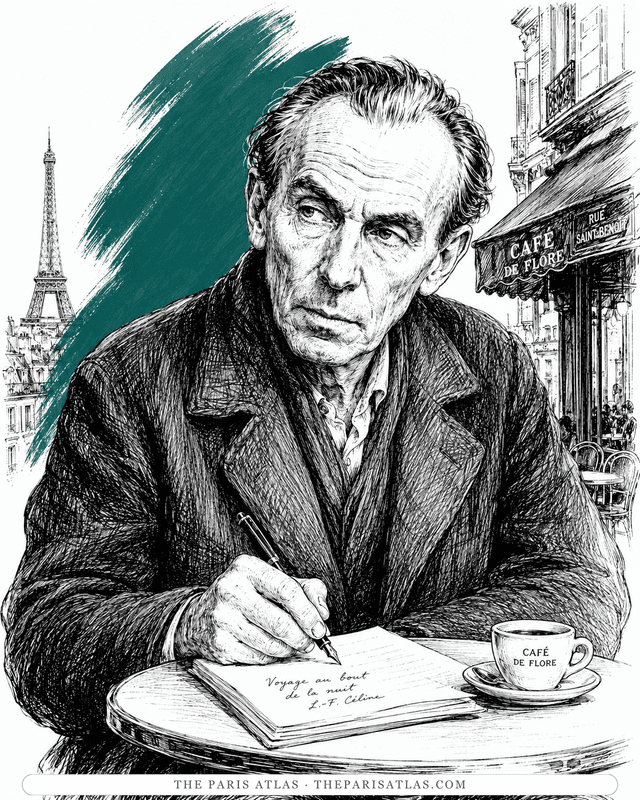
The doctor of the Paris slums who wrote the century's blackest, funniest novel — and changed the sound of French prose.
View author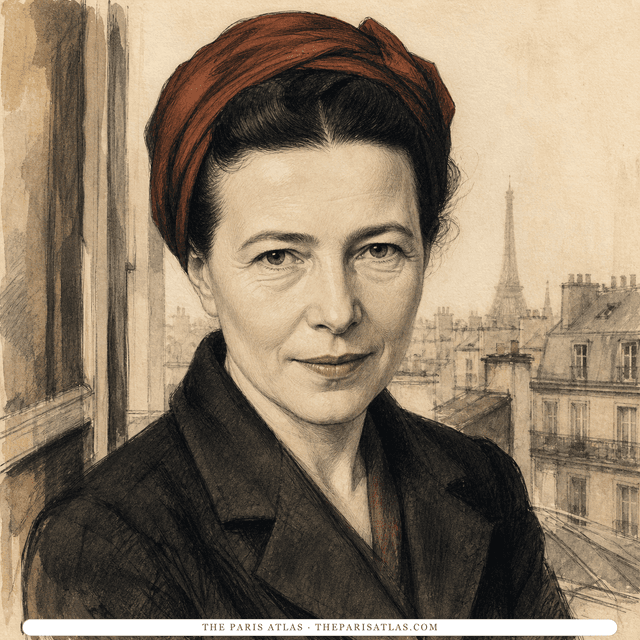
French writer and philosopher whose novels, memoirs, and social analysis examined freedom, gender, responsibility, aging, and the material conditions that shape a life.
View author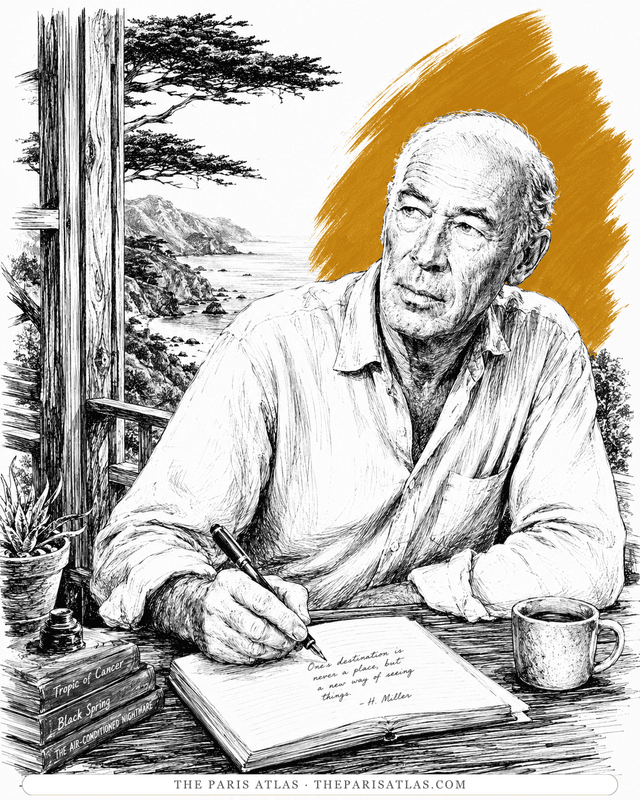
The Brooklyn dropout who arrived in Paris broke at thirty-eight and wrote the exuberant, banned books that ended American censorship.
View authorThe sources below include the primary text, editions, scholarship, archival materials, and other records that informed this page. They document The Waves, its publication, and its place in literary history.

Gale's Novels for Students entry, used for the working title and for Herbert Marder's excerpt on Thoby Stephen, the interludes and the real people behind the six.
Edward Mendelson's textual notes: the British and American publication dates, which text came first, the Albatross edition, the proofs and the notebook drafts.
The 1931 Hogarth Press first edition, read in Edward Mendelson's scan for the plot, the character readings and every quotation. Page numbers throughout refer to this edition.
Full electronic text, read alongside the first edition. At page 93 it has the American edition's comma after "black tie", so it does not follow the Hogarth text exactly.

Mendelson in the Times Literary Supplement on the corrected American proofs at Columbia and the chapter Woolf fixed in proof.
Trudi Tate's lecture extract, which reproduces Woolf's diary entries on finishing the book and on writing to a rhythm, and Leonard Woolf's verdict.
The Virginia Woolf Society of Great Britain's list of principal works: The Waves, 1931, novel.
Places The Waves with Mrs Dalloway and To the Lighthouse as the three novels on which her modernist reputation mainly rests.
BBC Culture poll of 82 critics outside the United Kingdom, December 2015: The Waves at number 16.
Maïca Sanconie on Marguerite Yourcenar's translation: the commission, the meeting with Woolf and the September 1937 publication.
Bibliothèque nationale de France record for the 1937 Paris edition.
Beatriz Vegh on the translation, quoting Yourcenar's preface and its later reprinting.
The Yourcenar society's list of editions of Les Vagues.
Kathleen Shields on the 1993 dispute between the Yourcenar and Wajsbrot translations.
La Colline's education pack for the 2011 Paris production.
Open Library record confirming ISBN 9780156949606 as the 1978 Harvest/HBJ edition.
Library of Congress record confirming ISBN 9780199642922 as the 2015 Oxford World's Classics edition.
Library of Congress record confirming ISBN 9780521852517 as the Cambridge edition.
The primary text represented by this page, used for descriptions of the work’s contents and for any quoted passages shown here.
The primary text is the baseline reference for every book page. Additional references document publication history, interpretation, and historical context where that evidence is available.
 Explore more resources