The Paris AtlasCharting the artists, works, and places worth returning to.
  • Painter
  • Author
  • Educator
· Russian-born; French from 1939 · 1866–1944

Wassily Kandinsky

Russian painter, celebrated as a pioneer of abstract art, who gave up a Moscow law career at thirty to study painting in Munich, co-founded the Blue Rider group in 1911, taught for eleven years at the Bauhaus, the German design school — and spent his last eleven years in a flat in Neuilly-sur-Seine that the French artist Marcel Duchamp had pointed him towards, painting soft cell-like forms nothing like the hard geometry Germany knew him for.

Details

Lived
1866–1944
Born
4 December 1866
Birthplace
Moscow
Died
13 December 1944 · aged 78
Place of death
Neuilly-sur-Seine
Nationality
Russian-born; French from 1939
Profession
Painter and art theorist
Major works
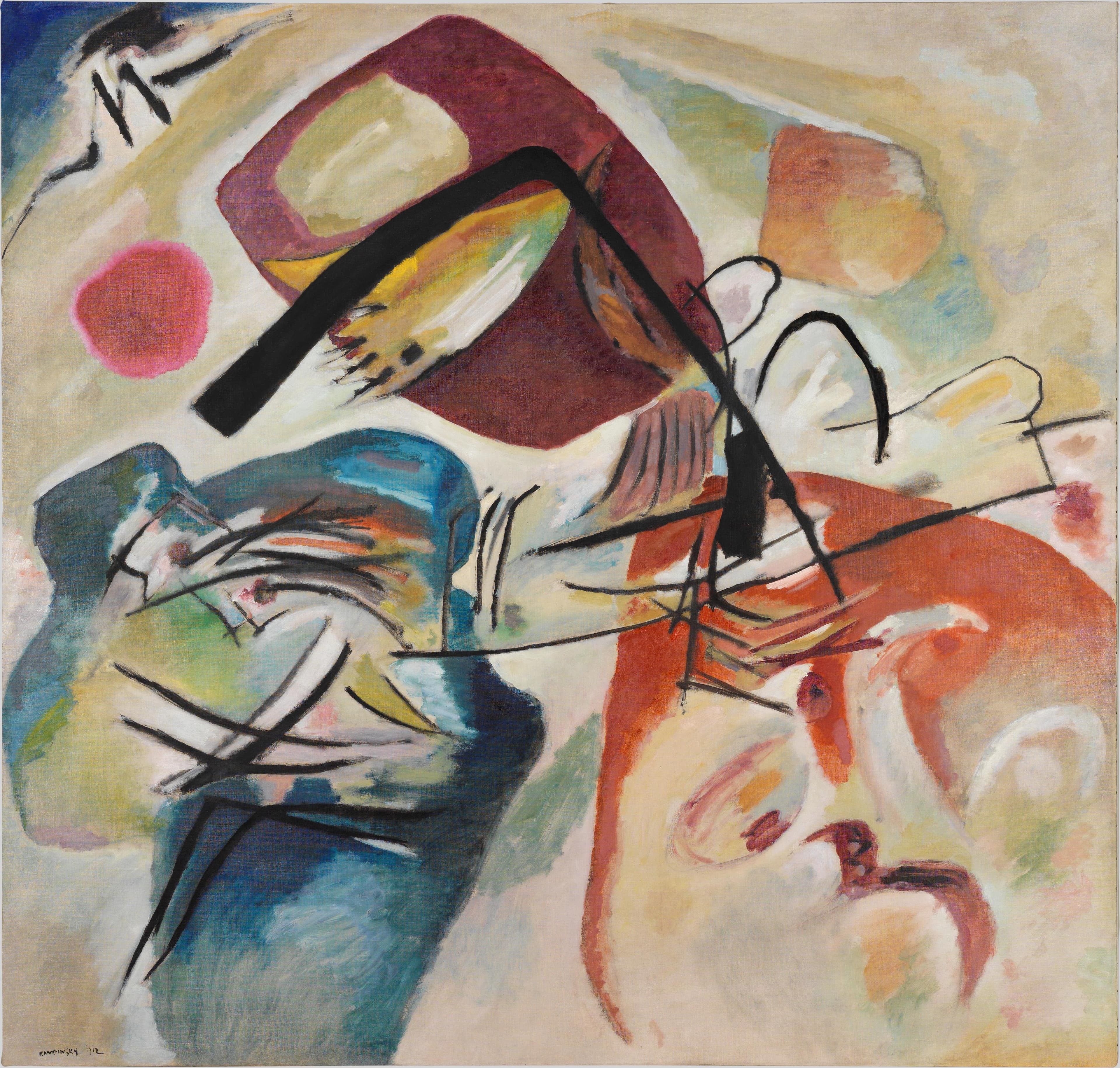
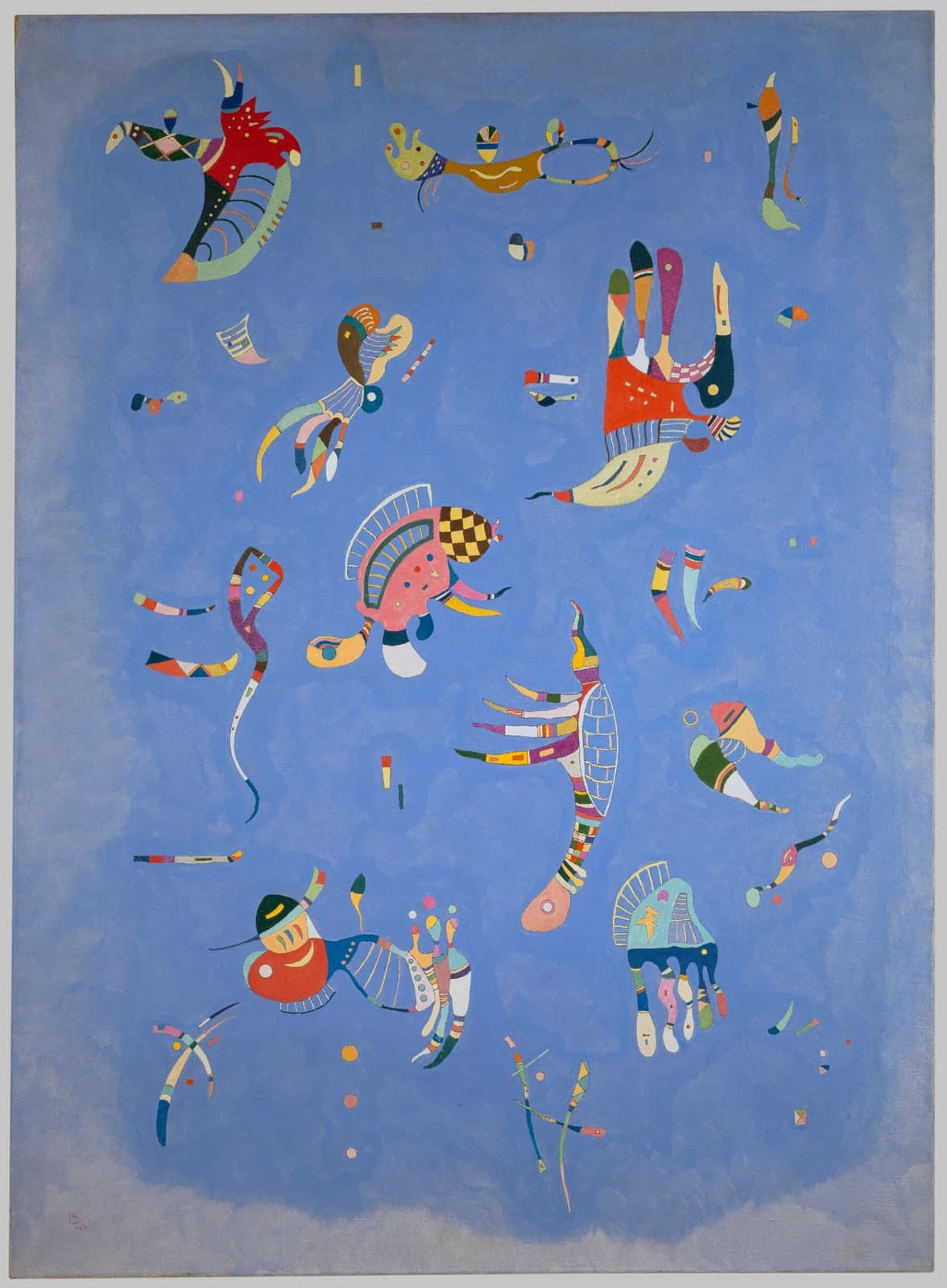
On the Spiritual in Art, Composition VIII, Sky Blue, Delicate Tensions
Roles
PainterAuthorEducator
Also known as
Vasily Kandinsky · Vassily Kandinsky

About Wassily Kandinsky

Wassily Kandinsky spent his twenties as a lawyer. He studied law and economics at the University of Moscow, worked as an academic assistant, and turned down a teaching post — then, at thirty, moved to Munich to learn to paint. What followed made him one of the artists most often named as a founder of abstract art: pictures that gave up on depicting recognizable objects and asked colour and line to do the work alone, backed by a book, On the Spiritual in Art, published in December 1911.

The Paris years are the least familiar part of that life and the last third of it. When the Nazis forced the Bauhaus — the German design school where he had taught since 1922 — to close for good in July 1933, the Kandinskys left Germany. In January 1934 they moved into a new building in Neuilly-sur-Seine, the town on the western edge of Paris, on the recommendation of Marcel Duchamp. Kandinsky took French citizenship in 1939, stayed put when Germany invaded in 1940, and died in Neuilly on 13 December 1944. The painting he did there went soft: biomorphic shapes drawn from magnified photographs of cells and tissue, encouraged by two artist friends from Paris's Surrealist circle — the movement that drew its images from dreams and the unconscious — Joan Miró and Jean Arp.

A lawyer until thirty

Kandinsky was born in Moscow on 4 December 1866. He studied law and economics at the University of Moscow from 1886 to 1892 and stayed on to work in the faculty, and he was offered a university teaching position. He turned it down to go and study art in Munich, which he did in 1896, at thirty — an age at which most painters have been working for a decade. He credited the decision to an exhibition he had seen in Moscow, and to one canvas in it from the Haystacks series by Claude Monet, the French Impressionist painter of fleeting light and open air.

In Munich he trained under the Slovenian painter Anton Ažbe from 1897 to 1899 and at the Academy of Fine Arts under the German painter Franz von Stuck in 1900. From June 1908 he worked between Munich and Murnau, a village in the Bavarian foothills, in the burst of production that took him towards what the Centre Pompidou's own account calls the beginning of his path to a painting without a subject.

The Blue Rider, and painting without a subject

In 1911 Kandinsky and the German painter Franz Marc broke away from the Munich artists' association they belonged to and set up their own. They called it Der Blaue Reiter — the Blue Rider — and it was less a movement with a doctrine than a shared platform: an exhibition, opened in Munich in December 1911, and an almanac, published in May 1912, that printed Bavarian glass painting, children's drawings, African carving and new music beside their own work, on the argument that all of it came from the same place. The painter Gabriele Münter and the graphic artist Alfred Kubin organized it with them.

The same December he published Über das Geistige in der Kunst — On the Spiritual in Art — the treatise that argued a painting could work the way music does, on the nerves and the spirit, through colour and form alone, with no object in it to recognize. The Centre Pompidou describes him as famous both as a pioneer of abstract art and as a theorist of it. He is one of several artists credited with arriving at abstraction around 1910 to 1913, and which canvas came first has been argued over ever since.

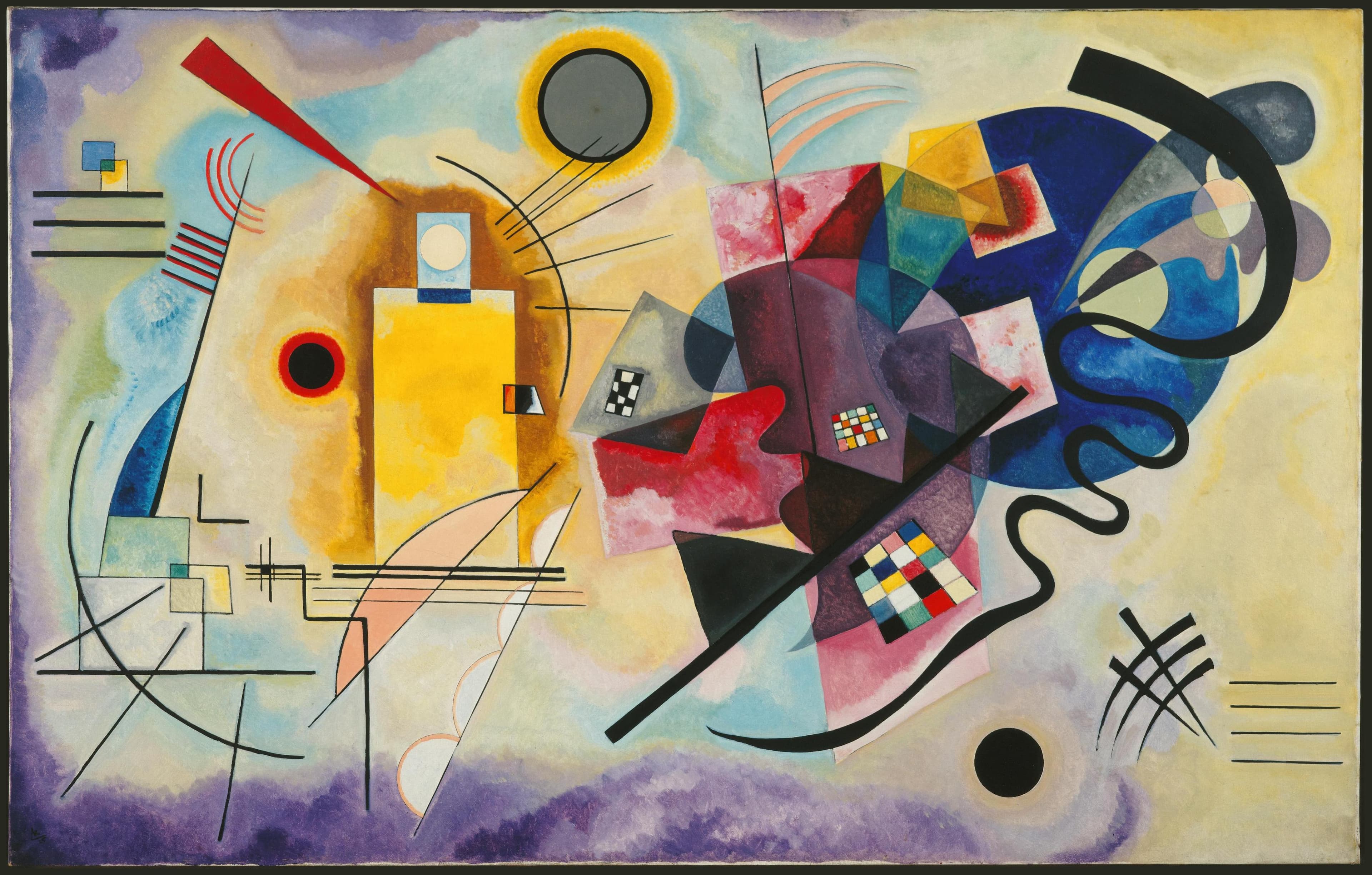
He was in Russia for the 1917 Revolution and its aftermath, and returned to Germany to teach at the Bauhaus, the state design school founded at Weimar, from 1922. The Bauhaus years are the ones that made his textbook reputation: circles, triangles, straight lines and hard-edged colour, taught as a system. In 1937 the Nazi regime seized fourteen of his works from German museums and exhibited them in Munich in Entartete Kunst — 'Degenerate Art' — the show staged to hold modern painting up for public ridicule.

Neuilly-sur-Seine, 1934

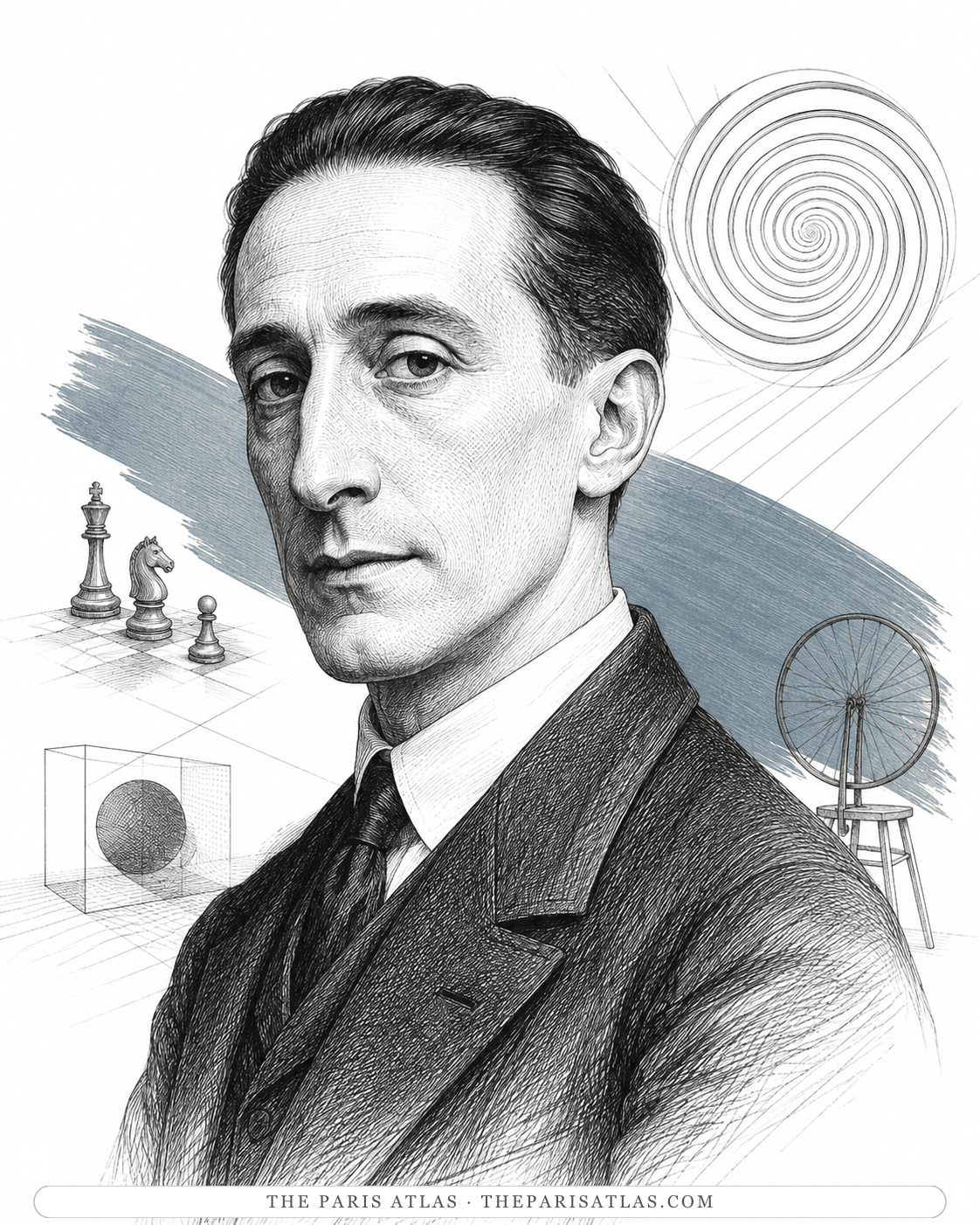
The Bauhaus closed for good in Berlin in July 1933 under Nazi pressure. In December the Kandinskys decided on exile and left for Paris, and in January 1934 they moved into a newly built block in Neuilly-sur-Seine, immediately west of the city — a flat pointed out to them by Marcel Duchamp. Kandinsky was sixty-seven. He showed between 1935 and 1937 with Abstraction-Création, the Paris association of abstract painters, and in exhibitions in New York and London.

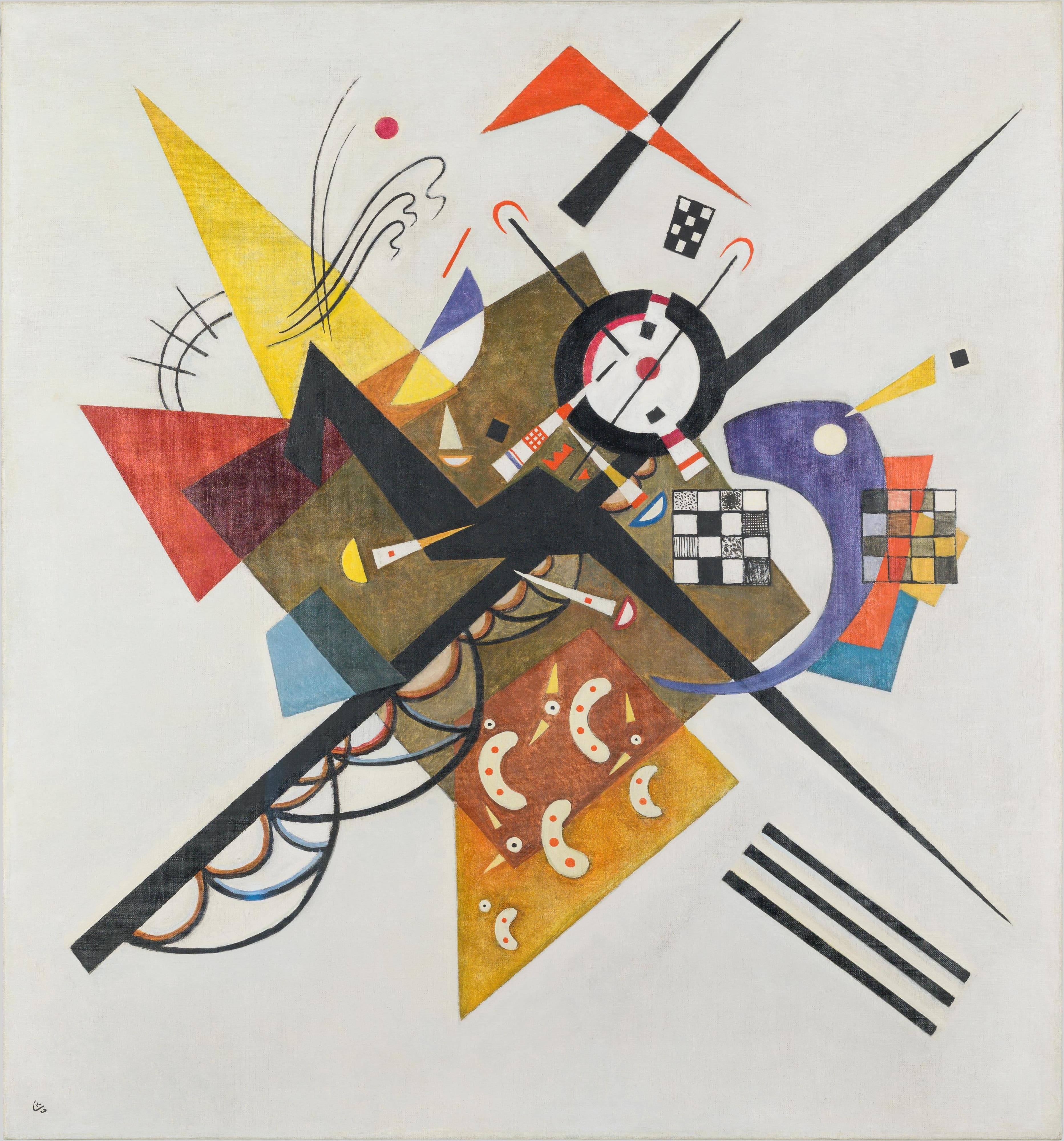
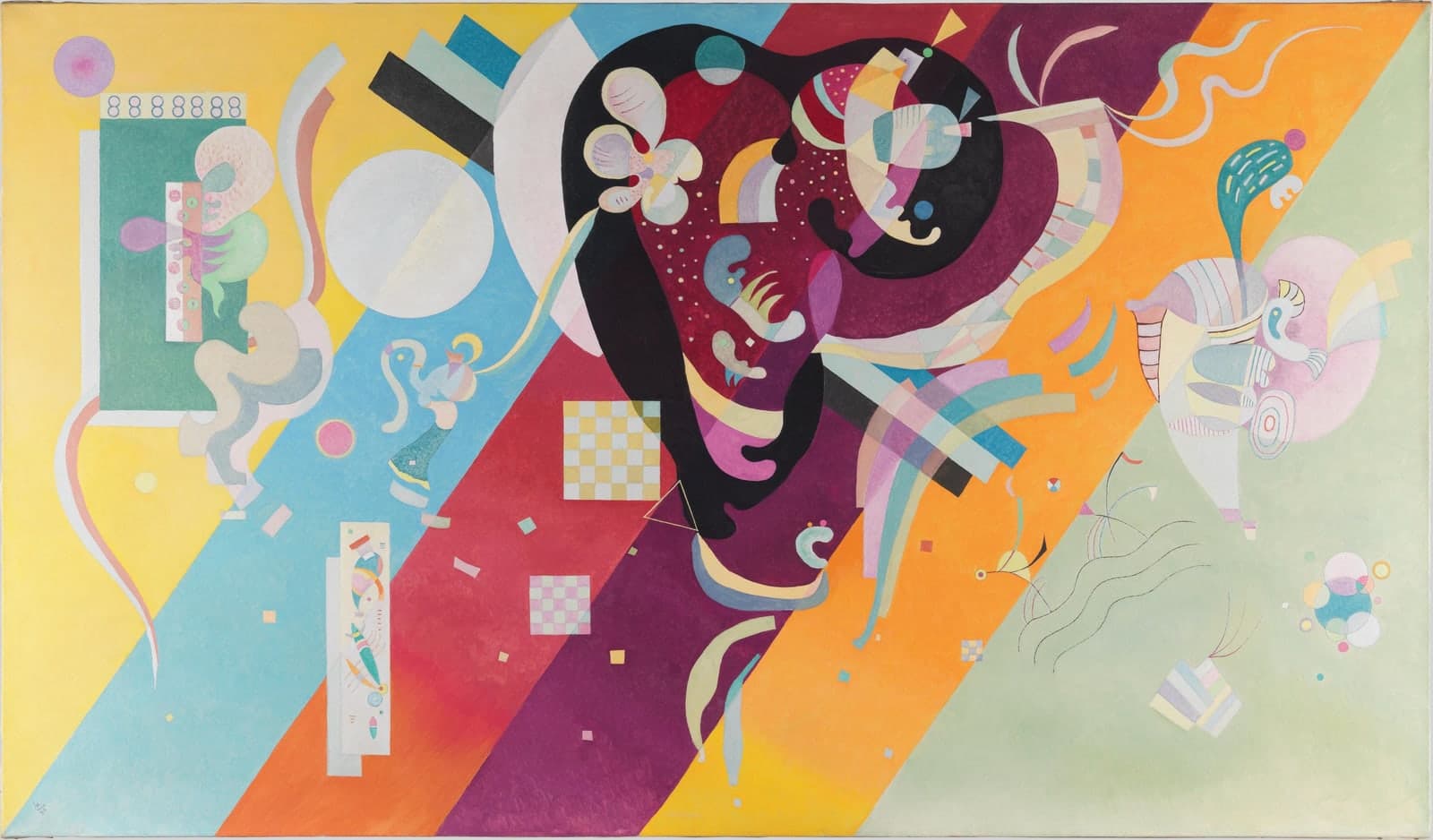
The painting changed in Neuilly, and the change is easy to see without knowing anything about him. The Bauhaus pictures are built from ruled geometry — circles, grids, sharp diagonals. The Paris pictures fill up with soft, rounded, tadpole-and-amoeba shapes that look alive, taken from magnified photographs of cells and tissue, floating on pale grounds. The Pompidou's account names the friends who steered that evolution: the Surrealists he saw in Paris, Joan Miró and Jean Arp above all, whose own vocabulary of curved organic forms was the nearest thing to a model.

The Kandinskys became French citizens in 1939. When Germany invaded France in 1940 they decided to stay in Paris despite the daily difficulties of the occupation, and he went on working: the last large canvas, Delicate Tensions, is dated 1942. He died at Neuilly-sur-Seine on 13 December 1944, some months after the liberation of Paris.

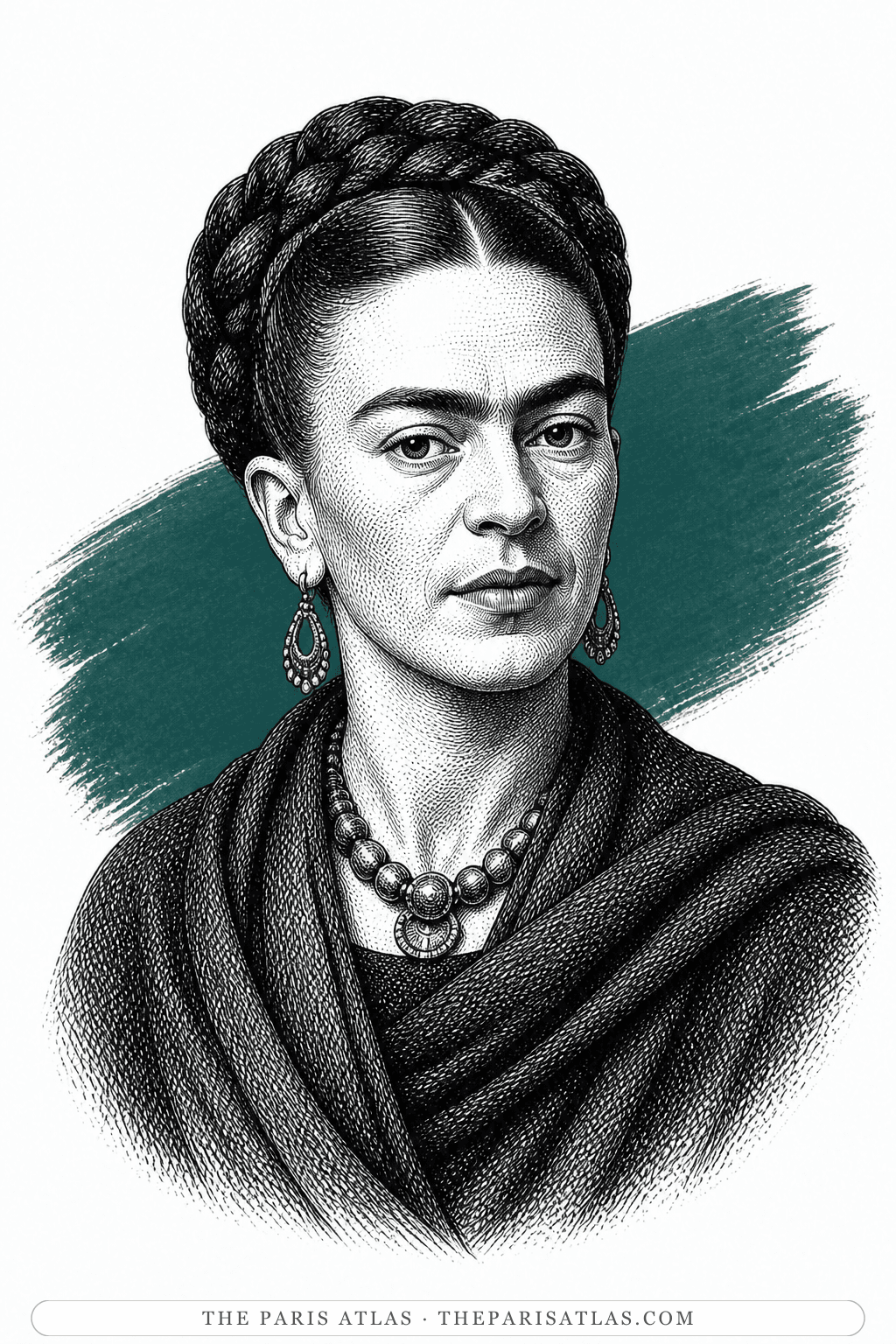
One Paris evening of his last decade is documented from both sides. On 10 March 1939 the Mexican painter Frida Kahlo opened an exhibition at the galerie Renou et Colle, and Kandinsky was among the artists who congratulated her. He wrote about her a week later, on 17 March: she was 'there in person, in Mexican dress — very charming'.

Why the Pompidou holds so much of him

His widow, Nina Kandinsky, gave the bulk of what she had inherited to the French national collections, and that generosity is why the Musée national d'art moderne at the Centre Pompidou holds 1,301 works by him — 110 paintings made between 1900 and 1944, plus hundreds of drawings, watercolours, prints and papers. The Pompidou's research library, which serves the whole museum, is named the Bibliothèque Kandinsky after him.

He was Russian by birth, German for most of his working life, and French only for his last five years, and the Paris decade produced no manifesto and no school — he was in his late sixties and seventies, living in a suburb, through a war. What it produced was the final body of work, and the largest collection of it in the world is a twenty-minute walk from the Seine.

Life events

  1. 1866

    Born in Moscow on 4 December.

    Vasily Kandinsky — artist biography

  2. 1886

    Studies law and economics at the University of Moscow until 1892, then works in the faculty.

    Vasily Kandinsky — artist biography

  3. 1896

    Declines a university teaching position and moves to Munich to study art, at thirty. He credited a Monet Haystacks canvas seen in Moscow with the decision.

    Vasily Kandinsky — artist biography; Kandinsky — dossier pédagogique (exhibition education dossier) (2009)

  4. 1908

    Returns to Munich in June and begins the Murnau years, the turn towards painting without a recognizable subject.

    Kandinsky — dossier pédagogique (exhibition education dossier) (2009)

  5. 1911

    With Franz Marc, leaves the Munich artists' association to found Der Blaue Reiter. The group's first exhibition opens in Munich in December; On the Spiritual in Art is published the same month.

    Vasily Kandinsky — artist biography; Kandinsky — dossier pédagogique (exhibition education dossier) (2009)

  6. 1912

    The Blaue Reiter almanac appears in May.

    Kandinsky — dossier pédagogique (exhibition education dossier) (2009)

  7. 1922

    Begins teaching at the Bauhaus in Weimar.

    Vasily Kandinsky — artist biography

  8. 1933

    The Bauhaus closes for good in Berlin in July under Nazi pressure. In December the Kandinskys leave Germany for Paris.

    Kandinsky — dossier pédagogique (exhibition education dossier) (2009)

  9. 1934

    In January they settle in Neuilly-sur-Seine, in a new building recommended by Marcel Duchamp. The late biomorphic style begins here.

    Kandinsky — dossier pédagogique (exhibition education dossier) (2009)

  10. 1935

    Exhibits with the Paris abstract group Abstraction-Création, and in New York and London, until 1937.

    Kandinsky — dossier pédagogique (exhibition education dossier) (2009)

  11. 1937

    Fourteen of his works, confiscated by the Nazis from German museums, are shown in the Degenerate Art exhibition in Munich.

    Kandinsky — dossier pédagogique (exhibition education dossier) (2009)

  12. 1939

    The Kandinskys obtain French citizenship.

    Kandinsky — dossier pédagogique (exhibition education dossier) (2009); Vasily Kandinsky — artist biography

  13. 1940

    Germany invades France; they choose to remain in Paris through the occupation.

    Kandinsky — dossier pédagogique (exhibition education dossier) (2009)

  14. 1944

    Paints his last large canvas, Delicate Tensions, in 1942, and dies at Neuilly-sur-Seine on 13 December 1944.

    Kandinsky — dossier pédagogique (exhibition education dossier) (2009); Vasily Kandinsky — artist biography

People they knew

Documented connections — every one carries its source.

Frida Kahlo

  • Painter

Met · 1939

Kandinsky, then living at Neuilly-sur-Seine, was among the artists who congratulated Kahlo at the opening of the Mexique exhibition on 10 March 1939. He described her in a letter of 17 March as there in person, in Mexican dress, very charming.

Didier Schulmann, Frida Kahlo in Paris — curated account of the 1939 stay, with dated letters

Illustrated portrait of Marcel Duchamp

Marcel Duchamp

  • Painter
  • Sculptor
  • Filmmaker

Met · 1934

When the Kandinskys left Germany after the Bauhaus closed, the new building they moved into at Neuilly-sur-Seine in January 1934 was one Duchamp had pointed out to them. Kandinsky lived there until his death in 1944.

Kandinsky — dossier pédagogique (exhibition education dossier) (2009)

Who they drew from

Influence running inward — the writers and artists whose work fed theirs. Admiration is not acquaintance; these edges claim neither a meeting nor a friendship.

Illustrated portrait of Jean Arp

Jean Arp

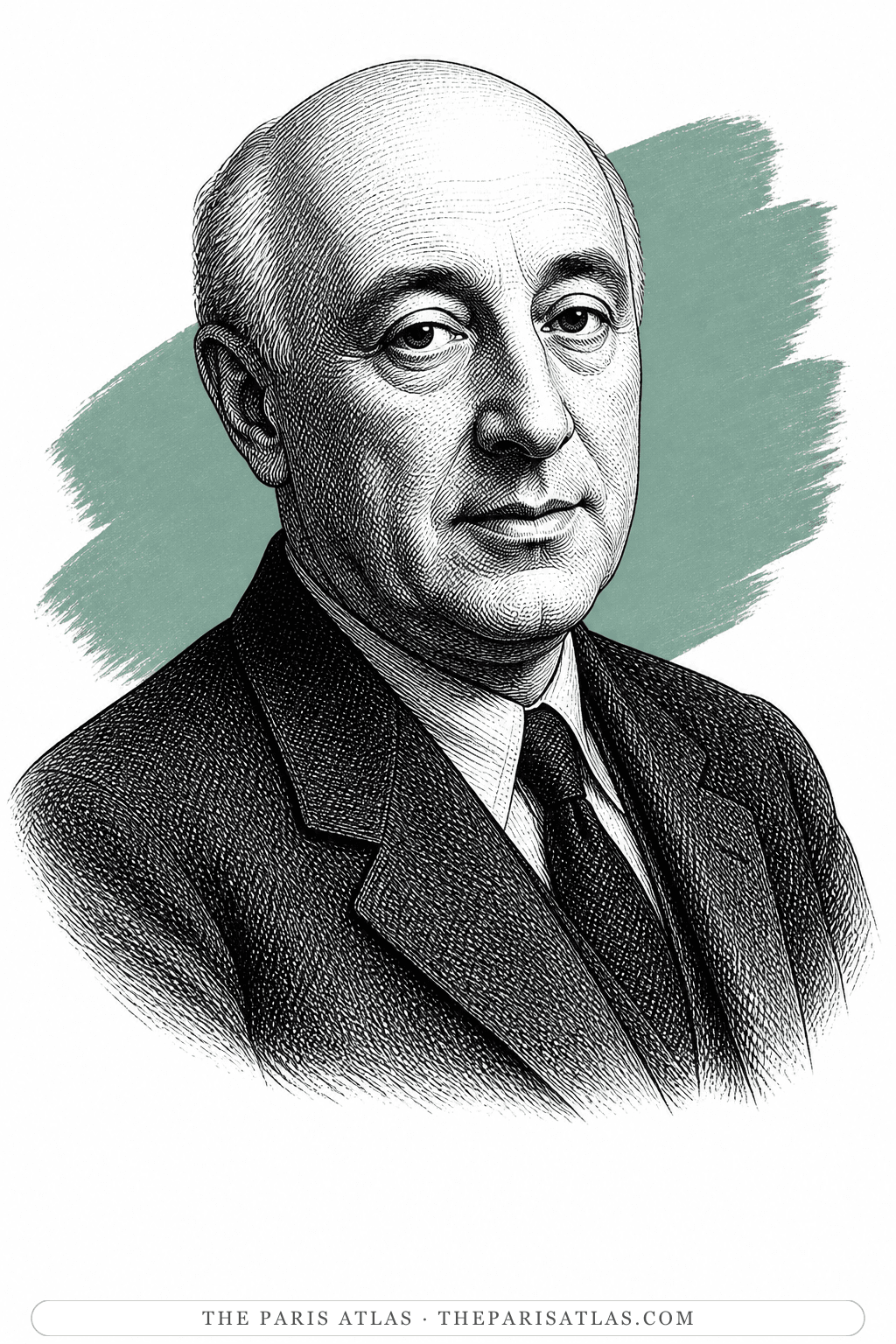
The Centre Pompidou's account of Kandinsky's Paris decade names his Surrealist friends, Arp and Miro in particular, as the artists who most directed his pictorial evolution there - the shift from Bauhaus geometry to the soft biomorphic forms of the late work.

Kandinsky — dossier pédagogique (exhibition education dossier) (2009)

Illustrated portrait of Joan Miró

Joan Miró

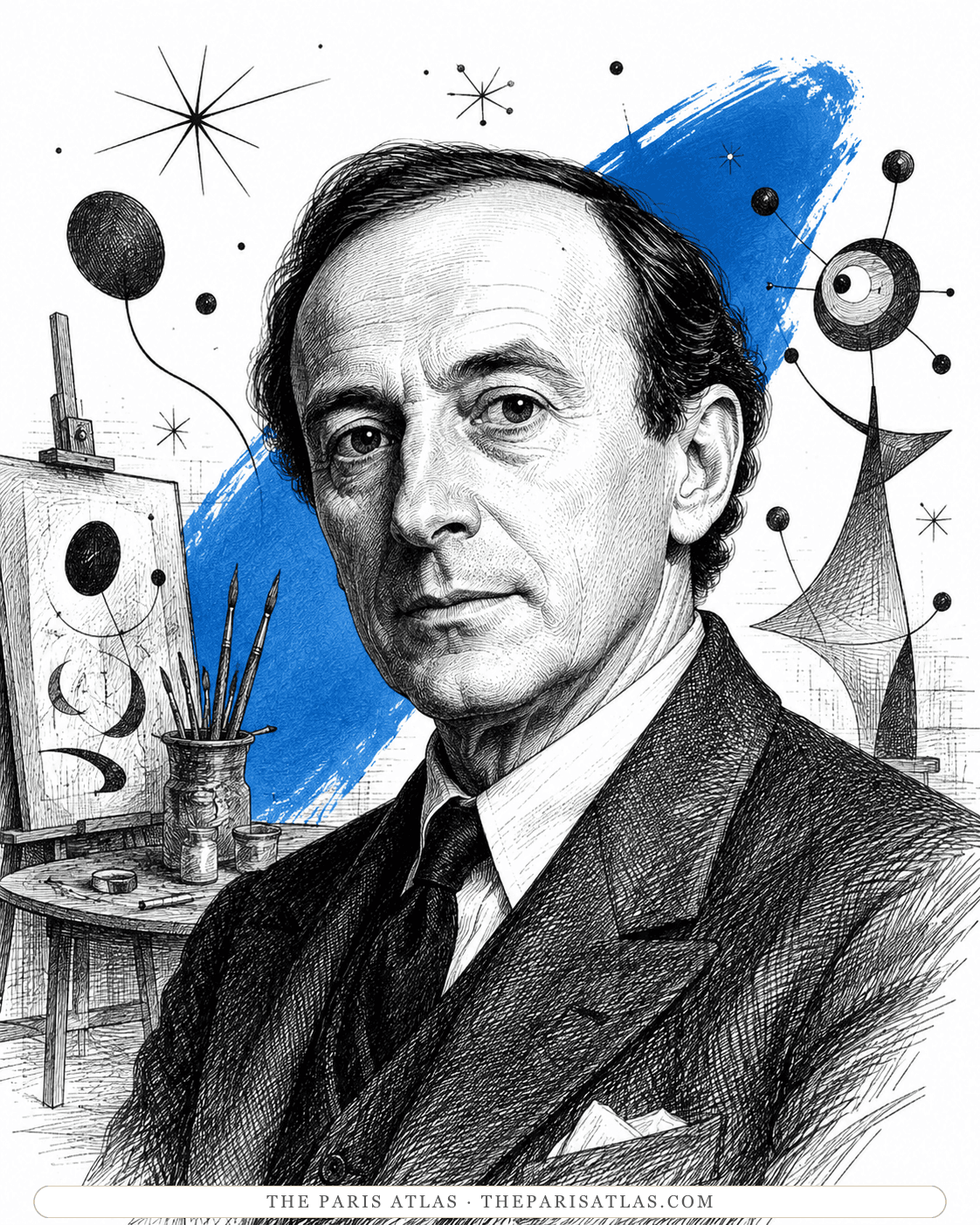
Named with Arp by the Centre Pompidou as the Surrealist friends who most directed Kandinsky's painting during his Paris years, when his forms turned organic and curved after a decade of Bauhaus geometry.

Kandinsky — dossier pédagogique (exhibition education dossier) (2009)

Questions about Wassily Kandinsky

Where did Kandinsky live in Paris?

In Neuilly-sur-Seine, the town immediately west of Paris, from January 1934 until his death on 13 December 1944. The flat was in a newly built block that Marcel Duchamp recommended to him. He had left Germany at the end of 1933, after the Nazis forced the Bauhaus to close.

How is Kandinsky's Paris work different from his Bauhaus work?

The Bauhaus paintings of 1922–33 are geometric: circles, triangles, grids, ruled lines, flat hard-edged colour. The Neuilly paintings are curved and organic — rounded, soft, embryo- and amoeba-like forms, often on pale grounds. He took them from magnified photographs of cells and tissue, and the Centre Pompidou credits his Surrealist friends in Paris, particularly Joan Miró and Jean Arp, with steering the change.

Did Kandinsky paint the first abstract painting?

He is one of the artists most often credited with it, and the Centre Pompidou calls him a pioneer of abstract art, but no single canvas settles the question. His break from recognizable subject matter came gradually between about 1908 and 1913, in Munich and Murnau, and other painters were moving the same way at the same time. His book On the Spiritual in Art, published in December 1911, is the clearest statement of why he thought a picture needed no object in it.

What was the Blue Rider?

Der Blaue Reiter, a group Kandinsky founded in Munich in 1911 with the German painter Franz Marc, after the two of them walked out of the artists' association they belonged to. It was a platform rather than a doctrine: a first exhibition in December 1911, and an almanac published in May 1912 that set Bavarian folk glass painting, children's drawings and non-European carving alongside contemporary art and music. Gabriele Münter and Alfred Kubin helped organize it.

Was Kandinsky French?

He became French in 1939, at seventy-two, five years after moving to Neuilly-sur-Seine and five years before he died there. He was born Russian in Moscow in 1866 and spent his working life in Germany — Munich, then the Bauhaus at Weimar, Dessau and Berlin — before the Nazis closed the school in 1933.

What did Kandinsky do during the German occupation of France?

He stayed. When Germany invaded in 1940 the Kandinskys decided to remain in Paris despite the daily hardships, and he kept working through the war; his last large canvas, Delicate Tensions, is dated 1942. He died in Neuilly-sur-Seine on 13 December 1944, months after the liberation of Paris.

Where can you see Kandinsky's work in Paris?

At the Centre Pompidou, whose Musée national d'art moderne holds 1,301 works by him, including 110 paintings made between 1900 and 1944. Most of it came from his widow, Nina Kandinsky, whose donation is the reason the collection is the size it is. The museum's research library is named the Bibliothèque Kandinsky.

Sourced claims

Every connection the graph holds for Wassily, with the evidence behind it.

Met · 1939

Frida Kahlo

Kandinsky, then living at Neuilly-sur-Seine, was among the artists who congratulated Kahlo at the opening of the Mexique exhibition on 10 March 1939. He described her in a letter of 17 March as there in person, in Mexican dress, very charming.

Didier Schulmann, Frida Kahlo in Paris — curated account of the 1939 stay, with dated letters

Met · 1934

Marcel Duchamp

When the Kandinskys left Germany after the Bauhaus closed, the new building they moved into at Neuilly-sur-Seine in January 1934 was one Duchamp had pointed out to them. Kandinsky lived there until his death in 1944.

Kandinsky — dossier pédagogique (exhibition education dossier) (2009)

Influenced by · 1934–1944

Jean Arp

The Centre Pompidou's account of Kandinsky's Paris decade names his Surrealist friends, Arp and Miro in particular, as the artists who most directed his pictorial evolution there - the shift from Bauhaus geometry to the soft biomorphic forms of the late work.

Kandinsky — dossier pédagogique (exhibition education dossier) (2009)

Influenced by · 1934–1944

Joan Miró

Named with Arp by the Centre Pompidou as the Surrealist friends who most directed Kandinsky's painting during his Paris years, when his forms turned organic and curved after a decade of Bauhaus geometry.

Kandinsky — dossier pédagogique (exhibition education dossier) (2009)

References

References

The sources below include biographies, scholarly essays, interviews, and primary materials that informed this page. They reflect both the historical record and ongoing critical conversations about Wassily Kandinsky and their work.

  1. 1Vasily Kandinsky — artist biography

    Peggy Guggenheim Collection, Venice

    Museum biography — birth and death dates, the law career and declined teaching post, Munich training, the Blue Rider, the Bauhaus, Neuilly and French citizenship.

    View source
  2. 2Kandinsky — dossier pédagogique (exhibition education dossier)

    Centre Pompidou, service éducatif, 2009

    The Centre Pompidou's education dossier: the Monet decision, Murnau, the 1933 exile, Duchamp and the Neuilly flat, the biomorphic late style, the 1937 seizures, and Nina Kandinsky's donation.

    View source
  1. 3Frida Kahlo in Paris — curated account of the 1939 stay, with dated letters

    Centre Pompidou, on Google Arts & Culture

    Quotes Kandinsky's letter of 17 March 1939 describing Frida Kahlo at her Paris exhibition.

    View source
i
Why these sources are here

These references anchor the page in the documented record and in the scholarly conversations around Wassily Kandinsky. Every claim on this page traces back to one or more of the works listed here.

Explore more resources
Browse all authors