Sky Blue
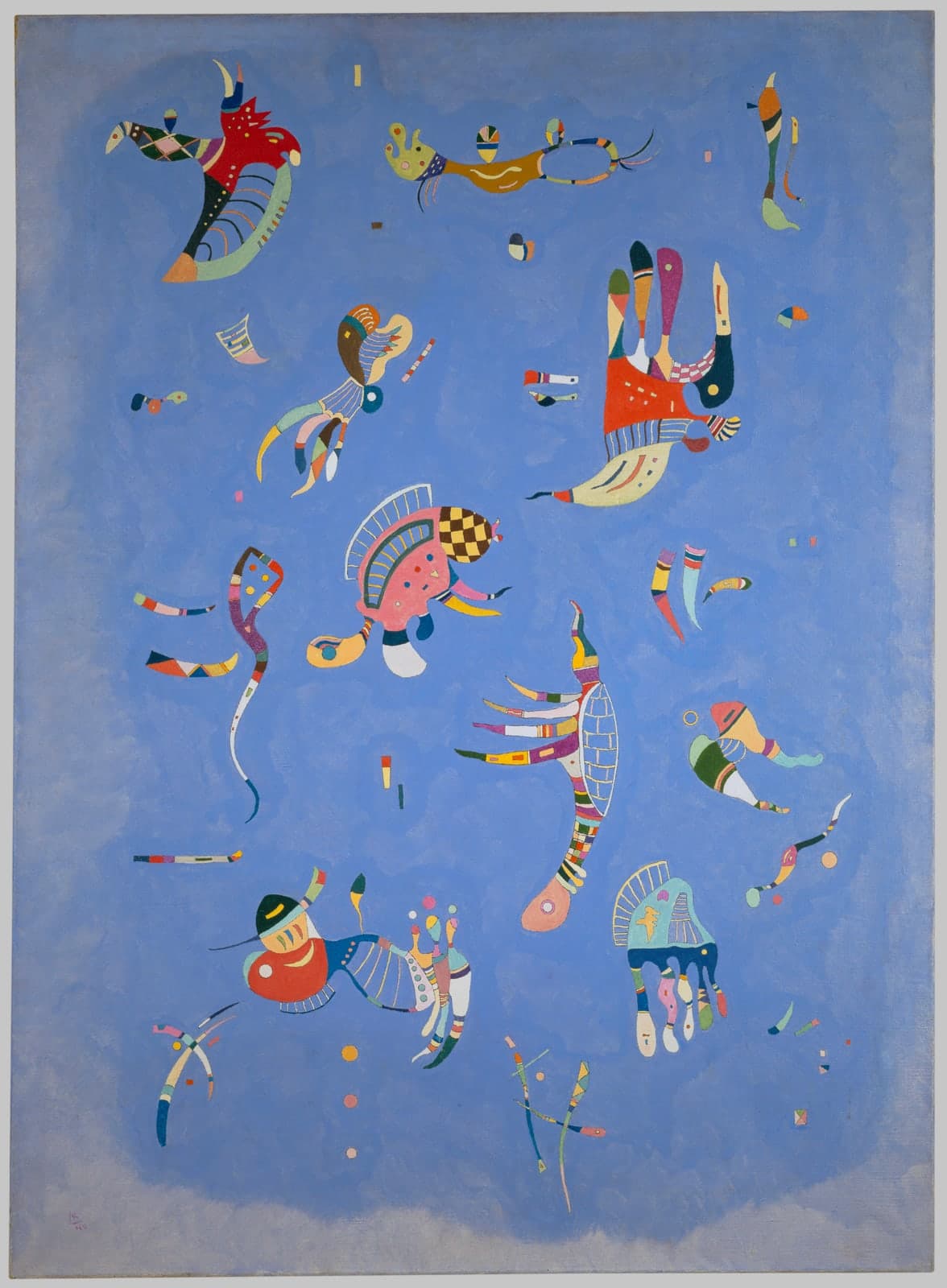
More than a dozen small striped and spotted creatures float on a milky blue ground, none of them touching another. Wassily Kandinsky painted it in his flat at Neuilly-sur-Seine in 1940, the year Germany occupied Paris, after a visit to Joan Miró on the Normandy coast. Nina Kandinsky gave it to the French state in 1976, and it belongs to the Centre Pompidou.
- 1940
- Oil on canvas
- Centre Pompidou, Musée national d'art moderne, ParisParis, France
About Wassily Kandinsky
What the painting shows
The canvas is upright, a metre high, and almost all of it is blue: a mottled, milky mid-blue that pales toward the edges, so the border reads lighter than the middle. On it float small figures, each drawn with a fine outline and filled with stripes, dots, chequers and patches of red, green, yellow, brown and pink. None of them overlaps another and none touches the edge.
At the top left a red-bodied creature with a serrated crest, a lattice body and a fan-shaped green tail leans into the picture. A brown one with a large open loop in its body lies along the top. At the right a striped figure hangs upside down, its patterned legs in the air and a cream tail sweeping to the left. Near the centre a pink form wears a brown-and-yellow chequered cap and a crest of fine cream lines.
Lower down are a crab-like creature with a cross-hatched oval body and striped legs, a red beetle with a green dome and three buds on stalks, and a pale blue-green dome with five drops hanging from it. Smaller bars, discs and crossed sticks fill the gaps. Kandinsky's monogram and date, VK 40, sit at the lower left, the only marks with straight edges.
The sky over Mont Valérien
Christian Derouet, the Centre Pompidou's Kandinsky curator, writes that in Sky Blue the compartments of the earlier work have gone. The ground, he says, is a milky, nuanced, falsely neutral blue, the atmospheric blue of the sky above Mont Valérien that the painter could see through his studio window. Kandinsky had lived since January 1934 in a flat at Neuilly-sur-Seine, on the western edge of Paris, which Marcel Duchamp had pointed him toward.
Derouet takes the title as a statement of priority: the painter puts the ground before the biomorphic forms suspended in it, and it is a mistake, he says, to amuse oneself detailing the little beings invited to the party. The one thing in the picture that keeps any geometric stiffness is the monogram at the lower left.
The museum's short notice gives the year's other source. In 1940 Kandinsky visited Joan Miró at Varengeville-sur-Mer, on the Normandy coast, and after that visit borrowed from him what the museum calls the colour of his dreams and the constellations of biomorphic forms. Miró was painting his Constellations series there at the time, and the Pompidou's account of the late style says Kandinsky went to see them with the painter Alberto Magnelli.
Cells, tapestries and the Occupation
The forms had two more sources. The Pompidou's 2009 exhibition dossier says Kandinsky drew his late shapes from macrophotographs of cells and tissue, the kind that need a microscope. Derouet adds old tapestries seen in Paris: in 1942 and 1943 Kandinsky drew mille-fleurs patterns, scatterings of small forms, for a luxury fabric edition run by Jean Bauret and the Société industrielle de la Lys.
Germany invaded France in May 1940 and Paris fell in June. The Kandinskys stayed, and Derouet writes that the Occupation shut them up in their building at Neuilly. He describes the painting's affinities with cells and amoebas as giving it a wonderfully optimistic atmosphere at a time when there was little to be optimistic about. Kandinsky's last visit to the dealer Jeanne Bucher, in 1943, was to see paintings by Miró.
Exhibitions and where it is
The canvas is number 673 in Kandinsky's own handlist, written on the back, and number 1111 in the catalogue raisonné by Hans K. Roethel and Jean K. Benjamin. It was shown at the Palais des Papes in Avignon in 1947, three years after the painter's death, and Nina Kandinsky gave it to the French national collection in 1976; its inventory number is AM 1976-862.
It has travelled widely since: to Milan in 2013, where it was on the catalogue cover, to Grenoble in 2016 for the exhibition on the Paris years, and to Beijing in early 2026. The Pompidou building in Paris closed on 22 September 2025 for a renovation scheduled to last until 2030. As of September 2026 the museum lists the painting as on loan to the Palazzo Bonaparte in Rome for the exhibition Kandinsky, from 15 September 2026 to 14 February 2027.
Close reading
Reading the work, detail by detail
The picture is a blue ground and a scatter of small creatures, none touching. Christian Derouet of the Centre Pompidou calls it a mistake to detail the little beings one by one, and close view does exactly that: each figure on its own, with its stripes, dots and chequers, and the mottled blue around it.
1.A red creature with a serrated crest
The creature at the top left has a cream head with an orange eye and a dark cap. Its body is dark green under a tan lattice set with pink and blue diamonds, and a magenta band joins it to a red section with a serrated crest and a blue horn with a pale tip. Its tail is dark green with pale dots, and a pale green fan striped with orange arcs curves down to an orange foot.
2.A brown creature with an open loop
The brown creature lies along the top of the canvas. Its head is a small striped pear, its collar is blue and yellow, and its body opens into a large loop, striped along the rim, with three thin whiskers trailing off to the right. A cream crescent marks its underside.
3.A striped figure hangs upside down
The figure at the right is upside down. Its legs point upward, one olive green, one capped in black and white, one magenta, one cream with a striped ankle. The body is orange-red with a pink chequered patch and a yellow disc, and a cream tail striped with dark lines sweeps off to the lower left. A striped knob sits at its hip.
4.A pink form in a chequered cap
The pink form near the centre wears a chequered cap of brown and yellow, and a crest of fine cream lines fans out above it. A second fan of yellow lines lies inside the pink, ringed in dark green, with two blue dots, a red dot and a yellow triangle beside it. Below hang a navy-and-white leg and a small blue foot, a yellow shoe with a teal disc sits at the lower left, and a yellow-and-pink striped tusk points to the right.
5.A cross-hatched body with striped legs
The body is an upright oval filled with a net of dark lines like brickwork. Five or six striped legs fan out to the left in white, black, magenta, orange and yellow. A striped spine runs down from the body to a pink foot with a white ring at its end.
6.A red beetle with buds on stalks
The creature at the lower left has a dark green dome, a cream face striped in orange and yellow, and a red body with a white disc on it. Blue wings dotted with black reach to the right into a cream fan of ribs, and three buds, magenta, pink and cream, stand on stalks above the fan. Cream legs hang below.
7.A dome with striped drops hanging from it
The dome is pale blue-green with a comb of cream lines along its crest, a small ochre animal shape and a magenta spot inside it, and a second fan of lines at its right. A dark navy hem runs along its base, and five drops hang from the hem, two cream, one pink, one green and one red, each with a striped collar. Nothing touches it.
8.The blue pales at the edge, and the monogram
The blue is not flat. It is mottled and brushed, and toward the edges it pales to a lighter band, so the middle of the canvas reads darker than its border. Kandinsky's monogram and the year, VK 40, sit in the corner on that lighter blue, drawn in straight strokes.
Timeline
1934
In January the Kandinskys move into a new building at Neuilly-sur-Seine, recommended by Marcel Duchamp.
1940
Visits Joan Miró at Varengeville-sur-Mer and paints Sky Blue, number 673 in his handlist. Germany occupies Paris in June; the Kandinskys stay.
1942
Draws mille-fleurs patterns for a luxury fabric edition run by Jean Bauret and the Société industrielle de la Lys, through 1943.
1943
Makes his last visit to the dealer Jeanne Bucher, to see paintings by Miró.
1944
Dies at Neuilly-sur-Seine on 13 December.
1947
Shown at the Palais des Papes in Avignon in Peintures et sculptures contemporaines, as number 75.
1976
Given to the French national collection by Nina Kandinsky; inventory number AM 1976-862.
2016
Shown at the Musée de Grenoble in Kandinsky, 1933–1944: les années parisiennes.
2026
On loan to the Palazzo Bonaparte in Rome for the exhibition Kandinsky, until 14 February 2027.
Where to see it
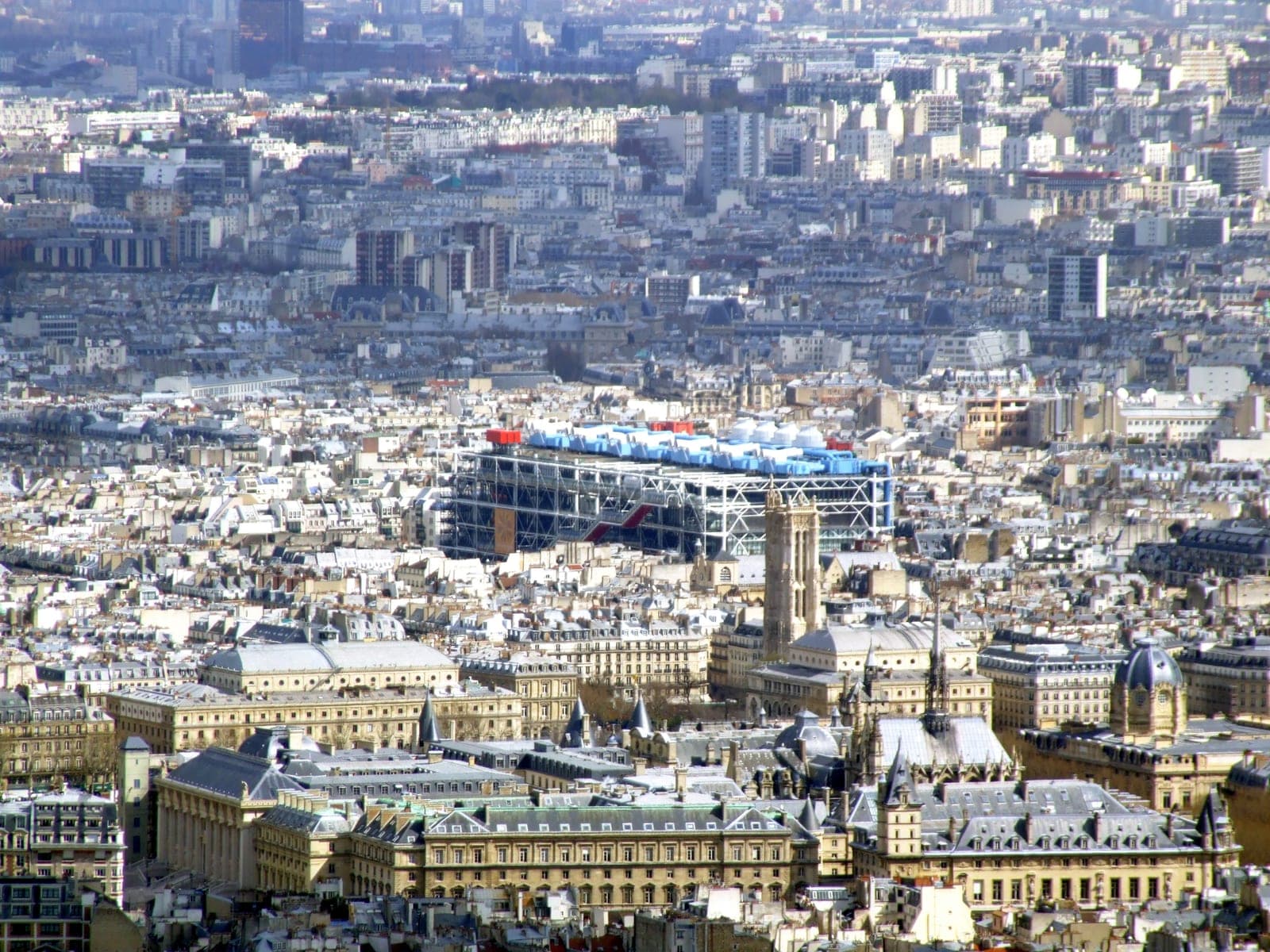
Centre Pompidou, Musée national d'art moderne, Paris
Place Georges-Pompidou, 75004 Paris, France
The Paris building is closed for renovation, with reopening planned for 2030. Check the museum’s off-site programme; this address is not currently a viewing location for the collection.
The Pompidou building is closed for renovation until 2030. As of September 2026 the museum lists the painting as on loan to the Palazzo Bonaparte in Rome for the exhibition Kandinsky, 15 September 2026 to 14 February 2027.
Plan your visitFrequently asked questions
Where is Sky Blue?
It belongs to the Centre Pompidou in Paris, inventory number AM 1976-862. The Pompidou building closed for renovation in September 2025 and is due to reopen in 2030. As of September 2026 the painting is on loan to the Palazzo Bonaparte in Rome, in the exhibition Kandinsky, until 14 February 2027.
Why is it called Sky Blue?
Christian Derouet of the Centre Pompidou says the ground is the atmospheric blue of the sky above Mont Valérien, the hill Kandinsky could see from his studio window at Neuilly-sur-Seine. He reads the title as putting that ground before the small forms floating on it.
What are the creatures in Sky Blue?
Invented forms, outlined and filled with stripes, dots and chequers. The Centre Pompidou's dossier traces Kandinsky's late shapes to macrophotographs of cells and tissue, and Derouet mentions their affinity with cells and amoebas and with old tapestries. The museum also links them to the constellations of biomorphic forms in Joan Miró's work, which Kandinsky saw at Varengeville in 1940.
Was Sky Blue painted during the Occupation?
It is dated 1940, the year Germany invaded France and occupied Paris. The Kandinskys stayed in their flat at Neuilly-sur-Seine, and Derouet writes that the Occupation shut them up in their building there. The museum's story on the late work calls the painting a reaction to the war that had just broken out.
How is Sky Blue different from Kandinsky's Bauhaus paintings?
The Bauhaus canvases of the 1920s are built from ruled geometry: circles, wedges, straight bars. Sky Blue has no straight edge except the monogram. Its forms are rounded, striped and organic, and Derouet says the compartments of the earlier work have disappeared.
How big is Sky Blue?
100 by 73 centimetres, an upright canvas about three feet three by two feet five. It is monogrammed and dated VK 40 at the lower left, with the handlist number 673 on the back.
Who gave it to the museum?
Nina Kandinsky, the painter's widow, in 1976, the year before the Centre Pompidou opened. Her gifts and bequest are the reason the museum holds 110 Kandinsky paintings.
More by Wassily Kandinsky
If you like Wassily Kandinsky
Explore painters from the same movements and circles.
Rosa Bonheur
At the horse markets of Paris and in her studio beside the forest of Fontainebleau, Rosa Bonheur gave animals the presence of great portrait subjects. The success of The Horse Fair helped her build a life shaped by her work, financial independence, and the women she loved.
View artist
William S. Burroughs
American Beat novelist, essayist, performer and visual artist who completed Naked Lunch at the Beat Hotel in Paris and made cut-up writing a defining avant-garde method.
View artist
Leonora Carrington
English painter and writer who fled a debutante's future for Surrealist Paris at twenty, survived the war's wreckage of that life — internment for her lover Max Ernst, an asylum in Spain for her — and rebuilt herself in Mexico into one of the century's great painters of the uncanny.
View artist
References
The sources below include collection records, catalogues, scholarly research, and primary materials that informed this page. They document Sky Blue, its making, and its place in cultural history.

1Bleu de ciel, 1940 — Vassily Kandinsky
WebsiteCentre Pompidou, Musée national d'art moderne — collection record, with the notice by Christian Derouet (2007)Used forThe museum's record: title, date, size, inscriptions, the Varengeville visit, Mont Valérien, the tapestries and fabric designs, the Occupation, the exhibition list and the current loan.
2Towards Biomorphic Abstraction
WebsiteCentre Pompidou, via Google Arts & CultureUsed forMiró's Constellations, Alberto Magnelli, and the painting as a reaction to the war.
3Kandinsky — dossier pédagogique (exhibition education dossier)
WebsiteCentre Pompidou, service éducatif, 2009Used forThe Neuilly flat of January 1934, Marcel Duchamp, the macrophotographs of cells, and Nina Kandinsky's donation.

4Kandinsky: Catalogue raisonné de l'œuvre peint (two volumes, 1900–1915 and 1916–1944)
NonfictionKarl Flinker, Paris, 1984Used forPublished analysis and historical context used in preparing the Sky Blue page.
5Vasily Kandinsky — artist biography
WebsitePeggy Guggenheim Collection, VeniceUsed forThe decision to stay in France in 1940 and the death at Neuilly-sur-Seine in December 1944.
62025-2030, Centre Pompidou is transforming itself!
WebsiteCentre PompidouUsed forThe closure of the Paris building from September 2025 to 2030.
These references provide the documented foundation for this work's history and interpretation. Claim-level citations remain attached to the specific claims they support.
 Explore more resources