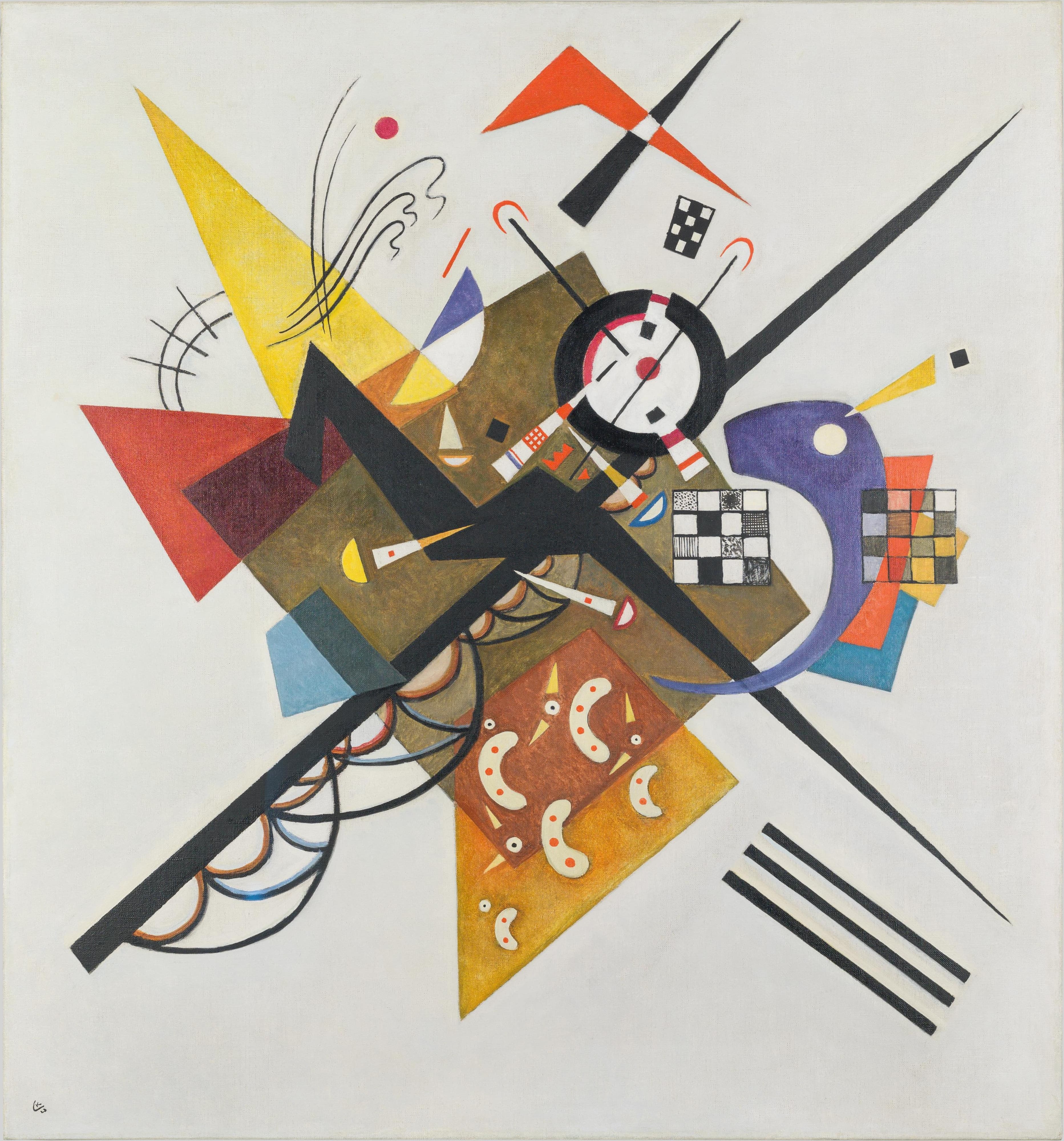
On White II
A black wedge, a yellow spike, a red triangle and a ringed circle fly outward from the middle of a white canvas, and only a violet hook curling back toward the centre slows them. Wassily Kandinsky painted it at Weimar between February and April 1923, in his second year teaching at the Bauhaus, and later hung it in the dining room of his flat at Dessau. It came to the Centre Pompidou with Nina Kandinsky's donation of 1976.
- 1923
- Oil on canvas
- Centre Pompidou, Musée national d'art moderne, ParisParis, France
About Wassily Kandinsky
What the painting shows
The ground is an even off-white, painted flat, with the canvas texture showing through. The shapes on it are hard-edged and most of them point outward. A yellow wedge tapers to a point near the top left corner. A thin black spike runs in from the top right corner, and a second one runs out toward the bottom right. A thick black bar drops to the lower left, with a row of nested semicircles hung along its underside.
The middle of the canvas is a black chevron laid over an olive-brown quadrilateral. Above it to the right sits a black ring with a white centre, a small red disc in the middle and two tiny black squares inside. To its right a violet shape curls back toward the centre, with a cream disc set in its head. Below the chevron, a rust-coloured panel and a yellow-orange one carry cream bean shapes dotted with orange, some with a black-and-white eye.
The remaining marks are small and exact. At the left a red triangle holds a dark wine rhombus, and at the top an orange chevron sits beside a thin black spike. There are three checkerboards of different kinds, a bundle of thin curling black lines beside the yellow wedge, and three parallel black bars at the lower right. Kandinsky's monogram and the date, VK 23, sit in the bottom left corner.
Flying apart, held by one hook
The Centre Pompidou's notice describes forms with sharp angles flying apart along diagonals under centrifugal force. Only the violet form curving back toward the centre, it says, seems to slow that movement. The picture follows a watercolour of 1922, also in the Pompidou, closely enough for the museum to call it a faithful repetition.
The museum also calls it one of Kandinsky's most Suprematist works. Suprematism was the Russian movement that Kazimir Malevich launched in 1915, built from flat geometric shapes on white grounds. Kandinsky had spent the years from 1914 to 1921 in Russia and knew that work at first hand before he returned to Germany.
Weimar, then a dining room in Dessau
Kandinsky joined the Bauhaus, the German design school, as a teacher in 1922, and the Pompidou dates the canvas to February to April 1923 at Weimar, where the school then was. The museum's short text calls it the painting that opened a new period, the geometric work of his Bauhaus years.
When the school moved to Dessau in 1925, Kandinsky chose this canvas for the dining room of his own flat there. That is the museum's account, and it is why the painting stayed with him rather than going to a collector. It remained with his widow, Nina Kandinsky, after his death at Neuilly-sur-Seine in December 1944.
Exhibitions and where it is
Nina Kandinsky gave the painting to the French national collection in 1976, the year before the Centre Pompidou opened; its inventory number is AM 1976-855. It has travelled often since. It went to the Museum of Modern Art in New York in 2009 for Bauhaus 1919–1933: Workshops for Modernity, to Milwaukee and Nashville in 2014, and to Madrid in 2015. In 2024 it was on the catalogue cover at the H'ART Museum in Amsterdam.
The Pompidou building in Paris closed on 22 September 2025 for a renovation scheduled to last until 2030. As of September 2026 the museum lists the painting as on loan to the Palazzo Bonaparte in Rome for the exhibition Kandinsky, from 15 September 2026 to 14 February 2027.
Close reading
Reading the work, detail by detail
Every shape sits on a flat off-white ground and almost every one points outward. Close view shows the hard edges Wassily Kandinsky gave them at the Bauhaus, the one violet form that curls back, and the small exact marks, checkerboards and bean shapes, that fill the spaces between the big ones.
1.A black ring with a red centre
The ring is a heavy black circle around a white disc. At its centre a small red disc sits inside a thin red ring, and two small black squares lie above and below it. A thin black line crosses the disc on a diagonal, and a short black wedge cuts in from the left. It is the one closed form in the picture.
2.The yellow wedge and a bundle of curling lines
The yellow wedge tapers to a point near the top left corner and widens toward the middle. Beside it a bundle of thin black lines sweeps upward and breaks into three wave-like curls, with a small crimson dot above them. Two black arcs crossed by radial lines sit lower down, like a fan.
3.A black chevron over olive brown
The black chevron has its point at the upper left and opens toward the lower right. It lies over an olive-brown quadrilateral, and small shapes crowd its edges: a yellow half-disc, a cream rod with red bands, a tiny black square, a blue-and-white fan. It is the darkest and heaviest mass on the canvas.
4.A red triangle with a wine-dark rhombus inside
The red triangle points to the left edge. Inside it a rhombus of dark wine red is set off by a thin margin of the lighter red. Behind it the olive-brown shape continues, and the lower arm of the black chevron passes below.
5.The violet hook curls back toward the centre
The violet shape is rounded at its head, where a cream disc sits, and curls back down toward the centre of the canvas. A yellow wedge with a thin line at its tip points up and away from it, and a tiny black square floats to the right. The Centre Pompidou reads this form as the one that slows the outward movement.
6.Semicircles hang under the black bar
The thick black bar runs down to the lower left and ends in a blunt square end. Along its underside hangs a row of semicircles, nested inside each other in black and grey with orange, red and blue rims. They grow larger toward the middle of the bar.
7.Cream bean shapes with orange dots
The rust-coloured panel carries cream bean shapes, each dotted with orange and outlined in a thin dark line. Small yellow triangles and black-and-white eye shapes sit between them. The yellow-orange panel below carries two more of the beans. They are the only rounded, soft-edged forms on the canvas.
8.Three parallel bars and a black spike
Three black bars run parallel on the same diagonal, each with a thin white edge, and stop short of the corner. Above them a thin black spike tapers from the centre of the picture to a point near the right edge. The white ground around them is bare.
9.Three checkerboards of different kinds
Three grids sit in the right half. A small black-and-white one hangs above the ring. A larger nine-cell grid below it mixes plain black and white squares with dotted and hatched ones. To its right a coloured grid runs through yellow, ochre, grey, brown and red.
Timeline
1922
Begins teaching at the Bauhaus in Weimar and paints the watercolour the canvas would follow.
1923
Paints On White II at Weimar between February and April; monogrammed and dated VK 23 at the lower left.
1925
The Bauhaus leaves Weimar for Dessau. Kandinsky hangs the canvas in the dining room of his flat there.
1976
Given to the French national collection by Nina Kandinsky; inventory number AM 1976-855.
2009
Shown at the Museum of Modern Art, New York, in Bauhaus 1919–1933: Workshops for Modernity.
2024
On the cover of the catalogue of the Amsterdam exhibition Kandinsky, pioneer of abstract art, at the H'ART Museum.
2026
On loan to the Palazzo Bonaparte in Rome for the exhibition Kandinsky, until 14 February 2027.
Where to see it
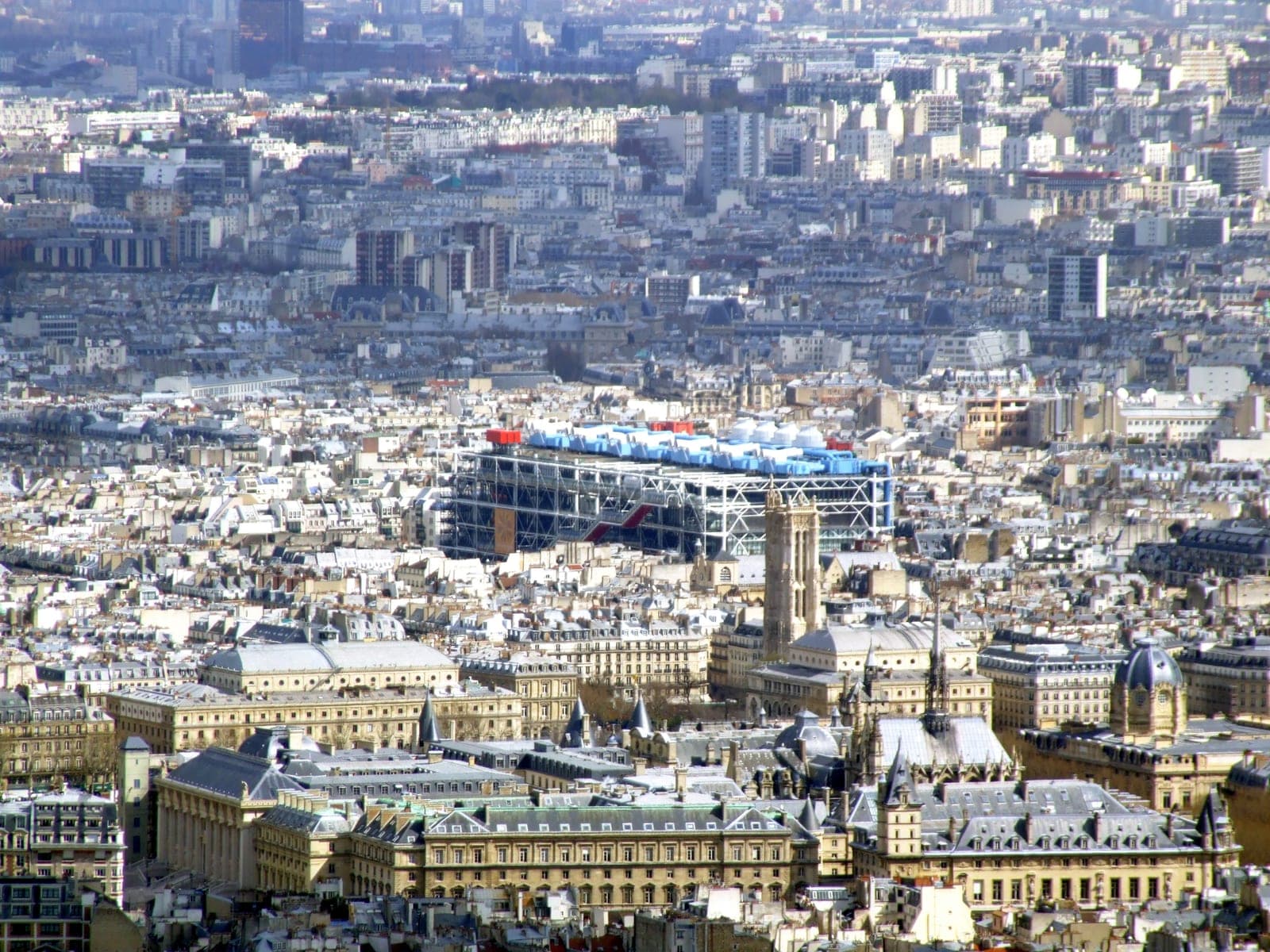
Centre Pompidou, Musée national d'art moderne, Paris
Place Georges-Pompidou, 75004 Paris, France
The Paris building is closed for renovation, with reopening planned for 2030. Check the museum’s off-site programme; this address is not currently a viewing location for the collection.
The Pompidou building is closed for renovation until 2030. As of September 2026 the museum lists the painting as on loan to the Palazzo Bonaparte in Rome for the exhibition Kandinsky, 15 September 2026 to 14 February 2027.
Plan your visitFrequently asked questions
Where is On White II?
It belongs to the Centre Pompidou in Paris, inventory number AM 1976-855. The Pompidou building closed for renovation in September 2025 and is due to reopen in 2030. As of September 2026 the painting is on loan to the Palazzo Bonaparte in Rome, in the exhibition Kandinsky, until 14 February 2027.
What does the title On White mean?
It names the ground. Every shape in the picture lies on a flat off-white field, and Kandinsky's German title, Auf Weiss II, says only that: on white, number two.
Why does the Pompidou call it Suprematist?
Because of the flat geometric shapes on a white ground, the hallmark of Suprematism, the Russian movement Kazimir Malevich launched in 1915. Kandinsky had lived in Russia from 1914 to 1921 and seen that work directly. The museum calls the canvas one of his most Suprematist works.
What is the purple shape for?
In the Centre Pompidou's reading it is the one form that curves back toward the centre while everything else flies outward along diagonals, and it seems to slow the movement. On the canvas it is a violet hook to the right of the black ring, with a cream disc set in its head.
Where did the painting hang in Kandinsky's lifetime?
In the dining room of his flat at the Bauhaus in Dessau, according to the Centre Pompidou. He chose it for that room himself after the school moved from Weimar to Dessau in 1925.
Is it based on an earlier work?
Yes. The Pompidou says the canvas faithfully repeats a watercolour of 1922 that is also in its collection.
How big is On White II?
105 by 98 centimetres, a little over three feet each way, so nearly square. It is monogrammed and dated VK 23 at the lower left.
More by Wassily Kandinsky
If you like Wassily Kandinsky
Explore painters from the same movements and circles.
Rosa Bonheur
At the horse markets of Paris and in her studio beside the forest of Fontainebleau, Rosa Bonheur gave animals the presence of great portrait subjects. The success of The Horse Fair helped her build a life shaped by her work, financial independence, and the women she loved.
View artist
William S. Burroughs
American Beat novelist, essayist, performer and visual artist who completed Naked Lunch at the Beat Hotel in Paris and made cut-up writing a defining avant-garde method.
View artist
Leonora Carrington
English painter and writer who fled a debutante's future for Surrealist Paris at twenty, survived the war's wreckage of that life — internment for her lover Max Ernst, an asylum in Spain for her — and rebuilt herself in Mexico into one of the century's great painters of the uncanny.
View artist
References
The sources below include collection records, catalogues, scholarly research, and primary materials that informed this page. They document On White II, its making, and its place in cultural history.

1Auf Weiss II (Sur blanc II), 1923 — Vassily Kandinsky
WebsiteCentre Pompidou, Musée national d'art moderne — collection recordUsed forThe museum's record: title, date and place, size, inscription, the 1922 watercolour, the Dessau dining room, the exhibition list and the current loan.
2Kandinsky : Jaune-rouge-bleu — dossier pédagogique
WebsiteCentre Pompidou, direction des publicsUsed forThe Bauhaus's move from Weimar to Dessau in 1925.
3Vasily Kandinsky — artist biography
WebsitePeggy Guggenheim Collection, VeniceUsed forThe Bauhaus appointment of 1922 and the Russian years.
42025-2030, Centre Pompidou is transforming itself!
WebsiteCentre PompidouUsed forThe closure of the Paris building from September 2025 to 2030.
These references provide the documented foundation for this work's history and interpretation. Claim-level citations remain attached to the specific claims they support.
 Explore more resources