Picture with a Black Arch
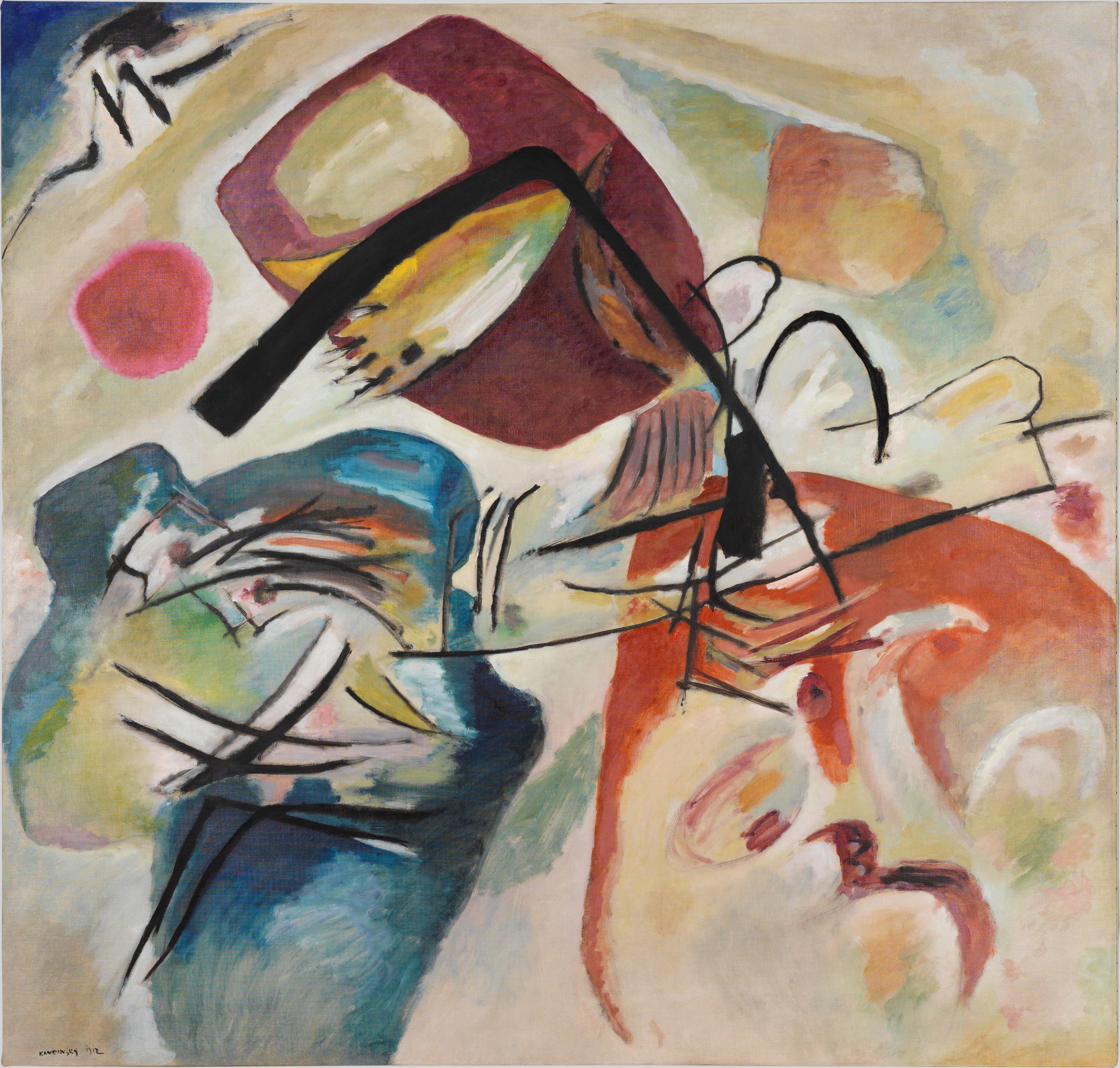
Three masses of colour, one wine-red, one blue and one orange-red, sit at the corners of a triangle on a pale ground, and a thick black arch crosses the upper half of the canvas. Wassily Kandinsky painted it in Munich in the autumn of 1912 and sent it to his first solo exhibition, at the Der Sturm gallery in Berlin, that October. Nina Kandinsky gave it to the French national collection in 1976, and it belongs to the Centre Pompidou in Paris.
- 1912
- Oil on canvas
- Centre Pompidou, Musée national d'art moderne, ParisParis, France
About Wassily Kandinsky
What the painting shows
The canvas is almost square, 189 by 198 centimetres. Its ground is a pale buff, brushed thin enough for the weave to show through, with washes of grey-green and lilac. A wine-red block with a pale window cut into it fills the upper centre. Below it, at the left, a blue mass runs down to the bottom edge, crossed by a tangle of thin black strokes. At the right, an orange-red mass does the same, with a cream hollow and a dark red hook inside it.
The black arch is a single thick stroke. It starts low at the left, about a third of the way down the canvas, climbs across the wine-red block and reaches its highest point just right of centre. Beyond that point it thins into a hooked line that drops into the red mass. Under the arch, a patch of yellow and a fan of short dark strokes sit on the wine-red block.
Smaller marks hold the corners. A rose-pink disc floats at the left, a peach square at the upper right, and a black zigzag on a dark blue ground occupies the top left corner. Kandinsky signed and dated the canvas at the lower left.
The arch and the three masses
The Centre Pompidou's notice describes three blocks of colour ready to collide, kept apart by the arch. The arch, it says, comes from the douga, the wooden shaft-bow of a Russian troika harness, the curved piece that stops three horses from running into one another. Christian Derouet, the museum's Kandinsky curator, adds that the black sign also reads as a triangle set against the near-square of the canvas.
Derouet points to one more habit. Kandinsky breaks the fit between picture and support by nicking the upper left corner with a black zigzag, which Derouet calls a kind of circumflex accent. On the canvas it is the one place where the ground turns dark blue.
A letter to Arnold Schönberg
Kandinsky had heard the composer Arnold Schönberg's music at a concert in Munich on 2 January 1911 and had written to him soon after. On 22 August 1912, with the canvas still being finished, he wrote to Schönberg again. Construction in painting, he said, had so far meant an insistent geometry, and he named Ferdinand Hodler and the Cubists. What he wanted to show was that construction could also be reached, and reached better, on the principle of dissonance.
The Pompidou quotes the letter, which is kept at the Library of Congress in Washington. It is Kandinsky's own account of what the picture was for, written while he was painting it.
Berlin, October 1912
Kandinsky's first solo exhibition opened at Herwarth Walden's Der Sturm gallery in Berlin on 2 October 1912, a day later than planned. The canvas was a late arrival. On 20 September he wrote to Walden that he was keeping back Improvisation 27, which the gallery had shown the previous winter. In its place he was sending Picture with the Black Arch, to hang in room II on the left wall.
After the exhibition the painting stayed with Gabriele Münter, the painter Kandinsky had lived with in Munich. She kept it until 1926, when the former couple settled accounts, and that year it went into temporary storage at the König-Albert-Museum in Zwickau. It reappeared in Paris in 1937, in the exhibition Origines et développement de l'art international indépendant, and again in 1939 in Réalités nouvelles at the Galerie Charpentier.
Where it is
Nina Kandinsky, the painter's widow, gave the canvas to the French national collection in 1976, the year before the Centre Pompidou opened. Its inventory number is AM 1976-852, and it is number 436 in the catalogue raisonné of the paintings by Hans K. Roethel and Jean K. Benjamin.
The Pompidou building in Paris closed on 22 September 2025 for a renovation scheduled to last until 2030. As of September 2026 the museum lists the painting as on loan to the Palazzo Bonaparte in Rome for the exhibition Kandinsky, from 15 September 2026 to 14 February 2027.
Close reading
Reading the work, detail by detail
The canvas is nearly square and most of it is bare buff ground. Wassily Kandinsky puts three masses of colour on it and one thick black arch, then works the corners and the gaps with smaller marks. Close view shows how thin the paint is, how the arch changes from a bar into a line, and how many of the black strokes are drawn rather than painted.
1.One thick stroke crosses the upper half
The arch is one stroke of black, wide enough to read from across a room, laid over the wine-red block. It rises from the left, about a third of the way down the canvas, and passes over a patch of yellow and a fan of short dark strokes. Just right of centre it thins and turns down into a hook.
2.A black zigzag on dark blue nicks the corner
The top left corner is the only dark blue in the picture. A zigzag of short thick black strokes sits on it, with a thin line trailing down toward the left edge. Christian Derouet calls the mark a kind of circumflex accent that breaks the fit between the painting and its square.
3.A rose-pink disc floats on the pale ground
The disc is rose pink with soft, feathered edges, alone on the buff ground below the zigzag. Nothing touches it. It is the roundest thing on the canvas and the only closed circle.
4.A pale window is cut into the wine-red block
The wine-red block is the largest mass of colour. A pale cream opening sits inside it, brushed in with visible strokes, so the block reads as a frame around a lighter shape. The arch crosses its lower part.
5.Thin black lines cross the blue mass
The blue mass is not one blue. Teal, dark blue and a pale grey-blue sit side by side, with yellow-green and white brushed in among them. Thin black strokes cross it in several directions, some long and straight, some curved, and a cluster of heavier black lines drops toward the bottom.
6.The arch thins into hooks and loops
Beyond its highest point the arch loses its thickness. A thin black line forms an open loop, another rises into a rounded hook, and a third outlines a pale lobed shape at the far right. Below them the black returns as a heavy downstroke into the red mass.
7.A cream hollow opens in the orange-red mass
The orange-red mass has a cream hollow near its middle, with a small dark red spot above it. Below sit two dark red hooks and a brown-red mark, and to the right a pale oval is outlined in white. Thin black lines cross the top of the mass where it meets the arch.
8.Signed and dated at the lower left
Kandinsky signed the canvas in small dark capitals at the lower left and added the year 1912. The Centre Pompidou records the inscription as signed and dated at the lower left. It sits on bare buff ground, below the blue mass.
Timeline
1911
Hears Arnold Schönberg's music at a Munich concert on 2 January and opens a correspondence with the composer.
1912
Paints the canvas in Munich in the autumn. On 22 August he tells Schönberg it is being built on the principle of dissonance rather than on geometry.
1912
On 20 September he sends it to Herwarth Walden in Berlin in place of Improvisation 27; his first solo exhibition opens at Der Sturm on 2 October.
1926
Gabriele Münter, who had kept the painting, hands it back as the former couple settle accounts. It goes into temporary storage at the König-Albert-Museum in Zwickau.
1937
Shown in Paris in Origines et développement de l'art international indépendant, 30 July to 31 October, as number 148.
1939
Shown at the Galerie Charpentier in Réalités nouvelles, 30 June to 15 July.
1976
Given to the French national collection by Nina Kandinsky; inventory number AM 1976-852.
2026
On loan to the Palazzo Bonaparte in Rome for the exhibition Kandinsky, until 14 February 2027.
Where to see it
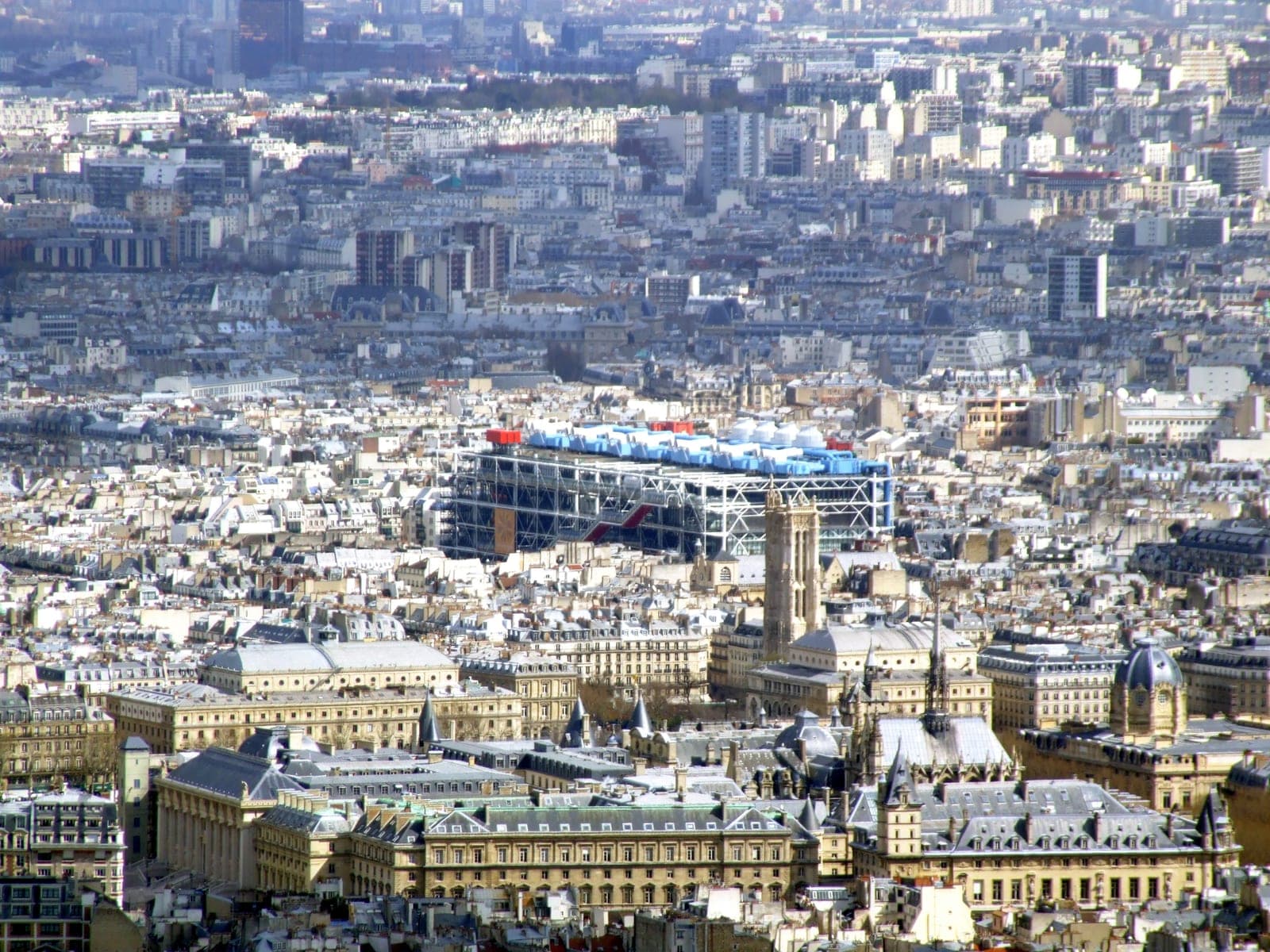
Centre Pompidou, Musée national d'art moderne, Paris
Place Georges-Pompidou, 75004 Paris, France
The Paris building is closed for renovation, with reopening planned for 2030. Check the museum’s off-site programme; this address is not currently a viewing location for the collection.
The Pompidou building is closed for renovation until 2030. As of September 2026 the museum lists the painting as on loan to the Palazzo Bonaparte in Rome for the exhibition Kandinsky, 15 September 2026 to 14 February 2027.
Plan your visitFrequently asked questions
Where is Picture with a Black Arch?
It belongs to the Centre Pompidou in Paris, inventory number AM 1976-852. The Pompidou building closed for renovation in September 2025 and is due to reopen in 2030. As of September 2026 the painting is on loan to the Palazzo Bonaparte in Rome, in the exhibition Kandinsky, until 14 February 2027.
What is the black arch?
A single thick black stroke that rises from the lower left across the upper half of the canvas. The Centre Pompidou traces it to the douga, the curved wooden shaft-bow of a Russian troika harness that keeps the three horses apart. Christian Derouet, the museum's Kandinsky curator, reads it also as a triangle laid against the near-square canvas.
What are the three colours in the painting?
A wine-red block in the upper centre, a blue mass at the lower left and an orange-red mass at the lower right, set at the corners of a triangle. The Pompidou describes them as three blocks of colour ready to collide, held in tension by the arch.
What did Kandinsky say about the painting?
In a letter to Arnold Schönberg of 22 August 1912, while the canvas was being finished, he wrote that construction had so far meant an insistent geometry, naming Ferdinand Hodler and the Cubists. He wanted to show that construction could also be reached on the principle of dissonance. The letter is at the Library of Congress and the Centre Pompidou quotes it.
Where was it first shown?
At Kandinsky's first solo exhibition, at Herwarth Walden's Der Sturm gallery in Berlin, which opened on 2 October 1912. Kandinsky sent it at the last moment, on 20 September, to replace Improvisation 27 in room II.
Who owned it before the museum?
Gabriele Münter, the painter Kandinsky had lived with in Munich, kept it until 1926. It then went into storage at the König-Albert-Museum in Zwickau, was shown in Paris in 1937 and 1939, and passed to the painter's widow, Nina Kandinsky, who gave it to the French state in 1976.
How big is Picture with a Black Arch?
189 by 198 centimetres, roughly six feet by six and a half, so nearly square. It is signed and dated KANDINSKY 1912 at the lower left.
Is Picture with a Black Arch abstract?
Nothing in it depicts an object, and the Centre Pompidou files it under its historical abstraction of 1910 to 1915. Kandinsky's own title names only the arch. The museum's notice reads the arch as a memory of the troika's shaft-bow, but the painting does not show a harness or a horse.
More by Wassily Kandinsky
If you like Wassily Kandinsky
Explore painters from the same movements and circles.
Rosa Bonheur
At the horse markets of Paris and in her studio beside the forest of Fontainebleau, Rosa Bonheur gave animals the presence of great portrait subjects. The success of The Horse Fair helped her build a life shaped by her work, financial independence, and the women she loved.
View artist
William S. Burroughs
American Beat novelist, essayist, performer and visual artist who completed Naked Lunch at the Beat Hotel in Paris and made cut-up writing a defining avant-garde method.
View artist
Leonora Carrington
English painter and writer who fled a debutante's future for Surrealist Paris at twenty, survived the war's wreckage of that life — internment for her lover Max Ernst, an asylum in Spain for her — and rebuilt herself in Mexico into one of the century's great painters of the uncanny.
View artist
References
The sources below include collection records, catalogues, scholarly research, and primary materials that informed this page. They document Picture with a Black Arch, its making, and its place in cultural history.


1Mit dem schwarzen Bogen (Avec l'arc noir), 1912 — Vassily Kandinsky
WebsiteCentre Pompidou, Musée national d'art moderne — collection record, with the notice by Christian Derouet (2007)Used forThe museum's record: title, date, size, inscriptions, acquisition, the letters to Schönberg and Walden, the provenance through Gabriele Münter, and the current loan.
2Focus sur… « Avec l'arc noir » de Vassily Kandinsky
WebsitePompidou+, the Centre Pompidou's magazineUsed forThe Schönberg concert of 2 January 1911, the douga and the three colour blocks.
3Black Arch Symphony
WebsiteCentre Pompidou, via Google Arts & CultureUsed forMunich, autumn 1912; the donation by Nina Kandinsky for the opening of the Centre Pompidou.

4Kandinsky: Catalogue raisonné de l'œuvre peint (two volumes, 1900–1915 and 1916–1944)
NonfictionKarl Flinker, Paris, 1984Used forPublished analysis and historical context used in preparing the Picture with a Black Arch page.
52025-2030, Centre Pompidou is transforming itself!
WebsiteCentre PompidouUsed forThe closure of the Paris building from September 2025 to 2030.
These references provide the documented foundation for this work's history and interpretation. Claim-level citations remain attached to the specific claims they support.
 Explore more resources