Yellow-Red-Blue
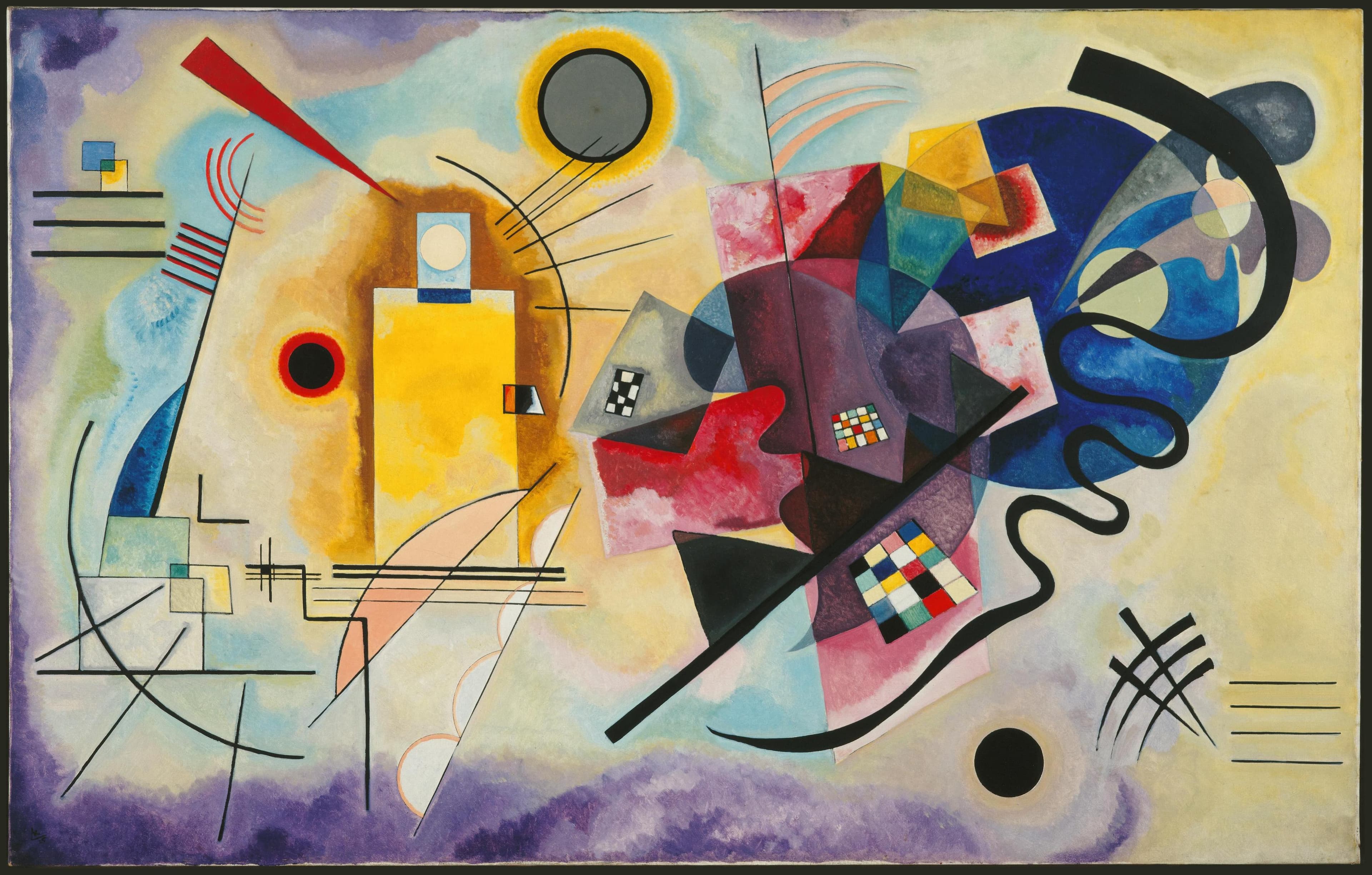
A yellow rectangle with a small blue head stands at the left, a deep blue circle wrapped in a heavy black curve fills the right, and red and violet shapes float between them. Wassily Kandinsky painted the two-metre canvas at Weimar between March and May 1925, in the last months of the Bauhaus there. Nina Kandinsky gave it to the French state in 1976, and it belongs to the Centre Pompidou in Paris.
- 1925
- Oil on canvas
- Centre Pompidou, Musée national d'art moderne, ParisParis, France
About Wassily Kandinsky
What the painting shows
The left half is light. Its ground is a pale cream washed with sky blue. The biggest thing on it is a bright yellow rectangle ringed by a brown-ochre glow, with a small pale blue rectangle holding a cream disc set on its top like a head. A black disc with a red rim sits to its left. Above and to the left, a red wedge tapers down from the top edge toward the yellow, beside four red arcs and a short ladder of red lines. At the top centre a grey disc in a yellow halo hangs like a sun, with a fan of thin black lines rising toward it.
The lower left is drawn rather than painted: thin black lines, a long bow-shaped curve, a stepped line, a small hash sign and stacked pale squares, with a salmon-pink crescent leaning against them. The right half is dark. A deep blue circle takes up most of it, with cyan, lavender and a cream lens laid over it. A thick black curve runs over the top of the circle and down its right side, turns into a wavy line across its lower half, and ends as a heavy diagonal bar pointing to the lower left.
Between the halves, translucent pink, crimson and violet quadrilaterals overlap, and two small multicoloured grids sit among them. A solid black disc floats at the lower right, near a black cross-hatch and four ruled horizontal lines. A violet cloud runs along the bottom edge and up the left side. Kandinsky's monogram and date, VK 25, are at the lower left, and his handlist number, 314, is written on the back with the German title.
Three primaries, left to right
The Centre Pompidou's notice reads the picture as a balance of opposed but complementary elements. Two parts seem to confront each other: geometric lines and luminous colours on the left, sinuous forms and dark tones on the right. The main accent, it says, falls on the three primary colours, which organise the composition from left to right, yellow, then red, then blue.
The museum ties the canvas to Point and Line to Plane, the book Kandinsky published from the Bauhaus in 1926, and calls the painting something like its formulation in paint. Its education dossier adds the pairings Kandinsky taught there: the circle with blue, the square with red, the triangle with yellow. The dossier also sets the picture beside a line from his 1911 book On the Spiritual in Art, in which warm, aggressive yellow is opposed to cold blue.
Weimar, spring 1925
Kandinsky had taught at the Bauhaus since 1922. The Pompidou dates the canvas to March to May 1925 at Weimar, the year the school, under political pressure in that city, moved to Dessau. The dossier notes the proportions, 128 by 201.5 centimetres, come close to the golden ratio.
Kandinsky kept a numbered handlist of his paintings, and this one is number 314. He wrote the number, the year and the title Gelb-rot-blau on the back of the canvas. The museum's notice describes the shift in his work during the 1920s from the lyrical, spontaneous abstraction of the Munich years to a more rational geometric language, and places this canvas in that second manner.
Exhibitions and where it is
Will Grohmann reproduced the painting in colour in his 1958 monograph on Kandinsky. It went to the Solomon R. Guggenheim Museum in New York in 1983 for Kandinsky: Russian and Bauhaus Years, which travelled to Atlanta, Zurich and Berlin, and to the Tretyakov Gallery in Moscow in 1989. It opened the Musicircus exhibition at the Centre Pompidou-Metz in 2016 as catalogue number one, and hung at the Philharmonie de Paris in Kandinsky: La musique des couleurs from October 2025 to February 2026.
Nina Kandinsky gave it to the French national collection in 1976; its inventory number is AM 1976-856. The Pompidou building in Paris closed on 22 September 2025 for a renovation scheduled to last until 2030. As of September 2026 the museum lists the painting as on loan to the Palazzo Bonaparte in Rome for the exhibition Kandinsky, from 15 September 2026 to 14 February 2027.
Close reading
Reading the work, detail by detail
The canvas is two metres wide and splits into a light half and a dark half. Close view follows the three primaries from the yellow rectangle at the left to the blue circle at the right, and picks out the drawn passages, thin lines, small grids and a black cross-hatch, that the big shapes hide from a distance.
1.The yellow rectangle and its blue head
The rectangle is the brightest yellow on the canvas, and a brown-ochre glow spreads around it, darkest at the top. On its upper edge stands a small pale blue rectangle with a cream disc inside and a strip of darker blue at its base. The pairing reads as a body with a head, though nothing in it is a figure.
2.A grey disc in a yellow halo
The disc is a flat mid-grey with a thin black outline, and a yellow halo radiates around it. From the lower left a fan of thin black lines rises toward it, crossing a long thin curve that bends the other way. It hangs at the top of the canvas where a sun would.
3.A black disc with a red rim, and a blue rosette
The black disc has a bright red rim, painted flat and hard-edged. Above it and to the left a soft blue rosette is brushed in feathered strokes, lighter at its centre, one of the few soft passages in the left half. The brown glow of the rectangle comes up to the disc's right edge.
4.A red wedge, red arcs and a ladder of lines
The red wedge is widest at the top edge and tapers to a point at the brown glow. Left of it four red arcs curve one inside the other, and below them a short ladder of red and dark lines runs on the diagonal. A single thin black line runs down through the whole group and closes the ladder's right end.
5.The blue circle under a black curve
The circle is deep ultramarine, with patches of cyan, a lavender wedge and a cream lens laid over it. A thick black curve starts above it, runs over its top and down its right side, then bends back into the circle as a wavy line. Pale pink arcs sit above the circle to the left.
6.The wavy line becomes a heavy bar
The black line leaves the lower part of the circle as a wave, loops back on itself, and then thickens into a heavy bar that runs down to the left across the pink shapes. Its lower end tapers to a point. It is the longest continuous line in the picture.
7.A multicoloured grid among the pink shapes
The grid is tilted and its cells are painted in yellow, red, cyan, white, pink, green and black with no repeating order. It lies on the pink and violet quadrilaterals between the two halves. A second, smaller grid sits higher up, near the red shapes.
8.A black disc, a cross-hatch and four ruled lines
The solid black disc sits on the cream ground with a faint darker halo around it. To its right a cross-hatch of thin curved strokes leans one way and then the other. Four short horizontal lines are ruled near the right edge, evenly spaced. Below all of it the violet cloud runs along the bottom.
9.Thin lines and pale squares at the lower left
The lower left is drawn in thin black lines: a long bow-shaped curve, straight lines crossing it, a stepped line, a small hash sign and two horizontal bars. Pale grey, white and cream squares are stacked among them. A salmon-pink crescent leans against the group at the right.
Timeline
1922
Begins teaching at the Bauhaus in Weimar.
1925
Paints Yellow-Red-Blue at Weimar between March and May, as number 314 in his own handlist. The Bauhaus moves to Dessau the same year.
1926
Publishes Point and Line to Plane, the Bauhaus book the Centre Pompidou reads the canvas alongside.
1958
Reproduced in colour in Will Grohmann's monograph Kandinsky: sa vie, son œuvre.
1976
Given to the French national collection by Nina Kandinsky; inventory number AM 1976-856.
1983
Shown at the Solomon R. Guggenheim Museum, New York, in Kandinsky: Russian and Bauhaus Years, 1915–1933.
2025
Hangs at the Philharmonie de Paris in Kandinsky: La musique des couleurs, 15 October 2025 to 1 February 2026.
2026
On loan to the Palazzo Bonaparte in Rome for the exhibition Kandinsky, until 14 February 2027.
Where to see it
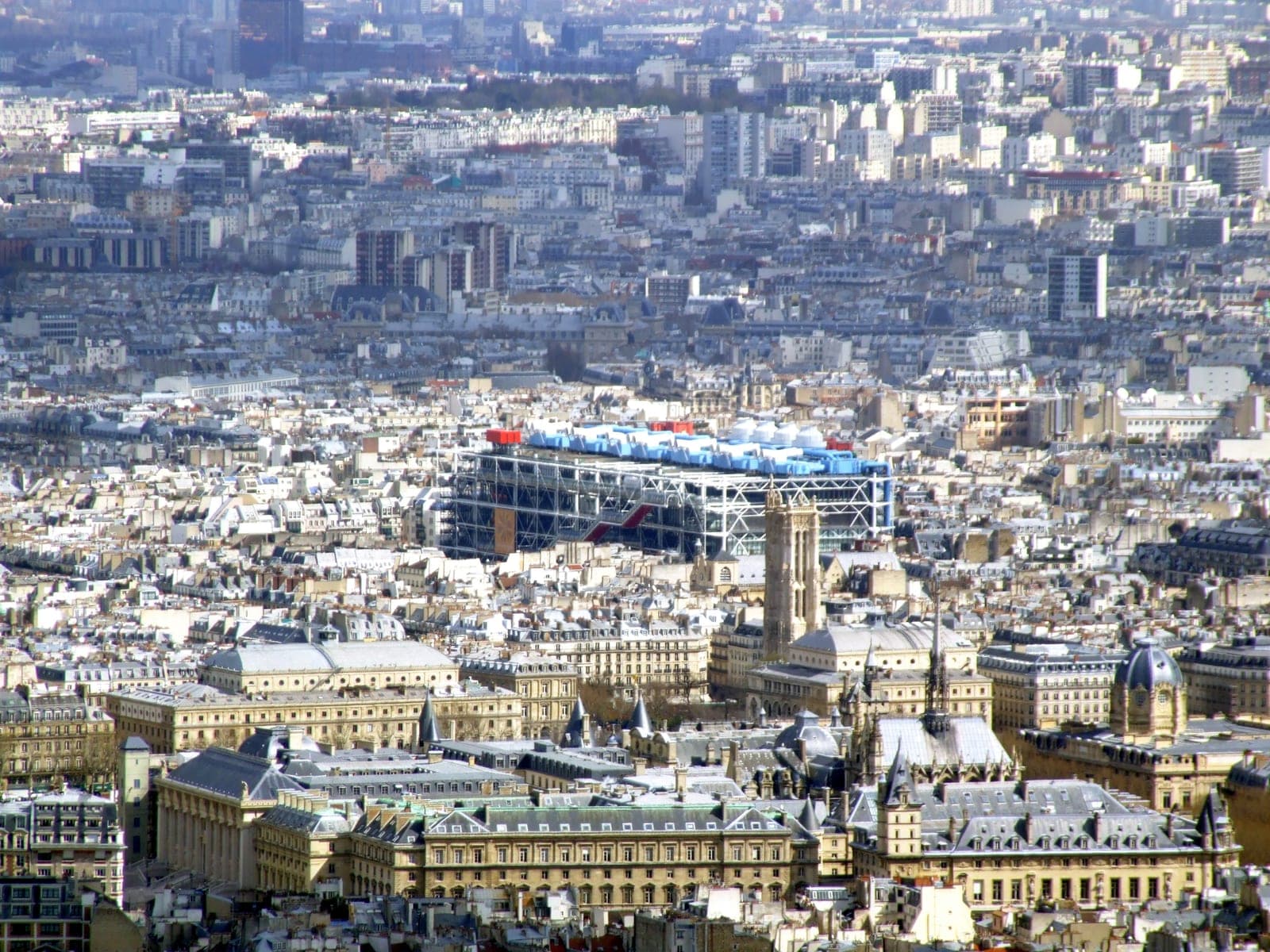
Centre Pompidou, Musée national d'art moderne, Paris
Place Georges-Pompidou, 75004 Paris, France
The Paris building is closed for renovation, with reopening planned for 2030. Check the museum’s off-site programme; this address is not currently a viewing location for the collection.
The Pompidou building is closed for renovation until 2030. As of September 2026 the museum lists the painting as on loan to the Palazzo Bonaparte in Rome for the exhibition Kandinsky, 15 September 2026 to 14 February 2027.
Plan your visitFrequently asked questions
Where is Yellow-Red-Blue?
It belongs to the Centre Pompidou in Paris, inventory number AM 1976-856. The Pompidou building closed for renovation in September 2025 and is due to reopen in 2030. As of September 2026 the painting is on loan to the Palazzo Bonaparte in Rome, in the exhibition Kandinsky, until 14 February 2027.
Why is it called Yellow-Red-Blue?
The three primary colours run across it from left to right: the yellow rectangle at the left, red shapes in the middle, the blue circle at the right. Kandinsky wrote the German title, Gelb-rot-blau, on the back of the canvas with his handlist number, 314. The Centre Pompidou's notice says the main accent falls on those three colours.
What do the shapes mean?
The Centre Pompidou reads the canvas as two halves in confrontation: geometric lines and light colours on the left, curving forms and dark tones on the right. Its dossier adds the pairings Kandinsky taught at the Bauhaus, circle with blue, square with red, triangle with yellow. The painting itself puts a yellow rectangle on one side and a blue circle on the other.
When and where was it painted?
At Weimar between March and May 1925, according to the Centre Pompidou, while Kandinsky was teaching at the Bauhaus. The school moved from Weimar to Dessau that year.
How big is Yellow-Red-Blue?
128 by 201.5 centimetres, about four feet two by six feet seven. The museum's education dossier notes that the proportions come close to the golden ratio.
What is written on the back?
Kandinsky's monogram, his handlist number and the year, VK N° 314/1925, followed by the title Gelb-rot-blau. The front carries the monogram and date VK 25 at the lower left.
Who gave it to the museum?
Nina Kandinsky, the painter's widow, in 1976, the year before the Centre Pompidou opened. Her gifts and bequest are the reason the museum holds 110 Kandinsky paintings.
Has it been shown outside Paris?
Often. It went to the Guggenheim in New York in 1983, the Tretyakov Gallery in Moscow in 1989, Milwaukee and Nashville in 2014, Madrid in 2015 and the Centre Pompidou-Metz in 2016, and it is in Rome until February 2027.
More by Wassily Kandinsky
If you like Wassily Kandinsky
Explore painters from the same movements and circles.
Rosa Bonheur
At the horse markets of Paris and in her studio beside the forest of Fontainebleau, Rosa Bonheur gave animals the presence of great portrait subjects. The success of The Horse Fair helped her build a life shaped by her work, financial independence, and the women she loved.
View artist
William S. Burroughs
American Beat novelist, essayist, performer and visual artist who completed Naked Lunch at the Beat Hotel in Paris and made cut-up writing a defining avant-garde method.
View artist
Leonora Carrington
English painter and writer who fled a debutante's future for Surrealist Paris at twenty, survived the war's wreckage of that life — internment for her lover Max Ernst, an asylum in Spain for her — and rebuilt herself in Mexico into one of the century's great painters of the uncanny.
View artist
References
The sources below include collection records, catalogues, scholarly research, and primary materials that informed this page. They document Yellow-Red-Blue, its making, and its place in cultural history.


1Gelb-Rot-Blau (Jaune-rouge-bleu), 1925 — Vassily Kandinsky
WebsiteCentre Pompidou, Musée national d'art moderne — collection recordUsed forThe museum's record: title, date and place, size, inscriptions, the notice on the two halves and the three primaries, the exhibition list and the current loan.
2Kandinsky : Jaune-rouge-bleu — dossier pédagogique
WebsiteCentre Pompidou, direction des publicsUsed forThe education dossier: Weimar and the move to Dessau, the colour-and-shape pairings, the line from On the Spiritual in Art, and the golden-ratio remark.

3Kandinsky: Catalogue raisonné de l'œuvre peint (two volumes, 1900–1915 and 1916–1944)
NonfictionKarl Flinker, Paris, 1984Used forPublished analysis and historical context used in preparing the Yellow-Red-Blue page.
4Kandinsky — dossier pédagogique (exhibition education dossier)
WebsiteCentre Pompidou, service éducatif, 2009Used forNina Kandinsky's donation and the size of the Pompidou's Kandinsky holdings.
52025-2030, Centre Pompidou is transforming itself!
WebsiteCentre PompidouUsed forThe closure of the Paris building from September 2025 to 2030.
These references provide the documented foundation for this work's history and interpretation. Claim-level citations remain attached to the specific claims they support.
 Explore more resources