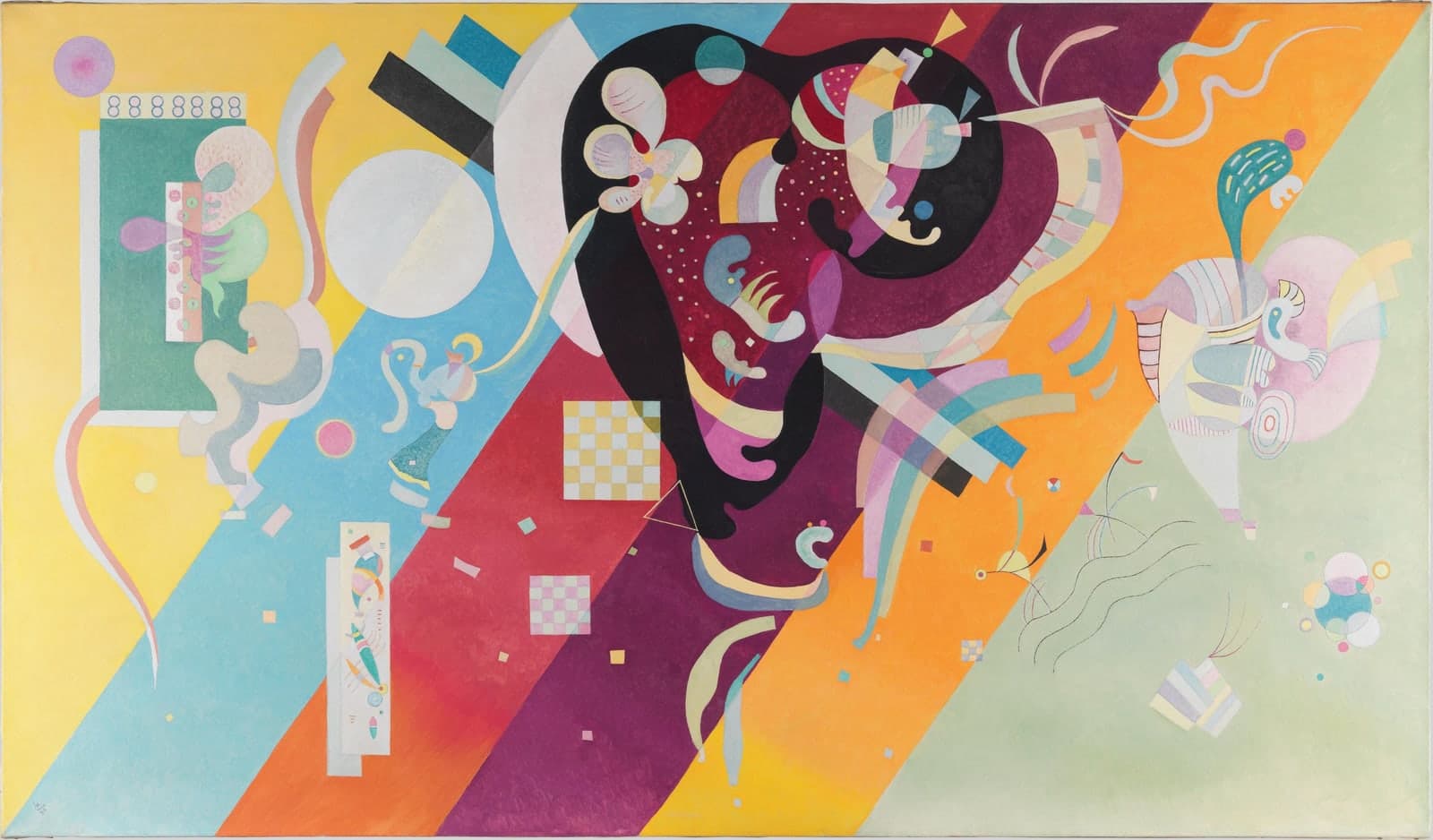
Composition IX
Six diagonal bands of flat colour, yellow, blue, red, purple, orange and pale green, run from the lower left to the upper right behind a crowd of small floating forms and one large dark shape like a kidney. Wassily Kandinsky painted it at Neuilly-sur-Seine in 1936, two years after leaving Germany, and the French State bought it in 1939 for a twentieth of his asking price. It was the only painting of his to enter a French museum in his lifetime.
- 1936
- Oil on canvas
- Centre Pompidou, Musée national d'art moderne, ParisParis, France
About Wassily Kandinsky
What the painting shows
The ground is six bands of flat colour laid on the diagonal, so that each leans toward the upper right. From the left they are yellow, blue, red, purple, orange and pale green. The yellow band is a wedge, wide at the top and almost gone at the bottom edge. The red band turns orange-red near the bottom, and the orange band pales to yellow there. None of the bands has any texture.
The largest thing on them is a dark form shaped like a kidney or a heart, with a black rim and a crimson interior, which hangs from the top edge across the middle of the canvas. Inside it are a white four-lobed cell dotted with pink, a lens shape in cream and blue, a striped cap and a field of small pale dots. A pale cream ribbon trails out of it to the right.
The rest is small. A white circle sits on the blue band, and a dark green panel with a row of seven blue figure-eights along its top sits on the yellow. A tall white panel holds a column of tiny signs at the lower left. There are two checkerboards, one yellow and one pink, tiny squares scattered on the bands, a pink cloud with a white spiral at the right, a teal form like a feather, thin wavy lines and a small striped cube. Kandinsky's monogram and the year, VK 36, sit on the yellow at the lower left.
What Kandinsky meant by a Composition
Kandinsky gave the title Composition to ten canvases between 1910 and 1939, and to nothing else. The Centre Pompidou's notice quotes his own definition, from On the Spiritual in Art. Compositions were expressions that formed slowly in him, taken up at length and almost pedantically after the first sketches. In them reason, consciousness and intention played a predominant role, though feeling always won out over calculation. Composition VIII of 1923 is at the Solomon R. Guggenheim Museum in New York; Composition X of 1939, the last, is at the Kunstsammlung Nordrhein-Westfalen in Düsseldorf.
Christian Derouet, the Pompidou's Kandinsky curator, calls Composition IX the smallest of the series. He wonders why Kandinsky gave the title to this canvas rather than to Dominant Curve, painted the same year, which was larger and which the painter himself thought more accomplished. The big diagonals dividing the ground, Derouet says, are exceptional in Kandinsky's work even in 1936. The forms floating over them he compares to decalcomanias, refined details laid on in a second layer.
The painting was first called L'Un et l'Autre, One and the Other. Derouet's verdict is blunt: a difficult, if not thankless, picture.
Neuilly, and 5,000 francs from the State
Kandinsky had left Germany at the end of 1933, after the Nazis forced the Bauhaus to close, and in January 1934 he and Nina Kandinsky moved into a new building at Neuilly-sur-Seine, on the western edge of Paris. Composition IX was painted there in 1936, as number 626 in his own handlist, which he wrote on the back of the canvas. The Pompidou's notice says he was developing the repertoire of forms worked out at the Bauhaus into large compositions, and in the same years the soft, cell-like shapes of his Paris work began to fill them.
Early in 1939 Kandinsky approached the Musée du Jeu de Paume, which then showed the national collection of living foreign artists, to negotiate a retrospective. Its director, André Dezarrois, bought Composition IX instead. Kandinsky deposited the canvas at the museum and asked 100,000 francs; he received 5,000. It was the only painting by him to join a French museum during his lifetime, two years after the Nazi regime had seized fourteen of his works from German museums for its Degenerate Art exhibition.
The inventory number still carries the Jeu de Paume's prefix, JP 890 BIS P. The 1954 catalogue-guide of the Musée national d'art moderne listed the picture simply as Composition.
Exhibitions and where it is
The canvas went to the Solomon R. Guggenheim Museum in New York for the Kandinsky retrospective of 1963. In 1968 it toured five American museums in Painting in France 1900–1967. The venues were the National Gallery of Art in Washington, the Metropolitan Museum of Art, the Museum of Fine Arts in Boston, the Art Institute of Chicago and the de Young in San Francisco. In 1969 it hung in the Galerie Maeght's Paris show of the Paris period and at Knoedler in New York.
The Pompidou building in Paris closed on 22 September 2025 for a renovation scheduled to last until 2030. As of September 2026 the museum lists the painting as on loan to the Palazzo Bonaparte in Rome for the exhibition Kandinsky, from 15 September 2026 to 14 February 2027.
Close reading
Reading the work, detail by detail
Six diagonal bands of flat colour run behind a crowd of small floating forms and one large dark shape. Close view shows what the forms are: a white cell, a panel of figure-eights, checkerboards, a column of tiny signs, and some of the smallest marks Wassily Kandinsky put on any Composition.
1.A white cell inside the dark form
The dark form has a black rim and a crimson interior. Near its top a white cell with four lobes is dotted with pink, and to its right a lens shape in cream and blue is ringed with fine lines, with a striped pink cap above it. A field of small pale dots spreads across the crimson below.
2.A white circle on the blue band
The circle is white above and cream below, split by a soft line like a horizon. It sits on the blue band, and three bars, one black, one teal and one pale, lean above it on the same diagonal as the bands. Two small curling forms sit under it.
3.A green panel with a row of eights
The panel is dark green inside a paler frame, and along its top runs a strip of seven blue figure-eights, each two circles outlined in blue-grey. Inside it a pink blob dotted in a darker pink presses against a green crescent, with a mauve teardrop and a vertical strip of small circles beside them. A lilac disc floats above the panel in the top left corner.
4.Two checkerboards below the dark form
Two checkerboards sit below the dark form. The upper one is yellow and white and touches the black rim; the lower one is pink and white and sits on the red band. Tiny pale squares are scattered across the bands around them, and a thin pink triangle is outlined between.
5.A column of tiny signs
The white panel stands upright on the blue band with a second pale panel behind it. Inside are tiny signs in a column. From the top: a green dot, a red bar above three short dashes, a teal-and-pink bud with an orange wedge, a red disc, a pink teardrop and three red dashes. Below them come a green pod striped pink and yellow, a pale blue disc and a small teal seed. It is the largest light shape in the lower half.
6.A pink spiral and a teal feather
On the pale green band a pink cloud holds a white spiral and a striped cone, with a small blue eye and a white bird-like shape at its edge. Above it a teal form spreads like a feather or a jellyfish, with a pink disc at its top and a small white head. Both sit clear of the dark form.
7.Wavy lines and a striped cube
Thin dark lines waver across the pale green band like hairs. Below them sits a small cube striped in pink, blue and yellow, and to the right a cluster of translucent circles overlaps in pink, teal and yellow. The band around them is otherwise empty.
8.The bands lean, and the monogram sits on yellow
At the bottom edge the yellow band narrows almost to nothing and the blue band takes its place, so the lean of the bands toward the upper right is easiest to see here. The red band's lower end reads orange-red. Kandinsky's monogram and the year, VK 36, sit on the yellow in the corner.
Timeline
1934
In January the Kandinskys move into a new building at Neuilly-sur-Seine, recommended by Marcel Duchamp.
1936
Paints the canvas at Neuilly as number 626 in his handlist, first titled L'Un et l'Autre.
1939
Bought by the French State through André Dezarrois of the Jeu de Paume for 5,000 francs, against an asking price of 100,000. Inventory JP 890 BIS P.
1954
Listed as Composition in the Musée national d'art moderne's catalogue-guide.
1963
Shown in the Kandinsky retrospective at the Solomon R. Guggenheim Museum, New York.
1968
Tours Washington, New York, Boston, Chicago and San Francisco in Painting in France 1900–1967.
2009
Shown in the Centre Pompidou's Kandinsky retrospective, 8 April to 10 August.
2026
On loan to the Palazzo Bonaparte in Rome for the exhibition Kandinsky, until 14 February 2027.
Where to see it
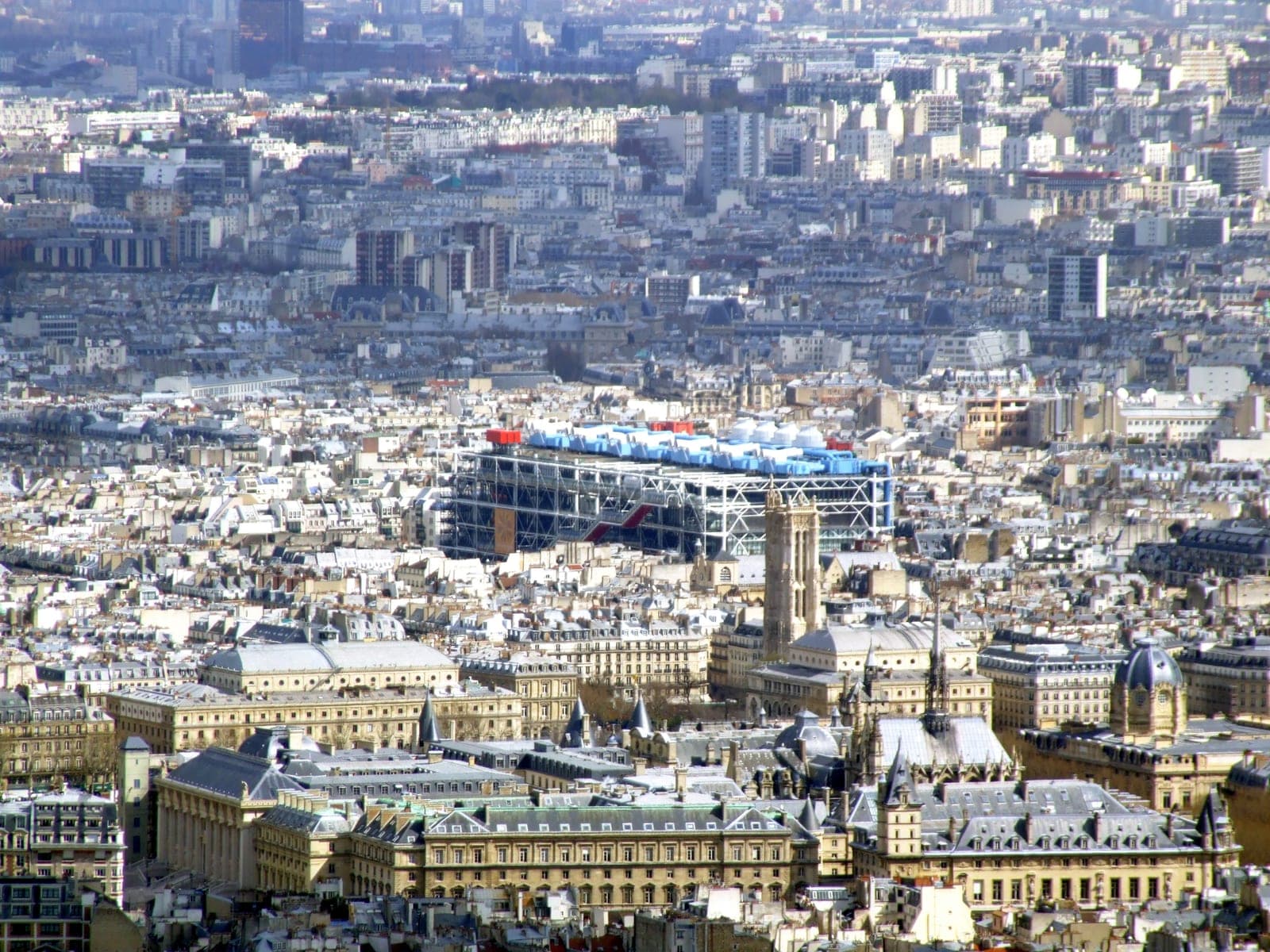
Centre Pompidou, Musée national d'art moderne, Paris
Place Georges-Pompidou, 75004 Paris, France
The Paris building is closed for renovation, with reopening planned for 2030. Check the museum’s off-site programme; this address is not currently a viewing location for the collection.
The Pompidou building is closed for renovation until 2030. As of September 2026 the museum lists the painting as on loan to the Palazzo Bonaparte in Rome for the exhibition Kandinsky, 15 September 2026 to 14 February 2027.
Plan your visitFrequently asked questions
Where is Composition IX?
It belongs to the Centre Pompidou in Paris, inventory number JP 890 BIS P. The Pompidou building closed for renovation in September 2025 and is due to reopen in 2030. As of September 2026 the painting is on loan to the Palazzo Bonaparte in Rome, in the exhibition Kandinsky, until 14 February 2027.
What does Composition mean in Kandinsky's titles?
It was a title he reserved for ten canvases painted between 1910 and 1939. In On the Spiritual in Art he described them as expressions that formed slowly in him and were worked up at length after sketches, with reason and intention in charge but feeling winning out over calculation. The Centre Pompidou quotes that passage in its notice on Composition IX.
Is Composition IX the last of the series?
No. Composition X followed in 1939 and is at the Kunstsammlung Nordrhein-Westfalen in Düsseldorf. Composition IX is the ninth of the ten and, according to the Pompidou's Christian Derouet, the smallest.
What was the painting's first title?
L'Un et l'Autre, One and the Other, according to the Centre Pompidou. Kandinsky later gave it the series title Composition IX. Derouet notes that Dominant Curve, painted the same year and larger, was the canvas Kandinsky himself thought more accomplished.
How much did France pay for it?
5,000 francs, in 1939, after Kandinsky had asked 100,000. He had approached the Jeu de Paume about a retrospective, and its director, André Dezarrois, bought this canvas. It was the only Kandinsky painting to enter a French museum while he was alive.
What are the diagonal bands?
Six bands of flat colour, yellow, blue, red, purple, orange and pale green from left to right, all leaning toward the upper right. Derouet says such diagonals dividing the ground are exceptional in Kandinsky's work, even in 1936. The small forms float in front of them.
How big is Composition IX?
113.5 by 195 centimetres, about three feet nine by six feet five. It is monogrammed and dated VK 36 at the lower left, and Kandinsky's handlist number 626 is written on the back.
Has it been shown in the United States?
Yes. It was in the Guggenheim's Kandinsky retrospective in New York in 1963, and in 1968 it toured Washington, New York, Boston, Chicago and San Francisco in Painting in France 1900–1967. Knoedler in New York showed it in 1969.
More by Wassily Kandinsky
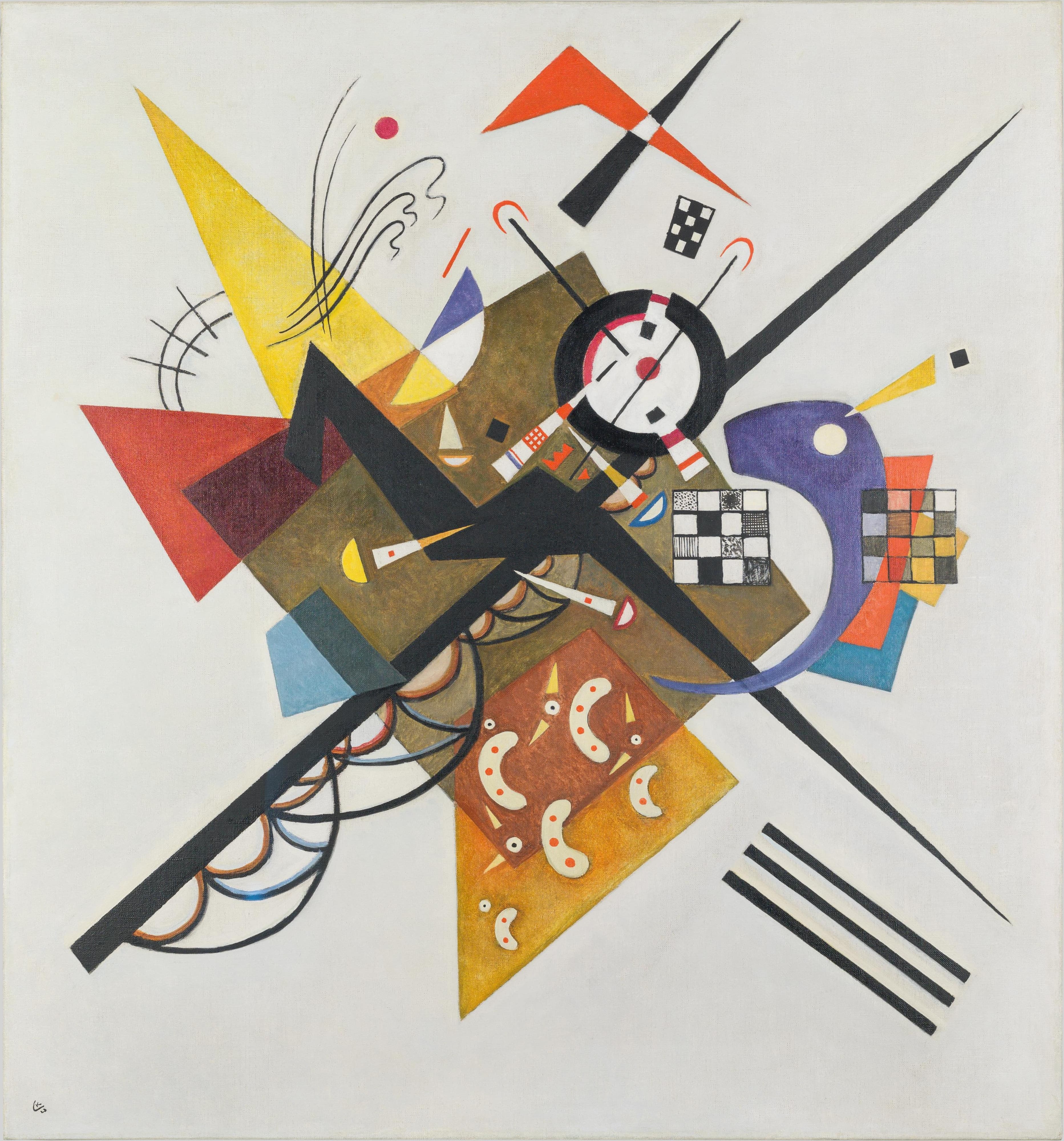
If you like Wassily Kandinsky
Explore painters from the same movements and circles.
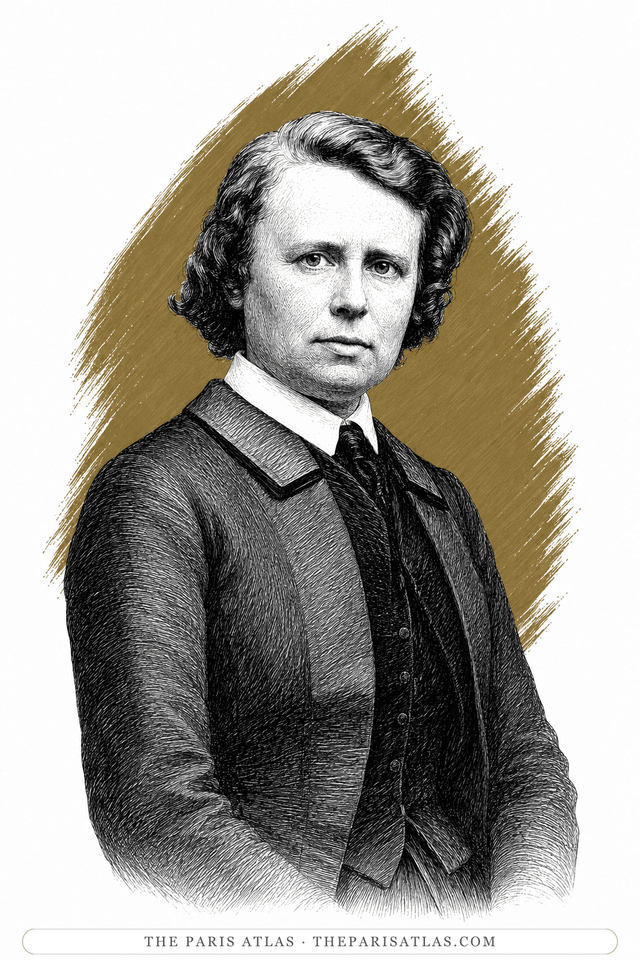
Rosa Bonheur
At the horse markets of Paris and in her studio beside the forest of Fontainebleau, Rosa Bonheur gave animals the presence of great portrait subjects. The success of The Horse Fair helped her build a life shaped by her work, financial independence, and the women she loved.
View artist
William S. Burroughs
American Beat novelist, essayist, performer and visual artist who completed Naked Lunch at the Beat Hotel in Paris and made cut-up writing a defining avant-garde method.
View artist
Leonora Carrington
English painter and writer who fled a debutante's future for Surrealist Paris at twenty, survived the war's wreckage of that life — internment for her lover Max Ernst, an asylum in Spain for her — and rebuilt herself in Mexico into one of the century's great painters of the uncanny.
View artist
References
The sources below include collection records, catalogues, scholarly research, and primary materials that informed this page. They document Composition IX, its making, and its place in cultural history.

1Composition IX, 1936 — Vassily Kandinsky
WebsiteCentre Pompidou, Musée national d'art moderne — collection record, with the notice by Christian Derouet (2007)Used forThe museum's record: title, date, size, inscriptions, the 1939 purchase and price, the first title, Kandinsky's definition of a Composition, the bibliography and the current loan.
2Kandinsky — dossier pédagogique (exhibition education dossier)
WebsiteCentre Pompidou, service éducatif, 2009Used forThe move to Neuilly, the approach to the Jeu de Paume in early 1939, André Dezarrois's purchase, and the 1937 seizures in Germany.
3Vasily Kandinsky, Composition 8 — collection page
WebsiteSolomon R. Guggenheim MuseumUsed forComposition VIII of 1923 at the Solomon R. Guggenheim Museum.
4Komposition X, 1939 — Wassily Kandinsky
WebsiteKunstsammlung Nordrhein-Westfalen, Düsseldorf — online collectionUsed forComposition X of 1939 at the Kunstsammlung Nordrhein-Westfalen, Düsseldorf.

5Kandinsky: Catalogue raisonné de l'œuvre peint (two volumes, 1900–1915 and 1916–1944)
NonfictionKarl Flinker, Paris, 1984Used forPublished analysis and historical context used in preparing the Composition IX page.
62025-2030, Centre Pompidou is transforming itself!
WebsiteCentre PompidouUsed forThe closure of the Paris building from September 2025 to 2030.
These references provide the documented foundation for this work's history and interpretation. Claim-level citations remain attached to the specific claims they support.
 Explore more resources