The Broken Column
by Frida Kahlo
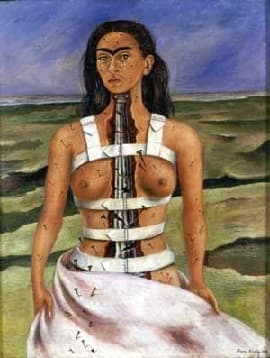
Frida Kahlo painted herself split open from throat to hips, with a fractured classical column standing where her spine would be and a corset of belts holding the body around it. Nails are driven into her face, arms, torso and the sheet across her hips, and she is crying. She painted it in 1944, the year a doctor prescribed the steel corset she wore for five months.
- 1944
- Oil on canvas mounted on board
- Museo Dolores OlmedoMexico City, Mexico
About Frida Kahlo
What the painting shows
Frida Kahlo faces forward, nude to the hips, her torso opened by a vertical split that runs from her throat to her abdomen with raw red edges. Inside the split stands a grey fluted column, broken by horizontal fractures along its length. Her hair is loose and long over both shoulders, and tears stand on both cheeks. Her mouth is closed and her expression does not change.
A white corset holds her together. Two vertical straps pass over the shoulders, each with a riveted fitting, and four horizontal bands cross the body: above the breasts, below them, at the waist and at the hips. The Museo Dolores Olmedo describes these as metal belts lined with fabric.
Nails are driven into her forehead, cheeks and chin, into her neck, both arms and her torso, and into the pale sheet wrapped around her hips. Behind her the ground is olive green and split by deep dark fissures running back to a flat horizon, under a deep blue sky. The painting is small, roughly forty centimetres high.
The column
The Museo Dolores Olmedo describes a completely fractured Ionic column on the verge of collapse in place of her spinal column, with her head resting on the capital. The museum gives no count of the breaks, and the column is fractured along its whole visible length.
An Ionic column is one of the classical orders, recognised by the pair of scrolls at the top of the shaft. Using one as a spine puts a piece of architecture inside a body. The column here is load-bearing in the way a spine is: everything above it rests on it, and it is broken in several places.
What the corset was for
Frida Kahlo's spine had been fractured in three places when a streetcar hit the bus she was riding on 17 September 1925, and she spent the rest of her life in and out of orthopaedic supports. In 1944 the doctor Alejandro Zimbrón prescribed a steel corset, which she wore for five months. She owned about twenty-five different corsets over her life.
The Museo Dolores Olmedo's text says the painting was made shortly after she had undergone surgery on her spinal column. The documented chronology does not support that. Her spinal fusion, four lumbar vertebrae joined by the surgeon Philip Wilson in New York, was performed in June 1946, two years after the picture was painted. The steel corset of 1944 is the support the painting belongs with.
The nails
The Museo Dolores Olmedo separates the nails into two kinds. The largest, along the column, stand for the damage done by the 1925 accident. Those on her left breast stand for grief and for her sense of being alone.
One nail is much bigger than the others. It is driven at an angle into the upper part of her left breast, at the right of the picture, and the skin around it is reddened. The rest are small, scattered widely, and each casts a short shadow.
Where the painting is
The Museo Dolores Olmedo holds the picture at the La Noria hacienda in Xochimilco, in the south of Mexico City, and shows it in the display Frida Kahlo en dos tiempos alongside Henry Ford Hospital. The museum reopened at that site on 30 May 2026 after six years closed.
The museum publishes no catalogue record for individual objects, and no owner's figures for this painting's size or support exist. Accounts in circulation give 40 by 30.7 centimetres, 39.8 by 30.6 centimetres, and 43 by 33 centimetres, and describe the support as either masonite or canvas mounted on board.
Close reading
Reading the work, detail by detail
Frida Kahlo painted herself split open from throat to hips, with a fluted stone column standing where her spine would be and a surgical corset holding the body around it. The picture is small, about forty centimetres high. The close views work down the column and across the nails.
1.Tears run down an unmoving face
Tear drops stand on both cheeks and run down towards the jaw. The mouth is closed and the eyes look straight out, with no change in the features. Small nails are driven into the forehead, the cheeks and the chin.
2.The column reaches her throat
The top of the column sits at the base of her throat, partly hidden by her chin. The shaft is grey and fluted with vertical grooves, and a darker horizontal band closes it off at the top. The Museo Dolores Olmedo identifies the column as Ionic and describes her head as resting on its capital.
3.The shaft is broken in several places
The shaft runs down the centre of the torso in sections divided by dark horizontal breaks. Several fractures are visible between throat and waist. The opened flesh is dark red along both edges of the split.
4.Straps and bands hold the body together
Two vertical straps pass over the shoulders, each with a pale riveted fitting at the top. Four horizontal bands cross the body: above the breasts, below them, at the waist and at the hips. The Museo Dolores Olmedo describes them as metal belts lined with fabric.
5.One nail is much bigger than the rest
A single large nail is driven at an angle into the upper part of her left breast, at the right of the picture. Its head and shank are both drawn, and the skin around the entry point is reddened. The Museo Dolores Olmedo reads the nails on that breast as standing for grief rather than for the injuries.
6.Small nails cover the arm and torso
Small dark nails are driven into the arm and the ribs at varying angles. Each casts a short shadow on the skin. They continue across the shoulders, the torso and the cloth below.
7.A pale sheet wraps the hips
A pale sheet is wrapped around her hips and falls open across the lower third of the picture. The folds are shaded pink and lilac. Nails are driven into the cloth as well as the skin.
8.The ground behind her is torn open
The ground behind her is olive green and broken by deep dark fissures. The cracks run back towards a flat horizon. A pale band of cloud sits above them, below a deep blue sky.
Timeline
1925
A streetcar hits the bus Frida Kahlo is riding on 17 September, fracturing her spine in three places along with her pelvis, collarbone, ribs and right leg.
1944
The doctor Alejandro Zimbrón prescribes a steel corset, which she wears for five months.
1944
Paints The Broken Column, signed and dated at the lower right.
1946
The surgeon Philip Wilson fuses four of her lumbar vertebrae in New York, two years after the painting was made.
2026
The Museo Dolores Olmedo reopens at the La Noria hacienda in Xochimilco on 30 May, with the painting in the display Frida Kahlo en dos tiempos.
Where to see it
Museo Dolores Olmedo
Mexico City, Mexico
A public viewing address has not yet been confirmed for this holding.
The museum reopened at the La Noria hacienda in Xochimilco on 30 May 2026, and shows the painting in the display Frida Kahlo en dos tiempos. It publishes no catalogue record for individual objects.
Frequently asked questions
What does The Broken Column by Frida Kahlo show?
Frida Kahlo nude to the hips, her torso split open from throat to abdomen, with a fractured grey Ionic column standing where her spine would be. A white corset of shoulder straps and four horizontal belts holds her body around it, nails are driven into her face, arms, torso and the sheet at her hips, and tears stand on both cheeks.
Where is The Broken Column?
The Museo Dolores Olmedo, at the La Noria hacienda in Xochimilco in the south of Mexico City. The museum reopened at that site on 30 May 2026, and shows the painting in the display Frida Kahlo en dos tiempos. It publishes no catalogue record for individual objects.
Did Frida Kahlo paint The Broken Column after spinal surgery?
Not after the fusion, which came later. The Museo Dolores Olmedo's text says the painting followed surgery on her spine, but the operation in which Philip Wilson fused four of her lumbar vertebrae took place in New York in June 1946, two years after the picture. What 1944 brought was a steel corset, prescribed by the doctor Alejandro Zimbrón and worn for five months.
What do the nails in The Broken Column mean?
The Museo Dolores Olmedo reads them in two groups. The largest, running along the column, stand for the damage done by the streetcar accident of 17 September 1925. Those on her left breast stand for grief and for her sense of being alone.
How big is The Broken Column?
About 40 by 30.7 centimetres, roughly sixteen by twelve inches. The owning museum publishes no measurements, and accounts in circulation also give 39.8 by 30.6 centimetres and 43 by 33 centimetres.
Why is there a column in The Broken Column?
It stands in for her spine, which had been fractured in three places in the 1925 accident. The Museo Dolores Olmedo describes it as a completely fractured Ionic column on the verge of collapse, with her head resting on its capital. An Ionic column is a classical order, identified by the pair of scrolls at the top of the shaft.
More by Frida Kahlo
If you like Frida Kahlo
Explore painters from the same movements and circles.
Jean Arp
Strasbourg-born sculptor and poet — Hans in German, Jean in French, both all his life — who co-founded Dada at the Cabaret Voltaire in 1916, composed collages by dropping torn paper 'according to the laws of chance', and settled at Meudon outside Paris in a house his wife Sophie Taeuber-Arp designed.
View artist
Leonora Carrington
English painter and writer who fled a debutante's future for Surrealist Paris at twenty, survived the war's wreckage of that life — internment for her lover Max Ernst, an asylum in Spain for her — and rebuilt herself in Mexico into one of the century's great painters of the uncanny.
View artist
Henri Cartier-Bresson
French photographer who turned a pocket-sized 35mm camera into an instrument of split-second composition — the idea the world knows as 'the decisive moment'. He trained as a painter, was taken prisoner in 1940 and escaped on his third try, photographed the Liberation of Paris in August 1944, co-founded the photographer-owned agency Magnum Photos in 1947, gave up reporting for drawing in the 1970s, and left Paris a foundation in the Marais that deliberately hangs no permanent display of his own pictures.
View artist
References
The sources below include collection records, catalogues, scholarly research, and primary materials that informed this page. They document The Broken Column, its making, and its place in cultural history.


1The Broken Column — the Museo Dolores Olmedo's own catalogue text, in Frida Kahlo: alas para volar
Exhibition catalogueFundación Casa de México en España, from documentation owned by the Museo Dolores Olmedo, 2022Used forCatalogue scholarship used to verify attribution, provenance, chronology, and interpretive context for The Broken Column.

2The museum — visiting hours and the collection at the La Noria hacienda, Xochimilco
WebsiteMuseo Dolores OlmedoUsed forWeb source consulted for documented facts and historical context presented on the The Broken Column page.
3Museo Dolores Olmedo to reopen in 2026 amid controversy — the cancelled move to Parque Aztlán
PeriodicalThe Art Newspaper, 2025Used forContemporary reporting or criticism used to document the historical reception and context of The Broken Column.
4Biography of Frida Kahlo (official museum biography, PDF)
WebsiteMuseo Frida KahloUsed forWeb source consulted for documented facts and historical context presented on the The Broken Column page.
These references provide the documented foundation for this work's history and interpretation. Claim-level citations remain attached to the specific claims they support.
 Explore more resources