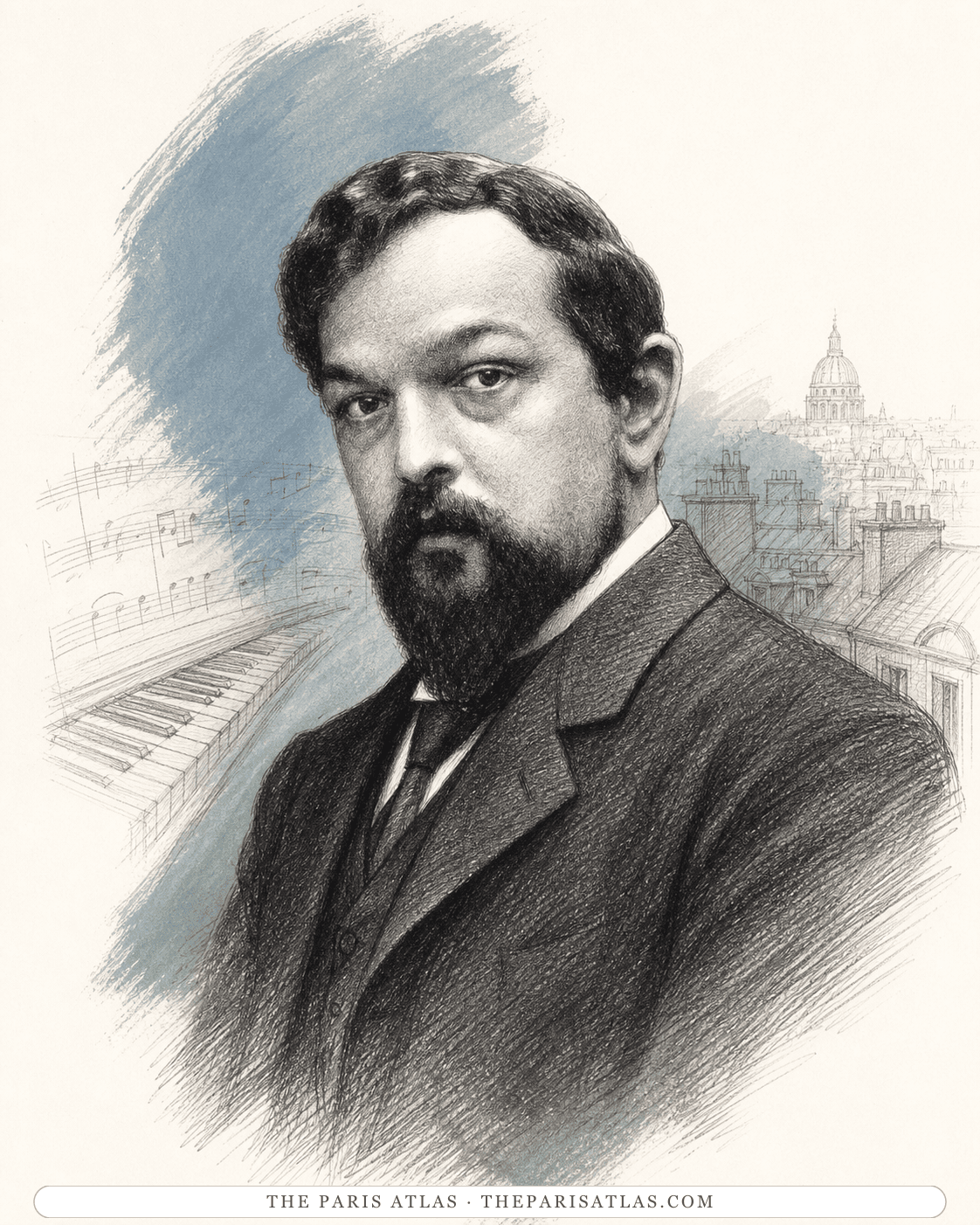
Claude Debussy
Debussy's use of modal, pentatonic and nontraditional tonal materials helped Bartók see how folk-derived scales and modern harmony could coexist outside conventional nineteenth-century tonality.
The modernist composer who built on Debussy's modal, pentatonic, and nontraditional tonal materials.
Béla Bartók was a Hungarian composer, pianist and ethnomusicologist, born in Nagyszentmiklós in the Kingdom of Hungary, now Sânnicolau Mare in Romania, on 25 March 1881. He and Franz Liszt are commonly ranked as Hungary's greatest composers. His major works include the opera Bluebeard's Castle, the ballet The Miraculous Mandarin, six string quartets, Music for Strings, Percussion and Celesta, and the Concerto for Orchestra.
What he changed came from fieldwork. From 1904, Bartók went into villages with a phonograph and recorded what peasants actually sang, first in Hungary, then across Slovakia, Romania, Bulgaria, Algeria and Turkey. He found that genuine Hungarian folk music was pentatonic and Asian-rooted, not the café music Liszt had rhapsodised. The work made him a founder of the discipline now called ethnomusicology, and it gave his own composition a language: folk scales and dance rhythms fused with the harmony of Debussy and the rigor of Beethoven and Bach. He showed later composers on every continent a modernism built from their own ground.[1]
An outspoken opponent of the Nazis, Bartók left Hungary for New York in October 1940, and struggled there. He died of complications of leukemia on 26 September 1945, aged 64, with the Concerto for Orchestra newly premiered and a piano concerto three days short of finished. Ten people attended his funeral. In 1988 Hungary brought his remains home to Budapest for a state burial.[1]
Béla Viktor János Bartók was born on 25 March 1881 in Nagyszentmiklós, a Banat town then in the Kingdom of Hungary and now Sânnicolau Mare in Romania. His father, also Béla, directed an agricultural school; his mother, Paula Voit, taught piano. The child could pick dance rhythms out of his mother's playing before he could speak in full sentences, played forty pieces at four, and began lessons with his mother at five.[2]
His father died suddenly in 1888, when the boy was seven, and his mother moved the family through a series of towns, settling in Pressburg, now Bratislava. At eleven Bartók gave his first public recital, playing among other things his own composition The Course of the Danube, written at nine. In 1899 he entered the Royal Academy of Music in Budapest, studying piano under István Thomán, a pupil of Franz Liszt, and composition under János Koessler.[2]
Two encounters set the course. In 1902 the Budapest premiere of Richard Strauss's Also sprach Zarathustra electrified him; he said afterward that at last he saw the way that lay before him. His 1903 symphonic poem Kossuth, on the hero of the 1848 revolution, is written in Strauss's language. Then, at a holiday resort in the summer of 1904, he overheard a young nanny, Lidi Dósa from Transylvania, singing folk songs to the children in her care. He never stopped following that sound.[2]
At the Academy he had met Zoltán Kodály, who became a lifelong friend and collaborator. In 1908 the two went into the countryside with a phonograph to record old Hungarian melodies from the peasants who still sang them. What they found overturned the received idea, fixed by Liszt's Hungarian Rhapsodies, that Hungarian music meant the popular art songs played by Romani café bands. The old village melodies were built on pentatonic scales, kin to the folk musics of Central Asia, Anatolia and Siberia. Charles Seeger later called Bartók one of the greatest field collectors of the century's first half.[1]
In 1907 Kodály brought Claude Debussy's scores back from Paris, and Bartók found in them the harmonic permission the folk material needed: proof that modern music could live outside the major-minor system. The same year he joined the Liszt Academy as a piano professor, a post that spared him the touring virtuoso's life. His String Quartet No. 1 (1908) is the first work where the folk discoveries clearly sound.[3]
In 1909, at twenty-eight, Bartók married Márta Ziegler, sixteen; their son Béla was born the next year. In 1911 he wrote his only opera, Bluebeard's Castle, dedicated to Márta: one castle, two singers, seven doors, and the argument that people cannot control their fates. The Hungarian Fine Arts Commission rejected it as unstageable, and the disappointment pushed him almost entirely into folk-music collecting for several years, with expeditions through the Carpathian Basin and, in 1913, Algeria. The First World War ended the fieldwork, and he returned to composing with the ballet The Wooden Prince and the String Quartet No. 2.[2]
His pantomime score The Miraculous Mandarin, begun in 1918 under the influence of Igor Stravinsky, Arnold Schoenberg and Strauss, was kept off the stage until 1926 by its sexual subject matter. In 1923 he divorced Márta and married the piano student Ditta Pásztory, ten days after proposing; their son Péter was born in 1924. The mature masterpieces came in a steady line: the Third and Fourth String Quartets in 1927–28, the Fifth in 1934, Music for Strings, Percussion and Celesta in 1936, the Sixth Quartet in 1939. In 1936 he travelled to Turkey to collect folk music around Adana with the composer Ahmet Adnan Saygun.[1]
Politics pressed in throughout. After participating in the 1919 revolution, he was pressured by the Horthy government to strike the name of his librettist Béla Balázs, who was Jewish and blacklisted, from Bluebeard's Castle. After 1933 he refused to perform in Germany and left his German publisher. His will of October 1940 asked that no street or square in Hungary be named for him while any still bore the names of Hitler or Mussolini.[2]
Bartók sent his manuscripts abroad first, then followed, reluctantly, with Ditta, reaching New York by steamer from Lisbon on the night of 29–30 October 1940. America knew him as a pianist and scholar more than as a composer; concert demand was thin, and he worked on a Columbia University research fellowship, cataloguing Serbian and Croatian folk song. He was proud about money, refused most offered help, and, though often short of cash, never fell into the destitution of legend.[2]
His health began failing in 1940 with a stiffening shoulder, then fevers; in April 1944 the diagnosis came back leukemia, too late to treat. The dying man's late works are the paradox of his career. Serge Koussevitzky's commission produced the Concerto for Orchestra, premiered by the Boston Symphony Orchestra in December 1944 to immediate acclaim, quickly his most popular work. Yehudi Menuhin commissioned the Sonata for Solo Violin. The Third Piano Concerto, written as a surprise birthday present for Ditta, was three days of orchestration short of finished when he died.[2]
Bartók died of complications of leukemia in a New York hospital on 26 September 1945, aged 64. Ten people attended the funeral. He was buried at Ferncliff Cemetery in Hartsdale, New York; in 1988, at the request of the Hungarian government and his sons, his remains were returned to Budapest and reburied beside Ditta at Farkasréti Cemetery after a state funeral. His pupil Tibor Serly completed the Third Piano Concerto and assembled the sketched Viola Concerto.[1]
Bartók described three ways a composer could use peasant music. He could quote the melody and set it, invent imitations of it, or absorb the idiom so completely that it becomes, in Bartók's phrase, a musical mother tongue, present with no melody quoted at all. His own work runs through all three, from the eighty set folk tunes of For Children to the late scores where the village is in the grammar rather than the themes. The synthesis he aimed at, stated in his own words, was Bach's counterpoint, Beethoven's form and Debussy's harmony, on folk foundations.[1]
The signature sounds are easy to name. Uneven Bulgarian dance rhythms. Drumming, percussive piano writing. Melody built on old five-note scales. And the slow movements of hushed, eerie night sounds, heard at their purest in Music for Strings, Percussion and Celesta. As a scholar he collected thousands of melodies across at least six countries, insisting on the phonograph for accuracy. His six string quartets are commonly placed beside Beethoven's as the spine of the form.
In his lifetime Bartók's fame ran far behind his achievement, above all in the American years, when little of his music was played. The reversal after 1945 was total. The quartets, the Concerto for Orchestra and the Music for Strings, Percussion and Celesta entered the standard repertoire. Hungary put his face on its money, and in 1988 brought his body home for a state funeral.[2]
His longer influence is a road not taken by the century's other modernisms. The critic Anthony Tommasini's summary is the standard one. Facing Schoenberg's formulations, Bartók showed another way, a blend of tonality, unorthodox scales and atonal wandering. He empowered generations of composers to build on the folk and classical traditions of whatever culture they came from. The discipline of ethnomusicology counts him among its founders.
Born in Nagyszentmiklós, Kingdom of Hungary, on 25 March; his mother begins teaching him piano at five.
Gives his first public recital at eleven, including his own composition The Course of the Danube.
Enters the Royal Academy of Music in Budapest, where he meets Zoltán Kodály.
Overhears the nanny Lidi Dósa singing Transylvanian folk songs at a resort, and begins a lifelong devotion to folk music.
Kodály brings Debussy's scores back from Paris; Bartók joins the Liszt Academy as a piano professor.
Begins systematic phonograph fieldwork with Kodály in the Hungarian countryside; writes the String Quartet No. 1.
Writes his only opera, Bluebeard's Castle; the Fine Arts Commission rejects it as unfit for the stage.
The Miraculous Mandarin finally reaches the stage, eight years after composition, delayed by its sexual subject.
Composes Music for Strings, Percussion and Celesta, and collects Turkish folk music around Adana with Ahmet Adnan Saygun.
Refusing life under the Axis alliance, emigrates with Ditta to New York, arriving by steamer from Lisbon on 29–30 October.
Leukemia is diagnosed in April; the Concerto for Orchestra premieres in Boston in December to immediate acclaim.
Dies of complications of leukemia in New York on 26 September, aged 64, the Third Piano Concerto unfinished by three days' work.
Hungary exhumes his remains from Ferncliff Cemetery and reburies them in Budapest with a state funeral on 7 July.
Debussy's use of modal, pentatonic and nontraditional tonal materials helped Bartók see how folk-derived scales and modern harmony could coexist outside conventional nineteenth-century tonality.
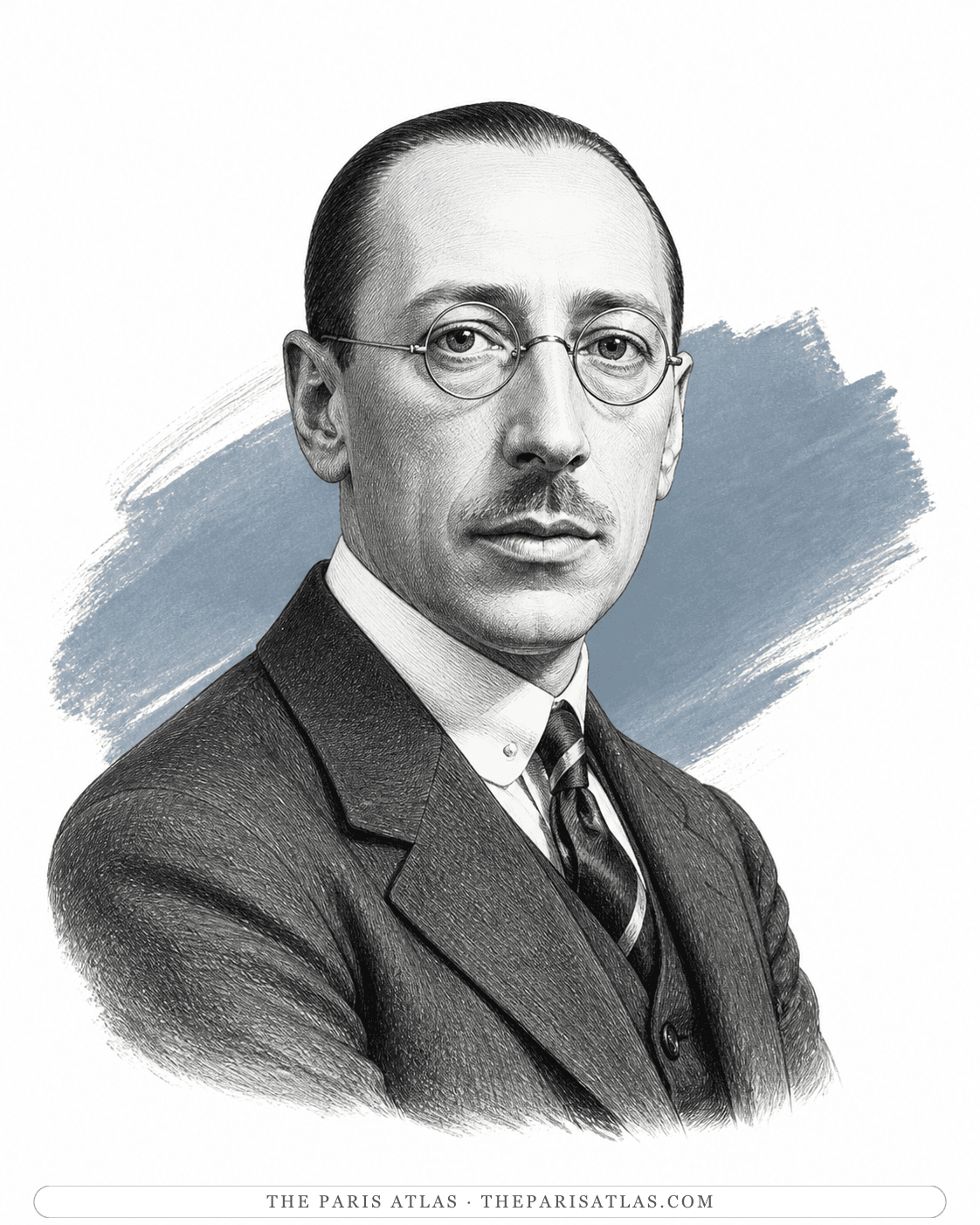
The mark is clearest in The Miraculous Mandarin, Bartók's 1918–1924 pantomime score, whose driving rhythmic violence takes up the language of Stravinsky's Russian-period ballets alongside Schoenberg and Strauss. The two composers' names became the twin poles of interwar modernism, and Bartók engaged with Stravinsky's percussive piano writing in his own concertos of the 1920s.
Béla Bartók (1881–1945) was a Hungarian composer, pianist and ethnomusicologist, ranked with Franz Liszt as Hungary's greatest composer. His best-known works are the opera Bluebeard's Castle, the ballet The Miraculous Mandarin, six string quartets, Music for Strings, Percussion and Celesta, and the Concerto for Orchestra. He was also a pioneering collector of folk music, recording thousands of village melodies across Eastern Europe, North Africa and Turkey, and is counted among the founders of ethnomusicology.
For building a modern musical language out of real peasant music. Bartók discovered, through phonograph fieldwork begun in 1908 with Zoltán Kodály, that authentic Hungarian village melody was pentatonic and ancient, unrelated to the café music the world knew as Hungarian. He fused those scales and dance rhythms with the harmonic freedom of Debussy and the formal discipline of the German classics. The result, in the string quartets and the late orchestral works, offered twentieth-century composers a modernism rooted in their own folk traditions rather than in Schoenberg's atonality.
Because of the Nazis and Hungary's alliance with them. Bartók refused to perform in Germany after Hitler came to power in 1933 and broke with his German publisher. As Hungary bound itself to the Axis he sent his manuscripts abroad and, in October 1940, reluctantly emigrated with his wife Ditta to New York. His will, written that month, asked that no Hungarian street be named after him while any still carried the names of Hitler or Mussolini.
Of complications of leukemia, in a New York hospital on 26 September 1945, at 64. His health had been failing since 1940, but the leukemia was only diagnosed in April 1944, too late for treatment. He composed to the end: the Concerto for Orchestra premiered in December 1944, and the Third Piano Concerto, a birthday present for his wife Ditta, was left three days short of complete. Only ten people attended his funeral. In 1988 his remains were returned to Budapest for a state burial.
The Concerto for Orchestra (1943), commissioned by Serge Koussevitzky for the Boston Symphony Orchestra while Bartók was dying of leukemia, is his most performed piece. Among musicians, the six string quartets are often ranked with Beethoven's as the greatest cycle in the form, and Music for Strings, Percussion and Celesta (1936) is his most influential single score. Bluebeard's Castle holds the stage as one of the great one-act operas.
Debussy's scores, brought back from Paris by Zoltán Kodály in 1907, showed Bartók that serious harmony could live outside the major-minor system, exactly what his folk discoveries needed. Bartók said in 1939 that Debussy's great service was to reawaken musicians to harmony's possibilities, placing him beside Bach and Beethoven, and framed his own life's question as whether the three could be synthesised. His answer is his mature style.
Influenced by
Debussy's use of modal, pentatonic and nontraditional tonal materials helped Bartók see how folk-derived scales and modern harmony could coexist outside conventional nineteenth-century tonality.
Influenced by
The mark is clearest in The Miraculous Mandarin, Bartók's 1918–1924 pantomime score, whose driving rhythmic violence takes up the language of Stravinsky's Russian-period ballets alongside Schoenberg and Strauss. The two composers' names became the twin poles of interwar modernism, and Bartók engaged with Stravinsky's percussive piano writing in his own concertos of the 1920s.
The sources below include biographies, scholarly essays, interviews, and primary materials that informed this page. They reflect both the historical record and ongoing critical conversations about Béla Bartók and their work.


The Debussy biography behind the influence claim carried on this page.
Reference article cross-checked for the chronology, the fieldwork, the emigration, the last works, and the 1988 reburial.
These references anchor the page in the documented record and in the scholarly conversations around Béla Bartók. Every claim on this page traces back to one or more of the works listed here.
 Explore more resources