The Paris AtlasCharting the artists, works, and places worth returning to.
  • Author
  • Playwright
· French · 1619–1655

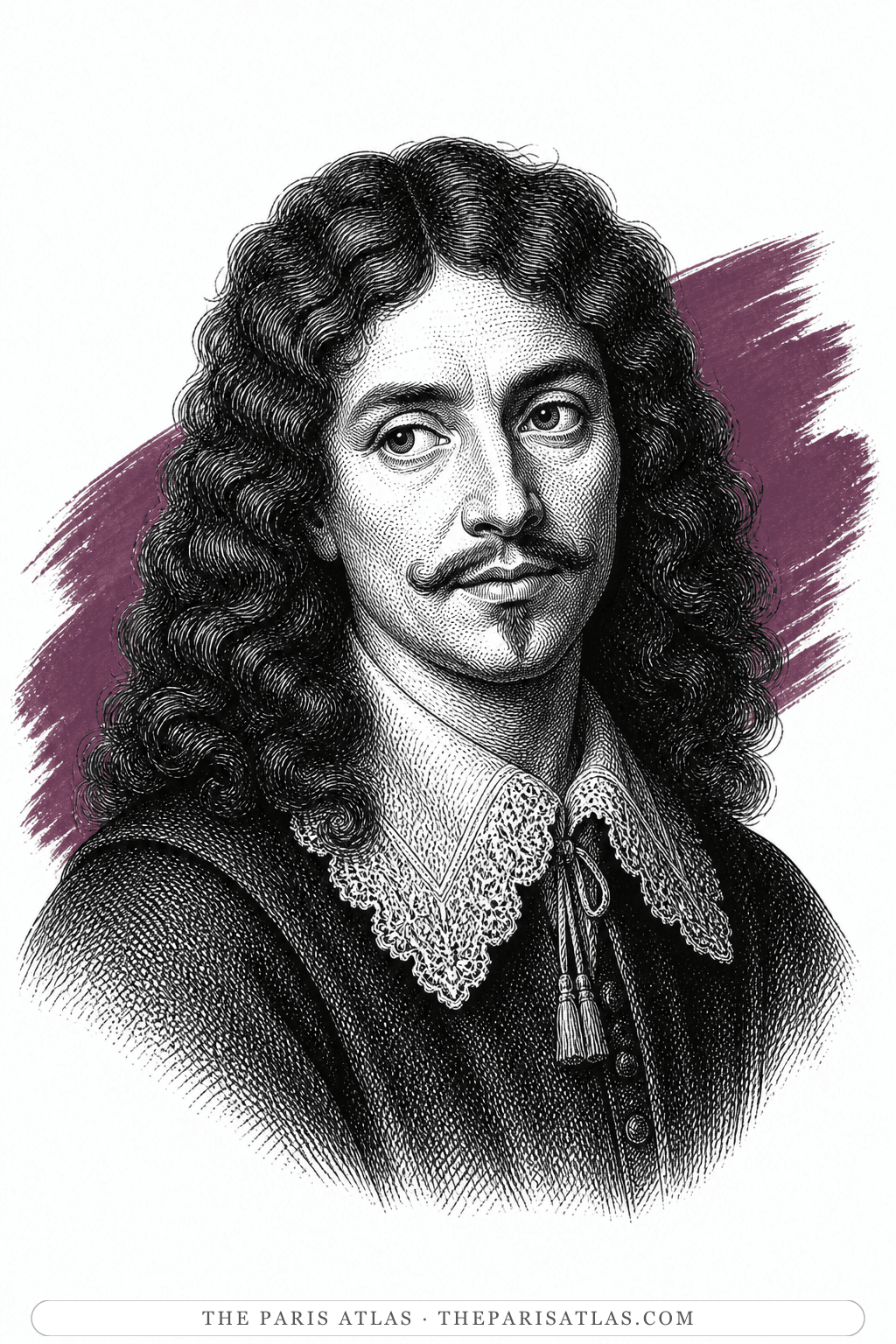
Savinien de Cyrano de Bergerac

The real man, not the character. Savinien de Cyrano de Bergerac lived from 1619 to 1655, two and a half centuries before Edmond Rostand wrote the famous play that carries his name: he was a guardsman wounded at two sieges, a duellist, a freethinker, and the author of L'Autre Monde (The Other World) — imaginary voyages to the Moon and the Sun, printed after his death and often called the first science fiction written in French. The giant nose was an exaggeration of the nineteenth century, made popular by the writer Théophile Gautier; Roxane and the ghost-written love letters were invented by Rostand in 1897.

Details

Lived
1619–1655
Born
1619
Birthplace
Paris
Birth name
Savinien de Cyrano
Died
1655
Place of death
Sannois, near Paris
Nationality
French
Profession
Soldier, playwright and libertine writer
Major works
L'Autre Monde, The Other World (Les États et Empires de la Lune, The States and Empires of the Moon, 1657; du Soleil, of the Sun, 1662), La Mort d'Agrippine, The Death of Agrippina (1653), Le Pédant joué, The Pedant Outwitted (1654)
Roles
AuthorPlaywright
Also known as
Cyrano de Bergerac · Savinien II de Cyrano

About Savinien de Cyrano de Bergerac

There are two Cyrano de Bergeracs, and this page is about the earlier and less famous one. The Cyrano most people picture is a stage character, invented by the French playwright Edmond Rostand for his play Cyrano de Bergerac in 1897: a swordsman with a monstrous nose who writes love letters for a handsome friend and dies without telling Roxane he wrote them. The other Cyrano is the real person Rostand borrowed the name from — Savinien de Cyrano de Bergerac, who lived from 1619 to 1655, fought in the French army, was wounded twice, wrote two comic voyages to the Moon and the Sun that could only be published after he was dead, and had one of the most dangerous minds of his century. Dangerous is meant literally: his opinions about God, the soul and the universe were the kind that could put a man in prison, which is why his best book circulated in secret.

Savinien de Cyrano de Bergerac was born in Paris in 1619, schooled at a Paris college whose brutal headmaster he later put into a comedy, and joined a company of guards at nineteen. He was shot through the body at the siege of Mouzon in 1639 and run through the throat at the siege of Arras in 1640. He fought, by his friends' count, more than a hundred duels — almost all of them as another man's second, the friend who backed a duellist and fought alongside him. And in the 1640s he wrote L'Autre Monde, The Other World, in which a Parisian straps rockets to a machine and reaches the Moon, finds it inhabited, and is lectured by its people on the absurdity of the Christian picture of the universe. He died at thirty-six. Rostand, writing in 1897 — two hundred and forty-two years after that death — made him immortal and unrecognisable at the same time.

The man and the play

Edmond Rostand's Cyrano de Bergerac — a comedy in five acts and in verse — opened in Paris on 28 December 1897 with Constant Coquelin, the most celebrated French stage actor of the day, in the title role, and was an instant and permanent success. Its Cyrano is a guardsman of monstrous facial ugliness and matchless verbal gift, a Gascon — a man from Gascony in the south-west, a region proverbial in France for touchy, boastful, quick-drawing gentlemen — who loves his cousin Roxane, writes the letters by which the beautiful and inarticulate Christian wins her, and only confesses on his deathbed fifteen years later. Almost none of that plot is history. Roxane, the letters, Christian's borrowed eloquence and the fifteen years in the convent are Rostand's invention.

The nose is a different case, and often misreported. It was not Rostand's idea either: he found it already in the nineteenth-century rediscovery of Cyrano, above all in Théophile Gautier (1811–1872), the French poet, novelist and critic who was one of the standard-bearers of French Romanticism and who wrote a series of essays resurrecting forgotten seventeenth-century writers. Gautier's essay on Cyrano made much of an unreasonable nose that swallowed the whole face. Cyrano's first English translator, the poet and novelist Richard Aldington, complained in 1923 that Gautier had wildly inflated a feature the surviving portraits show as distinctive but not grotesque. What Rostand did was take a nose that the previous generation had exaggerated and build an entire tragedy of unlovability on it.

The play's effect on the man was total. Aldington's verdict was that the world believed, and doubtless still believes, that the stage figure is the real Cyrano de Bergerac. The French literary scholar Jacques Prévot, writing in 1991 as serious study of Cyrano was finally taking off, put it more painfully: until recent times the writer's name had survived only because a dramatist borrowed it. Rostand saved him from oblivion and buried him at the same time.

Paris, 1619: a scrap of family land, a college and a bad headmaster

He was baptised in Paris on 6 March 1619, and his name was Savinien de Cyrano — the second in his family to carry it. Bergerac was not a birthplace and not the town in the Dordogne, in south-western France, that shares the name: it was a small family fief — a piece of land held on feudal terms, in this case a modest estate the Cyranos owned in the countryside near Paris — and Savinien was the only member of his family who bothered to append it to his name. He was, in other words, a Parisian who gave himself a country title, which tells you something about him before he has done anything at all.

He was educated at the collège de Beauvais, one of the boarding colleges of the University of Paris in the Latin Quarter — a collège in that century taught boys their Latin and philosophy, so it sat somewhere between a modern secondary school and a university hall — under a headmaster named Jean Grangier — described by Cyrano's translator as brutal, superstitious, violent and vicious. Cyrano got his revenge in print: Grangier is the pedant of Le Pédant joué, The Pedant Outwitted, the comedy he published in 1654. It is the first thing to know about how his mind worked. He did not forget, and he wrote things down.

The soldier, and the hundred duels

At nineteen he entered the company of guards commanded by Carbon de Casteljaloux — a real officer, whom Rostand would later put on stage under his own name — in a unit stuffed with Gascon gentlemen. The soldiering was short and expensive. In 1639 he was shot through the body at the siege of Mouzon; the following year, at the siege of Arras, he took a sword-thrust through the throat. Both wounds are documented; both effectively ended his military career while he was still in his early twenties.

The duelling was the other half of the reputation, and the striking fact about it is that the quarrels were hardly ever his own. He fought more than a hundred times as another man's second — the friend who accompanied a duellist and, by the custom of the time, fought the opposing second while the principals fought each other. The most famous of these actions was at the Porte de Nesle, a gate in the city wall on the Left Bank of the Seine, where he took on a gang lying in wait for his friend François Payot de Lignières, a satirical poet whose verses had made him enemies, and, in the account that comes down, killed two, wounded seven and put the rest to flight. Rostand staged it almost unchanged; it is the one part of the legend that appears to be roughly true.

The libertin — the freethinker — and the voyage to the Moon

Back in Paris, Cyrano joined the milieu the century called the libertins — a word that then meant freethinkers rather than rakes: men who read the ancient atomists, doubted miracles, and kept their most dangerous opinions in manuscript. The presiding intelligence of that world was Pierre Gassendi (1592–1655), a priest and mathematician who held the chair of mathematics at the Collège royal in Paris — the royal foundation of public lecturers, free and outside the Church-run university, that is now the Collège de France — and who spent his life reviving the atomic theory of Epicurus — the idea that everything is made of indivisible particles moving in a void — and reconciling it, with some strain, to Christianity. Cyrano was deeply indebted to him. The physics of Cyrano's fiction is Gassendi's physics, and modern scholarship reads L'Autre Monde as a working-out of the atomist hypothesis in narrative form.

That fiction is L'Autre Monde — The Other World — in two parts: Les États et Empires de la Lune, The States and Empires of the Moon, composed around 1648, and its sequel Les États et Empires du Soleil, The States and Empires of the Sun. The narrator tries several methods of leaving the Earth and finally reaches the Moon on a machine driven by rockets tied around it. The Moon turns out to be inhabited, its people walk on four legs, treat human beings as animals, and put the visitor on trial; their philosophers explain, at length and with perfect courtesy, that the universe is infinite, that the Earth is not its centre, that the soul may be material and the resurrection of the body an absurdity.

It is routinely called the first science fiction written in French, and the label is fair as far as the machinery goes — the rockets, the trip, the alien society, the encounter used as a lens on our own. The Larousse encyclopedia — the standard French reference work — calls the book the herald of anticipatory literature and philosophical satire, an imaginary voyage written to criticise human society. Aldington resisted the science-fiction reading, preferring as his comparison Jonathan Swift's Gulliver's Travels of 1726, in which a traveller visits invented countries whose customs expose his own: not a book about the future, but a book that goes somewhere impossible in order to say what could not be said in Paris.

A patron, a falling piece of wood, and a death at thirty-six

Towards the end of 1652 Cyrano entered the service of the duc d'Arpajon — Louis d'Astarac, a great nobleman and soldier who, like others of his rank, kept writers in his household and paid for their books — and under that protection his work reached print for the first time: a verse tragedy, La Mort d'Agrippine (The Death of Agrippina, about the widow of a Roman general destroyed by the emperor Tiberius), in 1653, and in 1654 two handsome quarto volumes — quarto being a large, expensive book size — containing his letters and Le Pédant joué. He had, at thirty-four, become a published author with a noble patron. It lasted about a year.

Early in 1654 he was struck on the head — the story is that a piece of wood or a beam fell on him as he entered a house. Even his translator hedges it: the accident, if there were an accident. Whether the blow, or an illness, or something arranged by someone he had offended finally killed him has never been settled. He lingered more than a year and died on 28 July 1655 at Sannois, a village north-west of Paris, aged thirty-six.

His schoolfriend Henry Le Bret, who became a priest and acted as his literary executor, got the Moon voyage into print in 1657, two years after the death — and censored it hard, cutting the passages most likely to attract the attention of the church, some fourteen pages of the sharpest material. The Sun voyage followed in 1662; the Paris bookseller-publisher Charles de Sercy was still reprinting the Moon voyage in 1665. The uncensored text survived only in manuscript, and the twentieth century had to put the book back together. What eighteenth- and nineteenth-century readers knew of Cyrano was a bowdlerised version of a dead man's dangerous book.

What Molière took

One posthumous compliment is worth more than the play. Molière, the great comic dramatist of the next generation, went through Le Pédant joué and helped himself: several of its best scenes, situations and scraps of dialogue turn up in his own work, and the whole of the celebrated galley scene in Les Fourberies de Scapin — built on the repeated line 'Que diable allait-il faire dans cette galère?', 'What the devil was he doing on that galley?' — is lifted from Cyrano. It is one of the best-known jokes in French theatre, and its first author died unpublished and unread.

The rest of the afterlife is Rostand's. Since 28 December 1897 the name has meant a nose, a balcony and a dying confession, and the man himself — Paris-born, twice wounded, chronically insubordinate, dead at thirty-six with his best book unprinted — has had to be excavated from underneath his own fame. The excavation is largely a job of the last fifty years, and the excavated version is stranger and better than the play.

Life events

  1. 1619

    Baptised in Paris on 6 March, as Savinien de Cyrano; Bergerac is a family fief he alone adopts.

    Savinien de Cyrano de Bergerac; trans. Richard Aldington, Voyages to the Moon and the Sun — translated, with a biographical introduction, by Richard Aldington (1923); Savinien de Cyrano de Bergerac

  2. 1630s

    Educated at the collège de Beauvais in Paris under the headmaster Jean Grangier, whom he will pillory as the pedant of Le Pédant joué.

    Savinien de Cyrano de Bergerac; trans. Richard Aldington, Voyages to the Moon and the Sun — translated, with a biographical introduction, by Richard Aldington (1923)

  3. 1638

    Enters the company of guards commanded by Carbon de Casteljaloux, at nineteen.

    Savinien de Cyrano de Bergerac; trans. Richard Aldington, Voyages to the Moon and the Sun — translated, with a biographical introduction, by Richard Aldington (1923)

  4. 1639

    Shot through the body at the siege of Mouzon.

    Savinien de Cyrano de Bergerac; trans. Richard Aldington, Voyages to the Moon and the Sun — translated, with a biographical introduction, by Richard Aldington (1923)

  5. 1640

    Run through the throat by a sword at the siege of Arras; the military career effectively ends.

    Savinien de Cyrano de Bergerac; trans. Richard Aldington, Voyages to the Moon and the Sun — translated, with a biographical introduction, by Richard Aldington (1923)

  6. 1640s

    Back in Paris among the libertins — the freethinkers around the atomist philosopher Pierre Gassendi — and fighting duels, more than a hundred of them as another man's second.

    Savinien de Cyrano de Bergerac; trans. Richard Aldington, Voyages to the Moon and the Sun — translated, with a biographical introduction, by Richard Aldington (1923); Pierre Gassend, dit Gassendi

  7. 1648

    Composes Les États et Empires de la Lune, the voyage to the Moon, around this date; it circulates in manuscript.

    Histoire comique des États et empires de la Lune; Amalia Perfetti, L'hypothèse atomistique dans L'Autre Monde de Cyrano de Bergerac (2002)

  8. 1652

    Enters the service of the duc d'Arpajon, and is published for the first time.

    Savinien de Cyrano de Bergerac; trans. Richard Aldington, Voyages to the Moon and the Sun — translated, with a biographical introduction, by Richard Aldington (1923)

  9. 1653

    The verse tragedy La Mort d'Agrippine appears.

    Savinien de Cyrano de Bergerac

  10. 1654

    Le Pédant joué is printed, with his letters, in two quarto volumes — and early in the year a falling piece of wood strikes him on the head.

    Savinien de Cyrano de Bergerac; Savinien de Cyrano de Bergerac; trans. Richard Aldington, Voyages to the Moon and the Sun — translated, with a biographical introduction, by Richard Aldington (1923)

  11. 1655

    Dies on 28 July at Sannois, north-west of Paris, aged thirty-six.

    Savinien de Cyrano de Bergerac; trans. Richard Aldington, Voyages to the Moon and the Sun — translated, with a biographical introduction, by Richard Aldington (1923)

  12. 1657

    Henry Le Bret publishes the Moon voyage posthumously, cutting some fourteen pages of its most heretical material.

    Savinien de Cyrano de Bergerac; trans. Richard Aldington, Voyages to the Moon and the Sun — translated, with a biographical introduction, by Richard Aldington (1923); Histoire comique des États et empires de la Lune

  13. 1662

    Les États et Empires du Soleil, the voyage to the Sun, reaches print; Charles de Sercy is still reprinting the Moon in Paris in 1665.

    Savinien de Cyrano de Bergerac; Histoire comique des estat et empire de la lune, Paris: C. de Sercy, 1665 — catalogue record

  14. 1897

    Edmond Rostand's Cyrano de Bergerac premieres in Paris on 28 December with Constant Coquelin in the title role, and replaces the man with the character for the next century.

    Cyrano de Bergerac — comédie en 5 actes et en vers d'Edmond Rostand (1897); Jacques Prévot, Cyrano de Bergerac, ou l'homme qui avait la tête dans les étoiles (1991)

Who drew from them

Influence running outward — the writers and artists who built on their work.

Molière

Moliere took several of the best scenes, situations and scraps of dialogue from Cyrano's comedy Le Pedant joue (printed 1654), and the whole of the famous galley scene in Les Fourberies de Scapin (1671) — the one built on the repeated cry 'Que diable allait-il faire dans cette galere?' — is imitated from it. One of the most quoted jokes in French theatre, borrowed from a writer who had died unread nineteen years earlier.

Savinien de Cyrano de Bergerac; trans. Richard Aldington, Voyages to the Moon and the Sun — translated, with a biographical introduction, by Richard Aldington (1923); Savinien de Cyrano de Bergerac

Questions about Savinien de Cyrano de Bergerac

Was Cyrano de Bergerac a real person?

Yes. Savinien de Cyrano de Bergerac was born in Paris in 1619 and died at Sannois, just outside it, on 28 July 1655, aged thirty-six. He served in a company of guards, was wounded at the sieges of Mouzon (1639) and Arras (1640), wrote a tragedy and a comedy, and left two comic voyages to the Moon and the Sun that were published after his death. Edmond Rostand's 1897 play is built on him but is not a biography.

Did the real Cyrano have a huge nose?

He had a noticeable one, and the nineteenth century did the rest. The exaggeration was not Rostand's: Théophile Gautier's essay on Cyrano had already made the nose enormous, an unreasonable feature swallowing the whole face, and Rostand inherited it. His 1923 English translator, Richard Aldington, examined the surviving portraits and objected that Gautier had inflated something distinctive into something grotesque. So: a real feature, wildly amplified twice before the play was written.

Was Roxane real, and did Cyrano write love letters for another man?

No. Roxane, the beautiful Christian, the ghost-written letters and the deathbed confession fifteen years later are Rostand's invention — the machinery of a nineteenth-century romantic tragedy, attached to a seventeenth-century name. There is no such episode in the life of the actual Cyrano de Bergerac.

What did Cyrano de Bergerac actually write?

Two plays and one great book. The plays are La Mort d'Agrippine (1653), a tragedy in verse, and Le Pédant joué (1654), a comedy whose title character is his old headmaster. The book is L'Autre Monde — The Other World — in two parts: Les États et Empires de la Lune, composed around 1648 and printed in 1657, and Les États et Empires du Soleil, printed in 1662. Both are voyages to inhabited worlds where the locals demolish, politely, everything a French Catholic reader believed about the universe.

Is L'Autre Monde the first science fiction novel in French?

It is the usual candidate, and the machinery supports it: the narrator experiments with ways of leaving the Earth and finally gets to the Moon on a device driven by rockets, finds an alien society and uses it to look back at his own. The Larousse encyclopedia calls the book the herald of anticipatory literature and of philosophical satire. Its first English translator preferred to compare it to Gulliver's Travels — an impossible journey undertaken so the author could say, safely, things that were not sayable in Paris.

How did Cyrano de Bergerac die?

Uncertainly. Early in 1654 he was struck on the head by a falling piece of wood — a beam, in most tellings — as he entered a house. He never recovered properly and died on 28 July 1655 at Sannois. Whether the blow killed him, or a disease did, or whether the falling timber was an accident at all, has never been settled; Richard Aldington's 1923 account of the episode already hedges it as 'the accident, if there were an accident'.

What did Molière take from Cyrano de Bergerac?

Scenes. Molière went through Le Pédant joué and appropriated several of its best situations and exchanges — most famously the entire galley scene of Les Fourberies de Scapin, the one that turns on the repeated cry 'Que diable allait-il faire dans cette galère?' ('What the devil was he doing on that galley?'), which is imitated from Cyrano. It is among the most quoted jokes in French theatre and its inventor got no credit for it in his lifetime.

Why is he called 'de Bergerac' if he was born in Paris?

Because of a piece of land, not a town. Bergerac was a small family fief, and Savinien de Cyrano was the only member of his family who added it to his name. The Dordogne town of Bergerac, which has since adopted him enthusiastically, has no claim on him at all: he was a Parisian who gave himself a country handle, and then made it one of the most famous names in France.

Sourced claims

Every connection the graph holds for Savinien, with the evidence behind it.

Influenced · 1654

Molière

Moliere took several of the best scenes, situations and scraps of dialogue from Cyrano's comedy Le Pedant joue (printed 1654), and the whole of the famous galley scene in Les Fourberies de Scapin (1671) — the one built on the repeated cry 'Que diable allait-il faire dans cette galere?' — is imitated from it. One of the most quoted jokes in French theatre, borrowed from a writer who had died unread nineteen years earlier.

Savinien de Cyrano de Bergerac; trans. Richard Aldington, Voyages to the Moon and the Sun — translated, with a biographical introduction, by Richard Aldington (1923); Savinien de Cyrano de Bergerac

References

References

The sources below include biographies, scholarly essays, interviews, and primary materials that informed this page. They reflect both the historical record and ongoing critical conversations about Savinien de Cyrano de Bergerac and their work.

  1. 1Voyages to the Moon and the Sun — translated, with a biographical introduction, by Richard Aldington

    George Routledge & Sons, 1923

    Richard Aldington's 1923 translation, whose long biographical introduction supplies the baptism date, the collège de Beauvais, the sieges, the duels, the d'Arpajon patronage, the head injury and Le Bret's censorship.

    View source
  2. 2Savinien de Cyrano de Bergerac

    Encyclopédie Larousse

    The Larousse encyclopedia entry on the writer: dates, and the list of the plays and the two comic voyages with their publication years.

    View source
  3. 3Histoire comique des États et empires de la Lune

    Encyclopédie Larousse

    Larousse on the Moon voyage — composed around 1648, published 1657 — as the herald of anticipatory literature and philosophical satire.

    View source
  4. 4Cyrano de Bergerac — comédie en 5 actes et en vers d'Edmond Rostand (1897)

    Encyclopédie Larousse

    Larousse on Rostand's play: the premiere of 28 December 1897 with Coquelin, the plot, and Gautier's unreasonable nose as Rostand's inherited material.

    View source
  1. 5Cyrano de Bergerac, ou l'homme qui avait la tête dans les étoiles

    Littératures classiques, no. 15 (Persée), 1991

    Jacques Prévot on the modern scholarly recovery of Cyrano, and on a name that survived only through the dramatist who borrowed it.

    View source
  2. 6L'hypothèse atomistique dans L'Autre Monde de Cyrano de Bergerac

    Revue d'histoire des sciences, vol. 55-2 (Persée), 2002

    Amalia Perfetti on the atomist hypothesis inside L'Autre Monde, and on the two voyages' publication in 1657 and 1662.

    View source
  3. 7Pierre Gassend, dit Gassendi

    Encyclopédie Larousse

    Larousse on Gassendi (1592–1655), the Collège royal chair who revived Epicurean atomism — the physics behind Cyrano's fiction.

    View source
  4. 8Histoire comique des estat et empire de la lune, Paris: C. de Sercy, 1665 — catalogue record

    Bibliothèque nationale de France

    The Bibliothèque nationale de France catalogue record for Charles de Sercy's 1665 Paris printing of the Moon voyage.

    View source
i
Why these sources are here

These references anchor the page in the documented record and in the scholarly conversations around Savinien de Cyrano de Bergerac. Every claim on this page traces back to one or more of the works listed here.

Explore more resources
Browse all authors