
Big Sur
How Neal appears in its pages: Duluoz's old friend. The novel's version of Neal Cassady, under the name Kerouac also gave him in Visions of Cody.
Jack Kerouac's friend, traveling companion and stylistic muse—the principal model for Dean Moriarty in On the Road and Cody Pomeray in Visions of Cody.
Neal Cassady was an American writer and a central figure of two movements: the Beat Generation of the 1950s and the psychedelic counterculture of the 1960s. He was born in Salt Lake City on 8 February 1926 and grew up on the skid rows of Denver. He published almost nothing in his lifetime, yet shaped the work of others more than most published writers do.
His medium was talk and letters. Cassady's headlong, unpunctuated correspondence taught Jack Kerouac the spontaneous prose of On the Road, in which Cassady appears, barely disguised, as Dean Moriarty. He is Cody Pomeray in Kerouac's later books, a presence in Allen Ginsberg's poetry, and, a decade on, the driver of Ken Kesey's bus Furthur in Tom Wolfe's The Electric Kool-Aid Acid Test. He linked the Beats to the hippies in one restless life.
That life burned fast. Cassady married three times, worked the railroads, served two years in San Quentin on a minor marijuana charge, and drove endlessly across America. He died beside a railway track in San Miguel de Allende, Mexico, on 4 February 1968, four days short of 42.
Neal Leon Cassady was born in Salt Lake City on 8 February 1926. His mother died when he was ten, and he was raised by an alcoholic father in Denver, much of his youth spent on skid row or in reform school. He was arrested repeatedly as a boy, for car theft, shoplifting and fencing, and served eleven months of a prison sentence at eighteen. He also read voraciously, and his intelligence caught the eye of the Denver educator Justin Brierly, who got him into East High School and supervised his reading.[1]
In 1945 Cassady married sixteen-year-old LuAnne Henderson. In 1946 the couple went to New York to visit a friend at Columbia University, and there Cassady met Jack Kerouac and Allen Ginsberg. He was not a student, but he fell in with them and their circle, the nucleus of the Beat Generation, and asked Kerouac to teach him to write fiction. The exchange ran the other way too.
Cassady became the human engine of the Beat years. He crossed and recrossed the country with Kerouac and Ginsberg, trips Kerouac turned into On the Road. His personal life was as fast as his driving. He annulled his marriage to LuAnne in 1948 and married Carolyn Robinson, with whom he had three children and a ranch house south of San Francisco. In 1950 he bigamously married the model Diane Hansen. His long, on-and-off sexual relationship with Allen Ginsberg ran across twenty years.[2]
For much of the 1950s he worked as a brakeman for the Southern Pacific Railroad, the steadiest job of his life. It was in these years that his letters, above all a famous long letter to Kerouac, did their work on American literature. In 1958, after offering a small amount of marijuana to an undercover agent in a San Francisco club, Cassady was sentenced to two years in San Quentin State Prison.[1]
Released in 1960, Cassady struggled, and Carolyn divorced him in 1963. He then made the leap that few of the Beats did, into the next counterculture. He met the novelist Ken Kesey and became one of the Merry Pranksters, and in 1964 he drove Kesey's psychedelic bus, Furthur, on its cross-country trip. Tom Wolfe put him at the wheel of The Electric Kool-Aid Acid Test, the manic non-stop talker linking the Beat generation to the hippies.[1]
His last year was frantic and unmoored, shuttling between the United States and Mexico. On 3 February 1968 he attended a wedding party in San Miguel de Allende, Mexico, where he took an unknown quantity of the barbiturate secobarbital. Afterward he set out to walk along a railway track to the next town, in cold rain, wearing only a T-shirt and jeans, and passed out. He was found in a coma by the tracks in the morning and died in hospital a few hours later, on 4 February 1968, four days before his forty-second birthday. The exact cause was never settled; exposure is usually cited, though his former wife believed kidney failure. His autobiographical novel The First Third was published posthumously in 1971.[3]
Cassady's real work was a way of using words that he mostly spoke and wrote in letters rather than published. His prose runs on like breathless speech: unpunctuated, associative, hypermanic. It reads closer to talk than to written sentences. Reading it, Kerouac abandoned the careful, Thomas Wolfe-influenced manner of his first novel and resolved to write in a rush of mad ecstasy, without self-consciousness. That decision produced the spontaneous prose of On the Road and Visions of Cody.[2]
He was also the subject as much as the source. Dean Moriarty in On the Road and Cody Pomeray in the later Kerouac books are Cassady, and he appears in Ginsberg's poetry and in Wolfe's Prankster chronicle. He published only fragments himself, so his influence is measured almost entirely in other people's masterpieces, an unusual kind of literary importance, and a real one.
Cassady is remembered as the muse and catalyst of the Beat Generation and a bridge to the psychedelic 1960s, the man who set two literary movements in motion while barely writing a book. His letters have been collected and published since his death, his novel The First Third has kept its readers, and his family maintains an archive of the circle.
He also stands as the counterculture's cautionary figure, the endlessly moving man who wore himself out, sung by the Grateful Dead in Cassidy and by others, and filmed in documentaries of the Pranksters. His importance is real but reflected: it lives in On the Road, in Ginsberg's poems, and in the myth of the American road he did more than anyone to create.
Born Neal Leon Cassady in Salt Lake City on 8 February.
The Denver educator Justin Brierly, struck by his intelligence, helps him into East High School.
Meets Jack Kerouac and Allen Ginsberg in New York, joining the circle that became the Beat Generation.
Annuls his first marriage and marries Carolyn Robinson; works as a Southern Pacific brakeman.
On the Road is published, with Cassady as its hero Dean Moriarty.
Sentenced to two years in San Quentin after offering marijuana to an undercover agent.
Drives Ken Kesey's bus Furthur across the country as one of the Merry Pranksters.
Dies beside a railway track in San Miguel de Allende, Mexico, on 4 February, four days short of 42.
His unfinished autobiographical novel The First Third is published posthumously.
How Neal appears in its pages: Duluoz's old friend. The novel's version of Neal Cassady, under the name Kerouac also gave him in Visions of Cody.
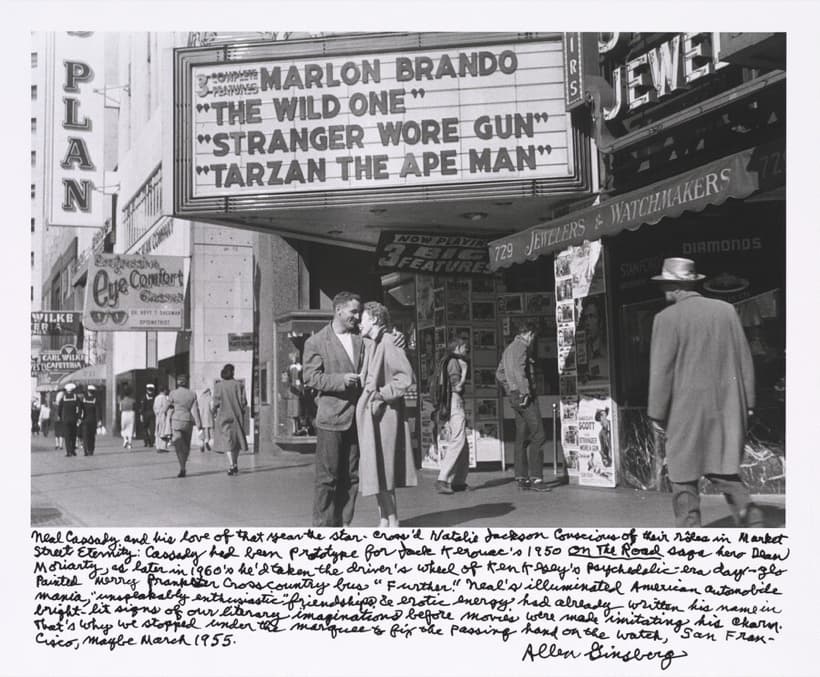
Photograph
A man in a light tweed jacket holds a woman in a pale swing coat under a cinema marquee, both laughing, while the street goes past them. Allen Ginsberg made the exposure on Market Street in San Francisco, and his caption dates it to maybe March 1955. The sitters are Neal Cassady, the model for Jack Kerouac's Dean Moriarty, and Natalie Jackson. He printed the negative in 1996 and wrote eight lines of caption in the border. The National Gallery of Art owns the print as 2009.103.10.
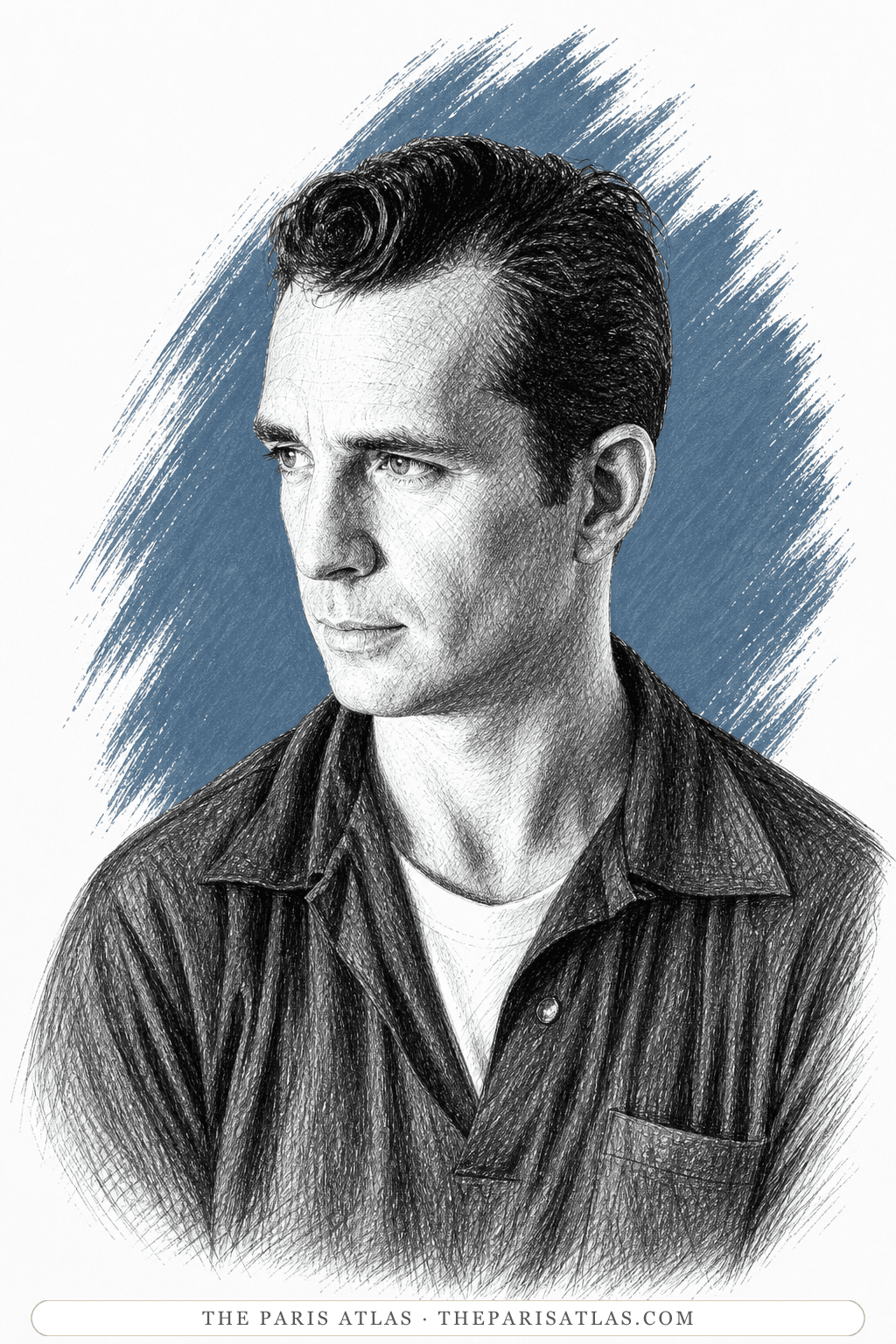
Met · 1946
Cassady became Kerouac's traveling companion, muse and the model for Dean Moriarty and Cody Pomeray; his talk and letters also influenced Kerouac's prose rhythm.
Reading Cassady's headlong, unpunctuated letters convinced Kerouac to abandon the mannered style of The Town and the City and write in a rush of mad ecstasy, the spontaneous prose that produced On the Road. Cassady was both the method and the subject: the model for Dean Moriarty in On the Road and Cody Pomeray in the later books.
Neal Cassady (1926–1968) was an American writer and a central figure of the Beat Generation and the 1960s psychedelic movement. Though he published almost nothing in his lifetime, his headlong conversation and letters influenced Jack Kerouac's prose profoundly, and he was the model for Dean Moriarty in Kerouac's On the Road. A decade later he drove Ken Kesey's bus Furthur as one of the Merry Pranksters, linking the Beats to the hippies.
Yes. Cassady is the real-life basis for Dean Moriarty, the restless, charismatic driver at the centre of Jack Kerouac's On the Road (1957); in the original scroll draft he appears under his own name. He is also the model for Cody Pomeray in several of Kerouac's later books, including Visions of Cody. Their cross-country trips together in the late 1940s are the events the novel fictionalises.
Through his letters. Cassady wrote in a breathless, unpunctuated style close to spoken talk. Reading it convinced Kerouac to abandon the mannered prose of his first novel, The Town and the City, and write instead, as he put it, in a rush of mad ecstasy without self-consciousness. That spontaneous method produced On the Road and Visions of Cody, so Cassady shaped the signature Beat style without publishing a novel of his own.
The Merry Pranksters were the group that formed around the novelist Ken Kesey in the early 1960s to promote psychedelic drugs and stage happenings. In 1964 they crossed the United States in a painted bus named Furthur, with Cassady as its main driver, a trip Tom Wolfe chronicled in The Electric Kool-Aid Acid Test (1968). Cassady's role made him a rare figure who belonged to both the Beat Generation and the hippie counterculture that followed it.
He died on 4 February 1968 near a railway track outside San Miguel de Allende, Mexico, four days before his forty-second birthday. The night before, at a wedding party, he had taken an unknown amount of the barbiturate secobarbital. He then set out to walk the tracks to the next town in cold rain, wearing only a T-shirt and jeans, and passed out. He was found in a coma in the morning and died in hospital hours later. The exact cause was never established; exposure is usually cited, though his former wife believed it was kidney failure.
Very little was published while he lived, only two short prose fragments. His literary reputation rests mostly on his letters, which have been collected since his death, and on an unfinished autobiographical novel, The First Third, published posthumously in 1971. His importance is unusual: it lies less in his own pages than in the work he inspired in Kerouac and Ginsberg, and in the myth of the American road he helped create.
Influenced
Reading Cassady's headlong, unpunctuated letters convinced Kerouac to abandon the mannered style of The Town and the City and write in a rush of mad ecstasy, the spontaneous prose that produced On the Road. Cassady was both the method and the subject: the model for Dean Moriarty in On the Road and Cody Pomeray in the later books.
Met · 1946
Cassady became Kerouac's traveling companion, muse and the model for Dean Moriarty and Cody Pomeray; his talk and letters also influenced Kerouac's prose rhythm.
Depicted in
Allen Ginsberg names Neal Cassady first in the caption he wrote on the print, and the National Gallery of Art takes that caption as the object's title.
The sources below include biographies, scholarly essays, interviews, and primary materials that informed this page. They reflect both the historical record and ongoing critical conversations about Neal Cassady and their work.

Tom Wolfe's chronicle of the Merry Pranksters, with Cassady driving Furthur.

Reference article cross-checked for the Denver youth, the marriages, the railroad and prison years, the Pranksters, and the death.
These references anchor the page in the documented record and in the scholarly conversations around Neal Cassady. Every claim on this page traces back to one or more of the works listed here.
 Explore more resources