Depicts
Neal Cassady
Allen Ginsberg names Neal Cassady first in the caption he wrote on the print, and the National Gallery of Art takes that caption as the object's title.
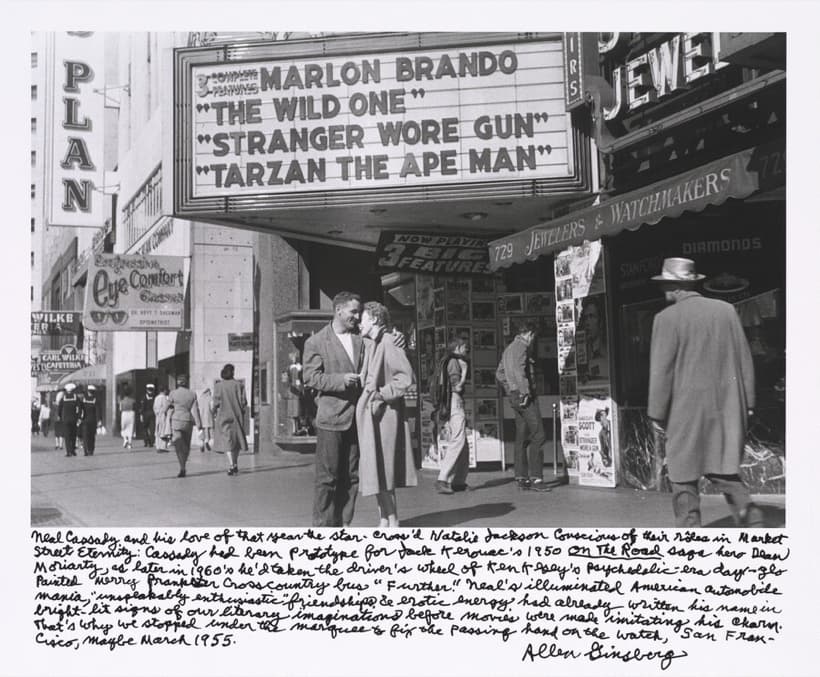
A man in a light tweed jacket holds a woman in a pale swing coat under a cinema marquee, both laughing, while the street goes past them. Allen Ginsberg made the exposure on Market Street in San Francisco, and his caption dates it to maybe March 1955. The sitters are Neal Cassady, the model for Jack Kerouac's Dean Moriarty, and Natalie Jackson. He printed the negative in 1996 and wrote eight lines of caption in the border. The National Gallery of Art owns the print as 2009.103.10.
Neal Cassady stands at the centre-left in a light tweed sports jacket over a white T-shirt and dark jeans, his right arm round Natalie Jackson's shoulders, his head bent to hers. Both are laughing. He holds something small and pale in his left hand at waist height. Natalie Jackson wears a pale full-length swing coat and has short curled hair, her face turned up to his.
The cinema marquee fills the top third of the frame and reads, in block capitals: 3 COMPLETE FEATURES, MARLON BRANDO, "THE WILD ONE", "STRANGER WORE GUN", "TARZAN THE APE MAN". Under it a banner reads NOW PLAYING 3 BIG FEATURES, and the street number 729 appears twice.
To the right of the couple, a wall of glazed poster frames covers the cinema front. One panel at the bottom carries a Western poster reading RANDOLPH SCOTT, THE STRANGER WORE A GUN — the full title the marquee above has shortened. Beyond it a scalloped awning reads 729 JEWELERS & WATCHMAKERS, with DIAMONDS and a jeweller's name lettered on the glass behind.
Eight other people are in the frame. A woman in light trousers walks left to right past the posters, and a young man in a pale jacket leans in to read them. A man in a pale overcoat and a light snap-brim hat walks away from the camera at the right edge, out of focus and close to the lens. At the far left, down the block, two sailors in dark uniform and white caps walk towards the camera, a third stands behind them, and two women walk away.
Shop signs run down the left side: a projecting painted sign for Progressive Eye Comfort Glasses with a pair of spectacles drawn on it and an optometrist's name below, and two signs for Carl Wilke Cafeteria.
The picture circulates as a Times Square photograph. It is not one. Allen Ginsberg's own caption ends "San Fran-Cisco, maybe March 1955", and the National Gallery of Art's title places the couple in Market Street Eternity.
The frame supports the caption. The businesses on the block — a jeweller and watchmaker at number 729, an optometrist, the Carl Wilke Cafeteria — are San Francisco addresses rather than New York ones, and uniformed Navy sailors on the sidewalk fit a Pacific-fleet port.
The films date the picture too. The Wild One and The Stranger Wore a Gun were both 1953 releases and Tarzan the Ape Man was older still, so a triple bill of all three is a second-run programme. A date of early 1955 is consistent with what the marquee is selling.
Allen Ginsberg wrote the caption in eight lines of black ink across the bottom border and signed it on a ninth line beneath them at the right. He printed the negative in 1996, forty-one years after the exposure, and signed the sheet in February of that year. The caption reads:
“Neal Cassady and his love of that year the star-cross'd Natalie Jackson Conscious of their rôles in Market Street Eternity: Cassady had been Prototype for Jack Kerouac's 1950 On The Road saga hero Dean Moriarty, as later in 1960's he'd taken the driver's wheel of Ken Kesey's psychedelic-era day-glo painted "Merry Prankster" Cross country bus "Further." Neal's illuminated American automobile mania, "unspeakably enthusiastic" friendships & erotic energy had already written his name in bright-lit signs of our literary imaginations before movies were made imitating his charm. That's why we stopped under the marquee to fix the passing hand on the watch, San Fran-Cisco, maybe March 1955.”
On The Road is underlined. Two words are corrected on the sheet: Prankster is written over an earlier attempt, and a stroke crosses the word Jack. The word rôles carries a circumflex, which is French orthography in an English sentence and is the only accent in the whole caption.
The syntax is Allen Ginsberg's poetry syntax, not a museum label's. One sentence runs from Neal Cassady's name through the 1960s and back to 1955, holding together by accumulation rather than by clause. The capital letters fall on nouns he wants weighted — Prototype, Conscious, Eternity — in the manner of an eighteenth-century title page.
The last clause is the one that earns the picture: that's why we stopped under the marquee to fix the passing hand on the watch. Written in 1996, it makes the exposure a deliberate act of preservation, undertaken because the people in it were already legendary. Nothing in 1955 could have supported that claim.
The caption calls Dean Moriarty the hero of "Jack Kerouac's 1950 On The Road". On the Road was published in 1957, two years after this exposure and six after the date Allen Ginsberg gives it.
The error is not careless so much as characteristic. Writing in 1996, he is dating the book to when it was being written and circulating among them rather than to when a publisher put it out. The whole caption works that way, folding forty years into a single present tense.
It also means the caption cannot be read as a caption in the ordinary sense. In March 1955 there was no published On the Road, no Dean Moriarty in print, no Merry Pranksters and no bus called Further. Everything the caption claims the picture is about had not yet happened.
Neal Cassady is the figure Jack Kerouac wrote as Dean Moriarty, and he later drove the Merry Pranksters' bus for Ken Kesey. Allen Ginsberg's caption sets out both roles and treats the man in the picture as the origin of a literary character.
Natalie Jackson is named in the caption as his love of that year and called star-cross'd. Allen Ginsberg photographed her at least twice more in 1955, in frames the National Gallery of Art also holds. The caption offers no further account of her, and the museum's record adds none.
Both sitters are identifiable, and neither is the photographer. The only rights the National Gallery of Art records on the object are Allen Ginsberg's; no institution consulted here records a claim by either sitter or their heirs.
Howard Greenberg Gallery, which represents the work, lists this picture on its Allen Ginsberg page under a title spelling the surname Cassidy. The National Gallery of Art and Allen Ginsberg's own handwriting both give Cassady.
The National Gallery of Art dates the negative 1955 and the print 1996. The verso carries the artist's copyright stamp with its 1994 date and fax number, and a note that he signed the sheet in February 1996.
The print came to Washington in 2009, a gift of Gary S. Davis, bought from the Allen Ginsberg Estate through Howard Greenberg Gallery in New York.
It hung as number 53 in Beat Memories: The Photographs of Allen Ginsberg. That exhibition ran from 2010 to 2013 at the National Gallery of Art, the Grey Art Gallery and Study Center at New York University, and the Contemporary Jewish Museum in San Francisco. The museum lists the print as not on view.
The exposure is set for the sunlit sidewalk, so the marquee lettering and the pale coats hold their tone while the cinema doorway behind the couple goes to black. There is no fill and no flash.
Depth of field is short. Neal Cassady and Natalie Jackson are sharp and the poster wall behind them is soft. The man in the overcoat at the right edge is badly out of focus, because he walked into the frame far closer to the lens than anyone else.
The horizon tilts. The marquee runs downhill to the right across the top of the picture, and the line of the awning below it tilts the same way, so the whole street leans.
None of that was corrected in the 1996 print. The blur, the tilt and the passer-by all stayed in, which is why the picture still reads as something that happened rather than something that was arranged.
Close reading
Read the signs first. The marquee, the poster wall, the awning and the shop fronts all name themselves, and together they fix the place and the date better than any of them does alone. Then read the eight lines of caption, written forty-one years later, and the one date in it that is wrong.
1.The marquee, line by line
Five lines of letters on a white ground, all in the cinema's own quotation marks. Three films are billed as one programme. The Wild One and The Stranger Wore a Gun were 1953 releases and Tarzan the Ape Man was older, so the bill is second-run — which is what makes Allen Ginsberg's date of maybe March 1955 hold up.
2.Neal Cassady and Natalie Jackson
Two figures, both laughing, both sharp. Neal Cassady's right arm is over Natalie Jackson's shoulders and his head is bent to hers; his left hand holds something small and pale at waist height that the print does not resolve. Her coat reaches almost to the ankle and her hair is cut short and curled.
3.The wall of glazed poster frames
Dozens of panels in rows, mostly production stills rather than posters, behind glass. The banner above repeats the programme in different words — NOW PLAYING 3 BIG FEATURES — and the street number 729 appears on it. A young man in a pale jacket leans in at the left edge to read them.
4.The title the marquee shortened
The poster gives the film's full title, THE STRANGER WORE A GUN, with Randolph Scott billed above it. The marquee overhead has dropped the article and the indefinite article to make it fit: STRANGER WORE GUN. The two readings are four feet apart in the same photograph.
5.729 Jewelers and Watchmakers
The awning carries the street number and the trade. Behind it, DIAMONDS is lettered on the glass above a shop name. Street numbers and trades of this kind are how the picture can be placed at all: no caption is needed to show that this is a commercial block, and the number matches the one on the cinema banner.
6.The passer-by who ruined the edge
One figure, far closer to the lens than anyone else, and completely out of focus because of it. He walked into the frame as the shutter went. Allen Ginsberg kept him in when he printed the negative in 1996 rather than cropping the right edge away, and he is a large part of why the picture still reads as something that happened.
7.Sailors up the block
Two sailors in dress uniform walk towards the camera and a third stands behind them. Uniformed Navy personnel on a downtown sidewalk fit a Pacific-fleet port, which is one more piece of evidence against the Times Square attribution the picture often carries.
8.The optometrist's sign
A hand-painted projecting sign, with a pair of spectacles drawn on it and an optometrist named in small capitals below, legible with effort as Dr Hoyt E. Sherman. A second sign further down the block reads WILKE, for the Carl Wilke Cafeteria. Businesses, not landmarks, are what date and place this street.
9.The caption's first lines
Eight lines, each hard against the left margin. The first sentence has no full stop for nearly a hundred words; it runs on a colon and then keeps going. Capital letters fall on nouns Allen Ginsberg wants weighted — Conscious, Prototype, Eternity — rather than on proper names alone.
10.The word Jack, struck through
A stroke crosses the word Jack, and the date that follows it reads 1950. On the Road was published in 1957, two years after this exposure. Allen Ginsberg is dating the book to when it was written and read among them rather than to when a publisher issued it, and the whole caption works that way.
11.Why they stopped under the marquee
The caption's last clause claims the exposure was deliberate: that's why we stopped under the marquee to fix the passing hand on the watch. San Francisco is broken across two lines as San Fran- and Cisco, with a capital C. The date that follows carries a hedge — maybe March 1955 — which is the only uncertainty Allen Ginsberg admits anywhere in the caption.
1953
Allen Ginsberg buys a second-hand Kodak Retina at a Bowery pawnshop in New York, the camera he uses through the 1950s.
1955
The negative is exposed under a cinema marquee on Market Street in San Francisco. The caption dates it to maybe March.
1994
He has the rubber stamp made that appears on the verso: Photograph By Allen Ginsberg, COPYRIGHT 1994 NYC, ALL RIGHTS RESERVED.
1996
The print is made and signed in February, forty-one years after the exposure, and captioned in seven lines.
2009
The print enters the National Gallery of Art as 2009.103.10, a gift of Gary S. Davis, acquired from the Allen Ginsberg Estate through Howard Greenberg Gallery.
2010–13
Shown as number 53 in Beat Memories: The Photographs of Allen Ginsberg, at the National Gallery of Art, the Grey Art Gallery and Study Center and the Contemporary Jewish Museum.
National Gallery of Art
Washington, United States
A public viewing address has not yet been confirmed for this holding.
The National Gallery of Art lists the print as not on view and states that the image is unavailable for download.
On Market Street in San Francisco, under a cinema marquee at number 729. Allen Ginsberg's handwritten caption ends "San Fran-Cisco, maybe March 1955", and the National Gallery of Art titles the picture Market Street Eternity. It is often misdescribed as Times Square.
Three, billed as 3 COMPLETE FEATURES: MARLON BRANDO in "THE WILD ONE", "STRANGER WORE GUN" and "TARZAN THE APE MAN". A poster panel below gives the second title in full as RANDOLPH SCOTT, THE STRANGER WORE A GUN. The first two were 1953 releases, so the programme is second-run.
Natalie Jackson. Allen Ginsberg's caption names her as Neal Cassady's love of that year and calls her star-cross'd. He photographed her at least twice more in San Francisco in 1955 in frames the National Gallery of Art holds.
No. Allen Ginsberg writes of "Jack Kerouac's 1950 On The Road", but the novel was published in 1957, two years after this exposure. He appears to be dating the book to when it was written and read among them rather than to its publication.
In 1996, forty-one years after the negative. The verso records that he signed the sheet in February 1996, and the National Gallery of Art catalogues the object as 1955, printed 1996.
The National Gallery of Art in Washington owns it as 2009.103.10, a gift of Gary S. Davis. The museum lists it as not on view and does not offer the image for download.
Depicts
Allen Ginsberg names Neal Cassady first in the caption he wrote on the print, and the National Gallery of Art takes that caption as the object's title.
The sources below include collection records, catalogues, scholarly research, and primary materials that informed this page. They document Neal Cassady and Natalie Jackson, Market Street, its making, and its place in cultural history.
The museum's object record: title, negative and print dates, medium, dimensions, inscription, credit line, accession number, provenance, exhibition history and copyright line.
The National Gallery of Art's published collection data, which carries the same fields as structured values and marks the image not open access at a 900-pixel cap.

The 2010 exhibition, in which the print hung as number 53.
The representing gallery, which lists the picture under a title spelling the surname Cassidy.
These references provide the documented foundation for this work's history and interpretation. Claim-level citations remain attached to the specific claims they support.
 Explore more resources