The Paris AtlasCharting the artists, works, and places worth returning to.
  • Poet
  • Author
  • Photographer
· American · 1926–1997

Allen Ginsberg

American poet whose long poem Howl and its 1957 obscenity trial made him a public figure, and who wrote Kaddish, his elegy for his mother, at the Beat Hotel in Paris.

In images

Details

Lived
1926–1997
Born
3 June 1926
Birthplace
Newark, New Jersey
Died
5 April 1997 · aged 70
Place of death
New York City
Nationality
American
Roles
PoetAuthorPhotographer
Also known as
Irwin Allen Ginsberg

About Allen Ginsberg

American poet, photographer, teacher and political activist whose expansive, autobiographical verse helped define the Beat Generation and changed what subjects, voices and forms could enter postwar American poetry. Allen Ginsberg is inseparable from Howl, the long poem that made him famous in the 1950s, but his importance cannot be measured by that work alone. During a career of more than four decades, he wrote about family, mental illness, homosexual desire, drugs, Buddhism, war, industrial America, ecological damage, friendship, aging and death with an unusual determination to place private experience in public language. He was also a tireless literary organizer. Long before the Beat Generation became an internationally recognized movement, Ginsberg was circulating manuscripts, introducing writers to publishers, arranging readings and arguing for the importance of Jack Kerouac, William S. Burroughs, Gregory Corso, Gary Snyder and many others. Later, he carried Beat ideas into the antiwar movement, gay liberation, Buddhist practice, university teaching, photography and collaborations with musicians and artists. His life connected several of the most important literary settings of the twentieth century. He grew up in Paterson, New Jersey, studied at Columbia University in New York, found his mature poetic voice in San Francisco, traveled through Mexico, Tangier, India and Japan, and lived for a formative period in Paris. At the inexpensive Left Bank residence later known as the Beat Hotel, he shared daily life with Peter Orlovsky, Gregory Corso, William S. Burroughs and other expatriate writers. There he began Kaddish, his great elegy for his mother, while the obscenity case surrounding Howl was turning him into a public figure across the Atlantic. Paris therefore occupies a precise place in his development: it stands between the public breakthrough of Howl and the more intimate, historically detailed achievement of Kaddish. Ginsberg also changed the sound of modern American poetry. His work joined Walt Whitman's long catalogues, William Blake's prophetic intensity, William Carlos Williams's attention to ordinary American speech, biblical cadence, Herman Melville's rhetoric, jazz improvisation and Buddhist observation. The long line that became his signature could carry a rush of memory, description and argument before the breath came to rest. Yet the apparent spontaneity of his poems was supported by serious study, revision and performance. Columbia University later described him as a Beat poet, countercultural prophet, Buddhist-Jewish spiritual seeker and distinguished professor. Those roles seem contradictory until one recognizes that teaching, organizing, protesting and writing were all parts of the same lifelong effort to make consciousness audible.

Early life in Newark and Paterson

Irwin Allen Ginsberg was born in Newark, New Jersey, on 3 June 1926, the younger son of Louis Ginsberg and Naomi Levy Ginsberg. The family soon settled in nearby Paterson, an industrial city of mills, factories, rail lines and working-class neighborhoods that later became part of his imaginative landscape. His older brother, Eugene, eventually became a lawyer and used the surname Brooks. The household was Jewish, literary and politically engaged, but it was not harmonious. Louis was a high-school teacher and a published lyric poet who preferred traditional meter, rhyme and carefully shaped forms. Naomi was a committed political radical who supported the Communist Party, took her sons to meetings and interpreted the world through class conflict and the hope of social revolution.

The differences between his parents gave Ginsberg two models that remained active in his work. From his father came the understanding that poetry was a craft requiring reading, memory and technical discipline. From his mother came sympathy for workers, political outsiders and people excluded by respectable society, along with a distrust of concentrated economic and governmental power. Ginsberg eventually rejected Louis's conservative taste in verse, but he never rejected the serious literary education that his father represented. Nor did he become an orthodox Communist like Naomi. His mature politics remained eclectic, suspicious of party discipline and shaped as much by pacifism, personal liberty and spiritual experiment as by the organized left.

Naomi's recurring mental illness had the deepest effect on the family. She experienced paranoia, delusions and repeated hospitalization, and Allen was exposed from childhood to crises that frightened him while also making him feel responsible for her safety. At times he accompanied her through disorienting journeys and witnessed the strain her illness placed on Louis and Eugene. He later had to confront the fact that decisions about her institutional treatment, including a lobotomy, had been made within a family and medical system that offered few humane alternatives. This history gave him firsthand knowledge of psychiatric institutions long before he entered one himself, and it helps explain why madness in his poetry is never merely a fashionable metaphor. It can signify visionary refusal of conformity, but it also represents fear, suffering, bodily vulnerability and the damage done within families.

Ginsberg began imagining himself as a writer at an unusually early age. A diary now held in his Stanford archive records the eleven-year-old's conviction that he would become some kind of genius, probably in literature. The claim was grandiose, but it was accompanied by serious reading. Edgar Allan Poe first fascinated him, and Walt Whitman eventually became his central American predecessor. Whitman offered a poetry that was democratic, sexual, urban, bodily and expansive, and his celebrations of male companionship gave Ginsberg a nineteenth-century ancestor for desires that mid-century culture treated as shameful or pathological. A second decisive influence lived close to Paterson: physician-poet William Carlos Williams, whose work demonstrated that modern poetry could emerge from New Jersey streets, local speech and precisely observed objects rather than from inherited European grandeur. Williams later encouraged the younger poet and helped introduce him to writers on the West Coast.

Columbia University and the first Beat circle

Ginsberg entered Columbia University on scholarship in 1943, when he was seventeen. He initially imagined using his education for a political career and wrote that he hoped to become an "honest revolutionary labor lawyer." Columbia instead redirected him toward literature and toward a group of friendships that would shape postwar American writing. His professors included the poet Mark Van Doren, the critic Lionel Trilling and the art historian Meyer Schapiro. Van Doren was especially important because he combined intellectual authority with a willingness to listen to the young Ginsberg's literary enthusiasms and later visionary claims. Even when Ginsberg's behavior became erratic, several professors recognized the seriousness of his reading and ambition.

The education outside the classroom proved even more consequential. Ginsberg met Lucien Carr, a charismatic Columbia student who introduced him to Jack Kerouac, a former Columbia football player already committed to becoming a novelist. Through the same network he encountered three more. William S. Burroughs was an older Harvard-educated writer with interests in crime, drugs, anthropology and systems of power. John Clellon Holmes later wrote one of the first Beat novels. Herbert Huncke was a Times Square hustler and storyteller whose experience of urban criminal life fascinated the younger writers. Neal Cassady, a restless, self-educated Westerner with extraordinary conversational energy, entered the circle soon afterward. These figures did not yet constitute a literary movement, and their later styles differed radically, but they shared a sense that conventional postwar culture excluded important forms of experience.

Carr, Ginsberg and Kerouac discussed what they called a "New Vision," a loose set of ideas about art, self-knowledge and the rejection of inherited restraint. The phrase never became a coherent manifesto. Its importance lies instead in the permission it gave the young writers to treat intense personal experience, sexuality, crime, intoxication, spiritual revelation and marginal social worlds as literary material. Kerouac moved toward improvisatory prose and the rhythms of spoken narrative; Burroughs developed a colder satire of addiction, bureaucracy and control; Ginsberg sought a form of visionary lyric poetry. Their common ground was less a shared style than the conviction that literature should tell truths respectable institutions preferred not to hear.

The circle was marked by danger as well as creative excitement. In August 1944, Carr killed David Kammerer after a confrontation in Riverside Park, confessed and later pleaded guilty to manslaughter. Ginsberg did not participate in the killing, but the case drew him into a grim mixture of loyalty, secrecy, sexuality and criminal law that complicated later romantic accounts of the Beats' beginnings. His Columbia career was repeatedly interrupted as well. He was suspended in a notorious episode after writing "Butler has no balls" in the grime of his dormitory window, a reference to university president Nicholas Murray Butler, and Columbia records that he was twice removed from the college. These disciplinary problems coexisted with intense study, prize-winning student poetry and continued respect from important teachers. He ultimately graduated in 1948 with an A-minus average.

Periods away from Columbia broadened his experience beyond the university. He worked ordinary jobs and served in the Merchant Marine, including a 1947 voyage aboard the S.S. John Blair. Ports, ships, highways, bus terminals, rail yards and cheap rooms later entered his poems not as decorative scenery but as the physical structure of modern life. Ginsberg's mature poetry would repeatedly move through such transitional spaces, treating transportation, labor and urban infrastructure as material capable of carrying spiritual and political meaning.

Vision, sexuality and psychiatric confinement

In 1948, shortly after leaving Columbia, Ginsberg underwent the experience he later called his "Blake vision." While reading William Blake in a Harlem apartment, he heard a voice that he understood as Blake's reciting poems including "Ah! Sunflower" and "The Sick Rose." He maintained that he had taken no drugs before the event. What mattered to him was the sudden conviction that visionary consciousness did not reveal a remote supernatural world. It disclosed the depth already present in ordinary reality. He spent years trying to understand and sometimes recover that perception, first through poetry and later through psychoactive drugs, meditation and religious practice.

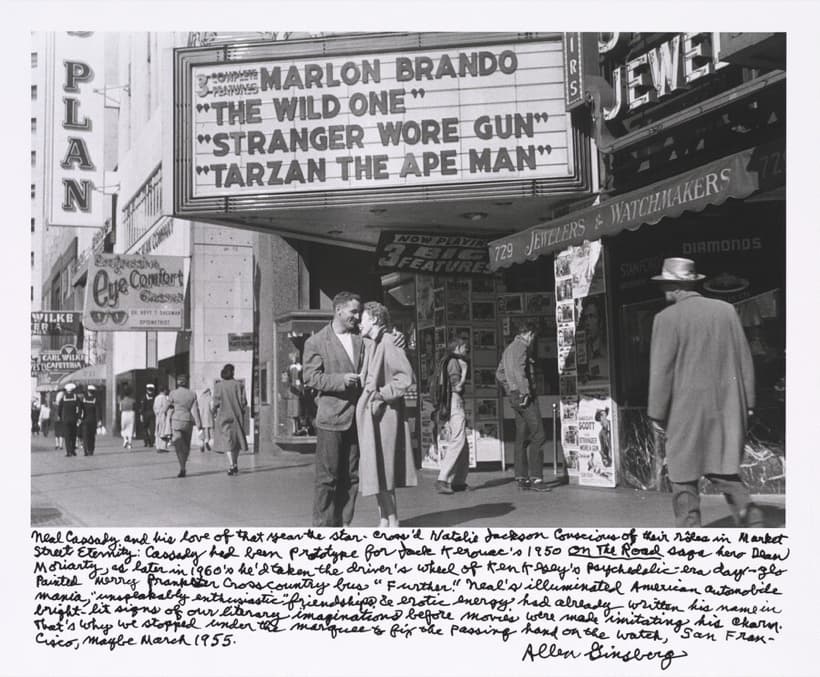
The vision occurred during a period in which Ginsberg was also struggling with his sexuality. He had fallen intensely in love with Neal Cassady, whose charisma, restless speech and movement through the American West became central to Beat mythology. Their sexual relationship was intermittent and emotionally unequal. Cassady was primarily oriented toward women and offered Ginsberg neither the stability nor the exclusivity he desired. Ginsberg nevertheless made him a major figure in letters, poems and photographs, while Kerouac transformed him into Dean Moriarty in On the Road. The relationship forced Ginsberg to confront homosexual desire at a time when same-sex relations were criminalized, professionally dangerous and classified by American psychiatry as illness.

He briefly attempted to construct a conventionally heterosexual life, including a relationship with the poet Elise Cowen, a Barnard graduate connected to the Columbia Beat community. Their relationship is often treated only as a footnote to Ginsberg's self-acceptance. Cowen was a serious and troubled poet, and her own work has become increasingly important to scholarship on women in the Beat circle. Ginsberg's inability to sustain the expected heterosexual role did not make the relationship unreal. It showed how strongly both people were living under social and psychological pressures that the male-centered story of the Beats often obscured.

A separate crisis brought Ginsberg into direct contact with psychiatric authority. After stolen goods belonging to an acquaintance were stored in his apartment, he faced possible prosecution and entered the New York State Psychiatric Institute as part of the legal resolution. He remained there for approximately eight months. At the institute he met Carl Solomon, a young intellectual undergoing psychiatric treatment, including electroconvulsive therapy. Solomon introduced him to writers such as Jean Genet and Antonin Artaud and became the dedicatee of Howl. Ginsberg recognized in him not an anonymous patient but a literary mind confined within an institution, and the poem's later refrain "I'm with you in Rockland" turned their friendship into an assertion of solidarity.

The hospitalization cannot be reduced to a simple story in which a sane rebel was punished by a conformist society. Ginsberg had genuine psychological distress, feared that his visions and sexuality indicated illness, and needed a workable way to live. At the same time, his mother's history and Solomon's treatment made him deeply suspicious of the power psychiatry possessed to define unacceptable behavior. A therapist later encouraged him to stop constructing his life around conventional expectations and to pursue the work and relationships he actually wanted. That permission became part of the path toward Howl, but the deeper result was a lifelong refusal to draw an easy line between visionary experience, mental suffering and institutional judgment.

New York friendships and literary apprenticeship

During the early 1950s, Ginsberg continued to work, write and maintain the network that later became known as the Beat Generation. His own poetry had not yet found its definitive form, but he was already acting as editor, advocate and archivist. He exchanged manuscripts with Kerouac, urged publishers to consider work they rejected and kept extensive letters and journals. Stanford's archive shows that his habit of promoting other writers began before he possessed a secure career of his own. This activity was not separate from his authorship. Ginsberg learned by reading the unfinished work of his friends, explaining it to editors and observing how different methods could emerge from common experiences.

His relationship with William S. Burroughs was especially complex. Burroughs functioned at different times as an older intellectual guide, friend, lover and literary collaborator. In 1953, while Burroughs stayed at Ginsberg's apartment on East Seventh Street, the two were sexually involved and worked together on manuscripts and letters connected with material later published as Queer and The Yage Letters. Ginsberg's photographs from the period capture Burroughs before the dark suit, hat and impassive expression hardened into an iconic public image. Their temperaments were markedly different: Ginsberg was emotionally demonstrative and eager to form communities, while Burroughs cultivated distance and analyzed addiction and authority with clinical severity. The intellectual exchange nevertheless continued throughout their lives.

Ginsberg met Gregory Corso in New York after Corso's release from prison. Corso had grown up in foster homes, reform schools and correctional institutions, but had educated himself through voracious reading and developed a poetry that combined classical allusion, surreal comedy and verbal play. Ginsberg recognized his ability immediately and became one of his most persistent champions. Their friendship shows an important aspect of Ginsberg's literary judgment: although he had a powerful personal style, he did not require the writers he promoted to imitate it. His role within the Beat network was often to identify intensity and originality wherever he found them, then bring the writer into contact with readers, publishers and other artists.

He also began taking photographs of this social world. With inexpensive cameras, he recorded Kerouac walking on the Lower East Side, Burroughs in apartments and on rooftops, Cassady beside cars and lovers, and Solomon after his hospitalization. These early images were informal "drugstore" snapshots rather than a planned documentary project, but they later became one of the most valuable visual records of Beat life. The photographs show people before their public images became fixed, and Ginsberg's later handwritten captions expanded them into miniature memoirs. In both poetry and photography, he was learning to preserve a moment by naming its concrete circumstances before memory could simplify it.

San Francisco, Peter Orlovsky and the making of Howl

Ginsberg moved to San Francisco in 1954 and entered a literary culture already in motion. The San Francisco Renaissance included poets such as Kenneth Rexroth, Robert Duncan, Jack Spicer, Madeline Gleason and Lawrence Ferlinghetti. Younger writers including Gary Snyder, Philip Whalen and Michael McClure were bringing new attention to Asian literature, anarchism, ecology and oral performance. William Carlos Williams supplied introductions, but Ginsberg's arrival did not create this scene and the San Francisco poets were never merely a western branch of the Beats. The importance of the encounter lay in the contact it established between the New York circle and an independent West Coast avant-garde.

San Francisco also brought Ginsberg the most durable romantic relationship of his life. In 1954 he met Peter Orlovsky, a young former soldier then associated with the painter Robert LaVigne. Ginsberg later recalled seeing LaVigne's large nude portrait of Orlovsky before meeting its subject and experiencing an immediate emotional shock. The two soon became lovers and marked their partnership with a private commitment ceremony in 1955. Their relationship was non-monogamous, sometimes turbulent and interrupted by periods of separation, but it endured until Ginsberg's death in 1997. Orlovsky became a poet, traveler and public figure in his own right, and the visibility of their partnership was significant in an era when openly gay domestic life could carry serious legal and professional consequences.

Ginsberg was simultaneously trying to free his poetry from several incompatible models. His early poems often used the rhyme and meter favored by his father or the short, object-centered line associated with Williams. Neither form could fully contain the crowded social and visionary material he wanted to write. Whitman offered the expansive catalogue; Blake offered prophetic address; biblical rhetoric and Melville supplied long syntactic movement; blues and bebop demonstrated how a phrase could extend, vary and gather pressure without falling into mechanical regularity. Ginsberg began composing lines organized less by fixed meter than by breath, grammatical momentum and the duration of a spoken thought.

The resulting poem, Howl, was shaped through both improvisation and revision. Its first section gathers a generation into a sequence of clauses linked by the repeated word "who": artists, addicts, psychiatric patients, queer men, wanderers, students and spiritual seekers. Part II names the destructive system "Moloch," turning an ancient name associated with sacrifice into a modern image of militarism, money, industry, bureaucracy and emotional deadness. Part III addresses Carl Solomon in confinement, while the "Footnote to Howl" tries to recover sacred value from everything the earlier poem has shown as damaged or degraded. The poem sounds as though it is being discovered in the moment of speech, but surviving drafts show deliberate construction, rearrangement and testing aloud.

On 7 October 1955, Ginsberg read the first part of Howl at the Six Gallery at 3119 Fillmore Street. Kenneth Rexroth served as master of ceremonies, and the other readers were Gary Snyder, Michael McClure, Philip Whalen and Philip Lamantia. Kerouac attended but did not read, instead passing wine and shouting encouragement. The audience's response helped turn a local reading into a foundational event in Beat history. Lawrence Ferlinghetti, poet and cofounder of City Lights Books, quickly asked to publish the poem, and Howl and Other Poems appeared in 1956 as the fourth volume in the City Lights Pocket Poets series.

The Six Gallery reading and City Lights edition gave Ginsberg a public form for experiences that had previously seemed private, shameful or clinically suspect. The poem did not simply reject the 1950s from outside; it recorded people trying to live within American cities, universities, hospitals and economies that had no stable place for them. Its anger was therefore inseparable from attachment. Ginsberg's speakers denounce America while wanting recognition from it, and the poem's final movement depends less on destruction than on companionship and the recovery of holiness.

The Howl obscenity case

The language that gave Howl its force also brought it into conflict with obscenity law. The first City Lights edition was printed in Britain, and on 25 March 1957 U.S. Customs officials seized 520 copies entering the United States. Customs eventually released the shipment, but local authorities in San Francisco pursued the matter. In June, City Lights store manager Shigeyoshi Murao sold a copy to an undercover police officer and was arrested; Ferlinghetti was subsequently charged as the publisher. Ginsberg himself was not a defendant and was abroad while the proceedings unfolded.

The trial asked whether explicit descriptions of heterosexual and homosexual acts made a literary work legally obscene or whether the poem possessed sufficient social importance to receive constitutional protection. Critics and writers including Mark Schorer, Kenneth Rexroth and Walter Van Tilburg Clark testified about its literary purpose. On 3 October 1957, Judge Clayton W. Horn ruled that Howl was not obscene. Murao was cleared because the prosecution had not proved that he knowingly sold an obscene work, and Ferlinghetti was acquitted because the poem possessed redeeming social importance.

The decision did not single-handedly remake American obscenity law, and it should not be confused with later Supreme Court rulings. Its importance was cultural and practical. A small independent press had successfully defended a work containing language and sexual material that most established publishers would not touch, and the publicity turned a slim poetry pamphlet into an international event. The case strengthened City Lights, made Ginsberg a symbol of literary free expression and demonstrated that serious writing about homosexual life could not automatically be excluded from publication as pornography.

Naomi Ginsberg and the writing of Kaddish

Ginsberg's mother died in 1956, while he was preparing to return to sea in the Merchant Marine. He did not attend the funeral and learned that the small gathering at the graveside had not included the ten Jewish men traditionally required to form a minyan for the public recitation of the mourner's Kaddish. The absence troubled him, but the poem that eventually answered it was not written immediately. The emotional and formal problem was larger than a conventional elegy. He had to mourn a mother he loved, feared and sometimes wished to escape, while also confronting the medical institutions and family decisions that had shaped her final years.

Howl had already drawn on the language of madness, but it did so by transforming numerous friends and experiences into a generational myth. Kaddish required a different kind of honesty. Naomi could not remain a symbolic victim of society; she had to appear as a specific person—a Russian-born immigrant, schoolteacher, Communist idealist, mother, psychiatric patient and aging body. The poem records childhood rooms, political conversations, delusions, hospital visits, family embarrassment and moments of tenderness without forcing them into a consoling story. It neither romanticizes her illness nor allows clinical diagnosis to exhaust her identity.

Ginsberg began the poem in Paris in December 1957 and continued it in New York through 1959. Its published dating—"Paris, December 1957—New York, 1959"—makes geography part of the poem's history. From a cheap room on the Left Bank, he reconstructed Paterson, Newark, American hospitals and the intimate disorder of his childhood. The distance of exile appears to have made sustained memory possible. He later described the growing work to Ferlinghetti as a large structure of narrative, lamentation, chant and hymn, and he continued revising it by reading it aloud before City Lights published Kaddish and Other Poems in 1961.

The title invokes the Jewish prayer for the dead, but Ginsberg does not simply reproduce the liturgy. He creates a personal counter-ritual from memory, direct address, bodily description and the repeated effort to bless what cannot be repaired. Judaism supplies the formal occasion, while Shelley, Blake, Buddhist ideas, popular music and modern psychiatric history enter the poem's emotional world. The result is not a tidy synthesis of religions. It is the record of a consciousness searching several traditions for language adequate to grief.

Kaddish expanded Ginsberg's achievement beyond the public controversy surrounding Howl. Its long line is still capable of prophecy and accumulation, but here it carries family history rather than a manifesto for a generation. The poem's refusal to idealize either mother or son gives it unusual moral and psychological complexity. Ginsberg admits fear, disgust, guilt, impatience and helpless love, and the specificity of those emotions prevents the work from becoming a generalized statement about mental illness. For many readers, Kaddish remains his deepest poem because it applies the formal freedom of Howl to a subject from which public performance offered no escape.

Tangier and the making of Naked Lunch

In 1957, Ginsberg and Peter Orlovsky traveled to Tangier, where William S. Burroughs had been living and writing in increasing isolation. Burroughs had accumulated a large body of letters, routines, scenes and manuscript fragments without a settled book structure. Ginsberg, Kerouac and others had long recognized the originality of his writing, but publication required practical labor: typing, reading, arranging, copying and persuading editors that the material formed more than a private archive of addiction and grotesque comedy.

Ginsberg and the writer Alan Ansen helped Burroughs work through the material, while Kerouac later contributed the title Naked Lunch. Accounts of the book's creation differ about exactly who arranged which pages, and Burroughs continued revising the manuscript. It is nevertheless clear that the novel emerged through collaboration as well as solitary authorship. Ginsberg's role was characteristic. He did not attempt to make Burroughs sound like himself; he helped create the circumstances in which a radically different writer could become legible to publishers and readers.

The Tangier period also demonstrates why the Beat Generation is best understood as a network of manuscripts rather than a uniform movement. Drafts traveled by mail and in suitcases, writers typed one another's pages, and editorial advice passed through friendships and love affairs. Ginsberg was the most energetic connector in this system. His later fame sometimes made him appear to be the group's official leader, but his influence often operated through less visible acts of advocacy and organization. From Tangier, he and Orlovsky continued through Europe, reaching Paris in the autumn of 1957.

Paris and the Beat Hotel

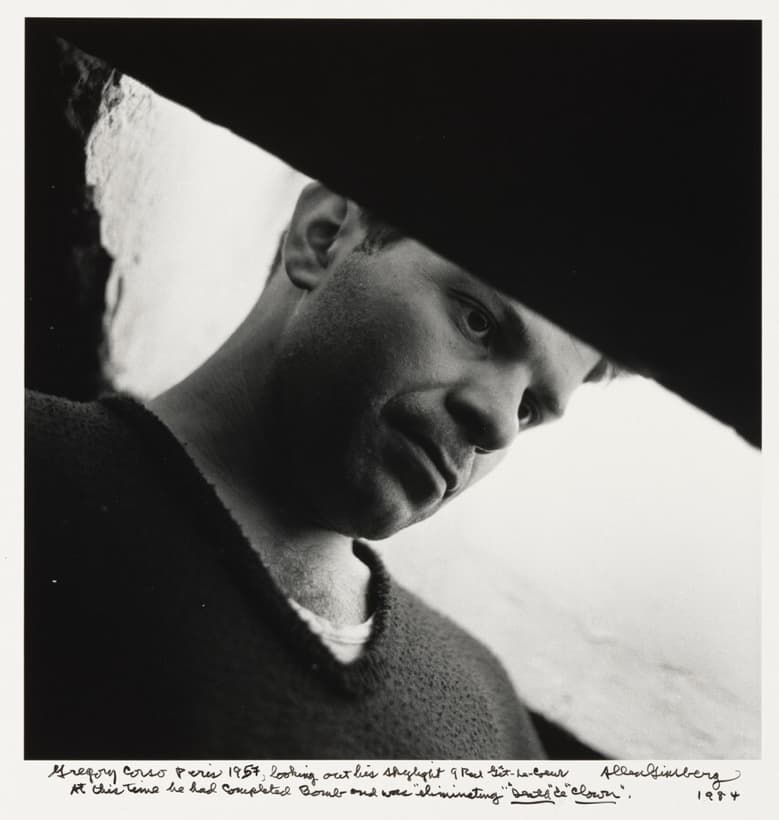
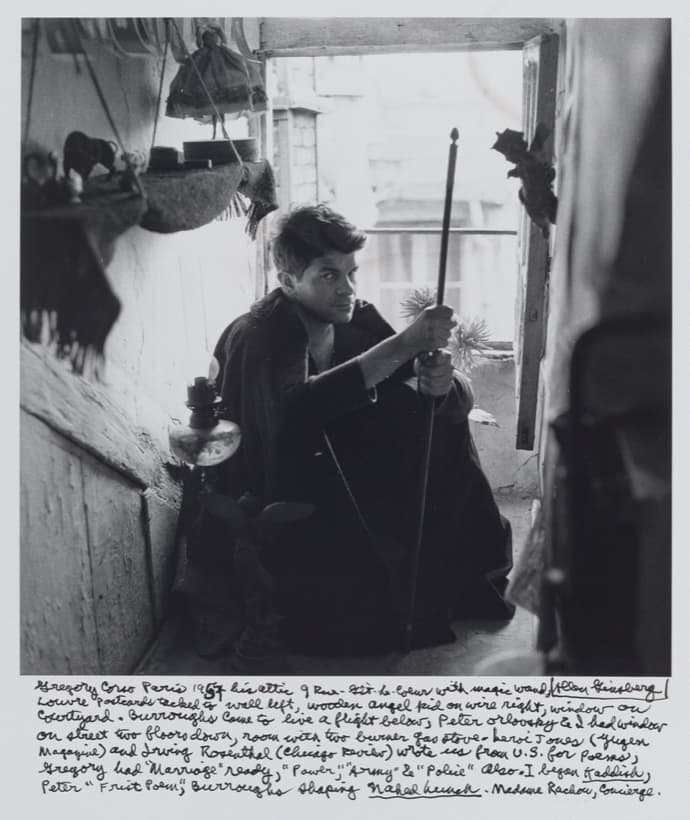
Ginsberg, Orlovsky and Gregory Corso settled in Paris in the autumn of 1957. Their base became the inexpensive residence at 9 rue Gît-le-Cœur, a narrow street running from the rue Saint-André-des-Arts toward the Seine. The building was operated by Madame Rachou and had no celebrated literary identity when the Beats arrived. It was known formally as the Hôtel Rachou and acquired the nickname Beat Hotel from its residents and visitors. Its low rents, tolerant management and primitive facilities made it suitable for people who had little money and irregular habits. Rooms were small, plumbing was limited and artists used the building as lodging, studio, office and social club.

The address became important because several major works developed within a few rooms of one another. Ginsberg began Kaddish there and wrote Paris poems including "At Apollinaire's Grave." Corso worked on poems such as "Bomb" and "Marriage," combining classical learning with anarchic humor and typographical experiment. Burroughs arrived with the material of Naked Lunch. He later worked with the artist Brion Gysin and the technician Ian Sommerville on cut-ups, tape experiments and the "Dreamachine." Peter Orlovsky wrote and participated in the daily exchanges that made the hotel a collective workshop. The residents did not share one method, but proximity allowed manuscripts, theories and practical assistance to circulate continuously.

Photographer Harold Chapman, who lived in the building for years, provided the most vivid visual record of this environment. His photographs show cramped rooms, peeling walls, beds used as desks and writers moving through nearby streets and cafés. One of the best-known images depicts Ginsberg and Orlovsky seated back-to-back on a double-sided bench in the Place Saint-Germain-des-Prés in the winter of 1957. Chapman recalled that Ginsberg translated street names and pointed out architecture during their walk, a small detail that complicates the stereotype of the Beats as Americans indifferent to the city around them.

The group also participated in the postwar literary life of the Left Bank. George Whitman's bookshop at 37 rue de la Bûcherie was then called Le Mistral; only later did it take the name Shakespeare and Company. It should therefore not be confused with Sylvia Beach's prewar shop, which had published James Joyce's Ulysses. Whitman welcomed itinerant readers and writers, and the shop became a meeting place for expatriates, students and members of the Beat circle. Maurice Girodias's Olympia Press represented another part of this literary ecosystem, publishing English-language books that conventional British and American firms considered legally or commercially dangerous, including the first complete edition of Naked Lunch in 1959.

Paris coincided with the Beats' sudden transformation into a media phenomenon. Kerouac's On the Road appeared in September 1957, and the Howl judgment followed in October. Ginsberg was therefore absent from the United States while journalists were constructing the public image of the Beat Generation. Unlike Kerouac, who often felt trapped and misrepresented by publicity, Ginsberg proved able to use attention strategically. From abroad he followed the obscenity case, corresponded with Ferlinghetti and continued promoting his friends. Yet Paris also gave him temporary distance from the public role that was forming around him.

That distance is central to the city's meaning in his life. He arrived as the controversial author of Howl, a poem already becoming a symbol of generational rebellion, and began a work about his mother that could not be sustained by public mythology. The Paris period therefore did more than add another bohemian address to Beat tourism. At 9 rue Gît-le-Cœur, Ginsberg participated in the collective development of Naked Lunch and Corso's poetry while turning toward the most private history of his own life. The Beat Hotel was both a workshop shared by friends and the place where his public voice learned to carry intimate grief.

Return to America and the problem of Beat fame

Ginsberg returned to the United States near the end of the 1950s to find that "Beat" had become a commercial label. Newspapers and television reduced a group of distinct writers to a recognizable costume of beards, black clothing, jazz, coffeehouses and slang, while the word "beatnik" turned literary dissent into a social caricature. Ginsberg disliked the simplification but understood that publicity could be used to direct attention toward books, political issues and writers who remained obscure. He gave interviews, organized readings and explained the movement's history with a patience that neither Kerouac nor Burroughs consistently possessed.

His position within the group was therefore unusual. He was not the inventor of a common Beat style, because no such style existed, and he did not speak for every writer associated with the term. Kerouac's Catholic mysticism and spontaneous prose, Burroughs's satirical systems of control, Corso's comic surrealism and Snyder's ecological verse remained distinct. Ginsberg's special role was to make a private network visible. He connected people, preserved correspondence, wrote introductions, took photographs and treated literary friendship as a form of cultural labor.

The cost of that role was that the public personality could overshadow the poems. The bearded prophet chanting at demonstrations became an instantly recognizable image, but Ginsberg was also a technically serious writer who revised, studied prosody and taught literary history. His best-known shorter poems from the 1950s already demonstrate that range. "A Supermarket in California" places an imagined Walt Whitman in a fluorescent grocery store, joining literary inheritance, consumer abundance, loneliness and homosexual companionship. "Sunflower Sutra" begins beside industrial machinery, where a damaged sunflower becomes evidence that living identity survives contamination without pretending the contamination is unreal. "America" addresses the nation in a voice that moves between accusation, family memory, Cold War parody and self-mockery. Together these poems show a writer who could be public and political without abandoning comedy, intimacy or exact physical detail.

India, Buddhism and an international poetic life

Ginsberg and Orlovsky traveled extensively during the early 1960s, moving through Europe, the Middle East, India and East Asia. India was particularly important. Ginsberg entered Bengali literary circles, met poets associated with the Hungry Generation, visited religious teachers and encountered Hindu and Buddhist practices outside the simplified versions then circulating in American bohemia. He and Orlovsky lived with limited money and moved through cities including Calcutta and Benares, while Ginsberg continued a voluminous correspondence with Ferlinghetti and other friends. His later photographs and journals preserve not only religious encounters but railway journeys, street scenes, illness, friendship and the practical disorder of prolonged travel.

Asian religion did not replace his Jewish upbringing or Blakean imagination. Ginsberg's spiritual life remained cumulative. Jewish mourning, Hindu mantra, Tibetan Buddhist meditation, Whitmanian democracy and Blake's visionary Christianity could coexist in the same poem or public performance without becoming a consistent theology. What united them was an interest in forms of consciousness that weakened the isolated, defended self. Chanting and breath connected poetry to collective sound; meditation offered a disciplined way of observing thought; pilgrimage and travel displaced the assumption that American cultural categories were universal.

The trip also deepened his relationship with Gary Snyder, whose study of Zen Buddhism, Asian languages and ecology had already influenced the San Francisco poetry world. Ginsberg traveled in Japan with Snyder and the poet Joanne Kyger in 1963. Snyder's example reinforced the possibility that religious practice could be a sustained discipline rather than an exotic literary ornament. Over time, Ginsberg's early pursuit of sudden visionary breakthrough gave way to greater interest in ordinary awareness: seeing what the mind was doing without immediately censoring, dramatizing or chemically intensifying it.

Tibetan Buddhism eventually became the most stable institutional form of his spiritual practice. He developed a close association with Chögyam Trungpa Rinpoche and took Refuge and Bodhisattva vows in 1972. Trungpa's unconventional style appealed to artists suspicious of moralistic authority, though his own conduct and leadership later generated serious controversy. For Ginsberg, the encounter helped connect meditation with artistic method. Buddhist attention did not make his poetry quiet or impersonal, but it encouraged a plainer documentary manner in which perception could be recorded before the poet converted it into argument.

Cuba, Prague and London in 1965

By the middle of the 1960s, Ginsberg's reputation gave him an international platform, but it did not make him politically predictable. In 1965 he traveled to Cuba as a correspondent for Evergreen Review. Although sympathetic to the Cuban Revolution's opposition to American power, he criticized censorship and the government's treatment of homosexual people. Cuban authorities ordered him to leave. The episode demonstrated that his hostility to American militarism did not translate into automatic loyalty to governments calling themselves revolutionary.

From Cuba he traveled to Czechoslovakia, where students in Prague elected him "King of May" during the traditional spring celebration. His popularity, sexuality and public irreverence alarmed the Communist authorities, who confiscated his papers and expelled him. Ginsberg turned the experience into the poem "Kral Majales," treating state surveillance with a mixture of anger and comic self-mythology. The expulsions from both Cuba and Czechoslovakia made his political position unusually visible: he could oppose American capitalism and foreign policy while also condemning repression practiced by Communist states.

Later that year he became a catalyst in London's emerging underground culture. He spent time around the experimental bookshop Better Books and participated in the International Poetry Incarnation at the Royal Albert Hall, a major reading that connected American Beat writers with British poets and a growing counterculture. His importance lay partly in the poems he read and partly in his ability to create a scene quickly. Ginsberg arrived in a city, located writers and publishers, introduced people who did not know one another and proposed events. His social energy functioned as a form of cultural infrastructure.

Counterculture, protest and the Vietnam War

Ginsberg became one of the most recognizable poets in the American counterculture, but he was older than many of the young people who gathered in San Francisco during the Summer of Love. His presence created continuity between the Beats of the 1950s and the hippie movement of the 1960s. At the Human Be-In in Golden Gate Park on 14 January 1967, he appeared alongside Timothy Leary, Gary Snyder, Lawrence Ferlinghetti, political activists and major San Francisco rock bands. The event joined poetry, music, psychedelics, spiritual practice and protest before a mass audience and helped establish the public image of the emerging counterculture.

His approach to protest emphasized nonviolence, theater and the management of public images. Ginsberg helped popularize the phrase "flower power" and proposed that demonstrators answer armed authority with flowers, chanting, music, humor and calm behavior. The strategy could seem naïve, but it rested on a practical recognition that political confrontations were also media events. A photograph of a demonstrator offering a flower to a soldier could expose the disproportion between peaceful dissent and militarized response more clearly than another image of reciprocal aggression.

At the March on the Pentagon on 21 October 1967, Ginsberg chanted mantras during the theatrical attempt to "exorcise" the building and symbolically levitate it. The organizers did not possess a single understanding of the ritual: for some it was satire, for others spiritual action, and for the press an irresistible spectacle. Ginsberg believed the event weakened the symbolic authority of the military by making it available to ridicule and imaginative transformation. His combination of mantra, absurdity and protest was characteristic of a politics that tried to change emotional atmosphere as well as policy.

He carried the same methods into the violence surrounding the 1968 Democratic National Convention in Chicago. Police attacked and tear-gassed antiwar demonstrators, and Ginsberg attempted to use controlled breathing and chanting to reduce panic within crowds. He later testified for the defense in the Chicago Seven trial. Whether chanting could alter the outcome of a confrontation involving organized police violence was uncertain, but the practice shows how completely his poetic, spiritual and political activities had merged. Breath was simultaneously a formal measure, a meditation technique and a means of collective self-control.

Ginsberg's activism was not limited to Vietnam. He protested censorship, nuclear weapons, environmental destruction, the war on drugs and American intervention in Latin America. In 1978, he and Orlovsky were arrested after occupying railroad tracks used by the Rocky Flats nuclear weapons plant in Colorado, part of a campaign against plutonium production, radioactive waste and official secrecy. Poems such as "Plutonian Ode" addressed nuclear danger in a language that combined scientific vocabulary, prophetic denunciation and Buddhist awareness. Others, including "Homework," used comic fantasy rather than solemn prophecy to imagine washing pollution and political violence from the earth.

Psychedelics, drugs and the limits of visionary experience

Ginsberg experimented with marijuana, peyote, LSD and other psychoactive drugs, and for a time he publicly advocated the possibility that psychedelics could expand consciousness. His interest was not simply recreational. He hoped chemical experience might recover or clarify the visionary intensity first encountered during the Blake vision, and he moved in circles that included Timothy Leary and other promoters of psychedelic culture. Drug imagery also entered his poetry as part of the actual lives of friends, many of whom experienced addiction, imprisonment or psychiatric crisis.

His position changed over time. Ginsberg never became an abstinence advocate, but he grew more skeptical of the belief that chemically induced revelation could provide a durable spiritual method. The Blake vision retained special authority precisely because it had arrived without drugs, and Buddhist meditation eventually offered a more disciplined approach to consciousness. This development complicates the common image of Ginsberg as an uncomplicated spokesman for intoxication. His writing records attraction, experiment, danger and disillusion rather than a single settled doctrine.

He was particularly attentive to the politics surrounding drugs. Ginsberg argued that prohibition encouraged misinformation, selective enforcement and state intrusion into private life, and he helped organize campaigns for marijuana-law reform. At the same time, the Beat world supplied abundant evidence that substances could damage bodies and relationships. Burroughs's addiction, Cassady's stimulant use and the suffering of less famous friends prevented drugs from functioning only as symbols of liberation. Ginsberg's strongest work treats altered consciousness as one human possibility among many, not as a guaranteed path to wisdom.

Tape-recorded composition and The Fall of America

During the 1960s, the portable tape recorder changed Ginsberg's method. He could dictate while moving through the landscape rather than reconstruct an experience later at a desk. The device captured his voice along with radio reports, popular songs, traffic, accidental conversation and the acoustics of cars, rooms and roadside stops. The resulting material placed private thought inside the machinery of mass communication. News of the Vietnam War could enter a poem at the same moment that a highway sign, town name or bodily sensation entered consciousness.

"Wichita Vortex Sutra" became one of the fullest expressions of this documentary method. Composed from recordings made while Ginsberg traveled through the American Midwest, the poem assembles newspapers, broadcasts, place names, political statements and direct observation into an argument about the language sustaining war. Its central concern is not only that governments lie, but that repeated phrases can make distant violence feel abstract and inevitable. The poet tries to interrupt that linguistic system by naming what official language conceals and by declaring, with deliberately impossible authority, an end to the war.

Ginsberg gathered work from 1965 to 1971 in The Fall of America: Poems of These States. The collection records movement through a country living with television, highways, political assassination, ecological damage and an overseas war. Handwriting, tape transcription, song and silent revision all contribute to its form. The book is less unified than Howl or Kaddish, but that unevenness is connected to its documentary ambition: it presents consciousness receiving a nation in fragments rather than reducing years of history to one controlled argument.

The Fall of America won the National Book Award for Poetry in 1974. The award confirmed that Ginsberg had not remained only the poet of a notorious 1950s breakthrough. He had adapted the long line to new media conditions and made the electronic environment itself part of poetic composition. The tape recorder extended his older concern with breath and immediate speech, but it also challenged the fantasy of a solitary voice. Radio, engines, headlines and other people were already speaking inside the poem.

Naropa, teaching and the preservation of poetic traditions

In 1974, Ginsberg and the poet Anne Waldman helped establish the Jack Kerouac School of Disembodied Poetics at Naropa Institute in Boulder, Colorado, under the broader guidance of Chögyam Trungpa. Writers including Diane di Prima and John Cage participated in the early Naropa community. The deliberately playful name acknowledged both practical poverty—the school initially lacked much of the ordinary equipment of an academic department—and a lineage of dead writers whose voices remained active in teaching. Waldman later explained that its faculty and inspirations were "disembodied" because they were peripatetic, absent or long gone.

The school joined literary study with contemplative practice. Ginsberg described the exchange as a way to teach meditators about poetic voice and poets about awareness. Its curriculum did not simply celebrate spontaneous expression. Students read Blake, Whitman, Ezra Pound, Williams, Gertrude Stein, Kerouac, Buddhist texts and many other traditions, while also attending to breath, performance, composition and the social history of experimental writing. Naropa became an important archive of living voices because classes and readings were extensively recorded.

Ginsberg's emergence as a professor can appear surprising only when his anti-establishment image is mistaken for anti-intellectualism. He had always been a scholar, annotator and teacher. In 1986–87 he returned to Columbia as a visiting professor, and in 1986 he joined Brooklyn College as a distinguished professor of English and creative writing, teaching almost until his death. Students encountered a demanding literary historian who could discuss meter, etymology, manuscript variants, Buddhist doctrine, song and performance with equal seriousness.

Teaching also allowed Ginsberg to preserve histories that academic institutions had once ignored. By the 1980s, many Beat figures were dead or in declining health, and the movement was vulnerable to caricature. Ginsberg used classrooms, interviews, annotated photographs, collected editions and archives to distinguish the actual writers from the commercial "beatnik" image. He did not merely institutionalize rebellion. He helped create the documents through which later readers could examine the movement critically rather than receiving it as legend.

Photography, music and artistic collaboration

Ginsberg's photography developed from the same documentary instinct as his poetry. He began with inexpensive cameras in the 1950s, making informal portraits of friends in apartments, streets, cars and temporary rooms. These images are valuable because their subjects had not yet become historical characters. Kerouac appears distracted or playful rather than monumental; Burroughs appears within the domestic space of friendship and sexual intimacy; Cassady is seen among cars, spouses and lovers; Solomon appears as a person with a life after the psychiatric institution.

In the 1980s, Ginsberg returned systematically to old negatives and resumed photographing. He made new prints and wrote extensive captions beneath them, identifying dates, places, relationships, books in progress and what later happened to the people shown. The captions transform the pictures into collaborations between the moment of exposure and decades of subsequent memory. They are factual but not impersonal, often containing gossip, affection, grief and retrospective correction. The National Gallery of Art's 2010 exhibition Beat Memories, the first major museum exhibition devoted to his photography, presented portraits from the early "drugstore" prints through the 1980s and 1990s.

He sometimes described this approach as "snapshot poetics." The phrase did not mean that art should be careless. It meant that an artist should recognize when a particular perception already contains sufficient form. A photograph can preserve the exact arrangement of bodies before fame or death alters its meaning; a poem can record a motel room, a radio bulletin or the expression on a friend's face before recollection becomes generalized. Ginsberg's enormous archive extends this principle. He saved manuscripts, letters, notebooks, recordings, photographs, flyers and mundane objects because the material life surrounding literature was itself historically meaningful.

Music provided another field of collaboration. Ginsberg sang, chanted and played harmonium at readings, recorded settings of Blake and his own poems, and worked with musicians from folk, rock, punk and contemporary classical traditions. He appeared within Bob Dylan's circle, performed on "Ghetto Defendant" with the Clash and collaborated with composer Philip Glass on Hydrogen Jukebox, a music-theater work built from poems spanning several decades. These projects did not represent a poet abandoning the page. They made explicit what had always been present in his work: rhythm, breath, repetition and the human voice were compositional structures, not merely methods of presenting a finished text.

Literary friendships, love and the work of advocacy

Ginsberg's career cannot be separated from the relationships through which it developed. Jack Kerouac remained a foundational friend from the Columbia years until Kerouac's death in 1969. Ginsberg recognized the scale of Kerouac's ambition long before On the Road found a publisher, circulated manuscripts and tried to explain his method to skeptical editors. Kerouac, in turn, encouraged Ginsberg to trust spoken cadence, personal memory and the energy of first perception. Their later political paths diverged: Ginsberg became an increasingly visible antiwar activist, while Kerouac resented the counterculture's appropriation of the Beat label and moved toward political conservatism. The disagreement did not erase the literary intimacy of their early years or Ginsberg's lifelong defense of Kerouac as a disciplined writer rather than a mascot for reckless travel.

William S. Burroughs remained equally important in a different way. His intellectual detachment, fascination with control systems and willingness to explore grotesque material offered a counterweight to Ginsberg's emotional openness. Ginsberg helped edit, type, arrange and promote Burroughs's work in New York, Tangier and Paris, and continued arguing for its importance after their sexual relationship ended. Burroughs could find Ginsberg's enthusiasm excessive, while Ginsberg sometimes resisted Burroughs's coldness, but the friendship lasted for decades. Their correspondence and photographs make clear that Beat literary history was shaped through practical care as well as artistic theory.

Gregory Corso inspired another form of loyalty. Ginsberg saw extraordinary talent in a poet whose poverty, addiction and erratic behavior repeatedly interfered with publication and stability. He introduced Corso to readers, praised him with extravagant conviction and helped preserve the seriousness of work that could otherwise be dismissed as charming improvisation. Corso did not always welcome Ginsberg's managerial energy, and their friendship included conflict, but Ginsberg's advocacy helped secure his place among the major Beat poets.

Peter Orlovsky occupied a different position from these literary friendships because he was Ginsberg's principal partner for more than forty years. They traveled together, lived together intermittently, exchanged letters, participated in demonstrations and cared for members of Orlovsky's family. Both had other sexual relationships, and periods of illness, addiction and separation placed heavy strain on the partnership. It was nevertheless the closest approximation to marriage in Ginsberg's adult life. He named Orlovsky openly in poetry and public records, making their bond visible rather than translating it into coded literary friendship.

Ginsberg's instinct to promote others extended well beyond the best-known male Beats. He supported poets, musicians, small magazines, political pamphleteers and younger writers who sent him work from around the world. He worked with Anne Waldman and Diane di Prima at Naropa, maintained contact with Gary Snyder and Joanne Kyger, encouraged international avant-garde movements and brought unfamiliar writers to the attention of American publishers. This generosity could become intrusive; Ferlinghetti sometimes resisted his assumption that every new enthusiasm required immediate publication. Yet the scale of the archive confirms that cultural brokerage was one of Ginsberg's major achievements. He did not simply belong to a movement. He built and preserved many of the connections by which the movement became visible.

Gay visibility, censorship and controversy

Ginsberg wrote directly about love and sex between men. He did so at a time when homosexual acts were still crimes across the United States, and when American psychiatry classified homosexuality as an illness. Howl, "A Supermarket in California," his later love poems and his published letters refused the protective codes earlier writers had used to represent same-sex desire. His openness did not end discrimination, but it helped make an openly gay literary life imaginable before the Stonewall uprising and before major institutions were willing to acknowledge queer writers without euphemism.

That visibility was inseparable from his defense of free expression. The Howl case gave him a public history of censorship, and he later defended writers and performers whose sexual or political language drew legal attack. He opposed the assumption that describing an act was equivalent to endorsing it and argued that literature had to retain access to the full vocabulary of lived experience. His broad application of that principle also led him into positions that became sources of lasting controversy.

The most prominent example was his membership in and public defense of the North American Man/Boy Love Association, commonly known as NAMBLA, an organization that advocated abolishing age-of-consent laws. Ginsberg said that he joined to defend freedom of speech and regarded the organization as a forum for discussing sexuality, law and censorship. Critics argued that his involvement gave public support to an organization seeking the removal of legal age-based protections. The association drew criticism during his lifetime, became an issue during Stanford's acquisition of his archive and remains part of assessments of his political and sexual views.

This involvement should be recorded separately from Ginsberg's broader place in gay literary and political history. NAMBLA did not represent the gay liberation movement as a whole and became increasingly isolated from major gay-rights organizations. Ginsberg's membership nevertheless belongs to the historical record, particularly because it shows how his expansive understanding of free expression intersected with disputes over age, consent and power. Scholars and biographers continue to differ over how much weight it should carry in an assessment of his life.

Later poetry and public recognition

Ginsberg continued publishing prolifically after The Fall of America. Collections including Mind Breaths, Plutonian Ode, White Shroud and Cosmopolitan Greetings show a poet moving among political documentary, Buddhist observation, comedy, elegy and the ordinary inconveniences of aging. The later poems are often less rhetorically overwhelming than Howl, but their plainness is deliberate. He increasingly favored a mind observing its own habits in real time, recording travel, bodily change, friendship, news and mortality without requiring every perception to become a revelation.

Some later works retained the scale of public witness. "September on Jessore Road," written after Ginsberg visited refugee camps during the Bangladesh Liberation War, attempted to direct attention toward mass displacement and suffering that received inadequate Western response. "Plutonian Ode" confronted the language and material history of nuclear weapons. Other poems turned toward deceased friends, his father, Orlovsky, domestic routines and the aging body. The prophetic and documentary modes were not opposites; both emerged from the belief that public history entered consciousness through specific images and sounds.

Institutional recognition accumulated around a writer who had once been associated with obscenity prosecutions and psychiatric confinement. The Fall of America received the 1974 National Book Award for Poetry. Ginsberg was elected to the American Academy and Institute of Arts and Letters, received the Robert Frost Medal and was appointed a Chevalier de l'Ordre des Arts et des Lettres by France in 1993. Cosmopolitan Greetings: Poems 1986–1992 was a finalist for the 1995 Pulitzer Prize in Poetry. These honors did not erase his countercultural identity, but they showed how completely the American literary institutions that had once treated Beat writing as marginal had absorbed him into the canon.

He remained highly visible in the East Village, at Naropa, in university classrooms and at international readings. The older Ginsberg could appear simultaneously as celebrity, neighborhood resident, Buddhist practitioner, political demonstrator and meticulous literary historian. He continued making recordings, taking photographs, writing poems and answering correspondence at a pace that contributed to the extraordinary size of his archive. Stanford acquired the principal collection in 1994; it eventually grew to roughly 1,350 linear feet of manuscripts, notebooks, letters, photographs, recordings, printed matter and personal material. The archive preserves not only Ginsberg's career but a vast documentary record of twentieth-century underground culture.

Final illness and death

By the 1990s, Ginsberg was living with several chronic health problems, including diabetes and hepatitis. In the spring of 1997, doctors diagnosed liver cancer. After learning that little time remained, he telephoned friends and wrote a sequence of brief final poems. He suffered a stroke the following day, entered a coma and died in New York City on 5 April 1997, two months before his seventy-first birthday.

The rapid final period suited, in a severe way, the method he had practiced throughout his life. He recorded the facts of bodily decline, fear, friendship and approaching death rather than placing mortality outside the ordinary world. The poems from his last years were published posthumously in Death & Fame: Last Poems, 1993–1997. Their tone ranges from comic inventory to direct farewell, preserving the same combination of self-observation and public address that had characterized his work since the 1950s.

Peter Orlovsky, members of Ginsberg's family and a wide international community of writers, artists, students and activists survived him. William S. Burroughs died only a few months later. By then, the private network formed around Columbia apartments, Times Square, San Francisco readings and the Beat Hotel had become part of literary history. Ginsberg had helped produce that history while also saving the documents through which it could be questioned, revised and understood.

Poetry and method

Ginsberg's poetry is often described as spontaneous, but the word can be misleading. He valued first thought, ordinary speech and the energy of a phrase before it became conventionally polished, yet he also revised extensively, rearranged passages and tested poems through repeated reading aloud. The useful distinction is between unedited composition and the crafted appearance of immediate speech. Ginsberg wanted a poem to retain the pressure of thought as it formed, not to display carelessness.

The long line, breath and syntax

The long line is his most recognizable formal device. Rather than relying on a fixed syllable count, Ginsberg often allowed a grammatical phrase to continue for the duration of an extended breath. Whitman provided the major American model, but Ginsberg also identified biblical rhetoric, Melville and jazz as sources. The line accumulates nouns, participles, addresses and locations until breath becomes an audible measure of emotional pressure. In Howl, the structure permits one grammatical sequence to contain a multitude of lives; in Kaddish, it allows memory to move between family history, physical detail and lament without pretending those materials can be neatly separated.

Breath did not function as a rigid rule. Some lines exceed what most readers could speak in one exhalation, and Ginsberg's recordings show that performance involved flexible pacing, pauses and emphasis. "Breath" is therefore best understood as a compositional principle joining syntax to the body. The line should carry a complete unit of attention and reveal where the voice strains, accelerates or comes to rest.

Repetition, catalogue and the concrete image

Ginsberg frequently used anaphora, the repetition of a word or phrase at the beginning of successive lines. The extended "who" sequence in Howl supplies enough grammatical stability to contain rapidly changing images, while the repeated address to Carl Solomon gives the poem's third section the form of a litany. Repetition joins modern free verse to prayer, political chant and oral performance. It also allows listeners to follow complex material without seeing the page.

From Whitman, Ginsberg learned that a catalogue could place people, objects and locations beside one another without conventional narrative. The method was political as well as formal. Hospitals, supermarkets, bus stations, lovers, saints, addicts, machines and newspapers could occupy the same field, challenging the hierarchy by which "poetic" subjects were separated from ordinary or disreputable life. Yet the catalogue remained grounded in the exact physical image, a discipline strengthened by William Carlos Williams. Even at his most prophetic, Ginsberg names specific clothes, streets, machinery, food, rooms and bodies. The concrete object prevents abstraction from becoming empty rhetoric.

Prophecy, comedy and self-exposure

William Blake gave Ginsberg a model of the poet as visionary and public speaker. The prophetic mode enabled him to address America, war, Moloch, death and the universe with a seriousness ordinary conversation could not sustain. Ginsberg also understood the danger of prophetic authority. His speakers interrupt themselves, confess vanity, make sexual jokes and acknowledge the absurdity of one person claiming to speak for a generation. Comedy and self-mockery keep the voice from becoming completely authoritarian.

His autobiographical candor likewise differs from simple confession. Ginsberg names lovers, friends, hospitals, political beliefs, drugs and family crises, but the self is rarely isolated from history. Private experience becomes evidence about psychiatric authority, consumer culture, war, sexuality or religious practice. The poet's body is not presented as uniquely important; it is the place where public language and institutions become personally measurable.

Jazz, performance and recorded sound

Jazz offered a model of rhythm based on variation rather than mechanical repetition. Ginsberg studied blues structures and bebop phrasing, listening to the way a musical line could stretch, syncopate and change direction while retaining momentum. This influence is clearest when the poems are heard. On the page, typography records an approximate structure; in performance, the voice completes it through breath, pitch, acceleration and pause.

Readings were therefore part of the art rather than publicity added after publication. The Six Gallery event established Howl through sound before most listeners encountered it in print. Later performances incorporated harmonium, mantra and song, weakening the boundary among poem, prayer, concert and political speech. The portable tape recorder added another layer by admitting radio, traffic and accidental sound into composition. By the time of The Fall of America, Ginsberg's "voice" was no longer a solitary instrument but one element within a media environment already speaking around him.

Buddhist attention and "first thought"

Buddhist meditation strengthened Ginsberg's commitment to observing the mind without excessive censorship. This principle can appear opposed to the ecstatic excess of Howl, but he understood both as ways of resisting habitual repression. The difference is that the older poet became less interested in forcing visionary intensity and more willing to notice ordinary perception. Later poems often begin with what is present—a room, an aging body, a headline, a friend's face—and allow significance to emerge without elaborate preparation.

This approach did not eliminate revision. "First thought" designated the freshness of perception, not an obligation to publish every first draft. Ginsberg's manuscripts show that immediacy could be edited without being extinguished. His lifelong technical problem was how to preserve the living movement of attention while giving it a form that another person could hear.

Howl and Other Poems

Published by City Lights in 1956, Howl and Other Poems remains Ginsberg's most consequential book because it joined formal experiment, sexual candor, political anger and public performance in a work that could reach readers outside the established poetry world. The title poem's first section creates a collective portrait from individuals damaged by addiction, poverty, psychiatric treatment, social exclusion and their own destructive impulses. Ginsberg drew on real friends, but the figures are transformed through exaggeration and accumulation into "the best minds" of a generation. The poem does not offer sociological accuracy in a narrow sense; it creates a myth large enough to make lives normally treated as private failure appear historically significant.

Part II shifts from people to the system Ginsberg calls Moloch. The name gathers many targets—industrial power, militarism, universities, money, architecture, bureaucracy and emotional numbness—without reducing them to one political program. Part III turns from denunciation toward Carl Solomon, whose confinement at "Rockland" becomes the basis for repeated declarations of companionship. The "Footnote to Howl" then insists upon holiness with such excess that the word begins to include bodies, machines, suffering and filth. The overall movement is therefore more complex than a descent into despair. The poem first records damage, names the system responsible, establishes solidarity and finally attempts to recover sacred value from a world that has not been purified.

The other poems in the volume broaden this method. "A Supermarket in California" imagines Whitman and Federico García Lorca within modern consumer space, while "Sunflower Sutra" finds damaged beauty beside industrial machinery. "Transcription of Organ Music" and other pieces explore meditation, landscape and domestic perception. The collection is small, but it establishes nearly all the central features of Ginsberg's early art: the long line, catalogue, vernacular speech, explicit sexuality, religious invocation and the movement from solitary perception toward public address.

Kaddish and Other Poems

Kaddish and Other Poems 1958–1960, published by City Lights in 1961, confirmed that Ginsberg's long line could do more than express generational revolt. The title poem reconstructs Naomi Ginsberg's life through the unstable movement of memory, combining scenes of childhood, political conviction, psychiatric crisis, hospitalization and bodily decline. Its power comes from refusing to protect either Naomi or the speaker. The mother is neither reduced to illness nor transformed into a sentimental emblem of suffering, and the son does not conceal his impatience, terror, guilt or love.

The Jewish prayer named by the title traditionally magnifies God rather than narrating the life of the dead. Ginsberg's poem creates an alternative act of mourning in which biography itself becomes ritual. It invokes religious language while filling the prayer with the material that polite memorials usually exclude: hospital rooms, medical procedures, sexual fear, family conflict and the body after death. The result is simultaneously secular, Jewish, Buddhist and Romantic, though none of those categories fully contains it.

The collection also includes "To Aunt Rose," "At Apollinaire's Grave," "The Lion for Real" and other poems that extend Ginsberg's autobiographical and visionary range. "At Apollinaire's Grave," written from his Paris experience, addresses Guillaume Apollinaire, the French poet associated with Cubism, modern city life and formal experiment. It places an American Beat poet inside a European avant-garde line of descent. The poem shows how Ginsberg used Paris. It was not picturesque background but a place where literary history could be met physically, in cemeteries, streets, bookshops and the remains of earlier artistic communities.

Reality Sandwiches and Planet News

Reality Sandwiches, first published in 1963, gathered poems from the years surrounding Ginsberg's breakthrough and travels. Its title suggests the pressure of material reality within poetic form: experience is not transcended so much as compressed, consumed and carried. The volume includes "The Green Automobile," "Siesta in Xbalba," "My Sad Self" and poems written across the United States, Europe and North Africa. Read together, they show that the poet of Howl was already capable of shorter, more controlled structures and of tones ranging from satire to tenderness.

Planet News: 1961–1967 records the expansion of Ginsberg's geographical and political world. India, Japan, Cuba, Prague, London and the United States enter the poems alongside psychedelics, mantra, sexual life and the Vietnam War. The book contains "Kral Majales," his account of being crowned and expelled in Prague, and "Wichita Vortex Sutra," his major experiment in tape-recorded political composition. The title "Planet News" captures his growing sense that poetry could function as an alternative news medium, reporting not only events but the language, bodily response and consciousness through which events were experienced.

These collections also reveal the unevenness of Ginsberg's documentary commitment. The desire to preserve immediate perception could produce passages of extraordinary historical presence, but it could also leave work diffuse or overly dependent on the interest of the life being recorded. That variability is part of the project. Ginsberg preferred the risk of excessive inclusion to a polished literary surface that removed the conditions under which a poem had been made.

The Fall of America

The Fall of America: Poems of These States 1965–1971 extends the documentary practices of Planet News across the most turbulent years of Ginsberg's public activism. The poems move by automobile, bus and airplane through a country saturated with radio, advertising, war reports and political conflict. Instead of presenting "America" as one stable subject, the book records many local landscapes and states of mind. Its title carries an apocalyptic suggestion, but the collection is less a single prophecy of national collapse than a chronicle of how collapse, violence and ecological damage enter daily perception.

The book's method depends on multiple technologies of inscription. Ginsberg wrote by hand, dictated into portable recorders, transcribed speech, incorporated broadcast language and sometimes turned texts into songs. This mixture of media allowed him to capture speed and simultaneity, but it also made the collection formally irregular. The 1974 National Book Award recognized that irregularity as part of a major poetic response to wartime America. The award, shared that year in poetry with Adrienne Rich for Diving into the Wreck, secured the book's place as more than a sequel to Howl: it was evidence of a writer continuing to revise his method in middle age.

Later collections

The poetry of the 1970s through the 1990s is less easily represented by a single defining volume. Mind Breaths joins Buddhist practice, political observation, sexuality and travel. Plutonian Ode centers on nuclear weapons, plutonium and the moral imagination required by technologies whose danger extends far beyond one lifetime. White Shroud contains elegies, family memory and encounters with aging. Cosmopolitan Greetings gathers the terse, observational and sometimes comic work of the late 1980s and early 1990s. The latter book's selection as a Pulitzer finalist in 1995 showed continuing institutional attention to work produced nearly forty years after Howl.

Ginsberg's later poetry often exchanges the rolling prophetic line for compact notation, song, diary-like observation or direct statement. Critics who value the concentrated architecture of Howl and Kaddish have sometimes found this work minor or repetitive. Its defenders see the plainness as the outcome of his Buddhist and documentary principles: aging is recorded without the artificial demand that every day yield a masterpiece. The strongest late poems are candid about fame, vanity, illness and death, subjects that allow Ginsberg's public persona to become material for the same unsparing observation he had applied to America and his family.

Death & Fame: Last Poems, 1993–1997, published after his death, provides a fitting final frame. Its title names the two conditions that had shadowed his adult life: extraordinary public recognition and the certainty that bodies, friendships and reputations disappear. The poems do not resolve that tension. They inventory it, joke about it and preserve the moments immediately before speech ends.

Allen Ginsberg and Paris

Ginsberg's direct residence in Paris was brief compared with the decades James Joyce or Samuel Beckett spent in the city, yet it was decisive because of when it occurred. He arrived in 1957 as Howl was being defended in San Francisco and On the Road was making the Beat Generation nationally famous. At the same time, Naomi's death remained unresolved in his writing. The room at 9 rue Gît-le-Cœur gave him both a community and a temporary distance from the American events defining his public identity.

The Beat Hotel should not be imagined as an elegant salon. Its importance came from low cost, permissive management and proximity. Writers who could not afford conventional expatriate life shared rooms, typewriters, manuscripts, meals and arguments. The surrounding neighborhood placed them near Saint-Michel, Saint-Germain-des-Prés, the Seine, Le Mistral bookshop and the network of English-language publishers and readers on the Left Bank. Paris offered historical prestige, but the Beats encountered that prestige from cheap rooms rather than from established cultural institutions.

Ginsberg's Paris work connects multiple literary generations. "At Apollinaire's Grave" addresses a poet of the earlier European avant-garde; Le Mistral connected postwar wanderers to the bookshop tradition later associated with Shakespeare and Company; Olympia Press linked expatriate publishing with works censored in the English-speaking world. Yet Ginsberg's most important Paris poem turns away from the city toward New Jersey. Beginning Kaddish there allowed him to use exile as a position from which home could be reconstructed in detail.

The essential point is therefore not simply that Ginsberg slept at a famous address. Paris occupies the hinge between two phases of his career. It is where the author made public by Howl began the private historical work of Kaddish. It is also where his own development took place inside a collective effort: the making of Naked Lunch, Corso's Paris poems, and the later experiments of Burroughs and Gysin. Few addresses illustrate more clearly how literary history can emerge from ordinary proximity.

Legacy

Ginsberg changed American poetry first by enlarging what it could admit. Psychiatric hospitals, homosexual desire, drugs, political protest, family shame, machinery, advertising, religious vision and ordinary street speech could occupy the same poem without being arranged according to conventional standards of decorum. This expansion was not merely thematic. His long line, catalogues, repetitions and public performances gave excluded experience a form capable of being heard by large audiences.

He also changed the social role available to a poet. Ginsberg acted as publisher's scout, publicist, archivist, teacher, photographer, political demonstrator and performer without treating those activities as distractions from writing. His example helped restore the poetry reading to the center of literary culture and connected print poetry with music, protest and recorded sound. At the same time, the scale of his public personality created a lasting critical problem: the historical celebrity can obscure both the disciplined craft of the major poems and the unevenness of the enormous body of later work.

His legacy as a gay writer is similarly substantial and contested. Ginsberg made male homosexual desire explicit in major American poetry before such openness was professionally safe, and his visible partnership with Orlovsky offered an alternative to the secrecy expected of earlier generations. His defense of NAMBLA remains a major controversy and should not be treated as representative of the broader gay liberation movement. Both histories belong in the record: his importance to queer literary visibility and the criticism generated by an organization he chose to support.

The Beat Generation's endurance also owes much to his work as a preserver. His photographs show its participants before fame, his captions identify the circumstances later myths erased, and his correspondence documents the practical labor of getting books written and published. The Stanford archive, highlighted in a major centenary exhibition in 2026, reveals a writer who saved almost everything and who understood that underground culture would need its own record. Because of that preservation, later scholars can examine the Beats as a network of actual people rather than accepting the mythology Ginsberg himself sometimes helped create.

His strongest poems remain powerful because they combine scale with specificity. Howl makes a generation audible through individual bodies and places. Kaddish makes family grief historical without turning it into abstraction. "Wichita Vortex Sutra" records political language as part of the environment. The late poems make fame and mortality ordinary enough to observe. Beneath the familiar image of the bearded prophet was a serious technician preoccupied with one durable question: how could the movements of consciousness—private, social, bodily and historical—be carried into the human voice without losing their pressure?
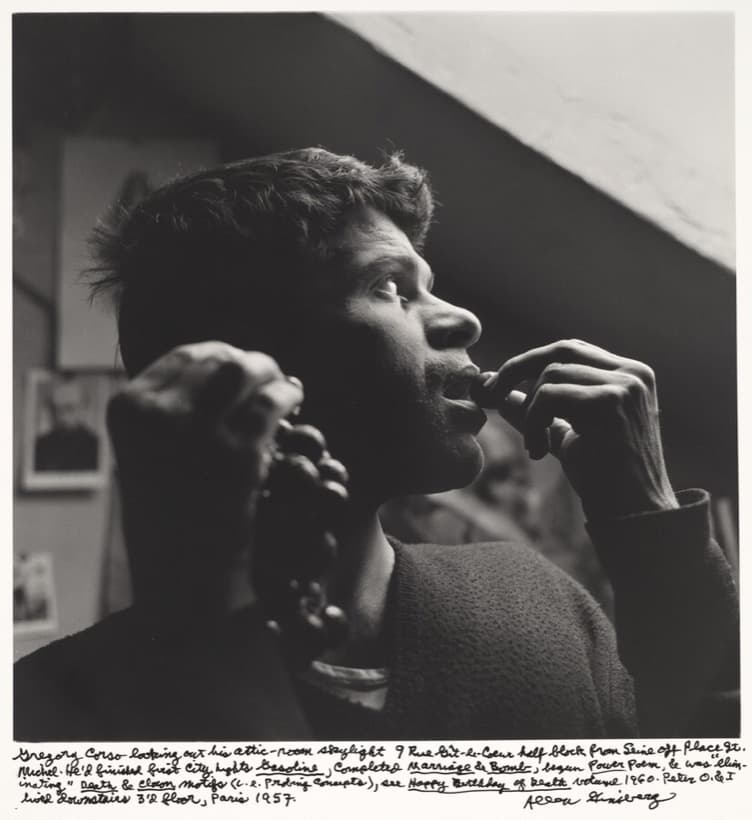
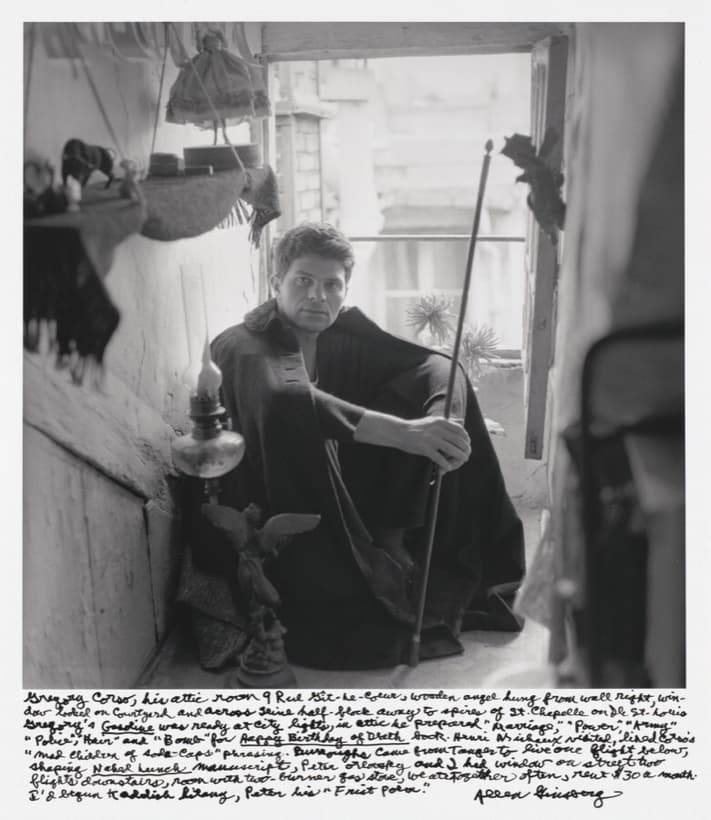
Selected works: poetry

  • Howl and Other Poems (1956)
  • Kaddish and Other Poems 1958–1960 (1961)
  • Empty Mirror: Early Poems (1961)
  • Reality Sandwiches: 1953–1960 (1963)
  • Planet News: 1961–1967 (1968)
  • The Fall of America: Poems of These States 1965–1971 (1973)
  • Mind Breaths: Poems 1972–1977 (1978)
  • Plutonian Ode: And Other Poems, 1977–1980 (1982)
  • Collected Poems 1947–1980 (1984)
  • White Shroud: Poems 1980–1985 (1986)
  • Cosmopolitan Greetings: Poems 1986–1992 (1994)
  • Death & Fame: Last Poems, 1993–1997 (1999; published posthumously)

Selected works: prose, letters, journals and photography

  • The Yage Letters, with William S. Burroughs (first published 1963; later expanded editions)
  • Indian Journals (1970)
  • Journals: Early Fifties, Early Sixties (1977)
  • Composed on the Tongue (1980)
  • As Ever: The Collected Correspondence of Allen Ginsberg and Neal Cassady (1977)
  • Straight Hearts' Delight: Love Poems and Selected Letters, with Peter Orlovsky (1980)
  • Deliberate Prose: Selected Essays 1952–1995 (2000)
  • I Greet You at the Beginning of a Great Career: The Selected Correspondence of Lawrence Ferlinghetti and Allen Ginsberg, 1955–1997 (2015)
  • Beat Memories: The Photographs of Allen Ginsberg (2010)

Selected works: music and performance

  • First Blues: Rags, Ballads & Harmonium Songs 1971–1974 (1975)
  • Hydrogen Jukebox, with composer Philip Glass and designer Jerome Sirlin (premiered 1990)

Life events

  1. 3 June 1926

    Irwin Allen Ginsberg is born in Newark, New Jersey, the younger son of teacher and poet Louis Ginsberg and political activist Naomi Levy Ginsberg.

  2. Late 1920s–1930s

    The family lives principally in Paterson, New Jersey, where industrial streets, mills and rail infrastructure later enter Ginsberg's poetry.

  3. 1930s

    Naomi Ginsberg experiences recurring psychiatric crises and periods of hospitalization, establishing the family history later central to Howl and Kaddish.

  4. 1937

    In a childhood diary, the eleven-year-old Ginsberg predicts that he will become some kind of literary genius.

  5. Early 1940s

    He reads Poe, Whitman and other poets, writes on political subjects and develops the ambition to combine literature with public life.

  6. 1943

    Ginsberg enters Columbia University on scholarship at seventeen, initially imagining a future as a labor lawyer.

  7. 1943–1944

    He meets Lucien Carr, who introduces him to Jack Kerouac and the social circle that also includes William S. Burroughs, John Clellon Holmes and Herbert Huncke.

  8. August 1944

    Carr kills David Kammerer after a confrontation in Riverside Park and later pleads guilty to manslaughter; the case deeply affects the young circle.

  9. Mid-1940s

    Ginsberg studies with Mark Van Doren, Lionel Trilling and Meyer Schapiro while participating in Columbia literary life and undergoing disciplinary suspensions.

  10. 1946–1947

    He works in the Merchant Marine and travels aboard ships, including the S.S. John Blair.

  11. 1948

    Ginsberg graduates from Columbia with a bachelor's degree after a repeatedly interrupted undergraduate career.

  12. 1948

    While reading William Blake in Harlem, he experiences the auditory and visionary event later known as the "Blake vision."

  13. Late 1940s

    His intense and unequal romantic attachment to Neal Cassady becomes central to his emotional life and early writing.

  14. 1949

    Following legal trouble involving stolen goods stored in his apartment, Ginsberg enters the New York State Psychiatric Institute.

  15. 1949–1950

    At the institute he meets Carl Solomon, who introduces him to writers including Jean Genet and Antonin Artaud and later becomes the dedicatee of Howl.

  16. Early 1950s

    Ginsberg works ordinary jobs, writes poetry, exchanges manuscripts and begins acting as an advocate for Kerouac, Burroughs and other friends.

  17. 1953

    William S. Burroughs stays with Ginsberg at his East Seventh Street apartment; the men are lovers during this period and work together on manuscripts.

  18. 1953

    Ginsberg meets Gregory Corso and begins a lifelong friendship marked by strong literary advocacy.

  19. 1953

    He takes important early photographs of Burroughs, Kerouac, Cassady, Solomon and others in the Beat circle.

  20. 1954

    Ginsberg moves to San Francisco and enters the poetry community associated with Kenneth Rexroth, Robert Duncan, Lawrence Ferlinghetti and the San Francisco Renaissance.

  21. 1954

    He meets Peter Orlovsky through painter Robert LaVigne; Ginsberg and Orlovsky become lovers and lifelong partners.

  22. 1955

    Ginsberg and Orlovsky mark their partnership in a private commitment ceremony.

  23. 1955

    Ginsberg develops the long-line structure and central sections of Howl.

  24. 7 October 1955

    He gives the first public reading of the opening section of Howl at the Six Gallery in San Francisco.

  25. October 1955

    Lawrence Ferlinghetti asks to publish Howl after the Six Gallery reading.

  26. 1955–1956

    Ginsberg writes major early poems including "A Supermarket in California," "Sunflower Sutra" and "America."

  27. 1956

    City Lights publishes Howl and Other Poems as Pocket Poets No. 4.

  28. 1956

    Naomi Ginsberg dies; Allen is absent from the funeral and begins considering an extended memorial poem.

  29. 25 March 1957

    U.S. Customs officials seize 520 copies of Howl and Other Poems arriving from its British printer.

  30. 1957

    Ginsberg and Orlovsky travel to Tangier and assist William S. Burroughs with the body of writing that becomes Naked Lunch.

  31. June 1957

    City Lights manager Shig Murao is arrested for selling Howl to an undercover officer, and Ferlinghetti is prosecuted as publisher.

  32. 3 October 1957

    Judge Clayton W. Horn rules that Howl is not obscene and acquits Ferlinghetti.

  33. Autumn 1957

    Ginsberg, Orlovsky and Gregory Corso settle in Paris, living at 9 rue Gît-le-Cœur, later known as the Beat Hotel.

  34. December 1957

    Ginsberg begins Kaddish in Paris; the final poem is dated "Paris, December 1957—New York, 1959."

  35. 1957–1958

    At the Beat Hotel, he lives and works near Corso, Burroughs, Brion Gysin and other writers and artists.

  36. 1958–1959

    After returning to New York, he expands and revises Kaddish through repeated reading and restructuring.

  37. 1959

    Olympia Press publishes the first complete edition of Burroughs's Naked Lunch in Paris.

  38. 1961

    City Lights publishes Kaddish and Other Poems 1958–1960 and Empty Mirror.

  39. 1961–1963

    Ginsberg and Orlovsky travel extensively through Europe, the Middle East, India and East Asia.

  40. 1962–1963

    An extended stay in India deepens Ginsberg's engagement with Hindu and Buddhist thought, mantra and meditation.

  41. 1963

    He travels in Japan with Gary Snyder and Joanne Kyger and publishes Reality Sandwiches.

  42. 1965

    Cuban authorities expel Ginsberg after he criticizes censorship and the treatment of homosexual people.

  43. 1965

    Prague students elect him King of May; Czechoslovak authorities soon confiscate papers and expel him.

  44. June 1965

    He participates in the International Poetry Incarnation at London's Royal Albert Hall and becomes an important link to the British underground.

  45. 1965–1971

    He uses notebooks and portable tape recorders to document travel, radio, political language and the Vietnam era.

  46. 1966–1967

    Ginsberg promotes nonviolent countercultural protest under the phrase "flower power."

  47. 14 January 1967

    He participates in the Human Be-In at Golden Gate Park, helping connect the Beat movement with the emerging hippie counterculture.

  48. 21 October 1967

    At the March on the Pentagon, he chants during the theatrical attempt to "exorcise" or symbolically levitate the building.

  49. 1968

    City Lights publishes Planet News: 1961–1967.

  50. August 1968

    Ginsberg is tear-gassed during police confrontations with antiwar demonstrators at the Democratic National Convention in Chicago.

  51. 1969

    He testifies for the defense in the Chicago Seven trial; Jack Kerouac dies later that year.

  52. 1971

    Ginsberg visits refugee camps connected with the Bangladesh Liberation War and writes "September on Jessore Road."

  53. 1972

    He takes Buddhist Refuge and Bodhisattva vows and deepens his formal commitment to Tibetan Buddhist practice.

  54. 1973

    City Lights publishes The Fall of America: Poems of These States 1965–1971.

  55. 1974

    The Fall of America receives the National Book Award for Poetry.

  56. 1974

    With Anne Waldman and others, Ginsberg helps establish the Jack Kerouac School of Disembodied Poetics at Naropa Institute.

  57. 1978

    City Lights publishes Mind Breaths; Ginsberg and Orlovsky are arrested during a protest against nuclear activity connected with Rocky Flats.

  58. Early 1980s

    Ginsberg writes "Plutonian Ode," records music and continues anti-nuclear, antiwar and free-speech activism.

  59. 1984

    Collected Poems 1947–1980 consolidates nearly four decades of work.

  60. 1980s

    He returns systematically to photography, printing old negatives, taking new portraits and adding extensive handwritten captions.

  61. 1986–1987

    Ginsberg returns to Columbia University as a visiting professor.

  62. 1987

    He joins Brooklyn College as a distinguished professor of English and creative writing.

  63. 1990

    Hydrogen Jukebox, his music-theater collaboration with Philip Glass and Jerome Sirlin, receives its full premiere.

  64. 1993

    France appoints Ginsberg a Chevalier de l'Ordre des Arts et des Lettres.

  65. 1994

    Cosmopolitan Greetings: Poems 1986–1992 is published.

  66. 1995

    Cosmopolitan Greetings becomes a Pulitzer Prize finalist, and Stanford acquires Ginsberg's principal personal archive.

  67. Spring 1997

    Doctors diagnose Ginsberg with liver cancer against a background of chronic hepatitis and other health problems.

  68. 5 April 1997

    Ginsberg dies in New York City at the age of seventy after a stroke and coma.

  69. 1999–2000

    Death & Fame: Last Poems, 1993–1997 and Deliberate Prose extend his work posthumously.

  70. 2010

    The National Gallery of Art presents Beat Memories, the first major museum exhibition devoted to Ginsberg's photography.

  71. 2026

    Stanford University Libraries marks the centenary of Ginsberg's birth with a major exhibition drawn from his personal archive.

People they knew

Documented connections — every one carries its source.

Illustrated portrait of William S. Burroughs

William S. Burroughs

  • Author
  • Painter

Met · 1943

Ginsberg became one of Burroughs's closest Beat colleagues, helping organize the Tangier word hoard and joining the Paris Beat Hotel community.

William S. Burroughs Papers; Naked Lunch: The First Fifty Years

Illustrated portrait of Jack Kerouac

Jack Kerouac

  • Author
  • Poet

Met · 1944

Kerouac and Ginsberg met in New York in 1944 and became central figures in the early Beat circle.

Jack Kerouac Papers

Questions about Allen Ginsberg

Who was Allen Ginsberg?

An American poet, born in Newark in 1926 and died in New York in 1997. His long poem Howl made him famous in the 1950s and its obscenity trial made him a public figure. He was central to the Beat Generation and remained a working poet, teacher and political activist for four decades.

What is Howl about?

It opens by describing a generation of Ginsberg's contemporaries destroyed by madness, poverty, drugs and institutional treatment, and it names the forces he held responsible. It was written in long breath-length lines meant to be read aloud, and it deals openly with homosexuality, drug use and mental illness at a time when American poetry rarely did.

Why was Howl put on trial?

United States customs seized copies in 1957 and the publisher Lawrence Ferlinghetti was prosecuted for selling obscene material. The court found that the poem had redeeming social importance and was not obscene. The trial made Ginsberg nationally known and widened what American publishers could print.

What is Kaddish?

Ginsberg's long elegy for his mother, Naomi, who had severe mental illness, was repeatedly hospitalised and underwent a lobotomy. He began it in Paris at the Beat Hotel and finished it in New York. It is generally considered his most sustained work.

What was Allen Ginsberg's connection to Paris?

He lived from 1957 at the cheap Left Bank lodging later called the Beat Hotel, at 9 rue Gît-le-Cœur, with Peter Orlovsky, Gregory Corso and William S. Burroughs. He began Kaddish there while the Howl obscenity case was making him famous in America, and he helped Burroughs assemble Naked Lunch.

Who was Peter Orlovsky?

The poet who was Ginsberg's partner for more than thirty years, from their meeting in San Francisco in 1954. They lived together, travelled together and were publicly a couple decades before that was safe for well-known figures.

Why is Allen Ginsberg's legacy contested?

Because of his defence of the North American Man/Boy Love Association, which he joined and publicly defended on free-speech grounds. The controversy is a live part of assessments of him, and it has been raised repeatedly since, including in centenary coverage in 2026.

Sourced claims

Every connection the graph holds for Allen, with the evidence behind it.

Met · 1943

William S. Burroughs

Ginsberg became one of Burroughs's closest Beat colleagues, helping organize the Tangier word hoard and joining the Paris Beat Hotel community.

William S. Burroughs Papers; Naked Lunch: The First Fifty Years

Met · 1944

Jack Kerouac

Kerouac and Ginsberg met in New York in 1944 and became central figures in the early Beat circle.

Jack Kerouac Papers

References

References

The sources below include biographies, scholarly essays, interviews, and primary materials that informed this page. They reflect both the historical record and ongoing critical conversations about Allen Ginsberg and their work.

  1. 1Allen Ginsberg

    Website
    Academy of American Poets
    Used for

    A concise institutional biography covering his family, Columbia years, Blake vision, San Francisco period, major publications, activism and death.

    View source
  2. 2Allen Ginsberg

    Website
    Poetry Foundation
    Used for

    A detailed overview of Ginsberg's life and work, including Naomi Ginsberg, psychiatric hospitalization, Peter Orlovsky, Howl, Buddhism, political activism, controversy and final illness.

    View source
  3. 3Allen Ginsberg," Columbia 250

    Website
    Columbia University
    Used for

    Useful for his undergraduate career, teachers, Beat friendships, suspensions, graduation, poetic method and later return as a professor. The page contains an incorrect date for the National Book Award; the National Book Foundation's 1974 record should be followed on that point.

    View source
  4. 4Allen Ginsberg papers, 1943–1991

    Website
    Columbia University Libraries
    Used for

    Finding aid for correspondence and archival material documenting Ginsberg's literary network, travels and career.

    View source
  5. 5The Allen Ginsberg centenary exhibition

    Website
    Stanford University Libraries
    Used for

    A 2026 account of Ginsberg's personal archive, childhood diary, manuscripts, correspondence, activism, travels and role as a preserver of underground culture.

    View source
  6. 6Allen Ginsberg papers, 1937–2017

    Website
    Online Archive of California
    Used for

    The principal finding aid for the Stanford collection, including manuscripts, correspondence, notebooks, photographs and recordings.

    View source
  7. 7I Celebrate Myself: The Somewhat Private Life of Allen Ginsberg

    Website
    Bill Morgan
    Used for

    The major full-length biography by Ginsberg's longtime archivist, based on extensive access to journals, correspondence and his personal circle.

    View source
  8. 8Allen Ginsberg in Context

    Website
    Erik Mortenson, editor
    Used for

    A major centenary collection of scholarly essays published by Cambridge University Press in 2026, with chapters on Ginsberg's life, poetics, politics, religion, media and Paris years.

    View source
  9. 9Best Minds: How Allen Ginsberg Made Revolutionary Poetry from Madness

    Website
    Stevan M. Weine
    Used for

    A psychiatric and historical study of Ginsberg's visions, hospitalization, family trauma and representation of mental illness.

    View source
  10. 10American Scream: Allen Ginsberg's Howl and the Making of the Beat Generation

    Website
    Jonah Raskin
    Used for

    A book-length history of Howl, its composition, performance, prosecution and cultural setting.

    View source
  11. 11Ann Charters on Ginsberg and Kerouac at Columbia

    Website
    Columbia University Libraries
    Used for

    Detailed research on Ginsberg's scholarship, early political plans, professors, student writing and friendships.

    View source
  12. 12The Last Beat

    Website
    Columbia Magazine
    Used for

    Background on Lucien Carr, the early Columbia circle and the 1944 killing of David Kammerer.

    View source
  13. 13early Howl typescript

    Website
    Columbia University Libraries
    Used for

    Archival page documenting Ginsberg's description of his "new style, long lines, strophes."

    View source
  14. 14Carl Solomon portrait and Ginsberg caption

    Website
    National Gallery of Art
    Used for

    A primary source for their shared time at the New York State Psychiatric Institute and Solomon's literary influence.

    View source
  15. 15Ginsberg aboard the S.S. John Blair

    Website
    National Gallery of Art
    Used for

    Primary visual documentation of his 1947 Merchant Marine period.

    View source
  16. 16Elise Cowen papers

    Website
    Barnard Archives
    Used for

    Archival material relating to Cowen's poetry and her place in the Barnard-Columbia Beat community.

    View source
  17. 17Howl and Other Poems

    Website
    City Lights
    Used for

    The publisher's page on the book, the Six Gallery reading, publication history and place in the Pocket Poets series.

    View source
  18. 18Howl on Trial: The Battle for Free Expression

    Website
    City Lights
    Used for

    Documentation and primary material concerning the publication and legal defense of Howl.

    View source
  19. 19Howl and Other Poems

    Website
    Academy of American Poets
    Used for

    A useful account of the 7 October 1955 Six Gallery reading and Ferlinghetti's response.

    View source
  20. 20Howl

    Website
    Poetry Foundation
    Used for

    Published text and composition information for the poem.

    View source
  21. 21Kaddish

    Website
    Poetry Foundation
    Used for

    Published text establishing the poem's dating as "Paris, December 1957—New York, 1959."

    View source
  1. 22Kaddish, Part I

    Website
    Academy of American Poets
    Used for

    Published excerpt and contextual material on the poem's memorial structure.

    View source
  2. 23As Ever

    Website
    Poetry Foundation
    Used for

    Selections from Ginsberg and Ferlinghetti's correspondence, valuable for Howl, Paris, Kaddish, India and Ginsberg's advocacy for other writers.

    View source
  3. 24The Beat Hotel: Ginsberg, Burroughs, and Corso in Paris, 1957–1963

    Website
    Barry Miles
    Used for

    The principal book-length history of the Beat Hotel and the expatriate network around 9 rue Gît-le-Cœur.

    View source
  4. 25The Beat Hotel

    Website
    City Lights
    Used for

    Publisher's overview of the hotel, its residents and the work created there.

    View source
  5. 26The Beat Hotel," in Allen Ginsberg in Context

    Website
    Cambridge University Press
    Used for

    A 2026 scholarly chapter on Ginsberg's Paris residence, writings and literary community.

    View source
  6. 27Harold Chapman's best shot

    Website
    The Guardian
    Used for

    Chapman's firsthand account of photographing Ginsberg and Peter Orlovsky in Saint-Germain-des-Prés in 1957.

    View source
  7. 28The Beat Goes On

    Website
    Poetry Foundation
    Used for

    Material from Ginsberg and Ferlinghetti's correspondence concerning the Howl case, Burroughs, publishing and the international Beat network.

    View source
  8. 29Caught on Tape

    Website
    Poetry Foundation
    Used for

    A detailed study of Ginsberg's portable tape recorder, documentary composition and The Fall of America.

    View source
  9. 30The Fall of America

    Website
    National Book Foundation
    Used for

    Official record confirming the book as a 1974 National Book Award winner in poetry.

    View source
  10. 31Take Me to Your Poets

    Website
    Naropa University
    Used for

    Institutional history of Ginsberg, Anne Waldman, Chögyam Trungpa and the founding of the Jack Kerouac School of Disembodied Poetics.

    View source
  11. 32the Human Be-In

    Website
    Smithsonian Magazine
    Used for

    Historical account of the January 1967 gathering in Golden Gate Park and its place in the emerging counterculture.

    View source
  12. 33the Pentagon protest

    Website
    Smithsonian Magazine
    Used for

    Historical account of the theatrical "exorcism" of the Pentagon and Ginsberg's use of mantra during the demonstration.

    View source
  13. 34Beat Memories: The Photographs of Allen Ginsberg

    Website
    National Gallery of Art
    Used for

    Official page for the first major museum exhibition devoted to his photographs, including early snapshots and later annotated portraits.

    View source
  14. 35William S. Burroughs on Ginsberg's roof, 1953

    Website
    National Gallery of Art
    Used for

    Ginsberg's own caption explicitly documents their sexual relationship and manuscript work during this period.

    View source
  15. 36Allen Ginsberg

    Website
    Howard Greenberg Gallery
    Used for

    Overview of his photographic practice, exhibitions and annotated prints.

    View source
  16. 37Hydrogen Jukebox

    Website
    Philip Glass
    Used for

    Official composition page confirming the collaborators, 1990 premiere and use of Ginsberg's poetry as libretto.

    View source
  17. 38Allen Ginsberg

    Website
    The Pulitzer Prizes
    Used for

    Official record of Cosmopolitan Greetings as a 1995 finalist in poetry.

    View source
  18. 39Death & Fame

    Website
    HarperCollins
    Used for

    Publisher's page for the posthumous collection of poems from 1993–1997.

    View source
  19. 40Beat Writers

    Website
    Columbia Research Initiative on the Global History of Sexualities
    Used for

    Historical context for Ginsberg's queer life, the Columbia circle and the representation of homosexual desire in Beat writing.

    View source
  20. 41Beat legend, ‘boy lover': how should we reckon with Allen Ginsberg's complex legacy?

    Website
    The Guardian
    Used for

    A 2026 centenary assessment of Ginsberg's influence and the continuing controversy surrounding his support for NAMBLA.

    View source
  21. 42Naked Lunch: The First Fifty Years

    Exhibition catalogue
    Columbia University Libraries
    Used for

    Catalogue scholarship used to verify attribution, provenance, chronology, and interpretive context for Allen Ginsberg.

    View source
i
Why these sources are here

These references anchor the page in the documented record and in the scholarly conversations around Allen Ginsberg. Every claim on this page traces back to one or more of the works listed here.

Explore more resources
Browse all authors