Depicts
Gregory Corso
Allen Ginsberg names the sitter in his own handwriting on the print, and the National Gallery of Art takes that caption as the object's title.
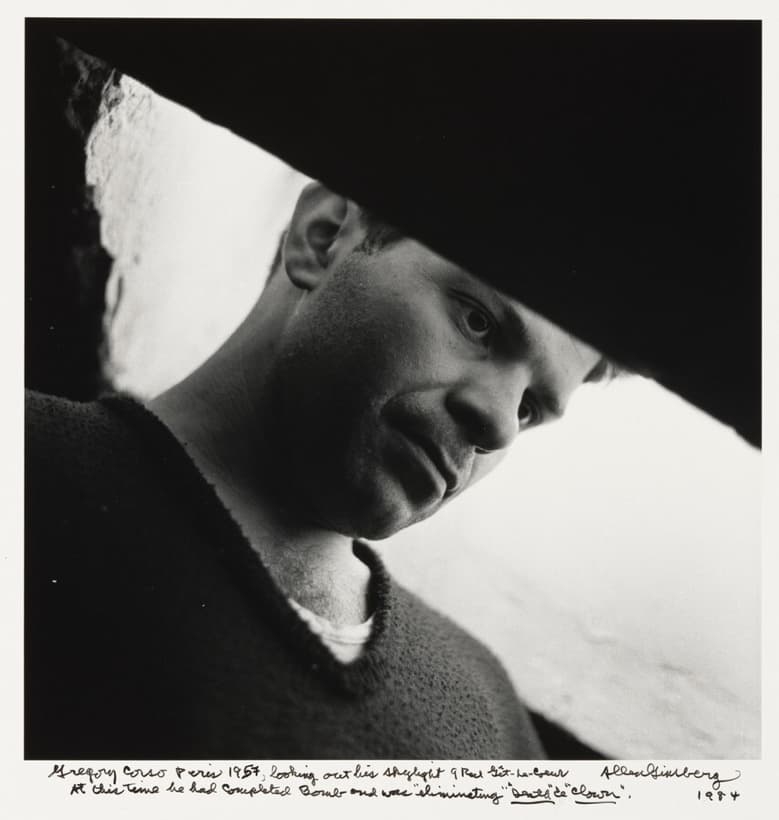
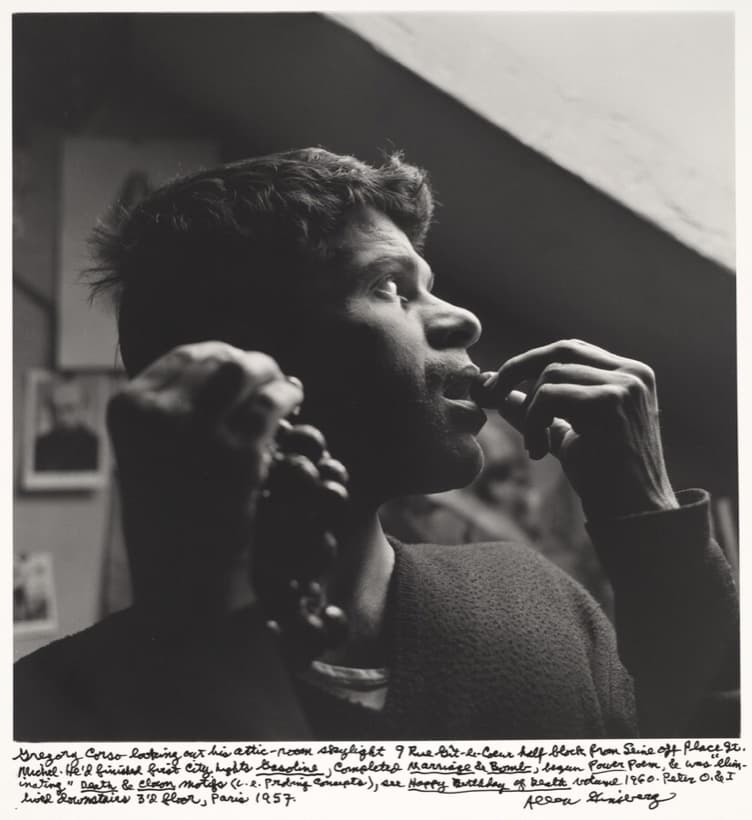
A face fills the frame diagonally, wedged between a black wedge above and a white one below. Allen Ginsberg made the exposure under the skylight of Gregory Corso's attic at 9 rue Gît-le-Cœur in Paris in 1957, and printed it in 1984. He wrote a two-line caption in the border and dated it 1984 in his own hand, the earliest print date on any of his captioned Paris frames at the National Gallery of Art, which owns it as 2010.137.15.
Gregory Corso's head lies across the frame on a diagonal, running from the lower left to the upper right. His near eye sits almost at the centre of the picture, open, with a small catchlight in it. He looks down and to his right, past the camera. His mouth is closed and his jaw and cheek carry several days of stubble.
A solid black wedge occupies the whole upper right of the frame, with no detail in it at all. A blown white wedge runs along the lower right edge, also without detail. The face is the only thing in the picture that holds tone, and it is lit from the white side.
He wears a dark crewneck sweater, the ribbing at the neck visible in the lower left. His ear and part of his hairline appear at the upper left corner.
The print is a tall rectangle, 35.4 by 20.32 centimetres, on a sheet the same height and 27.62 centimetres wide. There is no border at the top or sides, only at the bottom, where the caption runs.
The caption is two lines, in black ink, under the image. It is the shortest of the four captions Allen Ginsberg wrote on his Paris frames. It reads:
“Gregory Corso Paris 1957, looking out his skylight 9 Rue Gît-Le-Coeur Allen Ginsberg / At this time he had completed Bomb and was "eliminating" "Death" & "Clown". 1984”
Death and Clown are underlined. The signature sits at the end of the first line, and the year 1984 sits alone at the end of the second, far to the right, with a wide gap before it. Both dates are therefore on the print in his hand: 1957 for the negative inside the sentence, and 1984 for the print, set apart at the end.
Quotation marks do a lot of work in twenty-five words. The word eliminating is quoted, which marks it as Gregory Corso's word and not Allen Ginsberg's. Death and Clown are quoted and underlined together, which treats them as things Gregory Corso was removing rather than as titles he had written.
Howard Greenberg Gallery, which represents the work, dates almost all of Allen Ginsberg's captioned photographs between 1984 and 1996. The 1984 in this border is therefore at the very beginning of the practice, and the caption's shortness is consistent with that.
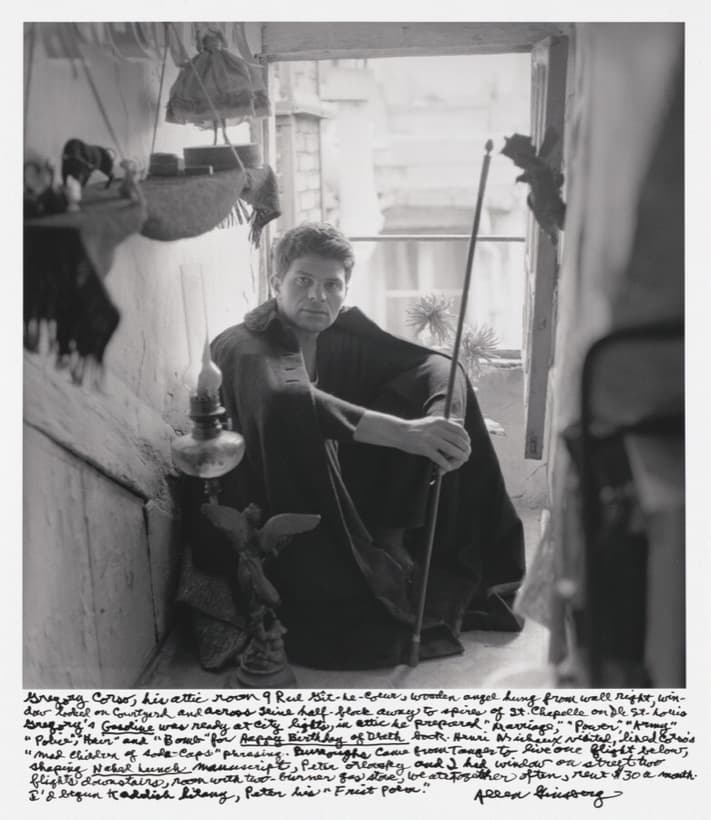
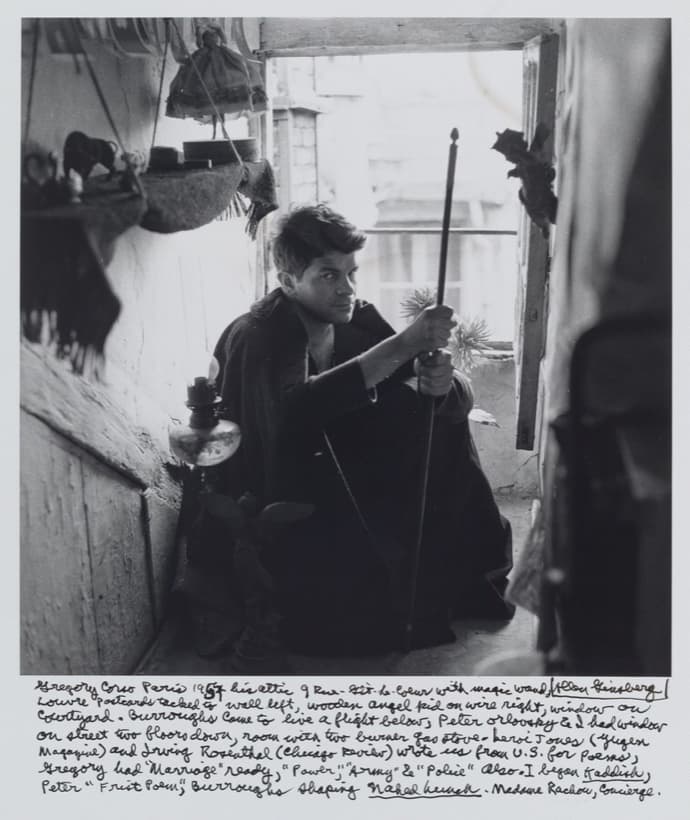
Set beside the captions he wrote on the same room in 1995 and later, the difference in ambition is plain. The later captions run to seven and eight lines and name magazines, editors, rents and concierges. This one gives a place, a date, and two facts about what Gregory Corso was doing to his own poems.
The National Gallery of Art records the print date as 1984 in its own object record, matching the year in the artist's hand. On the other three Paris prints the museum records the print date only as later, or as 1995.
The caption says Gregory Corso is looking out his skylight. In the frame he is looking down and to the side, not up, and no sky is visible anywhere.
What the frame does carry is the evidence of a skylight: a hard directional light striking one side of the face, and a black wedge cutting across the other. Allen Ginsberg made the exposure from close above or beside the aperture, which is why the two wedges meet on the diagonal and squeeze the head between them.
The camera is also tilted. The horizon of the picture, taken from the edge where black meets face, runs at roughly forty-five degrees. Nothing in the frame is level, and there is no reason to think that was planned.
The verso carries a note in Allen Ginsberg's own hand, read by the museum as "Gaveaway", and a crossed-out negative reference, BK 5 H 27A NEG 11, with the year 1957 beside it. The collection marks GD-AG-086, GDC-681 and AG-854 also appear there.
The print entered the National Gallery of Art in 2010 as a gift of Gary S. Davis, who had acquired it from the Allen Ginsberg Estate. The object record carries no exhibition history.
The museum lists the print as not on view.
The print holds three tones and very little between them: a black with no shadow detail, a white with no highlight detail, and the skin in the middle. That is a normal result for a small hand camera aimed at a face against a bright aperture, with no fill light.
Grain is fine and the focus is accurate on the eye. The 1984 print is a good one from an unpromising negative, and the choice to print it tall and tight, cropping to the diagonal, is the one compositional decision in the object.
Allen Ginsberg did not soften the contrast or burn in the white. The picture is left as the exposure made it, and the caption underneath is what carries the information the picture lost.
Close reading
The frame holds three tones and almost nothing between them. Work through the black wedge, the face and the white wedge in turn, then read the two-line caption, which is the shortest Allen Ginsberg wrote on any of his Paris prints and the only one that carries its print year in his own hand.
1.The open eye
One eye, sharp, with a catchlight in it. The focus plane sits exactly here, which is why the rest of the face falls away softly on both sides. He is looking down and to his right, past the camera. The caption says he is looking out his skylight, and nothing in the frame is consistent with that direction.
2.The black wedge
No detail survives anywhere in this part of the print — it is a flat black with no shadow information. The edge where it meets the face is a straight diagonal, which is the lip of the skylight aperture seen from close underneath. It takes up roughly a third of the picture.
3.The blown white edge
The opposite failure to the black wedge, in the same frame. The white holds no highlight detail at all. It is the light coming through the aperture, and it is what lights the face; Allen Ginsberg did not burn it in when he printed the negative in 1984.
4.Several days of stubble
The light comes in almost parallel to the skin, so every hair casts its own shadow and the growth reads as texture rather than as tone. This is the one part of the picture where the hard unfilled lighting works in the photograph's favour. The grain of the negative is visible through it at any size.
5.The ribbed neck of the sweater
A plain dark crewneck, its ribbing legible only where the light from the aperture reaches it. It is the same kind of garment he wears in the 1995 skylight print, and different from the heavy collared coat of the two attic frames, which suggests a different day rather than a different hour.
6.The caption's first words
Twenty-five words in two lines, the shortest caption on any of the four Paris prints. The negative's year sits inside the first sentence rather than at the end, and the street name is written with an accent on the first word. There is no bibliography, no rent and no list of who lived on which floor.
7.Eliminating, in quotation marks
Three sets of quotation marks in six words. Eliminating is quoted, which marks it as Gregory Corso's word rather than Allen Ginsberg's. Death and Clown are quoted and underlined together, which treats them as material being cut out rather than as poems already written.
8.The print year, written alone
Both dates are on the sheet in his hand. The negative's year, 1957, sits inside the first sentence; the print's year, 1984, sits alone at the end of the second line with a wide gap in front of it. The National Gallery of Art records the print date as 1984 on this evidence rather than inferring it, and the year is the earliest on any of his captioned Paris frames.
1957
The negative is exposed under the skylight of Gregory Corso's attic at 9 rue Gît-le-Cœur in Paris.
1984
Allen Ginsberg prints the negative and writes the caption, dating it 1984 at the end of the second line. It is the earliest print date on his captioned Paris frames at the National Gallery of Art.
2010
The print enters the National Gallery of Art as 2010.137.15, a gift of Gary S. Davis, from the Allen Ginsberg Estate.
National Gallery of Art
Washington, United States
A public viewing address has not yet been confirmed for this holding.
The National Gallery of Art lists the print as not on view and states that the image is unavailable for download.
The negative was exposed in 1957 at 9 rue Gît-le-Cœur in Paris, and the print was made in 1984. Allen Ginsberg wrote both dates on the print itself: 1957 inside the caption sentence, and 1984 alone at the right end of the second line.
Twenty-five words: "Gregory Corso Paris 1957, looking out his skylight 9 Rue Gît-Le-Coeur. At this time he had completed Bomb and was 'eliminating' 'Death' & 'Clown'." Death and Clown are underlined. It is the shortest of Allen Ginsberg's four Paris captions.
Because the light came from a skylight aperture and nothing filled the shadow. A solid black wedge with no detail takes the upper right of the frame, a blown white wedge runs along the lower right, and Gregory Corso's face is the only part of the picture holding tone.
Not in the frame. He is looking down and to his right, past the camera, and no sky appears anywhere in the picture. The hard directional light and the black wedge are the only evidence the skylight left.
The image is 35.4 by 20.32 centimetres, a tall narrow rectangle, on a sheet 35.4 by 27.62 centimetres. The extra sheet width is the border at the bottom that carries the caption.
The National Gallery of Art in Washington, as 2010.137.15, a gift of Gary S. Davis. The museum lists it as not on view and does not offer the image for download.
Depicts
Allen Ginsberg names the sitter in his own handwriting on the print, and the National Gallery of Art takes that caption as the object's title.
The sources below include collection records, catalogues, scholarly research, and primary materials that informed this page. They document Gregory Corso Looking Out His Skylight, its making, and its place in cultural history.
The museum's object record: title, negative and print dates, medium, dimensions, inscription, credit line, accession number and provenance.
The National Gallery of Art's published collection data, which carries the same fields as structured values and marks the image not open access at a 900-pixel cap.
The representing gallery's account of the captioning practice and its 1984–1996 span, against which this print's date sits at the start.
The 2010 exhibition of the captioned prints, which set out the body this frame belongs to.
These references provide the documented foundation for this work's history and interpretation. Claim-level citations remain attached to the specific claims they support.
 Explore more resources