Depicts
Gregory Corso
Allen Ginsberg names the sitter in his own handwriting on the print, and the National Gallery of Art takes that caption as the object's title.
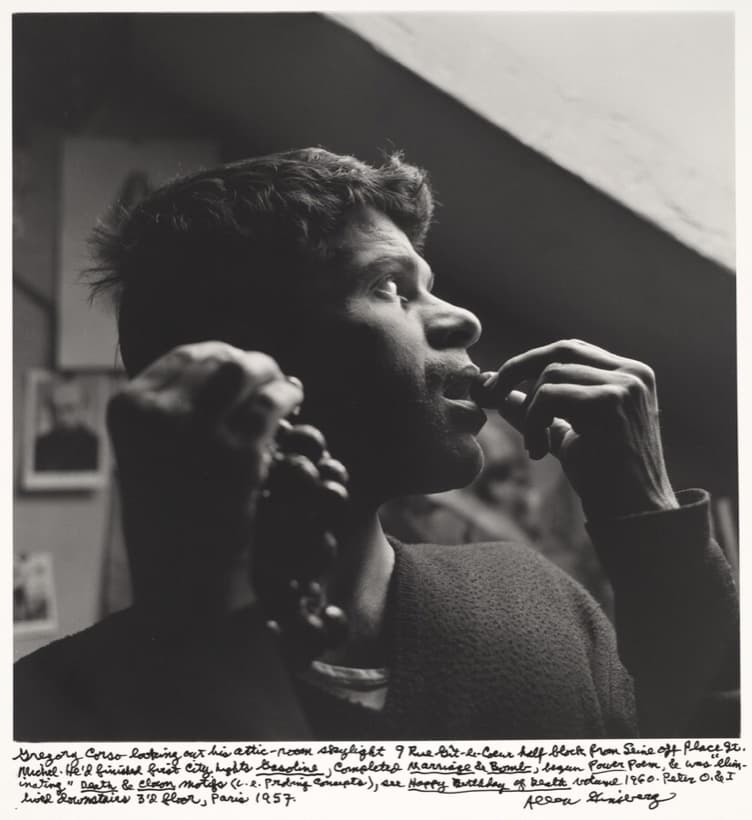
Gregory Corso is seen in profile, head tilted back, mouth open, one hand lifting something dark to his lips. Allen Ginsberg made the exposure under the skylight of the attic at 9 rue Gît-le-Cœur in Paris in 1957. He printed it in 1995, signed it on 28 April that year, and wrote a four-line caption in the border that lists the poems Gregory Corso then had in hand. The National Gallery of Art owns it as 2011.146.39.
Gregory Corso is in near profile, facing right, his head tilted back and his chin raised. His mouth is open and a small dark object is held at his lips between the thumb and forefinger of his right hand, which is lifted across the lower right of the frame. His left hand is a loose fist below, holding a dark cluster of small round forms.
Light comes from above and in front, hard and unfilled. It picks out the forehead, the bridge of the nose, the raised knuckles and the tendons on the back of the hand, and lets everything behind him fall to near black.
Two pale rectangles are pinned to the wall behind his shoulder at the left, badly out of focus. The upper one holds a dark mass inside a light border; the lower one holds smaller pale shapes. A dark diagonal crosses the upper left corner, which is the underside of the roof slope.
He wears a dark ribbed sweater with the cuff pushed up the raised wrist. The print is square, 35.6 by 35.5 centimetres, on a sheet 50.4 by 40.5 centimetres.
Allen Ginsberg wrote the caption in four lines of black ink across the bottom border and signed it below the last line at the right. He printed and signed the sheet in 1995. The caption reads:
“Gregory Corso looking out his attic-room skylight 9 Rue Git-le-Coeur half block from Seine off Place St. Michel. He'd finished first City Lights Gasoline, completed Marriage & Bomb, begun Power Poem, & was "eliminating" Death & Clown motifs (i.e. Probing Concepts), see Happy Birthday of Death volume 1960. Peter O & I lived downstairs 3'd floor, Paris 1957.”
Six titles are underlined: Gasoline, Marriage, Bomb, Death, Clown and Happy Birthday of Death. The word eliminating is broken across the second and third lines as elim- / inating. Its opening quotation mark is written above the end of the second line rather than beside the word, because the line had run out.
Two abbreviations shorten people and places to fit: Peter O for Peter Orlovsky, and 3'd for third. The caption ends with the place and the year — Paris 1957 — so the negative's date is the last thing a reader meets before the signature.
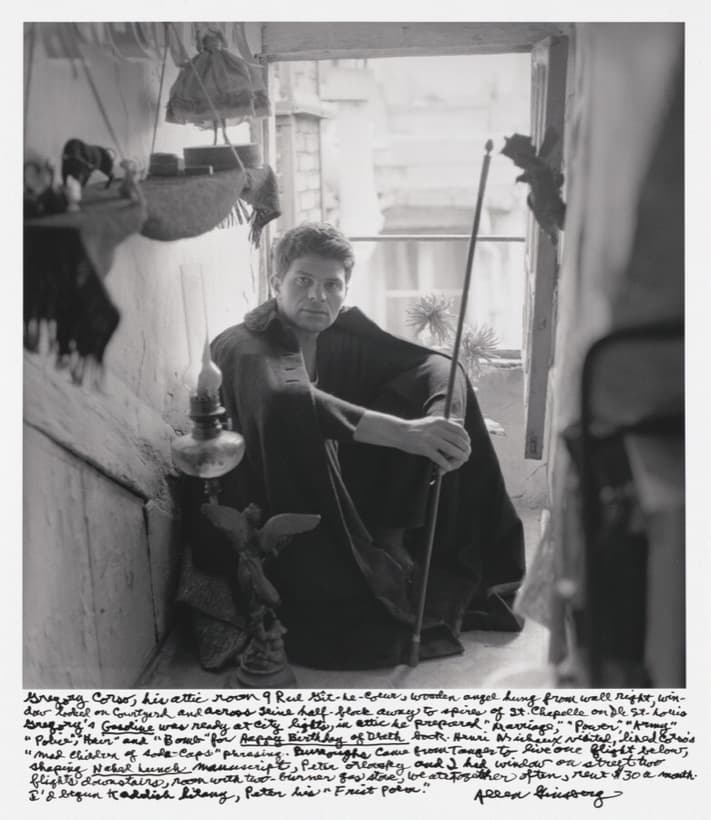
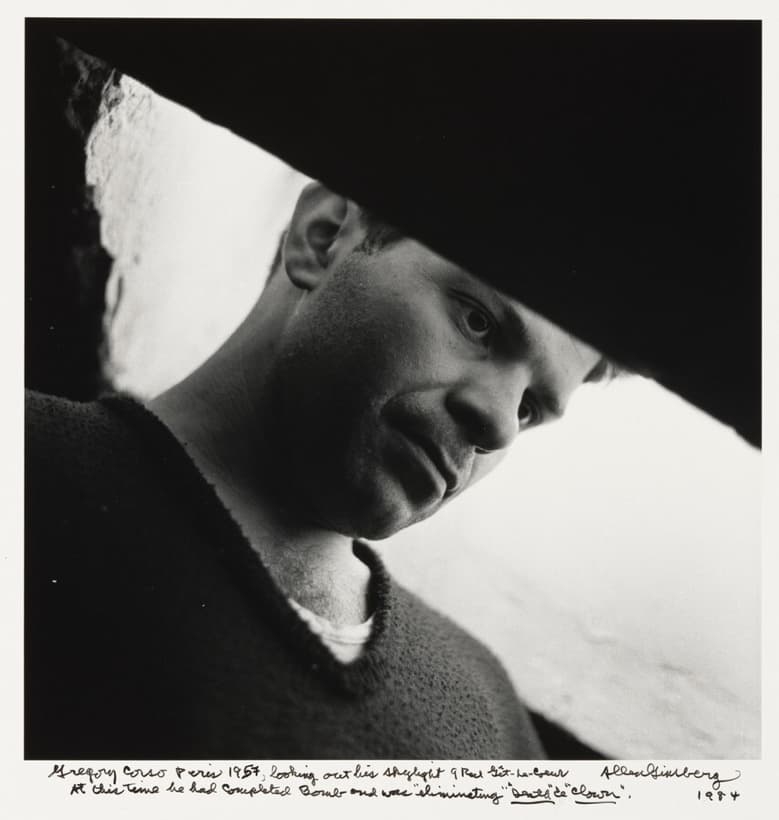
Allen Ginsberg had captioned a different negative from the same skylight in 1984, on the print now numbered 2010.137.15. That caption ran to twenty-five words: Gregory Corso had completed "Bomb" and was eliminating Death and Clown.
This caption, written about eleven years afterwards, opens from the same sentence and then keeps going. It adds the geography: half a block from the Seine, off the place Saint-Michel. It adds the book Gasoline and its publisher, the poems "Marriage" and "Power", and a gloss on what eliminating meant. It adds a citation to the 1960 volume where the poems landed, and the floor Allen Ginsberg and Peter Orlovsky lived on.
The core claim survives intact across the two captions and the eleven years: Gregory Corso was cutting Death and Clown out of his work. What grows around it is bibliography. By 1995 Allen Ginsberg is writing footnotes on his own snapshots, complete with a see reference.
The caption says Gregory Corso is looking out his attic-room skylight. In the frame his head is tilted back and his mouth is open, and he is putting something small into it. Nothing suggests he is looking at anything.
The dark cluster in his lower hand and the single dark object at his lips read as food. The print gives no way to identify it further, and the caption does not mention it at all.
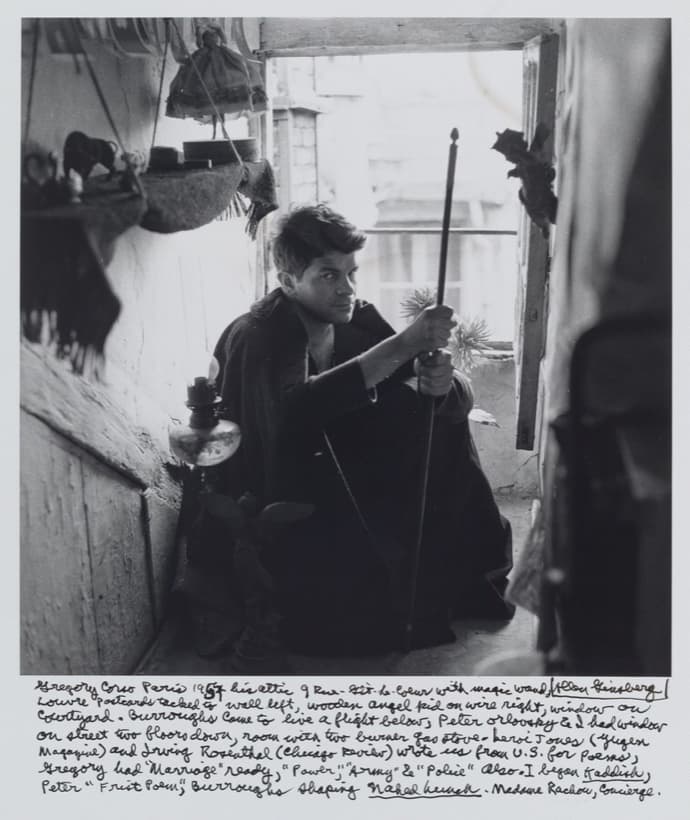
The pinned pictures on the wall behind him are the only decoration the room shows in any of Allen Ginsberg's four Paris frames. Neither this caption nor the others describes them, though the caption on 2012.118.58 asserts Louvre postcards tacked to a wall the frame does not show.
The verso carries the rubber stamp Allen Ginsberg had made for his photographs, reading "Photograph By Allen Ginsberg COPYRIGHT 1994 NYC ALL RIGHTS RESERVED" with a fax number. The stamp is dated 1994, the year before this print was signed.
Beside it, in graphite in his own hand: Signed 4/28/95 AG. The museum records the print date as 1995 on that evidence, rather than inferring it.
The collection marks PF 45139H, GD-AG-64 and GDC-954 also appear on the verso. They are the reference numbers of the Davis collection through which the print reached Washington.
The focus plane sits on the raised hand and the mouth, not on the eye. The eye is soft, the wall behind is a blur, and grain is coarse enough to be visible across the shadow areas at any reproduction size.
The hand also blocks a third of the face. Allen Ginsberg made the exposure while Gregory Corso was eating, which is why the composition is arranged around a gesture rather than a pose.
Printed large — the image is square and fourteen inches on a side — none of that is hidden. The 1995 print treats an ordinary domestic moment at full exhibition scale, and the caption beneath it treats the same moment as literary history.
Close reading
Follow the light down from the roof slope to the raised hand, and notice what the sitter is actually doing before reading the caption, which describes him doing something else and then lists nine years of publishing around it.
1.The open mouth
The mouth is open and the chin is lifted. The light strikes the forehead and the ridge of the nose and stops; the eye socket beneath the brow is dark. The focus plane does not sit on the eye, which is soft, but further forward on the hand.
2.The hand at the lips
The hand is where the focus is. Thumb and forefinger hold a small dark object at the lips, and the raking light picks out every tendon on the back of the hand. Gregory Corso is eating. No part of the caption mentions food.
3.The other hand, holding a cluster
A second hand, lower in the frame, holding a cluster of small round forms. It reads as a bunch of fruit, and it is the source of the object he is lifting to his mouth. The print gives no way to identify it further, and the darkness around it holds no detail.
4.Pictures pinned to the wall
Two rectangles, both well out of focus, both clearly images pinned or taped to the wall. They are the only decoration visible on any wall in Allen Ginsberg's four Paris frames. The caption on 2012.118.58 asserts Louvre postcards tacked to a wall the frame does not show; these are the pictures the room actually gives up.
5.The roof slope across the top
The straight diagonal above his head is the underside of the roof, running down towards the left. It is the only evidence of the attic's shape in the frame, and it is what places the light source above and slightly behind the sitter.
6.The caption's opening and its geography
Four lines, starting with the claim that he is looking out his skylight. The word eliminating is broken across the second and third lines as elim- and inating, and its opening quotation mark has been written above the end of the second line because there was no room beside the word.
7.Six underlined titles
Six titles take underlines in four lines: Gasoline, Marriage, Bomb, Death, Clown and Happy Birthday of Death. The underlines are drawn after the words, in the same ink, and several run past the last letter. The bracketed gloss — i.e. Probing Concepts — is Allen Ginsberg explaining his own shorthand in his own caption.
8.The close, and the signature
The caption ends on the place and the year, Paris 1957, so the negative's date is the last thing before the signature. Two abbreviations save space in the closing sentence: Peter O for Peter Orlovsky, and 3'd for third. The signature sits below the last line at the right, in the same ink.
1957
The negative is exposed under the attic skylight at 9 rue Gît-le-Cœur, where Gregory Corso had the top floor and Allen Ginsberg and Peter Orlovsky the third.
1984
Allen Ginsberg prints and captions a different negative from the same skylight, now 2010.137.15, with a twenty-five-word caption.
1994
He has the rubber stamp made that appears on the verso of this print: Photograph By Allen Ginsberg, COPYRIGHT 1994 NYC, ALL RIGHTS RESERVED.
1995
The print is made and signed. He notes the date on the verso in graphite: Signed 4/28/95 AG.
2011
The print enters the National Gallery of Art as 2011.146.39, a gift of Gary S. Davis, from the Allen Ginsberg Estate.
National Gallery of Art
Washington, United States
A public viewing address has not yet been confirmed for this holding.
The National Gallery of Art lists the print as not on view and states that the image is unavailable for download.
Eating. His head is tilted back, his mouth is open, and his right hand lifts a small dark object to his lips while his left holds a cluster of small round forms. Allen Ginsberg's caption describes him instead as looking out his attic-room skylight.
Four lines placing the room half a block from the Seine, off the place Saint-Michel. They then list Gregory Corso's work: Gasoline finished for City Lights, "Marriage" and "Bomb" completed, "Power" begun, and Death and Clown being eliminated. A reference to the 1960 volume The Happy Birthday of Death closes the list. It ends with Peter Orlovsky and Allen Ginsberg downstairs on the third floor, Paris 1957.
In 1995, thirty-eight years after the exposure. Allen Ginsberg noted the date on the verso in graphite as Signed 4/28/95 AG, and the National Gallery of Art records the object as 1957, printed 1995.
It starts from the same claim, that Gregory Corso was eliminating Death and Clown. It then adds street geography, a publisher, three more poem titles, a gloss on what eliminating meant, a citation to the 1960 book, and the floor Allen Ginsberg lived on. The 1984 caption is twenty-five words; this one is about four times as long.
A rubber stamp reading "Photograph By Allen Ginsberg, COPYRIGHT 1994 NYC, ALL RIGHTS RESERVED", with a fax number. It appears on versos throughout the National Gallery of Art's Allen Ginsberg holdings.
The image is square at 35.6 by 35.5 centimetres, fourteen inches on a side, on a sheet 50.4 by 40.5 centimetres. That is exhibition scale for a frame made on a small hand camera.
Depicts
Allen Ginsberg names the sitter in his own handwriting on the print, and the National Gallery of Art takes that caption as the object's title.
The sources below include collection records, catalogues, scholarly research, and primary materials that informed this page. They document Gregory Corso at His Attic-Room Skylight, its making, and its place in cultural history.
The museum's object record: title, negative and print dates, medium, dimensions, the full inscription including the verso stamp, credit line, accession number and provenance.
The National Gallery of Art's published collection data, which carries the same fields as structured values and marks the image not open access at a 900-pixel cap.
The 1984 print from a different negative under the same skylight, whose shorter caption this one expands.
The University of Toronto exhibition of the photographs, and the record of the eight thousand prints given by the Rossy Family Foundation.
These references provide the documented foundation for this work's history and interpretation. Claim-level citations remain attached to the specific claims they support.
 Explore more resources