Depicts
Gregory Corso
Allen Ginsberg names the sitter in his own handwriting on the print, and the National Gallery of Art takes that caption as the object's title.
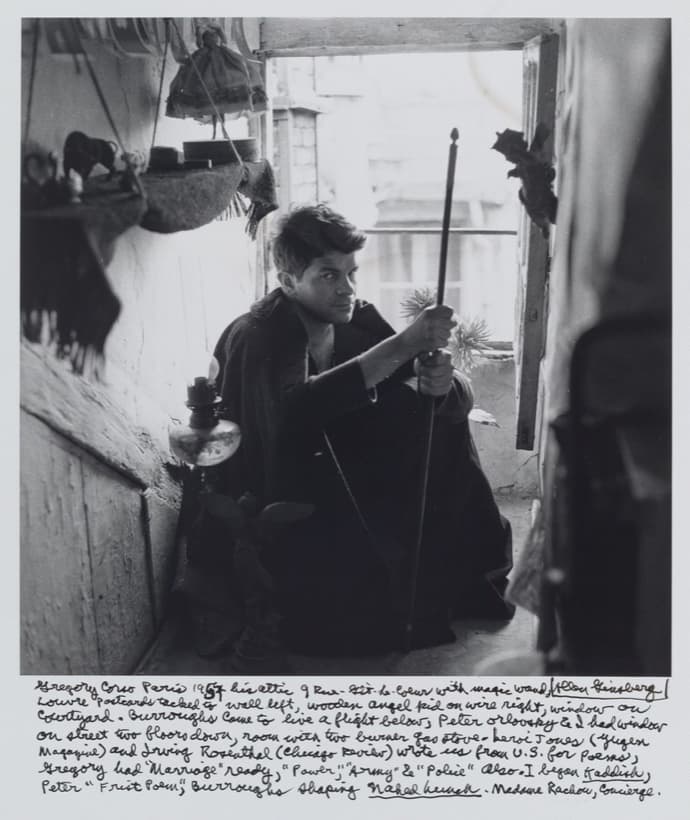
Gregory Corso sits on the floor of his Paris attic with a thin rod raised vertically in his left hand, looking up and away from the camera. Allen Ginsberg made the frame at 9 rue Gît-le-Cœur in 1957, on the same afternoon and from the same corner as another surviving exposure. He printed it decades later and wrote a seven-line caption in the border that names the hotel's concierge, two American magazine editors and four of Gregory Corso's poems. The National Gallery of Art owns the print as 2012.118.58.
Gregory Corso sits on the floor in the corner of an attic, knees up, in a dark coat with the collar turned high. His head is tipped back and turned to his left, past the camera, his mouth slightly open. His left hand is raised at the right of the frame, gripping a long thin rod that stands almost vertical.
A dried flower head with narrow spiky petals sits beside his raised hand at the sill. The glass oil lamp stands against the left wall by his shoulder, its chimney catching the light. Above and behind him a shelf carries a dark toy bull, a round tin, a flat box and a doll in a full crinoline skirt hanging on a string, with a fringed woven bag off the shelf's end.
The open casement window fills the upper right. Beyond it the courtyard is a white field with a pale building and two dark window openings barely holding together. The left wall is bare limewashed plaster with the shelf's shadow across it.
The print is square, 22.5 by 22.5 centimetres, on a sheet 35.3 by 27.5 centimetres. That is less than half the image area of the other surviving print from this corner.
Allen Ginsberg wrote the caption in seven lines of black ink under the image and signed it at the end of the first line rather than the last. The signature sits inside a hand-drawn rectangle, ruled on all four sides, which is unusual in this body of prints. The caption reads:
“Gregory Corso Paris 1957 his attic 9 Rue-Gît-Le-Coeur with magic wand, Louvre postcards tacked to wall left, wooden angel kid on wire right, window on courtyard. Burroughs came to live a flight below, Peter Orlovsky & I had window on street two floors down, room with two burner gas stove – Leroi Jones (Yugen magazine) and Irving Rosenthal (Chicago Review) wrote us from U.S. for poems, Gregory had "Marriage" ready, "Power," "Army" & "Police" also. I began Kaddish, Peter "Frist Poem," Burroughs shaping Naked Lunch. Madame Rachou, Concierge.”
Kaddish and Naked Lunch are underlined. The year is corrected on the print: the two digits of 57 are written over an earlier pair and stand out blacker and thicker than the rest of the line. The last four words, naming Madame Rachou, run to the very right edge of the sheet with no room to spare.
The hand is the same fast forward-sloping cursive as the other captioned prints, but the seven lines here are longer and set closer together, because the sheet is smaller and the text is nearly as long.
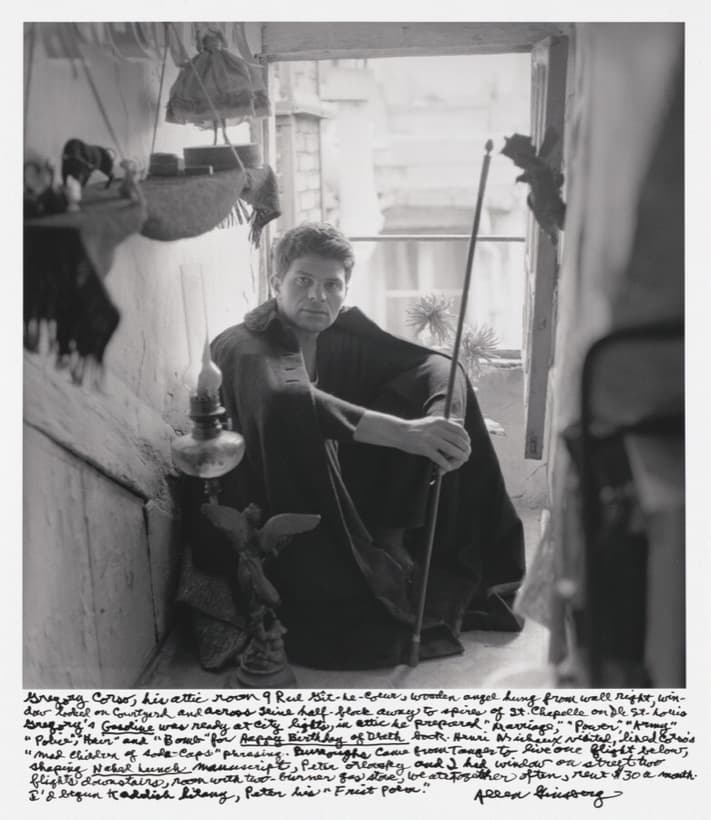
A second print in the National Gallery of Art, 2008.131.10, was made from a different negative shot in the same corner on the same occasion. The shelf, the oil lamp, the window and the coat are identical. In that frame Gregory Corso looks into the lens and holds the rod across his knees; here he looks away and holds it upright.
Allen Ginsberg captioned the two prints separately, and the captions do not match. The other one names Henri Michaux's visit, the poems "Hair" and "Bomb", the book The Happy Birthday of Death, a view to the Sainte-Chapelle and a rent of thirty dollars a month. This one names Louvre postcards, LeRoi Jones and Yugen, Irving Rosenthal and the Chicago Review, and Madame Rachou.
Both captions call the object in his hand something different. This one calls it a magic wand. The other does not name it at all.
Reading them side by side is the clearest available demonstration of what these captions are. They are not descriptions of negatives. They are separate acts of recall, written years apart from the same afternoon, and each one keeps a different set of facts.
The caption states that Louvre postcards were tacked to the wall on the left. Nothing in the print resolves into a postcard. The left wall below the shelf is bare limewashed plaster, cracked and unadorned, and the dark curved shapes along the top edge of the frame are the underside of the shelf, the hanging bag and their shadows.
Whether the postcards were out of frame, or on a part of the wall the exposure lost, or remembered from a different week, the print cannot say. The caption asserts them and the picture does not carry them.
The same room does hold pinned-up pictures in another of Allen Ginsberg's frames from 9 rue Gît-le-Cœur, 2011.146.39, where two pale rectangles with images inside them are visible on the wall behind Gregory Corso, well out of focus.
Madame Rachou kept 9 rue Gît-le-Cœur. Allen Ginsberg gives her the last four words of the caption and the job title Concierge, and no other sentence in it.
LeRoi Jones edited Yugen in New York, and Irving Rosenthal edited the Chicago Review. The caption has them writing to Paris for poems, which places the attic inside a working transatlantic magazine circuit rather than outside one.
The poems named as ready or under way — "Marriage", "Power", "Army" and "Police" — are Gregory Corso's. Kaddish is Allen Ginsberg's own, begun in this building. "Frist Poem" is Peter Orlovsky's, spelled as Peter Orlovsky spelled it. Naked Lunch is William S. Burroughs's, in manuscript a floor below.
Allen Ginsberg puts himself third in his own caption, after Gregory Corso and William S. Burroughs, and gives himself four words.
The National Gallery of Art dates the negative 1957 and the print later, without a year. The verso carries a crossed-out negative reference, BK5#27, and the year 1957 in graphite, alongside the collection marks GD-AG-087 and GDC-613.
The print entered the museum in 2012 as a gift of Gary Davis, who had bought it from the Allen Ginsberg Estate. It is one of roughly four hundred Allen Ginsberg photographs the museum catalogues, nearly all of them from the same donor across gifts made between 2008 and 2018.
The object record carries no exhibition history, and the museum lists the print as not on view.
Close reading
This frame and the one at 2008.131.10 were made minutes apart in the same corner. Look at what moved — the head, the arm, the rod — and then at the seven lines of caption, which keep an entirely different set of facts about the same afternoon.
1.Looking away from the camera
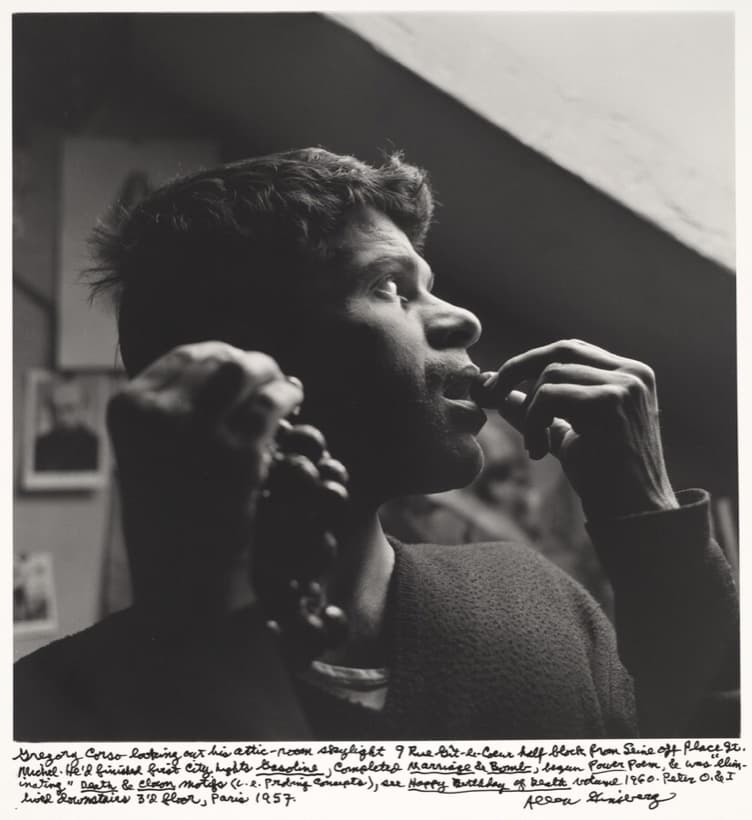
The same face as the companion print, turned away. His chin is lifted, his eyes are directed up and past the lens, and his mouth is slightly open. In the other frame he looks straight into the camera. That difference is the whole difference between the two exposures, and neither caption mentions it.
2.The rod raised
The rod is upright here, held in the left hand at about shoulder height, where in the other frame it lies across his knees. The dried flower head sits directly beside the knuckles. Allen Ginsberg's caption calls the object a magic wand; the caption on the companion print does not name it at all.
3.The left wall the caption furnishes
Nothing is tacked to this wall. The caption states that Louvre postcards were tacked to the wall on the left, and the left wall in the frame is bare plaster with a shelf shadow across it. Whether the postcards were out of frame or remembered from another week, the print cannot say.
4.The same shelf, the same doll
Identical to the companion print, object for object, which is the clearest proof the two exposures belong to one sitting. Above the shelf a row of dark curved shapes runs along the top edge of the frame; they are the undersides of the hanging objects and their shadows, and none of them resolves into a postcard.
5.The window and what survives outside it
This frame keeps slightly more of the courtyard than the companion does. A pale wall and two dark window openings survive in the glare, and the roofline reads. Everything else outside is white paper. Allen Ginsberg made no attempt to hold the highlight when he printed the negative thirty years later.
6.The oil lamp from a lower angle
The lamp stands in the same place as in the companion print, but the camera is a little lower and further back, so more of the wall behind it shows. The chimney glass takes a hard highlight down one side. The carved figure at its base is in deeper shadow here and reads only as a dark mass.
7.The corrected year
The two digits after 19 are written over an earlier pair and stand out blacker and thicker than any other characters in the caption. Allen Ginsberg corrected the year on the sheet. The museum records the negative as 1957, which is what the corrected digits now read.
8.The editors in the middle of the band
Two editors and two magazines in one line and a half, each name followed by its journal in round brackets: LeRoi Jones with Yugen, Irving Rosenthal with Chicago Review. The brackets are the only punctuation in the caption doing structural work. The lines here sit closer together than on the larger prints, because the sheet is smaller and the text is nearly as long.
9.The signature inside a drawn box
The signature is ruled into a box. Allen Ginsberg drew a rectangle around his own name on all four sides and underlined the name inside it, at the end of the first line rather than at the foot of the caption. Six lines below, the caption closes on Madame Rachou, Concierge — four words that reach the right edge of the sheet with nothing to spare.
1957
The negative is exposed in Gregory Corso's attic at 9 rue Gît-le-Cœur, from the same corner as 2008.131.10 and on the same occasion.
1984 onward
Allen Ginsberg prints the old negatives and writes captions in the borders; Howard Greenberg Gallery places almost all of the captioned prints between 1984 and 1996.
1994
He has a rubber stamp made reading "Photograph By Allen Ginsberg COPYRIGHT 1994 NYC ALL RIGHTS RESERVED", which appears on the versos of prints across the National Gallery of Art group.
2012
The print enters the National Gallery of Art as 2012.118.58, a gift of Gary Davis, from the Allen Ginsberg Estate.
National Gallery of Art
Washington, United States
A public viewing address has not yet been confirmed for this holding.
The National Gallery of Art lists the print as not on view and states that the image is unavailable for download.
A long thin rod, raised almost vertical in his left hand. Allen Ginsberg's handwritten caption calls it a magic wand. His caption on the companion print from the same afternoon, 2008.131.10, does not name the object at all.
Seven lines in Allen Ginsberg's hand naming the room at 9 rue Gît-le-Cœur, Louvre postcards on the left wall, a wooden angel on a wire, William S. Burroughs a flight below shaping Naked Lunch, Peter Orlovsky and Allen Ginsberg two floors down, LeRoi Jones and Irving Rosenthal writing from the United States for poems, four Gregory Corso poems, and Madame Rachou, the concierge.
No. The left wall in the frame is bare limewashed plaster, cracked and empty below the shelf, and nothing in the print resolves into a postcard. The caption asserts them; the photograph does not carry them.
The woman who kept 9 rue Gît-le-Cœur, the cheap hotel where Allen Ginsberg, Peter Orlovsky, Gregory Corso and William S. Burroughs all had rooms. Allen Ginsberg gives her the closing words of the caption and the title Concierge.
The image is square at 22.5 by 22.5 centimetres, on a sheet of 35.3 by 27.5 centimetres. The companion print from the same corner is more than twice the area, at 35.6 by 35.5 centimetres.
The National Gallery of Art in Washington owns it as 2012.118.58, a gift of Gary Davis. The museum lists it as not on view and does not offer the image for download.
Depicts
Allen Ginsberg names the sitter in his own handwriting on the print, and the National Gallery of Art takes that caption as the object's title.
The sources below include collection records, catalogues, scholarly research, and primary materials that informed this page. They document Gregory Corso with a Magic Wand, its making, and its place in cultural history.
The museum's object record: title, date, medium, dimensions, inscription, credit line, accession number and provenance.
The National Gallery of Art's published collection data, which carries the same fields as structured values and marks the image not open access at a 900-pixel cap.
The companion print from the same corner, whose caption keeps a different set of facts about the same afternoon.
The representing gallery's account of the captioning practice and its 1984–1996 span.
The book-length account of 9 rue Gît-le-Cœur and the writers who lodged there between 1957 and 1963.
These references provide the documented foundation for this work's history and interpretation. Claim-level citations remain attached to the specific claims they support.
 Explore more resources