Depicts
Gregory Corso
Allen Ginsberg names the sitter in his own handwriting on the print, and the National Gallery of Art takes that caption as the object's title.
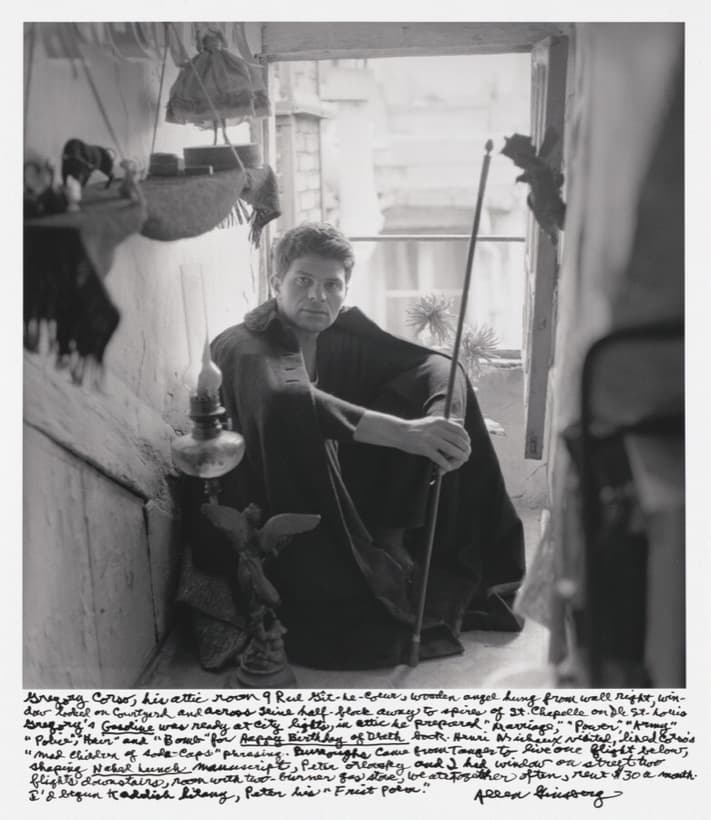
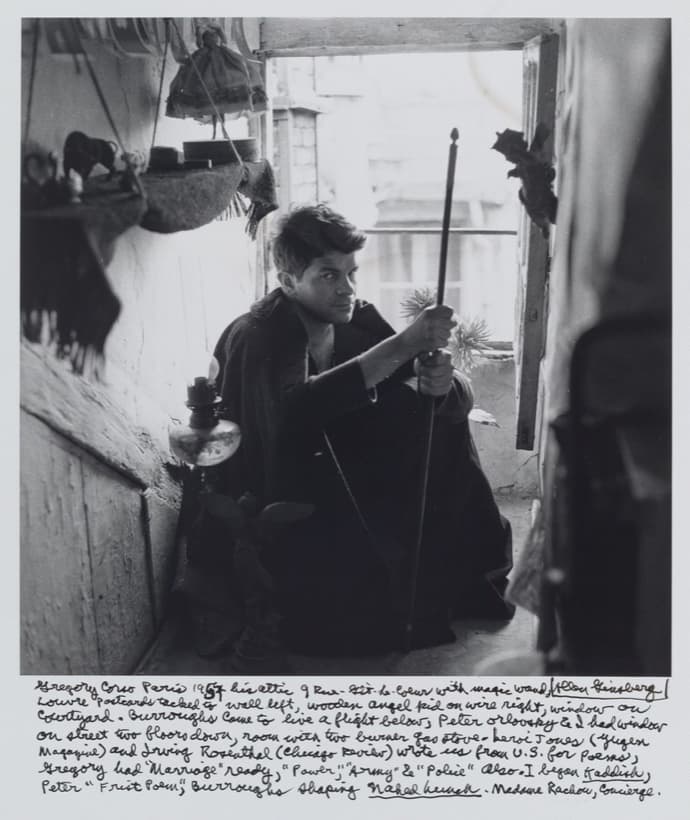
Gregory Corso sits on the floor in the corner of a Paris attic, wrapped in a dark coat, holding a long thin rod across his knees. Allen Ginsberg made the exposure in 1957 at 9 rue Gît-le-Cœur, the cheap hotel in the 6th arrondissement where he, Peter Orlovsky, William S. Burroughs and Gregory Corso all lived. He printed it decades afterwards and wrote a caption of about ninety words in ink along the white border beneath the picture. The National Gallery of Art owns the print as 2008.131.10.
Gregory Corso sits on the floor in a corner, knees drawn up, looking straight into the lens. He wears a dark coat with a high collar over a ribbed knit, and heavy boots. A long thin rod crosses his body from lower left to upper right, its tip near the open window; his right hand grips it about halfway along.
A shelf juts from the left wall above his head. A dark toy bull stands on it beside a round tin and a flat box, a small doll in a full skirt hangs on a string above, and a fringed woven bag hangs off the shelf's right end. A glass oil lamp with a tall chimney stands against the wall at his left shoulder, and a small carved winged figure stands at its base.
The casement window is open at the right. Its frame is bare wood with the paint flaking off, and a second dark winged shape is fixed to the jamb. Outside there is no detail at all: the courtyard wall has burned out to blank white paper, with a washing line crossing it and a roofline above.
The print is square, 35.6 by 35.5 centimetres, on a sheet 50.2 by 40.5 centimetres. Below the image the white border carries eight lines of handwriting and a signature.
Allen Ginsberg wrote the caption by hand in black ink across the bottom border, in eight lines running the full width of the sheet, and signed it below and to the right of the last line. He wrote it decades after the exposure. It reads:
“Gregory Corso, his attic room 9 Rue Git-le-Coeur, wooden angel hung from wall right, window looked on courtyard and across Seine half-block away to spires of St. Chapelle on Ile St. Louis. Gregory's Gasoline was ready at city lights, in attic he prepared "Marriage," "Power," "Army," "Police," "Hair" and "Bomb" for Happy Birthday of Death book. Henri Micheaux visited, liked Corso's "mad children of soda-caps" phrasing. Burroughs came from Tanger to live one flight below, shaping Naked Lunch manuscript, Peter Orlovsky and I had window on street two flights downstairs, room with two-burner gas stove, we ate together often, rent $30 a month. I'd begun Kaddish litany, Peter his "Frist Poem."”
Three titles are underlined in the hand: Gasoline, Happy Birthday of Death and Naked Lunch. The word Kaddish is gone over twice, so it sits noticeably blacker and heavier than the words on either side of it.
The writing is a fast, legible cursive with almost no ascender loops, sloping slightly forward, and it keeps its line straight without a ruled guide. Allen Ginsberg fits the text by compressing rather than by abbreviating: the lines get tighter towards the bottom and the last one ends early, leaving room for the signature.
The caption is not a title. It is a paragraph of literary history, written from memory, that names six poems, three books, a monthly rent and a visiting poet — none of which a viewer could get from the picture.
Two of its claims can be checked against the frame. Allen Ginsberg writes of a wooden angel hung from the wall on the right. The print holds two carved winged figures: one fixed to the window jamb at the right, and a second standing at the foot of the oil lamp on the left. He writes that the window looked across the Seine to the spires of the Sainte-Chapelle on the Île Saint-Louis; the Sainte-Chapelle stands on the Île de la Cité, and carries a single spire. Nothing outside the window survives the exposure in any case.
The National Gallery of Art transcribes the street as Rue Git-de-Coeur in its inscription field. The handwriting on the print reads Git-le-Coeur, which is the street's actual name.
The surname of the visiting poet is written quickly and the museum transcribes it Micheaux. The poet it refers to is Henri Michaux, the Belgian-born writer who lived in Paris.
Peter Orlovsky's "Frist Poem" is not a slip of Allen Ginsberg's pen. It was Peter Orlovsky's own spelling of his title, and Allen Ginsberg carried it into the caption unaltered.
Allen Ginsberg bought a second-hand Kodak Retina at a pawnshop on the Bowery in 1953. He recorded the purchase in two other captions in the same National Gallery of Art group, one calling it "Kodak Retina new-bought 2'd hand from Bowery hock-shop" and another "my $13.00 Kodak Retina pawn-shop camera". The Retina was a folding 35 mm camera with a fixed lens, made for snapshots.
He photographed his friends with it for about a decade, then stopped. Howard Greenberg Gallery, which represents the work, records that he lost the camera and did not return to photography for roughly twenty years. The gallery also records that the prints and negatives sat unseen until a cataloguer found them among the personal papers he had given Columbia University.
The cataloguer is named in another of Allen Ginsberg's own captions. Writing about Raymond Foye in 1991, he records that Raymond Foye "catalogued my photo negatives '47-'85, curated first photo show". That first show opened at the Holly Solomon Gallery in New York in January 1985, as a further caption in the same collection records.
Robert Frank, an old friend, advised him to use better cameras when he began again. The captioned prints date almost entirely from 1984 to 1996, and the printing was largely done by Sid Kaplan, whose name appears in graphite on the versos throughout the National Gallery of Art group.
The National Gallery of Art dates the negative to 1957 and the print simply to later, without naming a year. The two dates are decades apart and the museum keeps them separate on the object record.
The print came to Washington in 2008 as a gift from Ellen and Gary Davis of Greenwich, Connecticut, who had acquired it from the Allen Ginsberg Estate through Howard Greenberg Gallery in New York. Gary Davis gave the museum roughly four hundred Allen Ginsberg photographs across a run of gifts from 2008 to 2018.
It hung in Beat Memories: The Photographs of Allen Ginsberg as number 64. That exhibition opened at the National Gallery of Art and travelled to the Grey Art Gallery and Study Center at New York University and to the Contemporary Jewish Museum in San Francisco, running from 2010 to 2013.
The National Gallery of Art lists the print as not on view.
The technical facts of the picture are the facts of an amateur exposure made indoors on a small camera. The window burns out completely, so the courtyard reads as bare white paper. The shadowed left wall holds tone, but the objects on the shelf fall away into a soft grey with no edge to them.
Focus sits on Gregory Corso's face and the coat around it. The shelf above him and the flowers on the sill are out of focus in both directions. Grain is visible across the whole frame at any size.
Allen Ginsberg did not correct any of this when he printed the negative thirty years later. The blown highlight stayed blown, and the caption he added takes the picture as evidence of an afternoon rather than as a made object.
Close reading
Read the print in two halves. Look first at the room — the face, the two carved winged figures, the oil lamp, the shelf of objects and the window that has burned to white — and then at the eight lines of handwriting below it, which claim far more than the room can show.
1.Gregory Corso looking into the lens
One face, and it is the only thing in the frame in sharp focus. Gregory Corso was twenty-seven. He looks straight down the lens, mouth closed, with no expression that reads as posed. The coat collar stands up around his neck and a spiky dried flower head sits on the sill at the right of his head, level with his ear.
2.The winged figure on the window jamb
This is the wooden angel the caption names. It is fixed to the right-hand jamb of the open casement, small and almost in silhouette, with its wings spread. The rod Gregory Corso holds rises past it and ends in a rounded knob, which is the only part of the object that gives any support to the word wand.
3.The oil lamp and a second carved figure
Two objects, not one. The lamp is a paraffin lamp with a pressed-glass bowl, a metal burner and a tall chimney, and it stands on the floor against the wall rather than on a table. Below it a second carved figure with spread wings stands at the base. The caption names one wooden angel; the frame holds two winged carvings, and this is the one it leaves out.
4.The shelf above his head
Four objects and a doll. The bull stands at the left with its head down, a round tin and a flat box sit at the centre, and a doll in a full ruffled skirt hangs on a string so that its feet rest on the box. The fringed bag hangs off the right end. Nothing on the shelf is in focus; the whole group is a soft grey with no hard edges anywhere.
5.The courtyard, burned to white
The exposure was set for the shadowed interior, so everything beyond the glass is gone. One horizontal line survives, a rail or a washing line, and a roofline shows at the top. The caption says the window looked across the Seine to the spires of the Sainte-Chapelle. No view of any kind reaches the print.
6.The hand on the rod
One hand, gripping about halfway along. The pale cuff shows that a shirt is worn under the coat, which the rest of the frame keeps hidden. The rod is thin and even along its length, with no ornament except the knob at the far end, and the hand holds it loosely rather than brandishing it.
7.The caption's left margin, all eight lines
Eight lines, each starting hard against the left margin with no indent. Two underlines are visible in this third of the band, under Gasoline on line three and under Naked Lunch on line six. On the last line the word Kaddish has been retraced so heavily that it is twice the weight of the words around it. The street reads Git-le-Coeur, which is what the street is called; the museum's own transcription gives Git-de-Coeur.
8.The caption's middle, and the poems
The middle of the band carries the bibliography. Six poem titles run through it in quotation marks, and the book title Happy Birthday of Death takes a single long underline. City Lights is written in lower case as city lights, which the museum transcribes with capitals. The writing stays level line to line without any ruled guide under it.
9.The right end, and the signature
The last words of each line run almost to the edge of the sheet. Line seven ends on a figure — rent $30 a month — and line eight ends on Peter Orlovsky's title, spelled Frist Poem as Peter Orlovsky spelled it. The signature sits below and to the right on a line of its own, finished with a long horizontal stroke that loops back under the name.
1953
Allen Ginsberg buys a second-hand Kodak Retina at a Bowery pawnshop in New York for thirteen dollars, according to two of his own later captions.
1957
The negative is exposed in Gregory Corso's attic room at 9 rue Gît-le-Cœur in Paris, the date the National Gallery of Art assigns the picture.
1984
Allen Ginsberg begins printing the old negatives and writing captions in the borders. Howard Greenberg Gallery dates almost all the captioned prints between 1984 and 1996.
1985
His first photography exhibition opens at the Holly Solomon Gallery on 57th Street and Fifth Avenue in New York in January, curated by Raymond Foye.
2008
The print enters the National Gallery of Art as 2008.131.10, a gift of Gary S. Davis, acquired from the Allen Ginsberg Estate through Howard Greenberg Gallery.
2010–13
Shown as number 64 in Beat Memories: The Photographs of Allen Ginsberg, National Gallery of Art, then the Grey Art Gallery and Study Center and the Contemporary Jewish Museum.
National Gallery of Art
Washington, United States
A public viewing address has not yet been confirmed for this holding.
The National Gallery of Art lists the print as not on view and states that the image is unavailable for download.
In the top-floor room Gregory Corso rented at 9 rue Gît-le-Cœur in the 6th arrondissement of Paris, half a block from the Seine near the place Saint-Michel. Allen Ginsberg and Peter Orlovsky had a room two floors below, and William S. Burroughs took one a flight under Gregory Corso's. The National Gallery of Art dates the negative 1957.
It is a caption of about ninety words in Allen Ginsberg's hand, written in ink across the white border years after the exposure. It names the room, a wooden angel, the view towards the Seine, six poems Gregory Corso was preparing, a visit from Henri Michaux, William S. Burroughs working on Naked Lunch a flight below, and a rent of thirty dollars a month.
A Kodak Retina, a folding 35 mm snapshot camera, bought second-hand at a Bowery pawnshop in New York in 1953. Two of his other captions in the same National Gallery of Art collection name the camera and the thirteen dollars he paid for it.
Because the negative and the print were made decades apart. Allen Ginsberg exposed the frame in 1957, put his photographs away for about twenty years, and printed and captioned this one much later. The National Gallery of Art records the date as 1957, printed later.
The National Gallery of Art in Washington, as accession number 2008.131.10, a gift of Gary S. Davis. The museum lists it as not on view and does not offer the image for download.
Two things. Allen Ginsberg places the Sainte-Chapelle on the Île Saint-Louis, when it stands on the Île de la Cité, and he describes one wooden angel where the frame holds two carved winged figures. The museum's own transcription also misreads the street as Rue Git-de-Coeur; the handwriting reads Git-le-Coeur.
Depicts
Allen Ginsberg names the sitter in his own handwriting on the print, and the National Gallery of Art takes that caption as the object's title.
The sources below include collection records, catalogues, scholarly research, and primary materials that informed this page. They document Gregory Corso in His Attic Room, its making, and its place in cultural history.
The museum's object record: title, date, medium, dimensions, inscription, credit line, accession number, provenance, exhibition history and copyright line.
The National Gallery of Art's published collection data, which carries the same fields as structured values and marks the image not open access at a 900-pixel cap.

The 2010 exhibition that gathered the captioned prints, and the checklist number the object record cites.
The representing gallery's account of the lost camera, the twenty-year gap, the negatives found at Columbia University, Robert Frank's advice and the 1984–1996 span of the captioned prints.
The Columbia University archive of personal papers in which the negatives were catalogued.
These references provide the documented foundation for this work's history and interpretation. Claim-level citations remain attached to the specific claims they support.
 Explore more resources