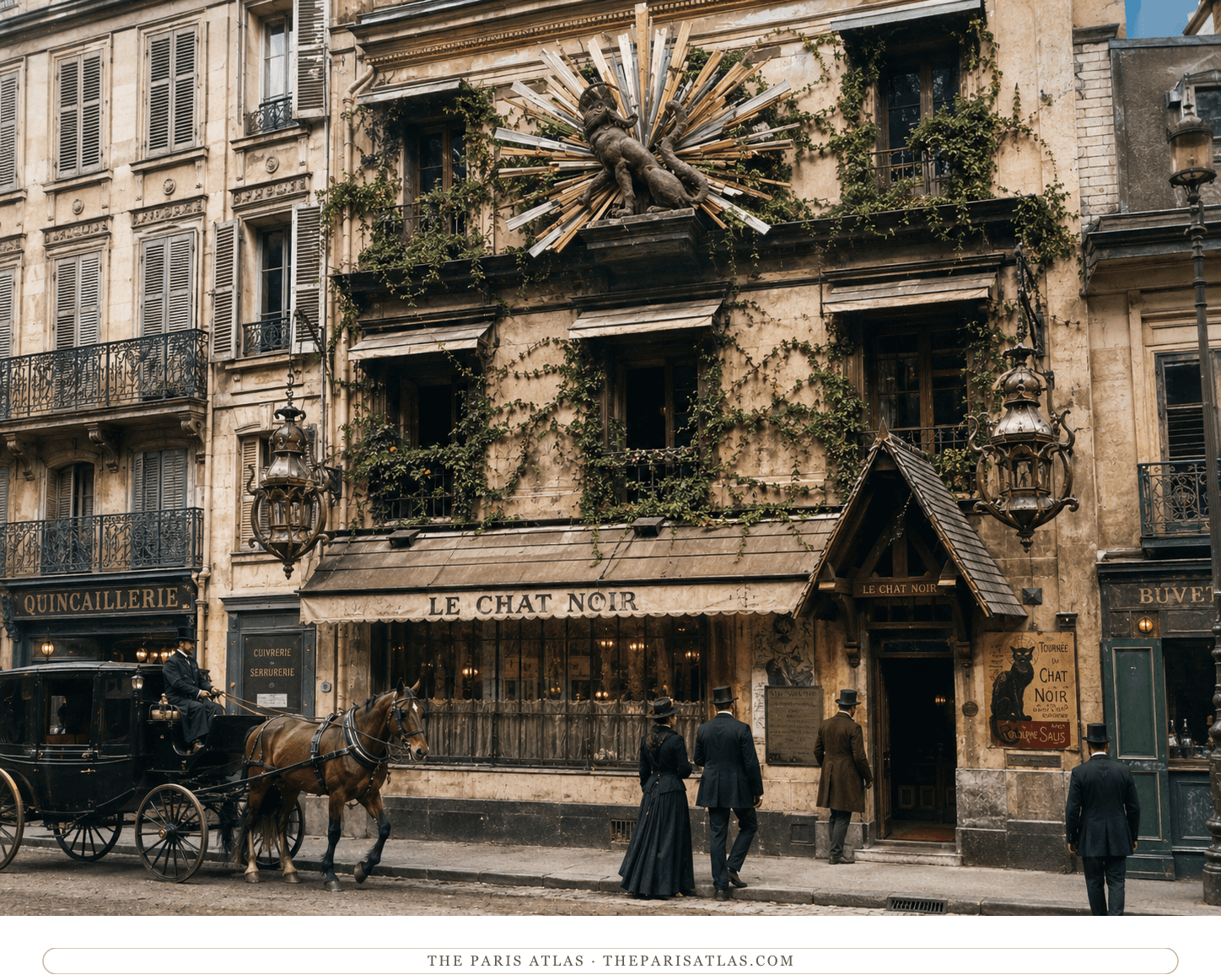
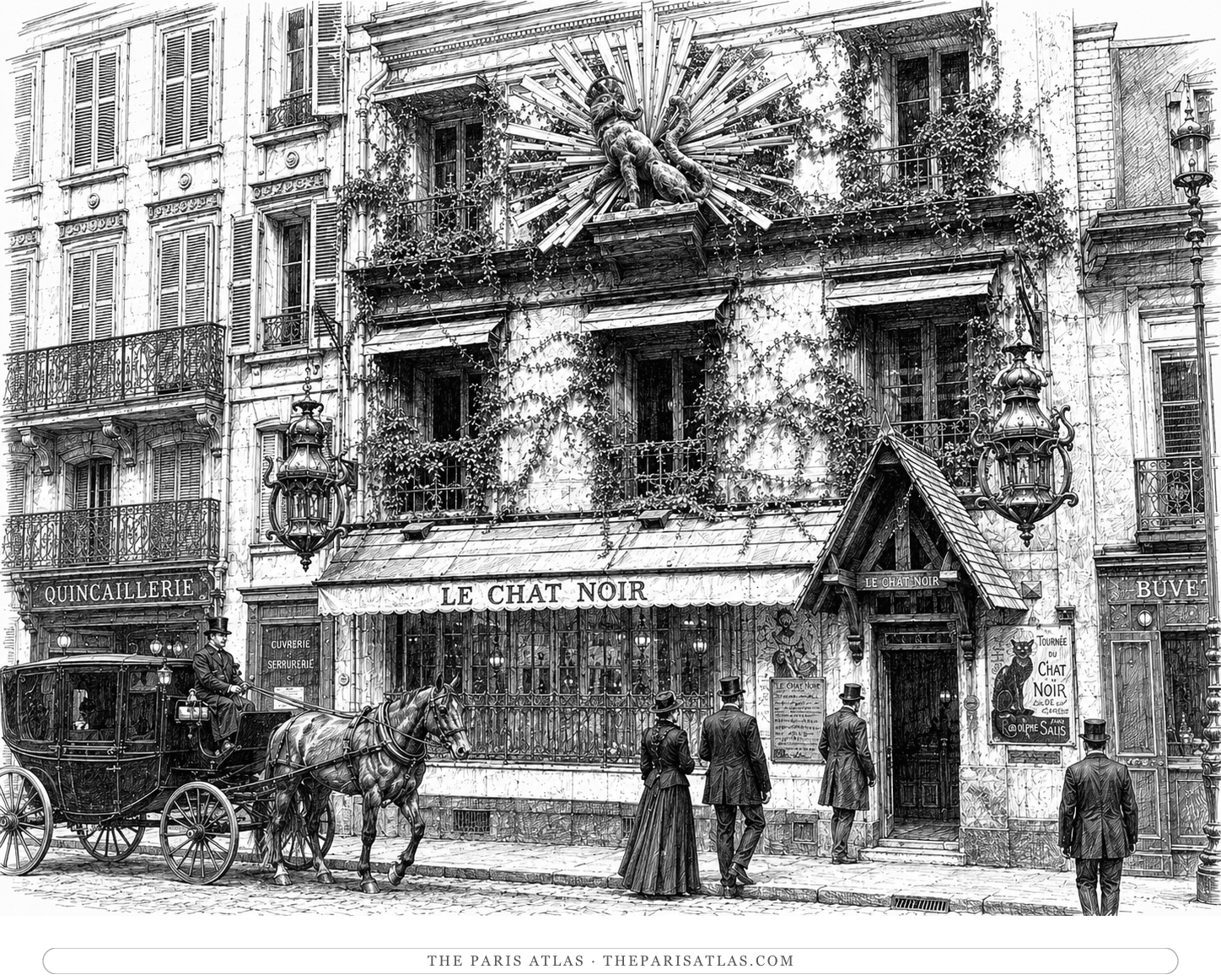
Rodolphe Salis was born in Châtellerault in the west of France in 1851 and moved to Paris as a young man, drifting through illustration, painting and a run of failed workshops before opening a room called Le Chat Noir at 84 boulevard de Rochechouart in Montmartre in November 1881. What he opened there is what the city's cabarets have been imitating ever since: not a café-concert with a stage at one end, but a densely furnished bourgeois interior loaded with painted signs, screens, mock-medieval oak, drawings pinned to the walls, and a proprietor who treated every customer as if they had wandered into a private literary reception in progress. Salis stood at the door in a Master of Ceremonies frock coat and addressed everyone as if they were minor royalty. The joke was the register.[1]
The room ran on regulars: the poet Émile Goudeau brought the Hydropathes literary circle across from the Latin Quarter and turned the back room into the Chat Noir's Wednesday reading nights. The illustrators André Gill, Adolphe Willette, Théophile-Alexandre Steinlen, Caran d'Ache and Henri Rivière became house artists. Aristide Bruant sang there in a red scarf until Salis got tired of him and sent him to open his own cabaret up the boulevard. The composer Erik Satie played piano; the poets Charles Cros, Jean Richepin, Alphonse Allais and Maurice Rollinat performed their own lines to a room that hissed them if the lines were bad. From 1882 the establishment published its own illustrated newspaper, Le Chat Noir, edited by Goudeau and later by Salis himself.[1]
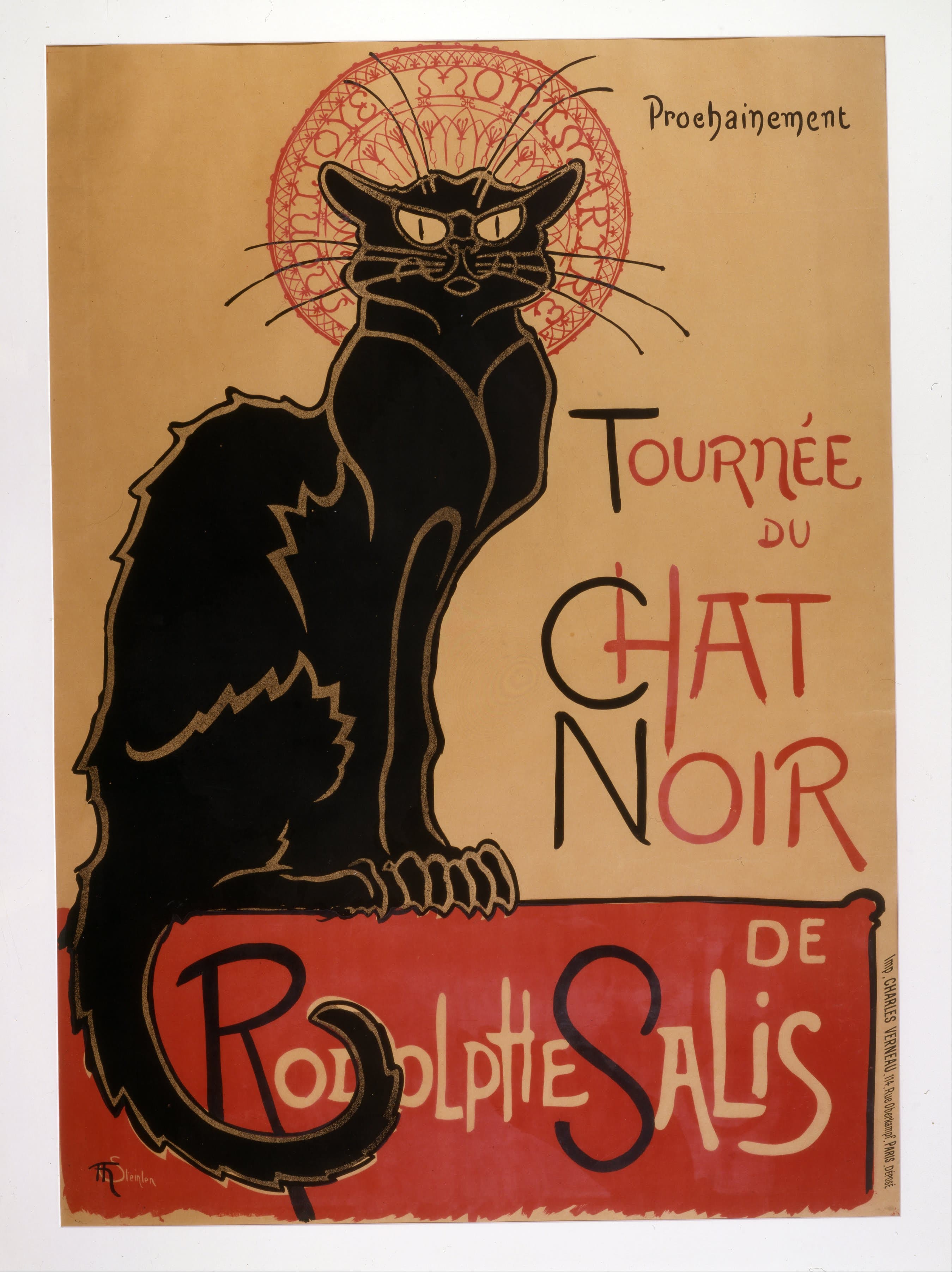
In 1885 the cabaret moved uphill to 12 rue de Laval (now rue Victor-Massé), a three-storey building that let Salis add the invention Le Chat Noir is most remembered for now — the shadow theatre. Henri Rivière and Caran d'Ache built increasingly elaborate zinc silhouette productions projected onto a small stage-frame from behind, with music by Satie and Georges Fragerolle and narration by the poets of the house. The most famous of them, Rivière's L'Épopée and La Marche à l'Étoile, ran for years. By the mid-1890s the shadow theatre and Salis's touring Compagnie du Chat Noir were the cabaret's biggest attraction, and it is that touring company that Steinlen's Tournée du Chat Noir de Rodolphe Salis of 1896 — the enormous poster with the yellow-eyed black cat — was drawn to advertise.[2]
Salis died in Naintré on 20 March 1897. Le Chat Noir closed with him; the building at 12 rue Victor-Massé was rebuilt, and every later establishment carrying the name is a different business. What survived him was the model: the master of ceremonies register, the mixed literary-visual-musical programming, the printed magazine as the venue's second body, the artist-designed advertising poster, and the phrase cabaret artistique itself. What the Musée d'Orsay's 2024–25 exhibition on Le Chat Noir made explicit was that Salis was not incidental to that model; he was the model, and the room emptied when he left it.[3]


 View source