
Inspired by · 1896
Rodolphe Salis
Salis commissioned the poster in 1896 for the Compagnie du Chat Noir's provincial tours; the sheet's full title, Tournée du Chat Noir de Rodolphe Salis, names him directly as the impresario the tour belongs to.
by Théophile-Alexandre Steinlen
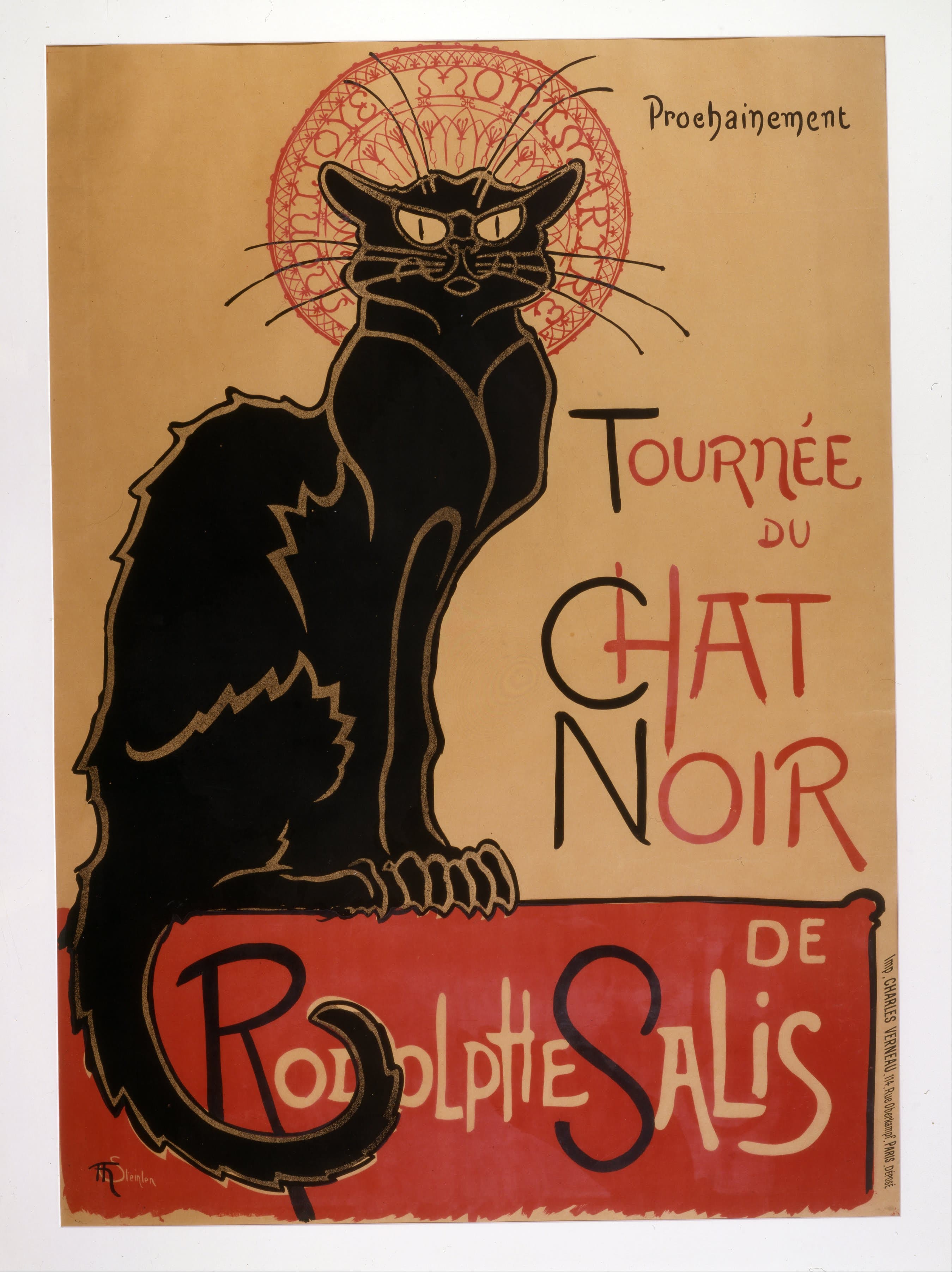
Théophile-Alexandre Steinlen's 1896 color lithograph, drawn for Rodolphe Salis's touring Chat Noir company: a black cat with yellow eyes, upright before a red halo and a gilded frame, set above the title Tournée du Chat Noir de Rodolphe Salis. Not a painting — a commercial advertising poster, and the most reproduced Belle Époque image after Toulouse-Lautrec's Moulin Rouge sheets.
A black cat, upright and confrontational, seen from the front. Its ears are pricked, its yellow eyes are wide, and its whiskers fan out flat across the picture plane. Behind the cat, a flat red disc reads as either a halo or the setting sun; behind that, a gilded frame the colour of old varnish, painted to look as if it were a proper museum picture. Below the cat, a Gothic-lettered title panel names the company being advertised: Tournée du Chat Noir de Rodolphe Salis.[1]
The whole design is flat, unmodelled, and reads as a piece of shop signage rather than an oil painting — because that is exactly what it was. It is a commercial advertising lithograph, printed in large runs and pasted on the walls of Paris and the provincial towns the Compagnie du Chat Noir was scheduled to visit.
The French phrase does not name a painting called "The Journey of the Black Cat." It is a tour announcement.[1]
Word by word: Le Chat Noir means "The Black Cat." Tournée means "tour" or "touring engagement," the same word English uses when a theatre company goes on tour. Tournée du Chat Noir de Rodolphe Salis translates as "Tour of Rodolphe Salis's Chat Noir" — the poster is announcing that Salis's Chat Noir company (its singers, its shadow-theatre performers, its poets) is coming to town.
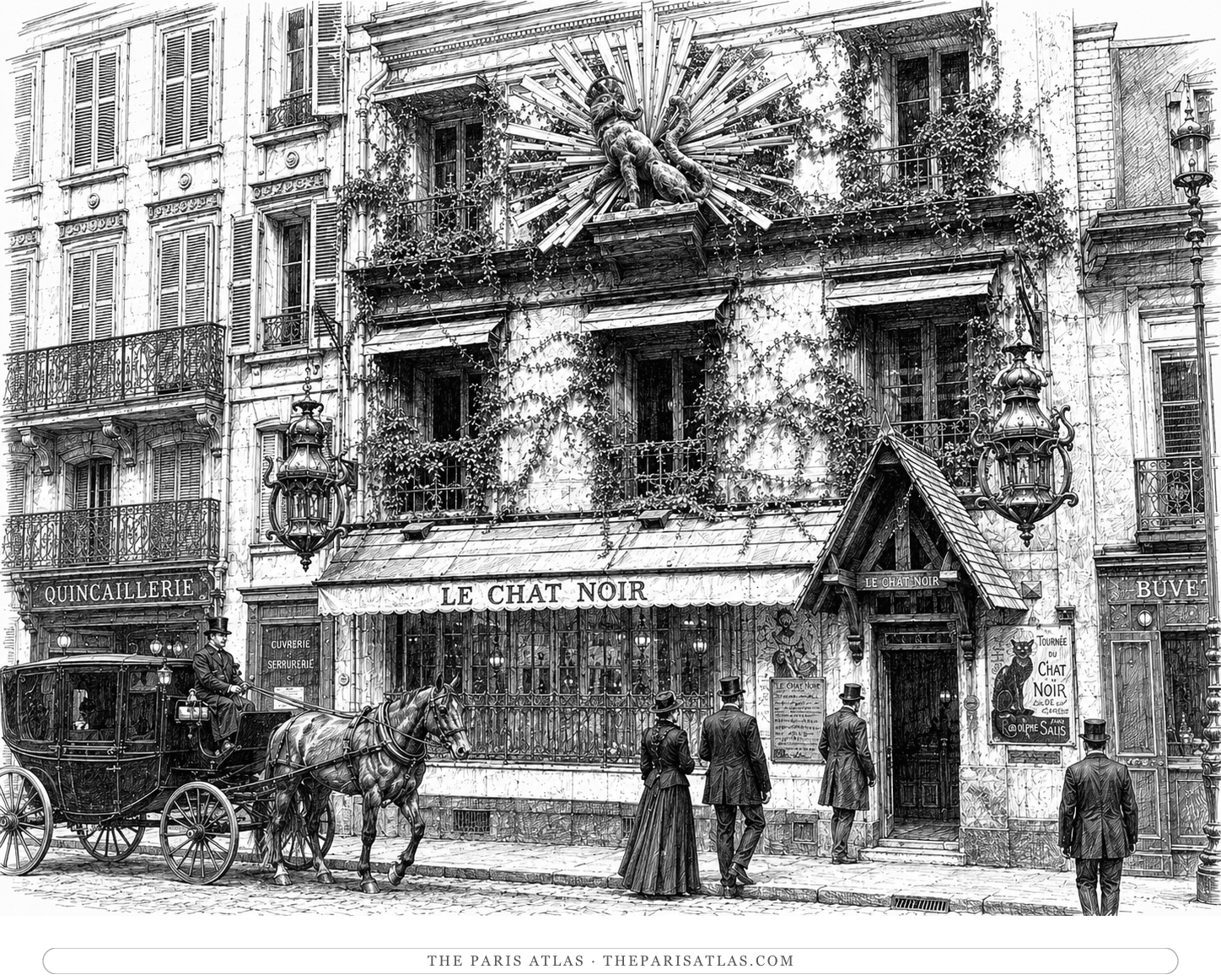
Le Chat Noir itself was Salis's Montmartre cabaret, opened at 84 boulevard de Rochechouart in November 1881 and moved to rue Victor-Massé in 1885. By 1896 the cabaret's touring company was one of its major sources of income, and this is the sheet that was drawn to sell it.
Théophile-Alexandre Steinlen was a Swiss-born illustrator who had settled in Montmartre in the early 1880s and drifted into Salis's Chat Noir circle. Cats had already become his signature — he lived with a household of them at his studio in what he called Cats' Cottage — and by the mid-1890s he was the illustrator Salis went to for his advertising work. The Metropolitan Museum of Art's essay on Steinlen situates the Tournée poster inside a lifelong political-artistic practice in which cats, cabaret and left-wing politics all overlap.[2]
Salis commissioned the poster in 1896 for the Compagnie du Chat Noir's provincial tours. The Musée d'Orsay's public conference series on the birth of French advertising identifies the sheet as one of the emblematic Belle Époque lithographs, contemporary with Toulouse-Lautrec's Moulin Rouge posters, Jules Chéret's music-hall sheets and Alphonse Mucha's Sarah Bernhardt commissions.
The image is often searched for as "the Le Chat Noir painting." It is not a painting.[3]
It is a color lithograph — an ink print pulled from a series of prepared stones, printed in large runs by a commercial atelier and pasted on street walls as advertising. The Metropolitan Museum of Art, the National Gallery of Art in Washington, D.C., the Musée d'Orsay and the Musée Carnavalet all hold original 1896 impressions, and every one of them catalogues it as a poster or lithograph — never as a painting.[3]
The image is nonetheless one of the most familiar works of Belle Époque visual culture. The gilded frame Steinlen drew around the cat is itself the joke — the poster gives itself museum airs while announcing a commercial tour. That is part of why it stayed after the tour was over.
The other confusion the poster generates is with Henri de Toulouse-Lautrec. Lautrec designed his own famous Montmartre advertising posters in the same years — Moulin Rouge: La Goulue (1891), Divan Japonais (1893), Aristide Bruant dans son cabaret (1893) — and belonged to Salis's Chat Noir circle. The Tournée du Chat Noir is not one of his.[4]
The 1896 Chat Noir cat is by Steinlen. The Met identifies the sheet unambiguously as Steinlen's Tournée du Chat Noir de Rodolphe Salis; the National Gallery of Art's Toulouse-Lautrec and Montmartre exhibition contextualises Steinlen's Chat Noir posters alongside Toulouse-Lautrec, Chéret and Mucha as separate hands working in the same Montmartre poster tradition.
Because the sheet was printed in large commercial runs, several institutions hold original 1896 impressions in their permanent collections. The Metropolitan Museum of Art (New York), the National Gallery of Art (Washington, D.C.), the Musée d'Orsay (Paris) and the Musée Carnavalet (Paris) are the principal public holdings. Individual copies also come up in the Belle Époque poster market and at Christie's, Sotheby's and Bonhams sales.[2]
Later re-strikes and 20th-century reproductions circulate at a scale the 1896 original never approached. Anything without documented provenance and a period impression date should be treated as a later reproduction, not an original poster.
Close reading
Steinlen makes an advertisement command attention through one frontal cat, a mock-sacred frame, and forceful lettering. The details show how animal image and typography work together before the viewer has time to read the announcement.
1.The cat meets the street head-on
Wide eyes, pricked ears, and horizontal whiskers make the animal confrontational rather than cute. The symmetrical face remains readable at the distance required of a street poster.
2.A red disc turns the cabaret animal into an icon
The disc reads at once as sun and halo, while the gold border imitates a serious picture frame. The parody elevates the Chat Noir's mascot without losing the joke.
3.The lettering is part of the spectacle
Large historical-looking letters name Rodolphe Salis's touring company beneath the modern commercial image. Typography supplies both information and the cabaret's mock-medieval theatrical identity.
4.The raised tail gives the cat a heraldic silhouette
The tail curls upward in a single memorable line. It makes the animal recognizable from a distance and helps transform a cabaret mascot into a repeatable public emblem.
5.The pale halo separates the black animal from the red disc
A narrow light border prevents the cat's silhouette from disappearing into the surrounding color. The device is practical poster design, but it also gives the animal an ironically sacred aura.
6.The tour announcement has to work at street distance
Large compressed letters turn logistical information into a major visual block. The poster succeeds because the name, image, and announcement can be grasped before a passerby stops to read closely.
A viewing location has not yet been listed for this work.
"Tour of Rodolphe Salis's Chat Noir." Le Chat Noir means The Black Cat — the name of Salis's Montmartre cabaret. Tournée means tour, as in a touring theatre engagement. The poster announces that the Chat Noir's touring company is coming to town.
Théophile-Alexandre Steinlen, a Swiss-born illustrator settled in Montmartre. He drew it in 1896 for Rodolphe Salis's touring Chat Noir company.
No. The famous 1896 black-cat poster is by Théophile-Alexandre Steinlen. Toulouse-Lautrec designed his own Montmartre posters in the same years — Moulin Rouge: La Goulue (1891), Divan Japonais (1893), Aristide Bruant — and belonged to the same Chat Noir circle, which is part of why the confusion recurs.
No. It is a color lithograph — an ink print pulled from a series of prepared stones, printed in large runs and pasted on street walls as advertising. Every institution that holds an original 1896 impression catalogues it as a poster or a lithograph.
The 1896 original measures approximately 138.5 × 95.6 cm (54 ½ × 37 ⅝ in) — the standard grand affiche size Belle Époque poster designers used for street display.
Original 1896 impressions are held by the Metropolitan Museum of Art (New York), the National Gallery of Art (Washington, D.C.), the Musée d'Orsay (Paris) and the Musée Carnavalet (Paris), among others. Later re-strikes and 20th-century reproductions circulate widely and should not be confused with the original impression.
Inspired by · 1896
Salis commissioned the poster in 1896 for the Compagnie du Chat Noir's provincial tours; the sheet's full title, Tournée du Chat Noir de Rodolphe Salis, names him directly as the impresario the tour belongs to.
Mentions · 1896
The poster's full title, Tournée du Chat Noir de Rodolphe Salis, names the cabaret directly — the sheet was drawn to advertise the Compagnie du Chat Noir's touring performances during the years the cabaret was still operating at rue Victor-Massé.
The sources below include collection records, catalogues, scholarly research, and primary materials that informed this page. They document Tournée du Chat Noir, its making, and its place in cultural history.


Published analysis and historical context used in preparing the Tournée du Chat Noir page.
Published analysis and historical context used in preparing the Tournée du Chat Noir page.
Published analysis and historical context used in preparing the Tournée du Chat Noir page.
These references provide the documented foundation for this work's history and interpretation. Claim-level citations remain attached to the specific claims they support.
 Explore more resources