The Paris AtlasCharting the artists, works, and places worth returning to.

Cabaret · Montmartre · 18e arrondissement

Le Chat Noir

Permanently closed

The original cabaret moved from 84 boulevard de Rochechouart to 12 rue de Laval (now rue Victor-Massé) in 1885 and closed in 1897; later uses of the name were separate establishments.

The legendary Montmartre cabaret where poets, singers, painters, cartoonists and musicians made the room itself an artistic creation — crowned by an extraordinary shadow theater.

First address
84 Boulevard de Rochechouart, 75018 Paris
Years
1881–1897
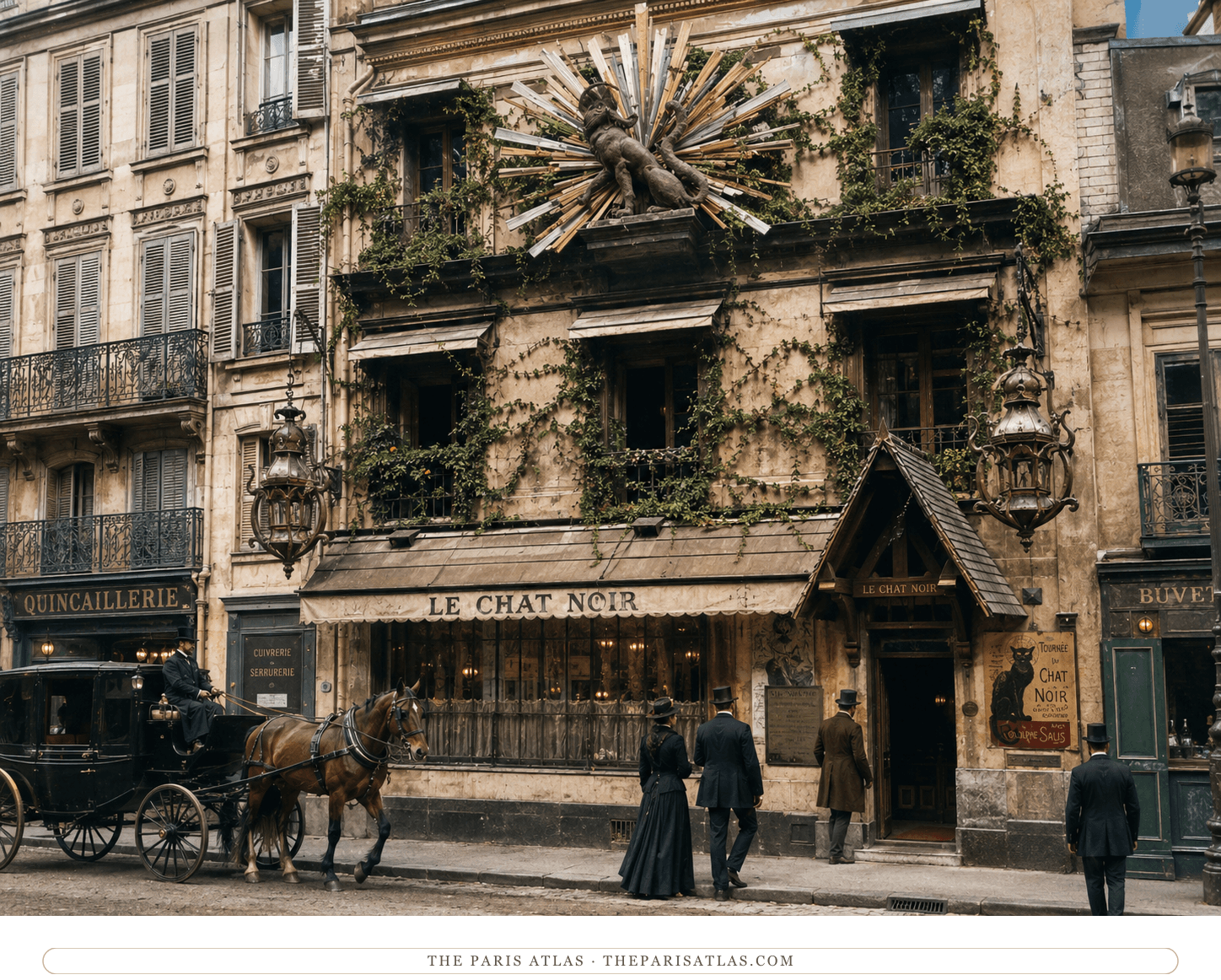
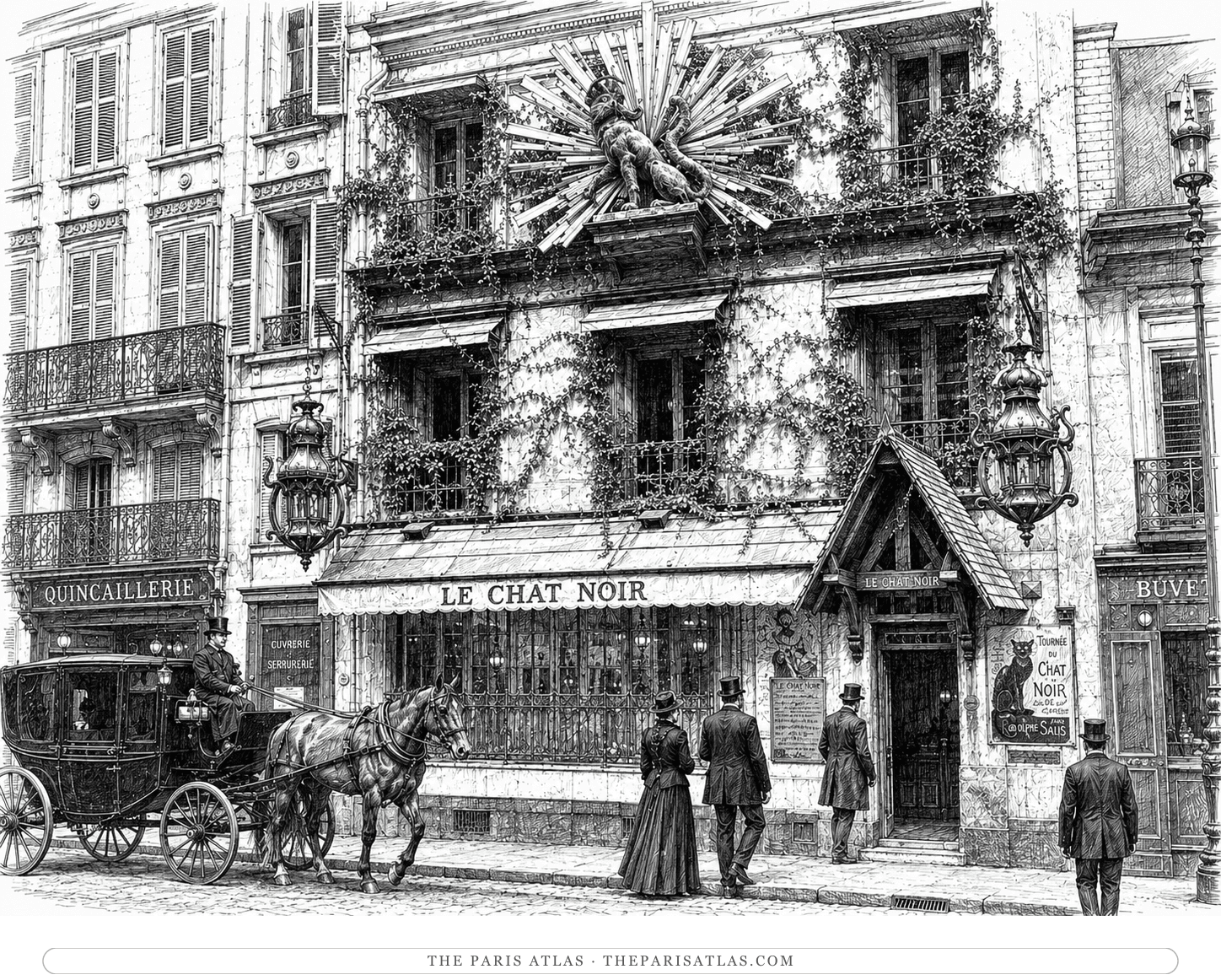
Artistic reconstructionColor editorial reconstruction of Le Chat Noir's elaborate Rue de Laval facade in the late nineteenth century

Le Chat Noir at its most celebrated address — a color editorial reconstruction. Hover to reveal the paired ink view.

Artistic reconstruction

Place dossier

Le Chat Noir at a glance

A quick orientation to the cabaret, its two Montmartre addresses and the artists who shaped its sixteen-year life.

The essential names, dates and addresses before entering the full story.

Name
Le Chat Noir — “The Black Cat”
Type
Artistic and literary cabaret
Founder
Rodolphe Salis
Founded
1881
Salis-era cabaret closed
1897

The two Montmartre addresses

  1. First location

    84 Boulevard de Rochechouart, at the foot of Montmartre

  2. Second location

    12 Rue de Laval, now Rue Victor-Massé

Best known for
Songs, poetry, satire, artists and writers, its illustrated newspaper, and its shadow theater
Important artists
Adolphe Willette, Théophile-Alexandre Steinlen, Caran d'Ache and Henri Rivière
Writers and performers
Émile Goudeau, Alphonse Allais and Aristide Bruant
Important surviving collections
Musée de Montmartre, Musée Carnavalet and Musée d'Orsay

Important distinction

A later establishment using the Chat Noir name opened on Boulevard de Clichy in the twentieth century. It should not be confused with Rodolphe Salis's original 1881–1897 cabaret.

The story

Le Chat Noir was the legendary Montmartre cabaret where poets recited new work, singers tested songs, painters decorated the walls, cartoonists produced a weekly newspaper, musicians played at the piano, and an extraordinary shadow theater transformed sheets of cut zinc into moving spectacles of light.

Opened by Rodolphe Salis in 1881, Le Chat Noir lasted only until 1897 in its original form. Yet during those sixteen years it helped establish a model of artistic nightlife that became inseparable from the idea of bohemian Paris.

This was not simply a café where famous artists happened to drink. Le Chat Noir was itself an artistic creation.

Its rooms were deliberately theatrical. Its proprietor behaved like a master of ceremonies. Its customers could become performers and its performers could become contributors to its newspaper. Paintings hung beside jokes, songs beside political satire, poetry beside commercial publicity. The line separating audience, artist, journalist and drinking companion was intentionally unstable.

Among the writers, artists and musicians associated with its world were Émile Goudeau, Aristide Bruant, Alphonse Allais, Adolphe Willette, Théophile-Alexandre Steinlen, Caran d'Ache, Henri Rivière, Toulouse-Lautrec, Erik Satie, Claude Debussy, Charles Cros, Villiers de l'Isle-Adam, Jean Lorrain, Léon Bloy and many others. Some were central collaborators; some were regulars; others are documented visitors or members of the larger artistic circle that passed through its rooms.

By the 1890s the Chat Noir name had become famous well beyond Paris. Its touring shows traveled with a poster by Steinlen depicting an enormous black cat staring directly at the viewer beneath the words “Tournée du Chat Noir.” The image is now one of the most recognizable posters of nineteenth-century France.

Before Le Chat Noir: why Montmartre?

To understand Le Chat Noir, it helps to understand the neighborhood in which it appeared.

Montmartre had been incorporated into Paris only in 1860. Even afterward, the hill retained something of the appearance and reputation of a separate village. There were old houses, winding streets and surviving windmills, while relatively cheap rents helped attract workers, students, painters, writers and musicians.

By the 1880s, Montmartre was becoming one of the great entertainment districts of Paris. Cabarets, cafés, dance halls, circuses and later establishments such as the Moulin Rouge drew Parisians uphill at night. At the same time, Montmartre carried a reputation for political independence and unconventional life. The memory of the Paris Commune of 1871, whose uprising had begun in Montmartre, was still recent.

The mixture was unusually fertile: poor and middle-class residents, aspiring artists, journalists, entertainers, political radicals, tourists and affluent Parisians all occupied the same relatively compact neighborhood.

The Metropolitan Museum of Art describes the Montmartre cabaret culture of the 1880s and 1890s as one in which artists could challenge bourgeois morality and politics while people from different social classes mixed together. Eventually that rebellious culture itself became a commercial attraction. Le Chat Noir sits directly at the center of that transformation.

Rodolphe Salis: the man who made the room a performance

The central figure in the story was Rodolphe Salis, born in 1851.

Salis was not the greatest poet, musician or painter to enter Le Chat Noir. His talent was different: he understood how to turn artists, atmosphere, publicity and spectacle into a single experience.

Before opening the cabaret, Salis had worked in Paris producing religious objects. By 1881, however, he was attempting something much more unconventional. Contemporary newspapers described the new establishment as an artistic brasserie.

Salis did not behave like an ordinary café proprietor.

He became part impresario, part comedian, part host and part character in his own show. He greeted arrivals, mocked customers, introduced performers and delivered elaborate comic speeches known as boniments. The Musée d'Orsay credits much of the success of Le Chat Noir to this combination of Salis's personality and his ability to surround himself with emerging talent.

The important point is that the show began before the scheduled entertainment began.

Walking through the door meant entering Salis's invented world.

The show began at the door: Salis as host, comedian and master of ceremonies — editorial illustration. (Illustration — The Paris Atlas)

Why was it called Le Chat Noir?

Even something as basic as the origin of the name comes with competing stories.

The Musée de Montmartre preserves a story that Salis discovered a black cat in the premises when he was establishing the cabaret in November 1881 and named the place after it.

Another explanation circulated historically linking the name to Edgar Allan Poe's 1843 story “The Black Cat.” Contemporary accounts make the Poe association part of the establishment's mythology.

Rather than pretending that one picturesque story can be conclusively proved, it is safer to say that the black cat rapidly became the cabaret's unmistakable emblem regardless of exactly how Salis arrived at the name.

Artist Adolphe Willette designed an extraordinary sign for the establishment: a black cat standing against a silver crescent moon. The original painted-metal sign survives in the Musée Carnavalet.

The cat was therefore not merely the name of the café.

It became its logo, mascot and eventually one of the great visual symbols of Montmartre.

1881: the first Chat Noir

84 Boulevard de Rochechouart

Le Chat Noir opened at 84 Boulevard de Rochechouart, near the foot of the Montmartre hill, in 1881. The Musée Carnavalet confirms both the original address and the later move to Rue de Laval.

The first establishment was comparatively small.

A report in Le Figaro in December 1881 described Salis's new business as a “brasserie artistique” with decoration inspired by the Louis XIII period. Other contemporary descriptions make it clear that the place rapidly accumulated paintings, curiosities and unusual objects. By 1882 it was already being described as something resembling a small museum.

This was an important part of the concept.

Salis did not decorate his café with anonymous commercial ornaments. The artists around him helped make the room.

Walls became places to paint. Illustrators produced signs and decorations. Artworks were commissioned specifically for the building. The surroundings reflected the same people who were drinking, talking and performing inside them.

The Hydropathes arrive

One of the most important events in the early history of Le Chat Noir was Salis's connection with Émile Goudeau.

Goudeau was a French poet and journalist and the leader of an unconventional literary group called the Hydropathes. The group brought together writers, poets, musicians and performers for meetings in which members presented work aloud, recited poems, sang, debated and entertained one another.

The Bibliothèque nationale de France identifies Goudeau as the leader of the Cercle des Hydropathes and a key figure in the first Chat Noir.

When Goudeau and members of his circle gravitated toward Salis's new establishment, Le Chat Noir gained something far more valuable than fashionable customers: it acquired a ready-made community of performers and creators.

This helped establish the formula that would define the cabaret.

A person might arrive with a poem rather than merely arrive for a drink.

Another might have a new song.

A cartoonist might sketch somebody at a table.

A writer might contribute a joke or article to the newspaper.

The café became a workplace disguised as nightlife.

A poem arrives with the customer: the Hydropathes turn the café into a working literary room — editorial illustration. (Illustration — The Paris Atlas)

What the first Chat Noir looked like

Surviving artworks are unusually helpful here.

They show that Le Chat Noir was not an austere modern room containing neat café tables. It was visually crowded, eccentric and intentionally atmospheric.

The space accumulated paintings, sculpture, lamps, signs and objects. Contemporary observers described Salis's establishment as a miniature museum.

One spectacular surviving piece gives a sense of the scale of its decoration.

In 1884, Salis commissioned Adolphe Willette to paint Parce Domine, an enormous allegorical canvas measuring approximately 199 by 390 centimeters. The painting later moved with the cabaret when Salis changed premises. It survives in the collection of the Musée Carnavalet.

Willette was an illustrator and painter whose mischievous, fantastic imagery became deeply connected to Montmartre. He also created the celebrated black-cat sign.

The fact that Salis commissioned work on this scale says something important about his ambitions: Le Chat Noir was being designed as an artwork-filled environment, not simply decorated as a bar.

What it felt like to enter

Accounts of Le Chat Noir repeatedly emphasize theater, joking and deliberate social discomfort.

Salis cultivated rituals around arriving customers. Contemporary reports describe an elaborately costumed doorman and a proprietor who was perfectly willing to tease the bourgeois men and women who came to see Montmartre's bohemian celebrities.

That reversal mattered.

A prosperous visitor accustomed to being treated deferentially elsewhere could come to Le Chat Noir and discover that the artists controlled the room.

The proprietor might joke about him.

A performer might turn the audience into material.

Someone at another table might interrupt.

The attraction lay partly in being allowed into a supposedly rebellious artistic world—and partly in being reminded that you were an outsider to it.

This tension eventually became central to Montmartre tourism. The bourgeoisie came to see bohemia; bohemia learned that the bourgeoisie's curiosity could pay the bills.

The piano

Music soon became integral to Le Chat Noir.

The Musée de Montmartre emphasizes the importance of the cabaret's piano in the development of its musical culture and places composers including Erik Satie and Claude Debussy within the musical orbit of the establishment.

Satie was a young French composer who would later become famous for works such as the Gymnopédies and for his eccentric, deliberately anti-grandiose approach to music. Debussy became one of the most influential composers of modern French music.

They belonged to a wider Montmartre culture in which the supposedly serious arts and popular entertainment were increasingly difficult to separate.

At Le Chat Noir, music did not have to occur in a concert hall.

It could accompany a comic monologue.

It could support a song.

Eventually it could become the soundtrack to moving shadows.

Aristide Bruant and the cabaret song

Among the most important performers associated with Le Chat Noir was Aristide Bruant, a singer, songwriter and cabaret performer whose songs drew heavily on Parisian street language and working-class life.

Bruant later became a major cabaret proprietor himself and one of the iconic personalities of Montmartre. Toulouse-Lautrec's posters of him—with broad hat, cape and red scarf—would make his image internationally famous.

The Musée d'Orsay argues that the modern Parisian cabaret song became a genuine social phenomenon at Le Chat Noir.

That is one of the establishment's most important legacies.

A song in this environment was not merely decorative music. It could be satirical, political, sentimental, obscene, observational or sharply local. It could describe the inhabitants of Paris rather than an idealized operatic world.

The audience was close enough to understand every word.

1885: Le Chat Noir changes its den

The first Chat Noir became too successful for its original premises.

In 1885, Salis moved the establishment to 12 Rue de Laval, the street now called Rue Victor-Massé.

He advertised the change with characteristic theatricality, describing the Chat Noir as changing its “den.”

The move fundamentally changed the scale of the operation.

What had begun as an intimate artistic drinking place developed into a larger, increasingly elaborate attraction. Salis now had more room for decoration, performance and spectacle.

It was here that Le Chat Noir reached the form remembered by history.

The second Chat Noir: art on the walls, art on the building

The larger premises allowed Salis to make the physical building part of the mythology.

The artworks accumulated at the original cabaret moved with the establishment. Willette's immense Parce Domine, for example, was installed in the new performance room.

Architectural and decorative projects were also produced specifically for the venue. The Musée d'Orsay preserves designs associated with the decorated façade of Le Chat Noir, evidence of how carefully the establishment cultivated its appearance.

The exterior announced that this was not an ordinary drinking establishment.

Period drawings show a deliberately conspicuous façade with fantastic decorative details and the black-cat identity unmistakably attached to the building.

The entrance itself became scenery.

An extraordinary surviving view of the entrance

One of the most useful historical images of Le Chat Noir is Paul Merwart's drawing of the entrance, preserved by the Musée Carnavalet.

It shows a building that looks almost like a piece of stage design placed on a Paris street: carriages outside, figures moving around the doorway, decorative objects projecting from the façade and the entrance framed as an attraction in its own right.

Most importantly for researchers today, Paris Musées has released a high-resolution reproduction of the work under CC0, making it freely reusable.

It is one of the best images to use when reconstructing how arriving at Le Chat Noir might have felt.

Inside Le Chat Noir

A second work by Paul Merwart, dated 1886 and now in the Musée Carnavalet, provides an exceptional view of the cabaret's interior.

The room appears crowded rather than polished.

People sit closely together. Art and architectural decoration cover the surroundings. Light sources are part of the decoration. A small illuminated screen or stage pulls the eye toward the rear.

It is precisely the kind of space in which the boundary between socializing and performance could disappear.

Another Merwart image depicts the editorial staff of the newspaper Le Chat Noir gathered inside the cabaret. Men sit together around tables amid bottles, papers and drawings.

These images help correct an easy misconception.

Le Chat Noir was not simply a theater with café service.

It was simultaneously a café, salon, editorial office, informal club, exhibition space and performance venue.

Le Chat Noir, the newspaper

Salis and his circle did not limit the Chat Noir identity to the building.

They created an illustrated weekly newspaper called Le Chat noir.

The Bibliothèque nationale de France catalogs it as an organ of Montmartre interests, with Émile Goudeau as editor-in-chief and Rodolphe Salis as director.

The paper carried poetry, prose, satire and illustration and gave the cabaret another way to circulate its culture beyond the people who could physically fit inside its rooms.

This was remarkably effective branding before the modern vocabulary of branding existed.

There was:

the place,

the black-cat emblem,

the artists,

the performances,

the newspaper,

the touring show,

and eventually the poster advertising the tour.

The Musée d'Orsay regards the newspaper as particularly significant in the development of illustrated humor and the history leading toward modern comics.

Le Chat Noir was therefore both a physical venue and a media network.

The newspaper after hours: drawings, proofs and jokes made the cabaret portable — editorial illustration. (Illustration — The Paris Atlas)

The circle

The people of Le Chat Noir

The temptation with a famous nineteenth-century café is to produce an enormous list of names. That can actually obscure what made the place important.

The people around Le Chat Noir did different things. Some built it. Some wrote for it. Some performed. Some decorated it. Some produced its newspaper. Some visited because it had become the place to encounter the Parisian avant-garde.

Ink illustration of Émile Goudeau

Émile Goudeau

Poet · Journalist · Editor

Émile Goudeau was a poet, journalist and leader of the Hydropathes. His circle helped supply the early Chat Noir with exactly the kind of writers and performers Salis needed. He later served as editor-in-chief of the Chat Noir newspaper.

Ink illustration of Aristide Bruant

Aristide Bruant

Singer · Author

Aristide Bruant was a singer and songwriter who transformed observations of Parisian street life into cabaret songs. His connection to the Chat Noir belonged to the distinctively Parisian chanson culture that flourished in Montmartre.

Ink illustration of Alphonse Allais

Alphonse Allais

Author · Journalist

Alphonse Allais was one of the great French humorists of the period—a writer famous for absurd stories, jokes and experiments with language. Literary seriousness and practical jokes occupied the same table in his Chat Noir world.

Ink illustration of Adolphe Willette

Adolphe Willette

Painter · Illustrator

Adolphe Willette was a painter and illustrator who helped give Le Chat Noir its visual identity. He designed the cat-and-crescent sign and created monumental decorative work for the cabaret, including Parce Domine.

Ink illustration of Théophile-Alexandre Steinlen

Théophile-Alexandre Steinlen

Illustrator · Painter

Théophile-Alexandre Steinlen became one of Montmartre's great illustrators. His 1896 touring poster, with its enormous haloed black cat, outlived the venue and became an emblem of Belle Époque Paris.

Ink illustration of Caran d'Ache

Caran d'Ache

Illustrator

Caran d'Ache—the pseudonym of Emmanuel Poiré—was an illustrator and caricaturist who also made ambitious shadow-theater work, including the Napoleonic spectacle L'Épopée.

Ink illustration of Henri Rivière

Henri Rivière

Illustrator · Painter

Henri Rivière was an artist, printmaker and designer who became one of the central technical and artistic innovators of the Chat Noir shadow theater, refining its silhouettes, lighting and scenic effects.

Ink illustration of Henri de Toulouse-Lautrec

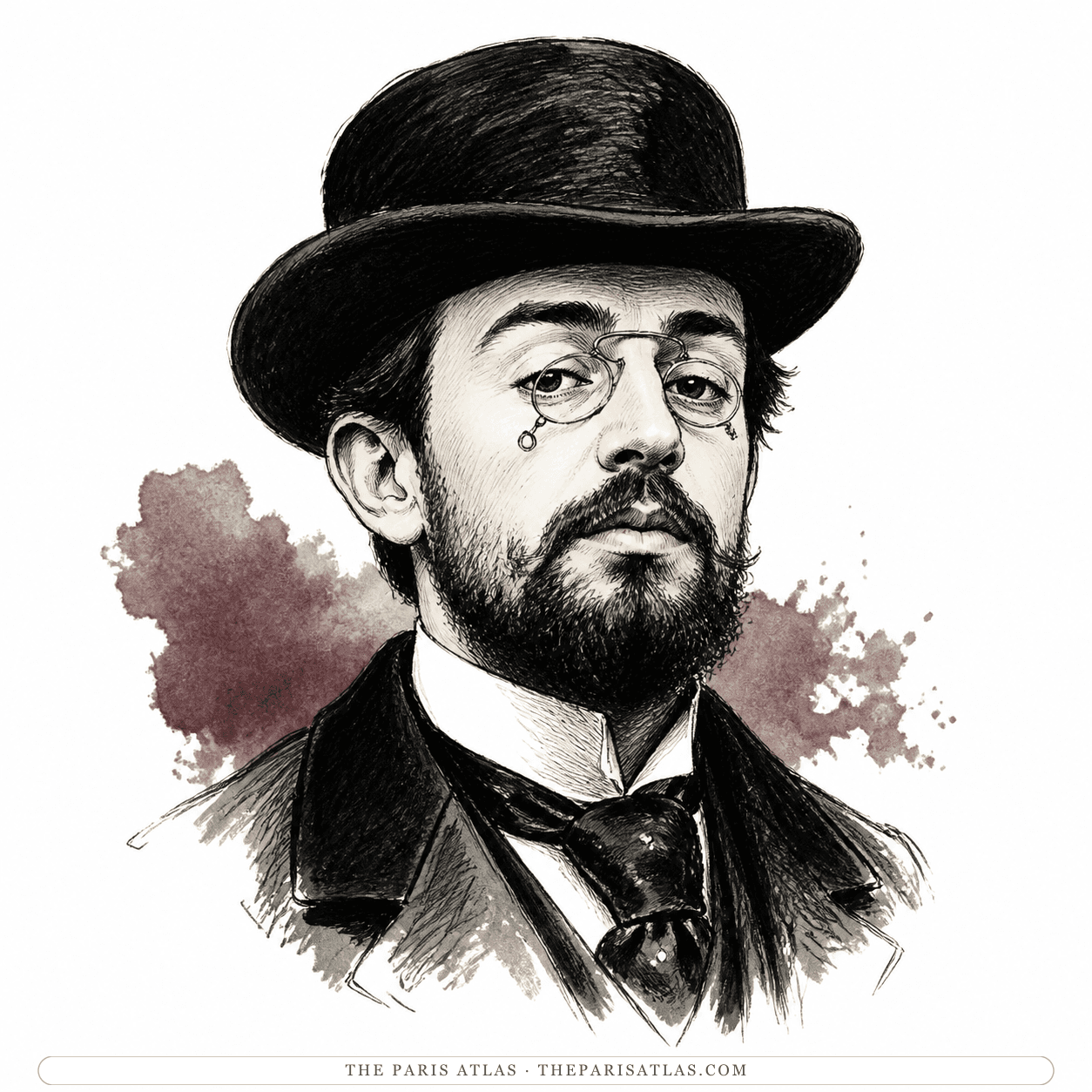
Henri de Toulouse-Lautrec

Painter · Illustrator

Henri de Toulouse-Lautrec recorded the singers, dancers and nightlife of 1890s Montmartre. Maurice Joyant's recollections place him inside Salis's noisy Chat Noir before the painter became famous.

Ink illustration of François-Rupert Carabin

François-Rupert Carabin

Sculptor

The sculptor and decorative artist François-Rupert Carabin was a documented participant in the cabaret world—a pillar of Le Chat Noir who drank there with Willette and Toulouse-Lautrec.

Ink illustration of Santiago Rusiñol

Santiago Rusiñol

Painter · Author · Collector

Santiago Rusiñol, the Catalan painter, writer and collector, lived in Paris during the early 1890s and frequented Le Chat Noir before becoming a leading figure of Catalan modernism.

Ink illustration of Erik Satie

Erik Satie

Musician

Erik Satie belonged to Le Chat Noir's musical orbit and played at the cabaret's piano before moving to the Auberge du Clou in the early 1890s.

View profile →
Ink illustration of Claude Debussy

Claude Debussy

Musician · Critic

Claude Debussy moved through the same Montmartre musical world as Satie. His precise relationship to Le Chat Noir is treated cautiously, but he belongs to the wider artistic circle around the cabaret.

View profile →

The wider orbit also included Charles Cros, Théodore de Banville, Jules Barbey d'Aurevilly, Alphonse Daudet, Léon Bloy, Villiers de l'Isle-Adam, Jean Lorrain and Albert Robida.

Associated with Le Chat Noir does not mean the same thing in every case: the cabaret had founders, employees, performers, contributors, close regulars, documented visitors and famous guests.

The invention that made Le Chat Noir legendary: the shadow theater

If the story ended with writers, artists and cabaret songs, Le Chat Noir would still matter.

But its most unusual artistic achievement was still to come.

In 1886, Le Chat Noir developed its celebrated shadow theater, associated especially with artists Henri Rivière and Henry Somm.

The Musée de Montmartre describes a system using cut zinc silhouettes and colored lighting.

Behind an illuminated screen, metal figures and scenery could be moved into position. Through lighting, color, music, narration and carefully designed silhouettes, flat pieces of zinc became armies, landscapes, religious visions, city scenes and fantastic stories.

This was not film—the technology and artistic language were different—but to a modern viewer it can feel astonishingly close to animation.

The image changed.

Characters appeared and disappeared.

Scenery shifted.

Music accompanied movement.

A story unfolded through projected light.

And all of it happened in a cabaret.

Behind the light: zinc silhouettes, layered scenery and colored lamps make a moving world — editorial reconstruction. (Illustration — The Paris Atlas)

Forty-five shadow plays

The Musée d'Orsay records that 45 different shadow plays were performed at Le Chat Noir and identifies Henri Rivière as the artist who brought the medium to its highest level there.

Some productions became elaborate combinations of visual art, poetry, music and engineering.

One of the best-known examples was Caran d'Ache's L'Épopée, represented today by surviving zinc figures.

Another celebrated production was La Marche à l'Étoile, associated with Henri Rivière and composer Georges Fragerolle.

These spectacles demonstrate something crucial about the Chat Noir aesthetic:

art did not have to remain in its traditional category.

A drawing could become a puppet.

A poem could become narration.

A composer could accompany projected images.

A newspaper illustrator could design theater.

A café wall could become an exhibition space.

This constant mixing of forms was one of Le Chat Noir's genuinely modern qualities.

A night at Le Chat Noir

No single evening can represent sixteen years of changing programs, but during its mature period a visitor might encounter several kinds of entertainment within the same night.

There could be songs.

There could be spoken monologues or poetry.

Salis might deliver comic introductions and insults.

Writers and illustrators might be sitting nearby.

The audience might recognize somebody whose work appeared in the Chat Noir newspaper.

Then the room could darken for a shadow performance combining images, spoken narration and music.

The important difference between Le Chat Noir and a formal theater was intimacy.

The artist was not safely isolated behind a distant proscenium.

Artist and audience drank in the same establishment.

That gave the performances immediacy—and sometimes hostility, interruption or improvisation.

A shadow play in performance, with pianist, narrator and a room held by projected light — editorial illustration. (Illustration — The Paris Atlas)

From bohemian clubhouse to tourist attraction

Success changed Le Chat Noir.

The first small establishment had been intimate enough to feel like a gathering place for insiders.

The second became a destination.

By the late 1880s, observers were already noticing the transformation. Writer and journalist Hugues Le Roux contrasted the earlier, more private artistic atmosphere with the increasingly fashionable establishment, where carriages brought prosperous customers eager to experience Montmartre.

This was not simply “selling out.” It was something more historically interesting.

Le Chat Noir helped invent bohemia as an experience that could be sold to outsiders.

The artists wanted freedom from conventional bourgeois culture.

The bourgeois public became fascinated by the artists' freedom.

The public then paid to enter the artists' world.

The money made larger productions possible.

The larger productions attracted still more visitors.

And eventually the once-small artistic circle became an institution.

The Metropolitan Museum notes the same wider transformation across Montmartre: by around 1900, what had once been an underground bohemian culture had become a major entertainment industry.

Le Chat Noir was one of the engines of that change.

Le Chat Noir and the birth of modern artistic publicity

The cabaret was also remarkably sophisticated in the way it presented itself to the public.

Its identity appeared repeatedly:

a black cat.

On the sign.

In the name.

On printed material.

In the newspaper.

And, most famously, on Steinlen's poster.

The 1896 Tournée du Chat Noir poster does not need to show the interior, performers or Paris skyline.

It shows the cat.

By then, that was enough.

The image functioned almost exactly as a modern logo does: one graphic symbol carried the identity of an entire cultural institution.

Steinlen's original lithograph is now in the Musée Carnavalet, and the Paris Musées digital reproduction is available under CC0.

The Chat Noir becomes a touring company: scenery, music and zinc silhouettes leave Montmartre together — editorial illustration. (Illustration — The Paris Atlas)

How Le Chat Noir influenced art

Le Chat Noir's influence cannot be reduced to one artistic movement.

It did several things at once.

It made the café an artistic medium

Parisian cafés had long been places where writers and artists met. Le Chat Noir went further.

The establishment itself became a collaborative production.

Its walls, signage, newspaper, performances and publicity were made by artists.

It gave graphic artists unusual power

Illustrators were not secondary decorators here.

Willette helped define the building.

Caran d'Ache created theatrical works.

Rivière engineered moving visual spectacles.

Steinlen created the image by which the establishment is now remembered.

Poetry, modern composition, caricature, drinking songs, jokes, political satire and commercial entertainment existed side by side.

Le Chat Noir therefore helped weaken the idea that important new art had to originate inside an academy, concert hall or official Salon.

It made performance multidisciplinary

The shadow theater combined drawing, mechanical movement, lighting, literature and music.

The Musée d'Orsay's 1992 exhibition on Le Chat Noir organized its historical importance around three major achievements: the newspaper, cabaret song and shadow theater.

That is an excellent way to understand the place.

Le Chat Noir created art that could be read, heard and watched.

From Montmartre to Barcelona

One of the clearest examples of Le Chat Noir's influence outside France appeared in Barcelona.

In 1893, Pere Romeu, a Catalan artist and entertainer, encountered the Chat Noir shadow theater in Paris.

The Metropolitan Museum of Art explicitly identifies Le Chat Noir as the model for the Barcelona establishment Els Quatre Gats, or “The Four Cats.”

Els Quatre Gats opened in 1897 and became a gathering place for the Catalan avant-garde.

Among the artists connected with it was a very young Pablo Picasso.

In other words, an artistic formula developed in Salis's Montmartre cabaret helped inspire a Barcelona café that subsequently became important in Picasso's early career.

That is a remarkable artistic family tree:

Le Chat Noir → Els Quatre Gats → the young Barcelona avant-garde.

Santiago Rusiñol, who had frequented Le Chat Noir while living in Paris, was also among the important founders of Els Quatre Gats.

Decline

The problem with turning bohemia into a successful business is that somebody else can imitate it.

By the 1890s, Montmartre contained numerous cabarets and entertainment venues. The landscape Le Chat Noir had helped create became increasingly competitive.

A report in Le Temps in early 1896 discussed financial difficulties and competition surrounding the establishment. Salis himself defended Le Chat Noir's achievements, arguing that his circle had helped create the artistic cabaret, develop a new form of satirical literary song and establish Montmartre as an artistic center.

The claim was self-interested.

It was also substantially justified.

The death of Rodolphe Salis and the end of the original Chat Noir

Rodolphe Salis died in March 1897.

The original Chat Noir did not survive him as the same institution.

The Musée Carnavalet dates the end of its original artistic adventure to 1897, directly connecting the closure with Salis's death.

This is revealing.

Salis had assembled extraordinary artists, but Le Chat Noir depended upon something less transferable than a building or a trademark: his particular ability to hold all the pieces together.

Without him, the strange combination of café, salon, newspaper, theater, joke and business could not simply continue unchanged.

What happened to the building?

The former Chat Noir premises at 12 Rue de Laval / Rue Victor-Massé continued to have an afterlife in Parisian entertainment.

Paris Musées records that by 1899 the location was associated with La Boîte à Fursy, described as operating in the former Hôtel du Chat Noir.

The famous name itself also returned.

A later Chat Noir was established on Boulevard de Clichy in the twentieth century. Historical summaries and museum cataloging can therefore show three Chat Noir addresses.

But for the biography of Rodolphe Salis's historic cabaret, the essential chronology is:

1881–1885 — 84 Boulevard de Rochechouart

1885–1897 — 12 Rue de Laval, now 12 Rue Victor-Massé

1897 — Salis dies and the original artistic enterprise ends

The later Boulevard de Clichy establishment belongs to the history of the name's revival, not to the uninterrupted history of Salis's original cabaret.

That distinction is important because the addresses are frequently conflated.

What survives of Le Chat Noir today?

Quite a lot—although it is scattered across museums.

Musée de Montmartre

The Musée de Montmartre is one of the most important places for understanding the Chat Noir today.

Its collections preserve material connected with the celebrated shadow theater, including historic zinc elements and paintings by Steinlen. The museum has been developing a reconstruction designed to reproduce the arrangement and appearance of the Chat Noir shadow theater, using a large reproduction based on historical imagery together with projections made from surviving zinc pieces.

According to the museum, its collections include approximately twenty scenes and around twenty silhouettes connected with the shadow theater.

That is especially valuable because the shadow theater is difficult to understand from written descriptions alone.

Seeing the metal silhouettes makes the process suddenly comprehensible: these apparently simple cut objects were the physical machinery behind one of the most celebrated visual spectacles of nineteenth-century Paris.

The Musée de Montmartre's major Chat Noir exhibition

In 2012–2013, the museum mounted an exhibition titled Autour du Chat Noir: Arts et plaisirs à Montmartre, 1880–1910.

It brought together more than 300 works and examined not only Le Chat Noir itself but the wider artistic entertainment culture that grew around Montmartre. Artists represented included Toulouse-Lautrec, Édouard Vuillard, Steinlen and Willette, among others.

The exhibition also reconstructed the atmosphere of the shadow theater and incorporated musical material associated with figures such as Aristide Bruant and Yvette Guilbert.

So yes: the Musée de Montmartre is a major source for this page, and its research substantially confirms the central role of Le Chat Noir in the neighborhood's literary, visual and musical culture.

Musée Carnavalet

The Musée Carnavalet, Paris's museum of the history of the city, preserves some of the most spectacular physical and visual remnants of Le Chat Noir.

Among them are:

the original black-cat cabaret sign designed by Adolphe Willette;

Willette's monumental Parce Domine painting from the cabaret;

Paul Merwart's drawings of the interior, entrance and newspaper staff;

artworks depicting performances and rehearsals;

and Steinlen's celebrated Tournée du Chat Noir poster.

For visual reconstruction of the original establishment, the Carnavalet holdings are indispensable.

Musée d'Orsay

The Musée d'Orsay has also played an important role in Chat Noir scholarship.

In 1992 it devoted a major exhibition to Le Cabaret du Chat Noir (1881–1897).

The museum's interpretation emphasizes three areas in which the cabaret was especially innovative:

its illustrated newspaper;

the development of cabaret song;

its shadow theater.

The exhibition was curated by Mariel Oberthür, who had previously worked at the Musée de Montmartre, further demonstrating how closely the history of the cabaret is tied to Montmartre museum scholarship.

Why Le Chat Noir still matters

Le Chat Noir existed for only sixteen years under Rodolphe Salis.

That is shorter than the careers of many of the artists who passed through it.

Yet its influence survives because Salis and his collaborators stumbled onto—or deliberately invented—something remarkably modern.

They created a place where culture could happen socially.

A visitor did not need to enter a museum to see new art.

A writer did not need to publish a book before finding an audience.

A composer did not need an orchestra.

An illustrator did not have to remain confined to the printed page.

A cartoon could become journalism.

A drawing could become theater.

A song could become political commentary.

A café could become a publishing house.

A cat could become a logo recognized around the world.

Le Chat Noir was never one artistic movement, and that was precisely its strength.

It was an ecosystem.

Artists influenced writers. Writers supplied performers. Illustrators designed theatrical scenery. Musicians accompanied images. Newspapers promoted performances. Performances attracted paying visitors. Those visitors funded more art.

Modern cities are filled with hybrid spaces that combine gallery, bar, music venue, bookstore, performance room and creative community.

Le Chat Noir demonstrated the power of that model more than a century ago.

And it did so in rooms on the edge of Montmartre with beer on the tables, drawings on the walls, insults from the proprietor and a black cat hanging over the door.
At the address

What you can see today

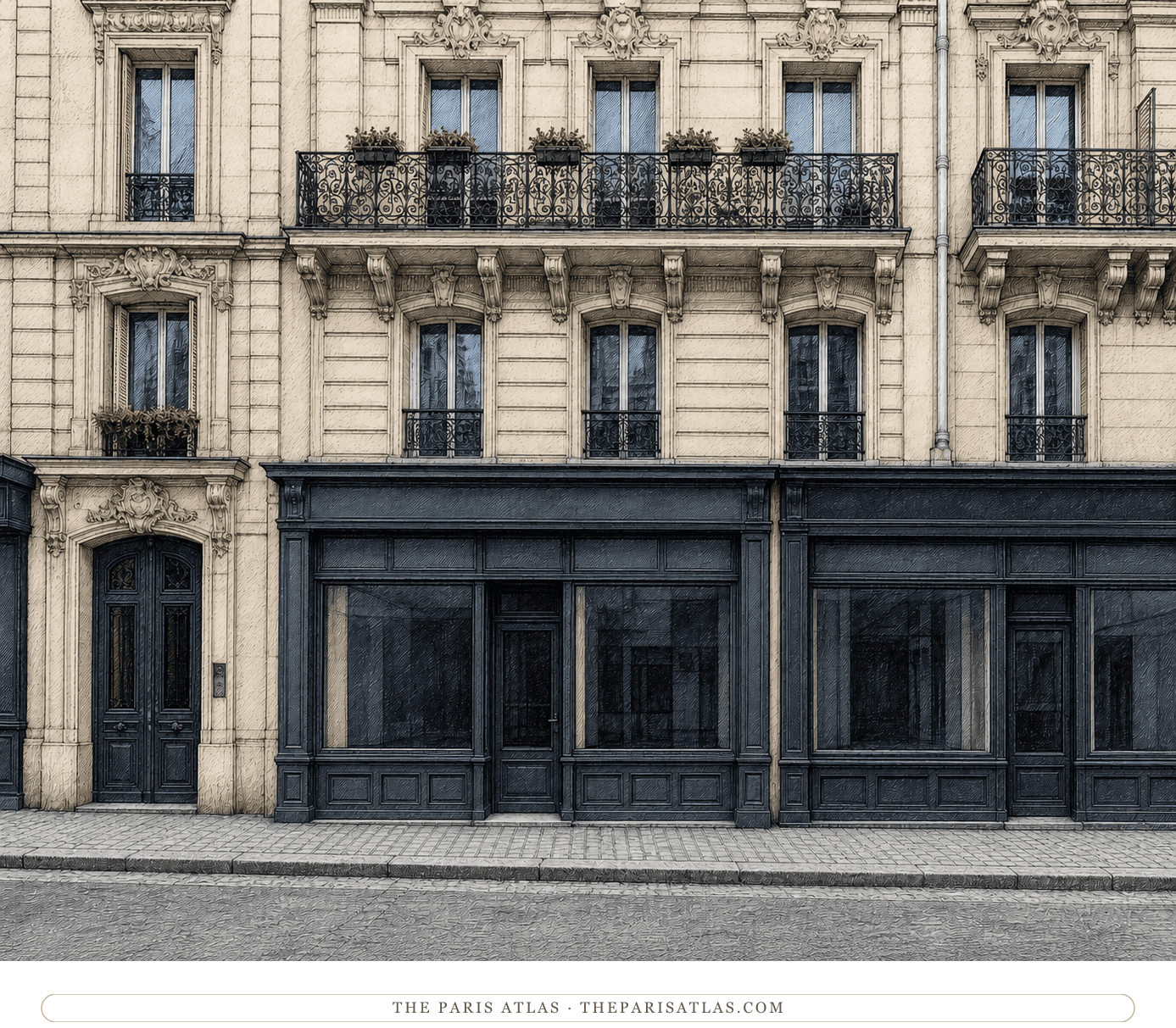
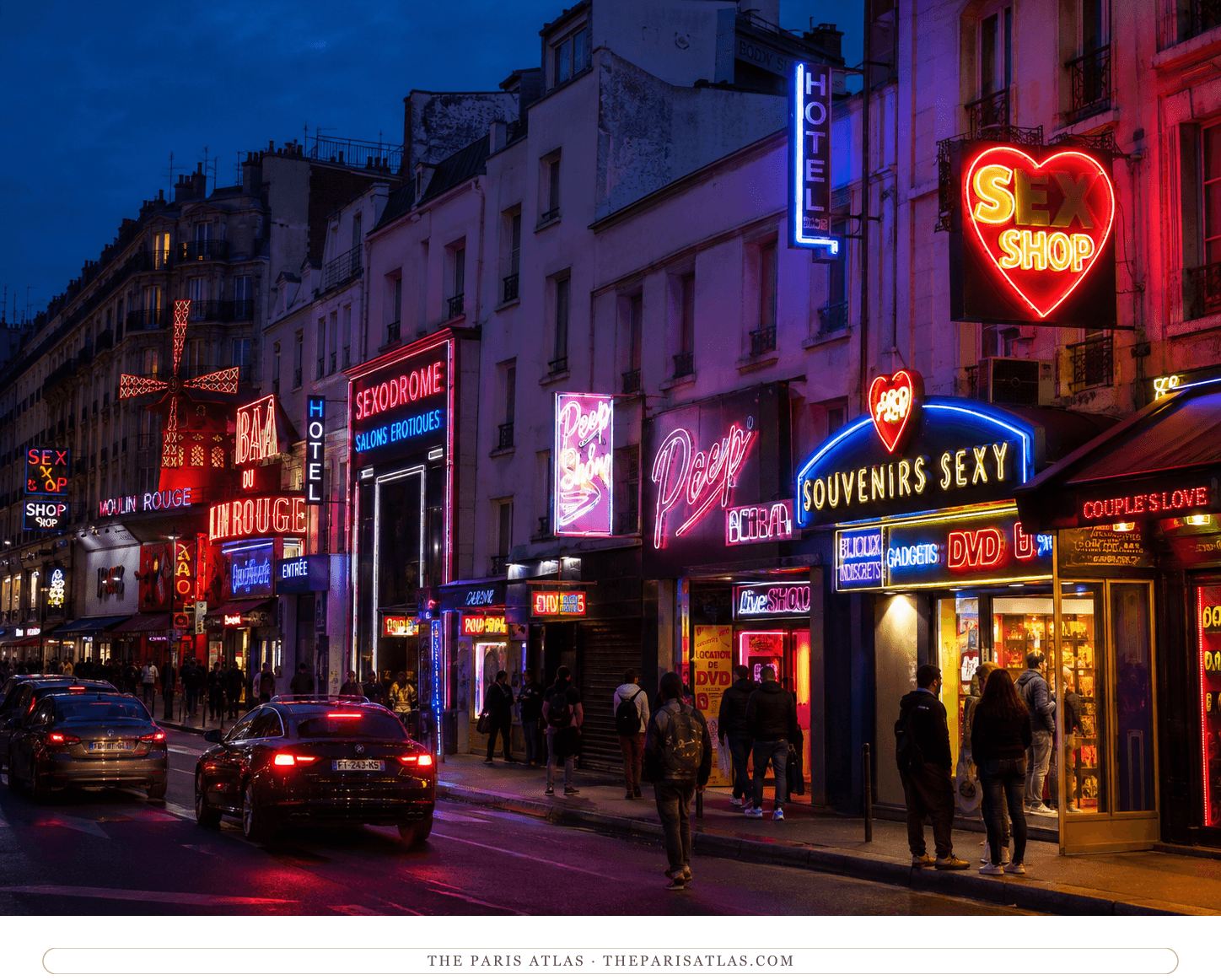
Le Chat Noir occupied two essential addresses. The original cabaret opened at 84 Boulevard de Rochechouart in 1881; that early building is gone, and a gift shop now trades at the address. A nearby Histoire de Paris marker preserves the connection for visitors.

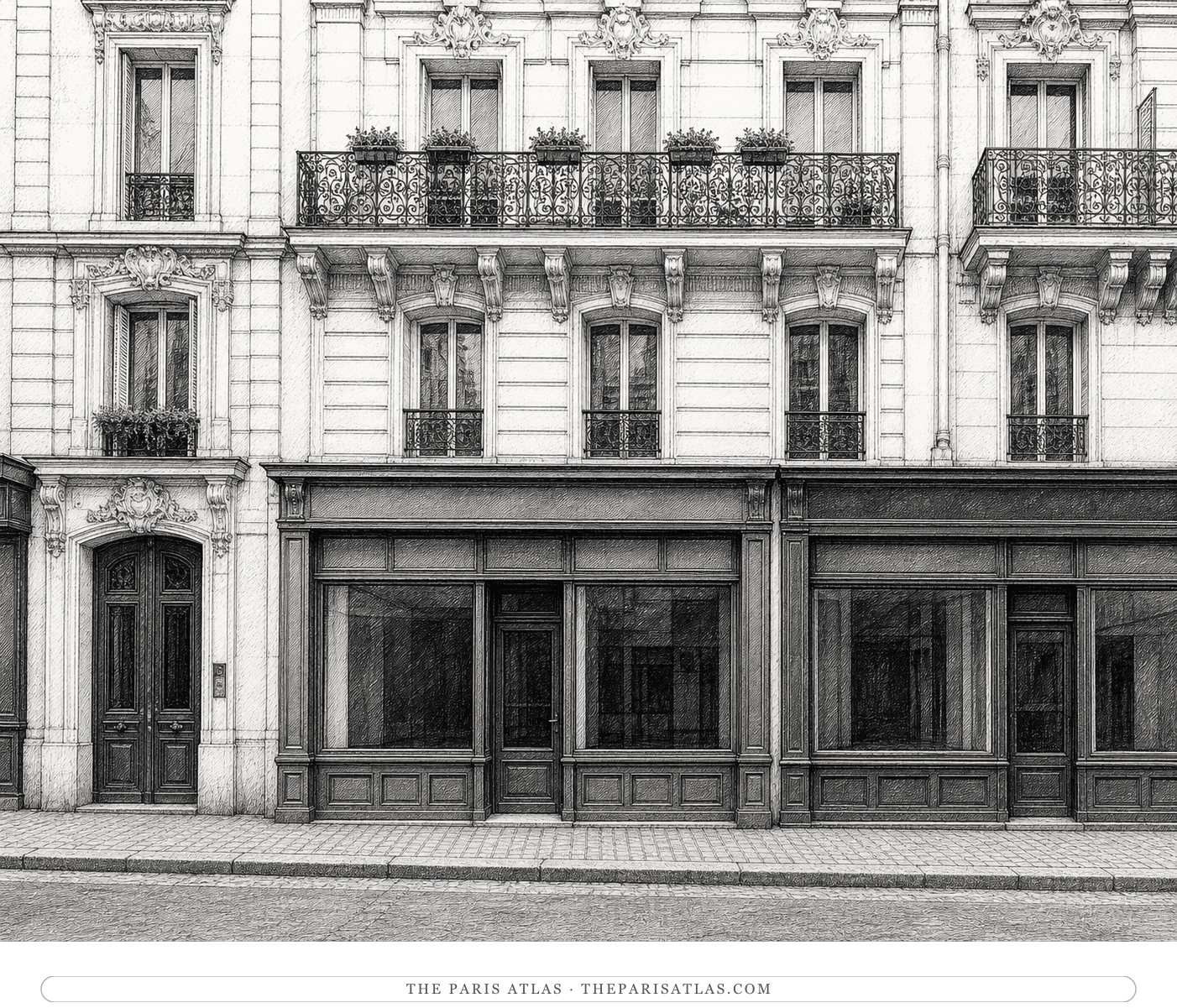
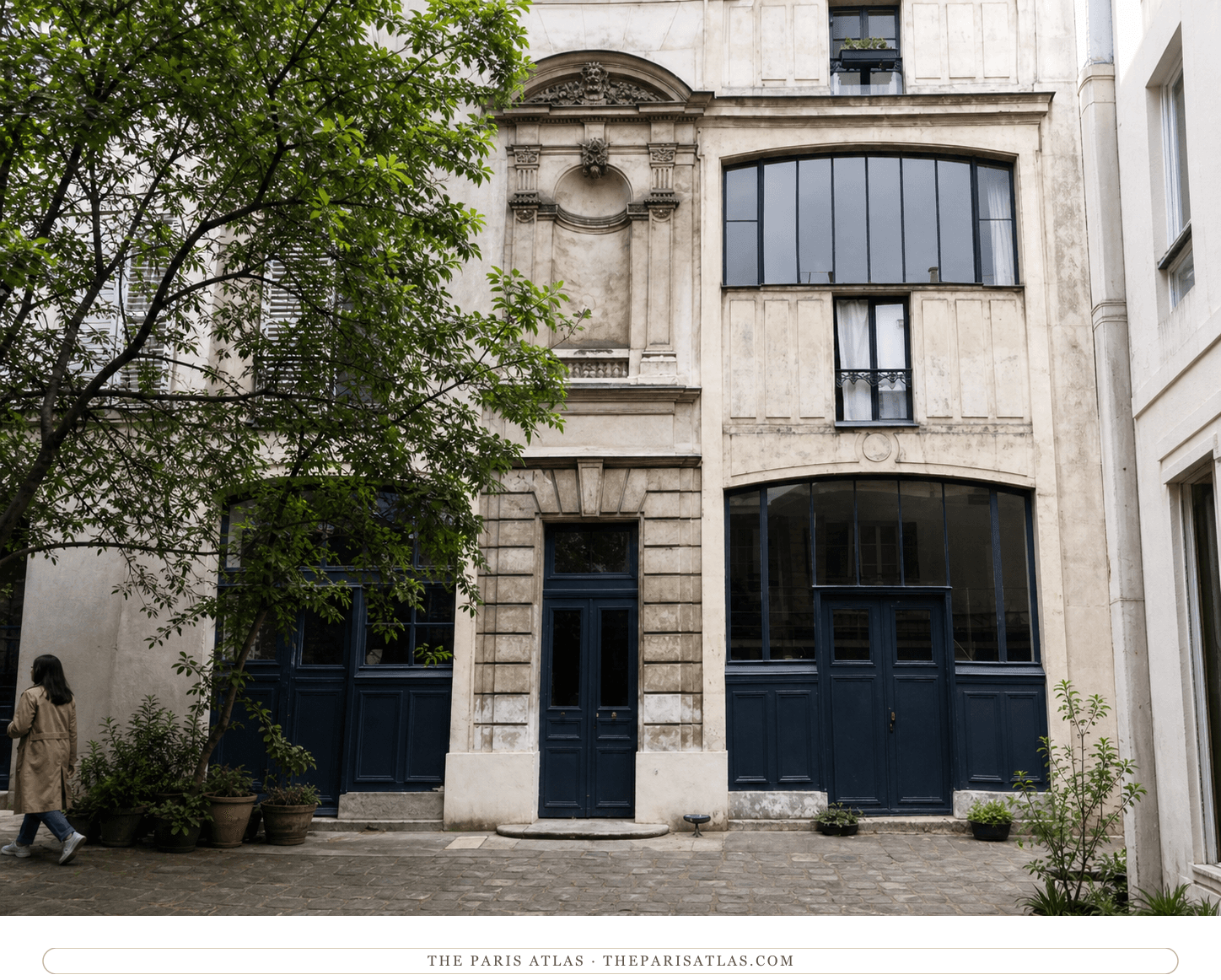
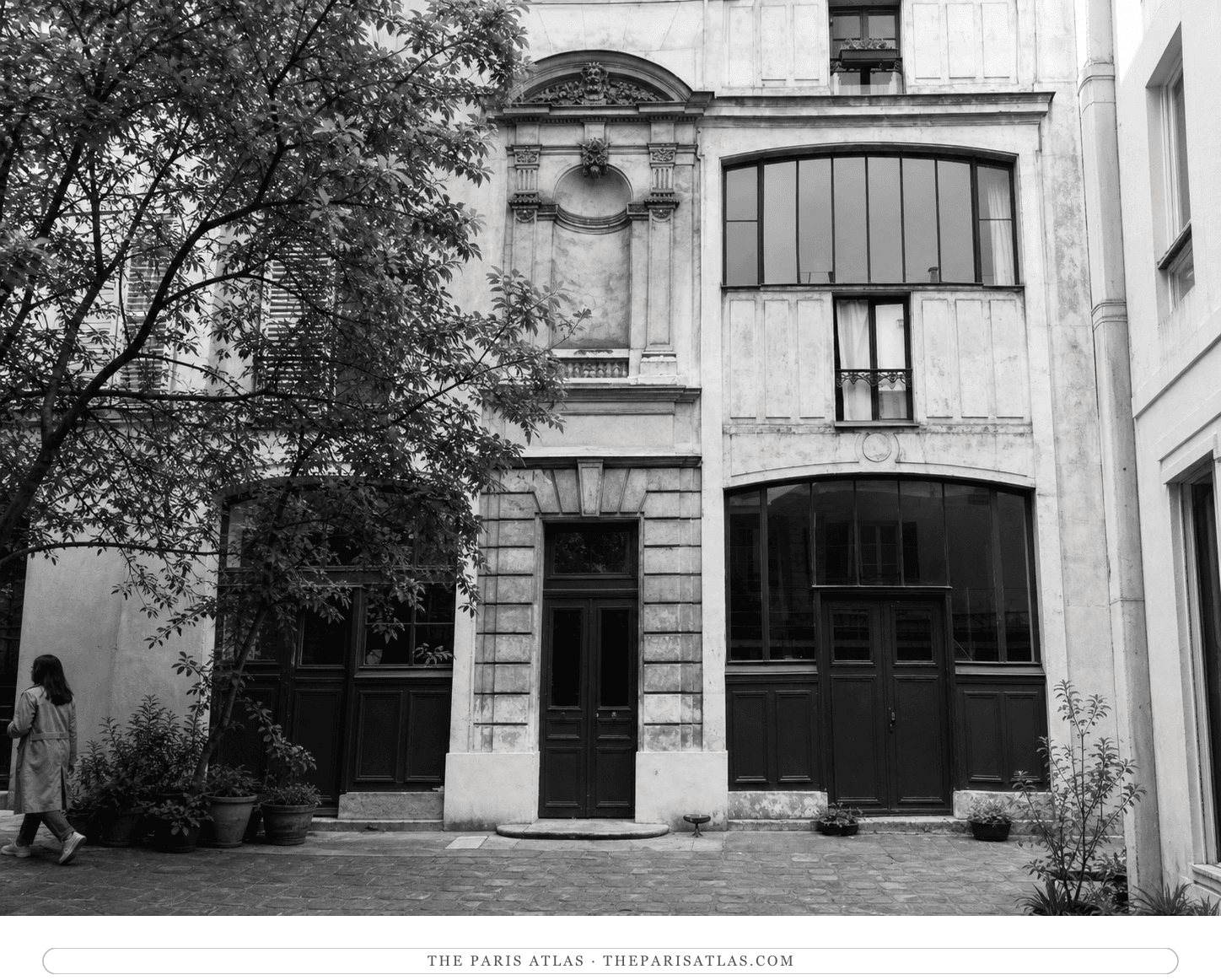
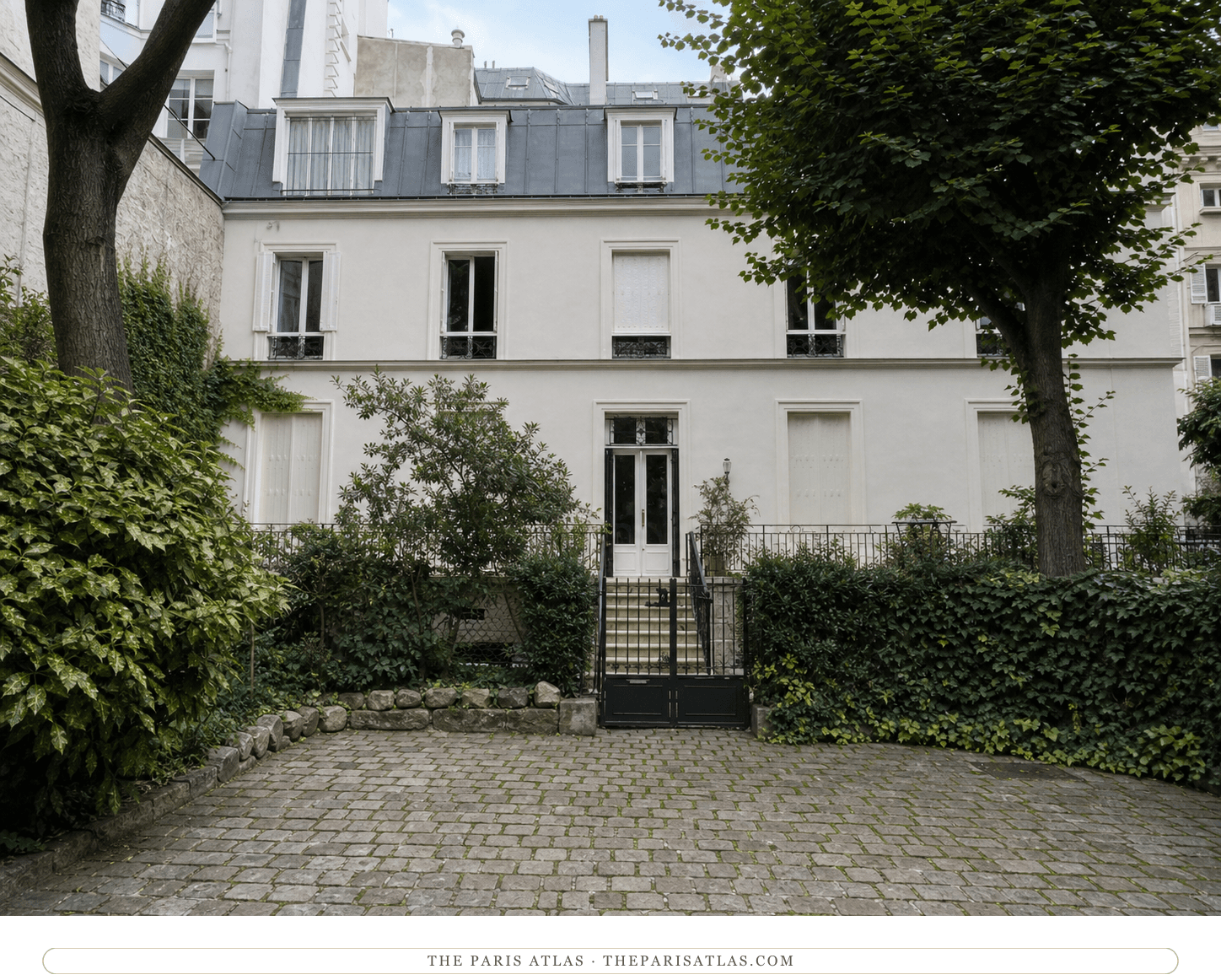
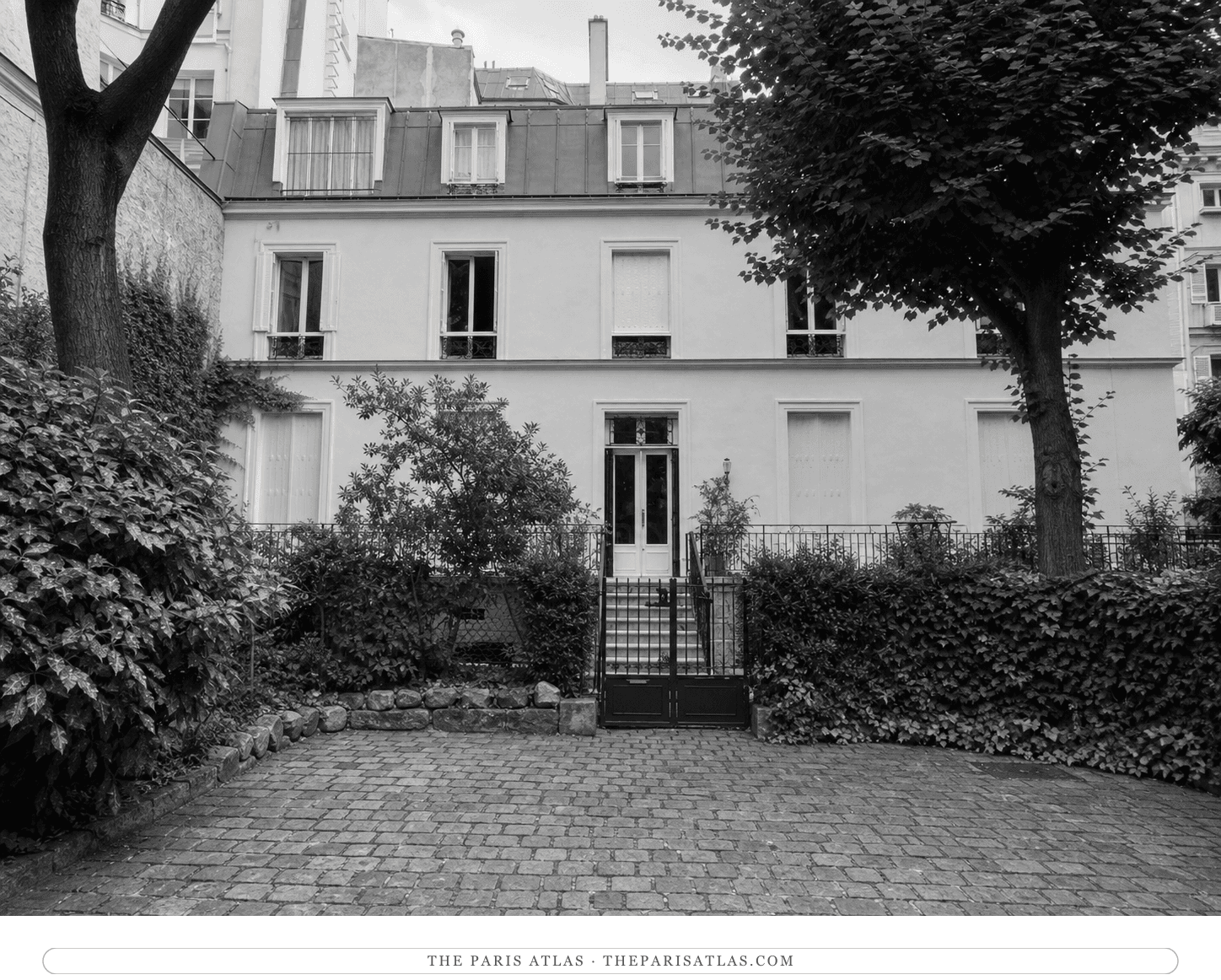
The surviving facade at 12 Rue Victor-Massé, formerly 12 Rue de Laval, belonged to the larger second Chat Noir from 1885 to 1897. A memorial plaque and small black-cat marker make that history legible from the pavement even though the cabaret itself is gone.

All four present-day views below are editorial reconstructions based on the current streetscapes, not documentary photographs.

84 Boulevard de Rochechouart today: the original building is gone and a gift shop occupies the address — editorial reconstruction.Artistic reconstruction
The first Chat Noir address as a present-day ink illustration. A Paris history marker commemorates the cabaret nearby.Artistic reconstruction
The second Chat Noir address as it appears today: a residential facade marked by a plaque and black-cat emblem — editorial reconstruction.Artistic reconstruction
The surviving Rue Victor-Massé facade in black-and-white ink — editorial reconstruction.Artistic reconstruction

Key facts

Name
Le Chat Noir — “The Black Cat”
Type
Artistic and literary cabaret
Founder
Rodolphe Salis
Founded
1881
First location
84 Boulevard de Rochechouart, at the foot of Montmartre
Second location
12 Rue de Laval, renamed Rue Victor-Massé
Original cabaret closed
1897, after sixteen years under Salis
Best known for
Songs, poetry, satire, its illustrated newspaper, and its shadow theater
Le Chat Noir at 12 Rue de Laval, now Rue Victor-Massé — a black-and-white ink reconstruction. This was the cabaret's second and most celebrated home, from 1885 to 1897.Artistic reconstruction
Le Chat Noir at its most celebrated address — a color editorial reconstruction. Hover to reveal the paired ink view.Artistic reconstruction
The original Le Chat Noir at 84 Boulevard de Rochechouart, its home from 1881 to 1885 — color editorial reconstruction.Artistic reconstruction
The original Boulevard de Rochechouart facade in black-and-white ink — editorial reconstruction.Artistic reconstruction
Théophile-Alexandre Steinlen, Tournée du Chat Noir, 1896. CC0 Paris Musées / Musée Carnavalet – Histoire de Paris.Artwork reproduction
Adolphe Willette's original sign for Le Chat Noir, 1881. CC0 Paris Musées / Musée Carnavalet – Histoire de Paris.Artwork reproduction
Paul Merwart, L'entrée du cabaret du Chat Noir. CC0 Paris Musées / Musée Carnavalet – Histoire de Paris.Artwork reproduction
Paul Merwart, L'intérieur du cabaret du Chat Noir, 1886. CC0 Paris Musées / Musée Carnavalet – Histoire de Paris.Artwork reproduction
Paul Merwart, Vue de l'intérieur du cabaret du Chat Noir : la rédaction du journal Le Chat Noir. CC0 Paris Musées / Musée Carnavalet – Histoire de Paris.Artwork reproduction
Auguste Lepère, Représentation au Chat-Noir, 1893. CC0 Paris Musées / Musée Carnavalet – Histoire de Paris.Artwork reproduction
A lively evening before the shadow play — an editorial reconstruction based on surviving views of the Rue de Laval interior.Artistic reconstruction
The shadow theater in performance — an editorial reconstruction based on surviving views of the cabaret and its stage.Artistic reconstruction
After hours: illustrators and theater makers at work — an editorial reconstruction based on period views of Le Chat Noir.Artistic reconstruction

Timeline

  1. 1881

    Rodolphe Salis opens Le Chat Noir at 84 Boulevard de Rochechouart. Artists, writers and members of Émile Goudeau's literary circle soon gather there.

  2. 1882

    Contemporary newspapers are already describing the establishment as a gathering place for eccentric artists and writers and as something resembling a small museum.

  3. 1880s

    The illustrated weekly Le Chat noir becomes an extension of the cabaret's literary and visual culture.

  4. 1884

    Adolphe Willette creates the monumental Parce Domine for the cabaret.

  5. 1885

    Salis moves Le Chat Noir to 12 Rue de Laval, now Rue Victor-Massé, giving the establishment more room for performances and elaborate decoration.

  6. 1886

    The celebrated shadow theater develops under figures including Henri Rivière and Henry Somm.

  7. Late 1880s–1890s

    The cabaret evolves from an intimate artistic gathering place into one of Montmartre's fashionable attractions. Shadow plays, songs, satire, journalism and graphic art combine under the Chat Noir identity.

  8. 1893

    Pere Romeu encounters the Chat Noir shadow theater during a trip to Paris. Le Chat Noir later serves as the model for Barcelona's Els Quatre Gats.

  9. 1896

    Steinlen creates Tournée du Chat Noir, the famous poster featuring the enormous black cat.

  10. March 1897

    Rodolphe Salis dies.

  11. 1897

    The original Chat Noir closes, ending the sixteen-year Salis-era artistic enterprise.

  12. 1899

    The former Rue Victor-Massé premises are associated with La Boîte à Fursy.

  13. Twentieth century

    The Chat Noir name is revived at a later establishment on Boulevard de Clichy, contributing to later confusion over the historic cabaret's addresses.

  14. 1992

    The Musée d'Orsay presents the exhibition Le Cabaret du Chat Noir (1881–1897).

  15. 2012–2013

    The Musée de Montmartre presents Autour du Chat Noir: Arts et plaisirs à Montmartre, 1880–1910, bringing together more than 300 works and reconstructing aspects of the cabaret's artistic environment.

  16. Today

    The Musée de Montmartre preserves important Chat Noir material and has worked on a dedicated reconstruction of its shadow theater using surviving historic zinc silhouettes and scenes.

On the map

Questions before you go

Was Le Chat Noir a café or a nightclub?

It was best described as an artistic cabaret. People could drink and socialize there as in a café or bar, but literature, songs, comedy, art and eventually elaborate shadow-theater performances were central to the establishment. It should not be imagined as a modern nightclub.

Who founded Le Chat Noir?

Rodolphe Salis, an entrepreneur and performer who became the establishment's host and master of ceremonies, founded it in 1881.

When did Le Chat Noir open?

The original Le Chat Noir opened in 1881 at 84 Boulevard de Rochechouart.

Where was the original Le Chat Noir?

Its first location was 84 Boulevard de Rochechouart. In 1885, Salis moved the cabaret to the much larger 12 Rue de Laval, now called 12 Rue Victor-Massé.

Why was Le Chat Noir famous?

It combined an unusually important community of writers, illustrators, singers and musicians with an illustrated newspaper and one of the most sophisticated shadow theaters of nineteenth-century Paris.

Who designed the famous Chat Noir poster?

Théophile-Alexandre Steinlen created the celebrated Tournée du Chat Noir lithograph in 1896.

Was Toulouse-Lautrec really there?

Yes. Musée d'Orsay material based on the recollections of Toulouse-Lautrec's friend Maurice Joyant specifically describes him entering Salis's Chat Noir.

Did Le Chat Noir invent shadow theater?

Shadow-puppet traditions are far older than Le Chat Noir, so it would be incorrect to say the cabaret invented shadow theater itself. What Le Chat Noir did was develop an unusually sophisticated modern Parisian version using zinc silhouettes, lighting, music and elaborate productions. Henri Rivière and Henry Somm were particularly important to its development from 1886 onward.

How many shadow plays were performed there?

Musée d'Orsay records 45 productions.

What happened to Le Chat Noir?

Competition increased during the 1890s. Rodolphe Salis died in March 1897, and the original Chat Noir artistic enterprise ended that year.

Is the later Chat Noir on Boulevard de Clichy the same place?

Not in the sense of an uninterrupted Salis-era cabaret. A later establishment revived the Chat Noir name after the original had closed. For the historic Rodolphe Salis cabaret, the two essential addresses are Boulevard de Rochechouart and Rue de Laval/Rue Victor-Massé.

Can you still see original objects from Le Chat Noir?

Yes. The Musée Carnavalet preserves the original sign, paintings and extensive visual material, while the Musée de Montmartre preserves important shadow-theater material and has developed a reconstruction devoted to that aspect of the cabaret.

Within walking distance

The Friday Letter

Paris, one address at a time.

The cafés, studios, and walk-up flats where the work was made — one story from the map in every letter.

One email a week. No spam, no selling your address. Unsubscribe anytime.