Moulin Rouge: La Goulue
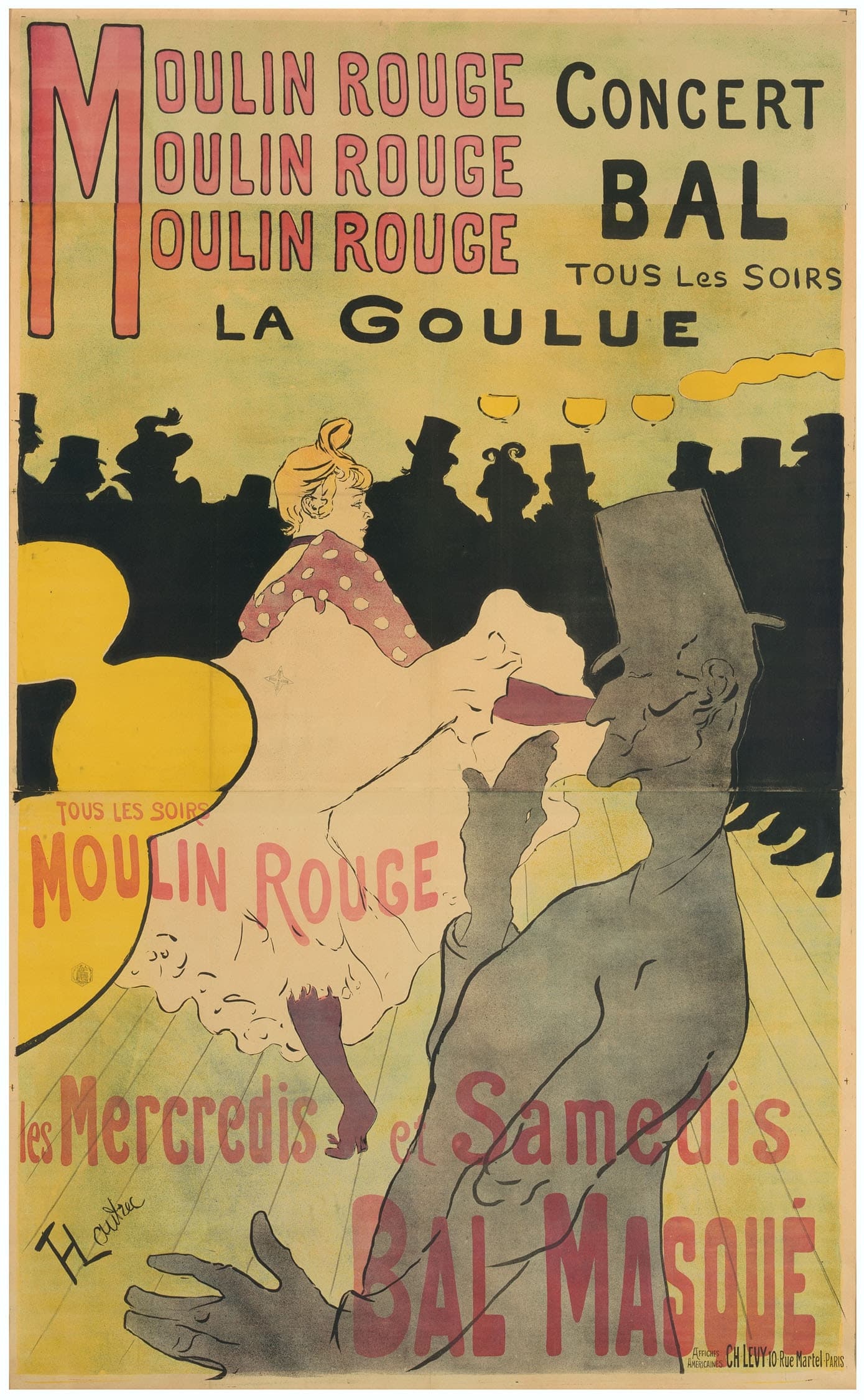
The dancer La Goulue kicks up her white petticoats in the middle of a packed dance floor, and her partner Valentin le Désossé stands in front of her in gray. Henri de Toulouse-Lautrec made the poster in 1891 for the Moulin Rouge in Montmartre. It was his first poster, and it made him famous. The Art Institute of Chicago's copy is 1954.1193.
- 1891
- Color lithograph on tan wove paper
- Art Institute of ChicagoChicago, United States
About Henri de Toulouse-Lautrec
What the poster shows
La Goulue dances in the middle of the sheet, seen from the side. Her blond hair is piled up in a twist on top of her head. She wears a pink blouse with pale polka dots and a dark ribbon at the neck. Her white petticoats spread out below her in a big frothy mass, and one leg in a dark stocking shoots out sideways toward the man in front of her.
That man is Valentin le Désossé, her dance partner. He stands in the foreground in gray, cut off at the waist by the bottom of the poster. He wears a tall hat and faces left, and one big gray hand reaches into the bottom left corner.
Behind the two dancers the crowd is a solid band of black. Only the shapes of the top hats and the women's hats show where one person ends and the next begins. Three yellow lamps hang above their heads, and a wavy yellow streak floats at the top right. It's not clear whether the streak is smoke, light or something else.
Words fill the top and bottom of the sheet. MOULIN ROUGE is printed three times in red at the top left, with one tall letter M serving all three lines. CONCERT, BAL and TOUS Les SOIRS sit in black at the top right, and LA GOULUE runs underneath. At the bottom, in big red letters, the poster announces the masked balls on Wednesdays and Saturdays: les Mercredis et Samedis BAL MASQUÉ.
His first poster
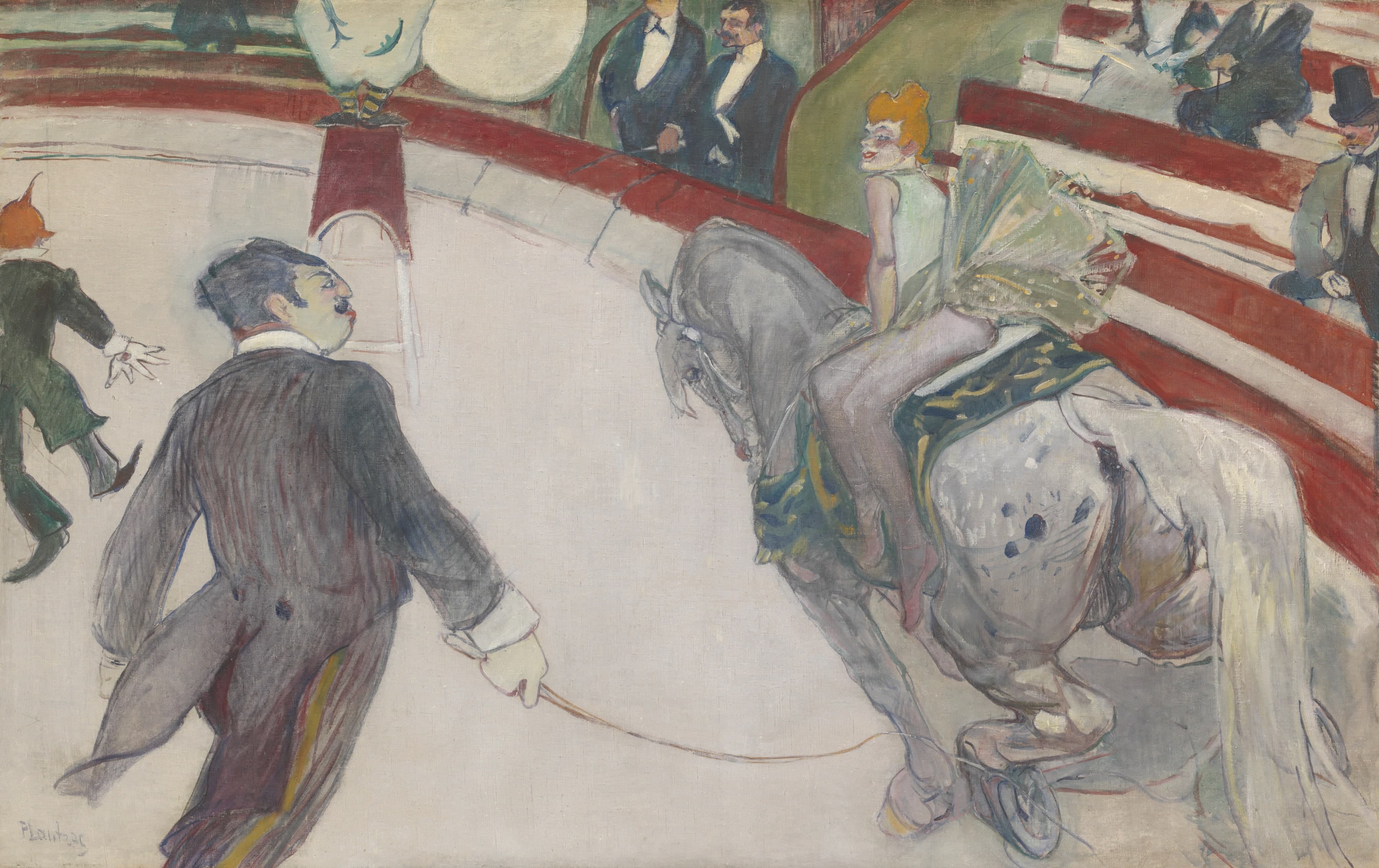
The Moulin Rouge opened on the boulevard de Clichy in 1889 as a dance hall with a drinking garden. Henri de Toulouse-Lautrec was a regular. One of his paintings, Equestrienne (At the Cirque Fernando), hung near the entrance, and he sat most nights at a front-row table with his friends.
The Musée Toulouse-Lautrec in Albi says Charles Zidler, the director of the Moulin Rouge, ordered the poster in 1891 for the start of the season. Colta Ives of the Metropolitan Museum of Art writes that Toulouse-Lautrec's first big painting of the dance floor, The Dance at the Moulin Rouge of 1889–90, led to the commission.
The Art Institute of Chicago says thousands of copies were pasted up around Paris. The poster was an instant success, and performers and cabaret owners began asking him for posters of their own. The Met says it made him famous overnight.
Ives adds that the poster outraged his family, who were old French aristocrats. His friend Thadée Natanson later said a poster should hit you like a fist in the face.
A dance floor, not a poster girl
The best-known posters in Paris at the time were by Jules Chéret, and they showed sweet, smiling young women beckoning to passers-by. Colta Ives calls Chéret the founding father of street advertising. Toulouse-Lautrec showed the crowded floor of a real dance hall instead, with two of its real stars.
La Goulue was the stage name of Louise Weber. It means the glutton. Valentin le Désossé means Valentin the boneless. The Victoria and Albert Museum in London repeats a story that he never took money for dancing and danced only for the love of it.
The Met describes the end of their dance, the chahut, when La Goulue's cancan skirts flew up. Ives adds that the crowd cheered when they did.
The Museum of Modern Art in New York points out that the white of La Goulue's petticoats is not printed at all. It is simply the bare paper left empty in the middle of the design.
Who is in the crowd
The black crowd looks anonymous at first. The Museum of Modern Art says some of the silhouettes are people Toulouse-Lautrec painted elsewhere, and that you can pick them out by their hats. It names the dancer Jane Avril, the hostess Misia Natanson and the painter William Warrener.
The museum does not say which silhouette is which, and the hats alone do not settle it. The woman's hat with a curled feather just to the right of La Goulue is the most distinctive shape in the row.
Printed in four colors on three sheets
The printer was Affiches Américaines, the firm of Charles Lévy in Paris, and its name runs along the bottom right edge. The Met describes the poster as a lithograph printed in four colors on three sheets of paper. In lithography the design is drawn on a flat stone, and each color needs a stone of its own.
The design was too big to print on one sheet. The joins show as faint horizontal lines across the poster. The clearest runs just above the words TOUS LES SOIRS on the left.
The Victoria and Albert Museum notes spatter effects on its copies. Those are the fine speckles of color that give the gray of Valentin's figure and the yellow of the floor their grainy texture.
Where the copies are
Several museums hold a copy. Posters are works on paper and are usually shown only for short periods. The Art Institute of Chicago's copy, 1954.1193, came with the Mr. and Mrs. Carter H. Harrison Collection. The Met bought its copy, 32.88.12, in 1932.
The Museum of Modern Art's copy is catalogued as one of a few known proofs. The Victoria and Albert Museum has several, including E.223-1921. The Musée Toulouse-Lautrec in Albi has the copy given by the artist's mother, Countess Adèle de Toulouse-Lautrec, in 1922.
The copies are not all the same size, because big posters were trimmed and mounted differently. The Art Institute gives 191 by 117 centimeters for its sheet, the Met 190 by 116.5, the Museum of Modern Art 195 by 119.5, and the Victoria and Albert Museum 195 by 122.5.
Close reading
Reading the work, detail by detail
Henri de Toulouse-Lautrec's first poster is more than six feet tall, and it was made to be read at a glance. Up close it is full of small details: a letter M that does three jobs, a petticoat made of bare paper, a crowd reduced to hats, and a printer's line tucked into the corner.
1.One tall M for three lines of MOULIN ROUGE
MOULIN ROUGE is printed three times in red, one line under another. A single tall letter M runs down the left side and starts all three words. Under them, LA GOULUE is lettered in heavy black capitals, and the tops of the crowd's hats begin just below.
2.La Goulue's topknot and polka dots
La Goulue is seen in profile, facing right. Her blond hair is twisted into a knot on top of her head, with loose curls at the back. A dark ribbon circles her neck, and her pink blouse is covered in pale round dots. The crowd behind her is flat black, so her pale face stands out sharply.
3.The kick ends at Valentin's nose
La Goulue's leg, in a dark pinkish-purple stocking, shoots out sideways from her petticoats. It stops right at the face of Valentin le Désossé, who stands in gray under his tall hat. The leg and his nose almost touch, right in the middle of the poster.
4.Petticoats made of bare paper
The petticoats are not printed white at all. They are the bare tan paper, with a few loose black lines to show the frills. The Museum of Modern Art points out this trick. Everything around them is printed in color, so the empty paper reads as the brightest thing on the poster.
5.The other leg, in a purple stocking
Below the frills, La Goulue's other leg hangs down in the same purple stocking. It is bent at the knee and does not seem to touch the floor. Faint pink letters of MOULIN ROUGE run behind her skirts.
6.A crowd made only of hats
The crowd is one flat black shape. You can only tell the people apart by their hats: several top hats and a woman's hat with a curled feather. The Museum of Modern Art says some of these silhouettes are people Toulouse-Lautrec knew, including Jane Avril, but it does not say which hat belongs to whom.
7.Three lamps and a yellow streak
Yellow bowl-shaped lamps hang in a row over the heads of the crowd. To their right a long wavy streak of the same yellow floats near the top edge. It might be smoke lit up by the lamps, or a stretch of light, but it's not clear what it is meant to be.
8.A big yellow shape at the left edge
A large flat yellow shape with rounded bumps fills the left edge, outlined in black. It's not clear what it is. It could be a lamp, or a skirt in the foreground, or simply a patch of color. A faint horizontal line crosses just above the red TOUS LES SOIRS, where two of the three printed sheets meet.
9.Valentin's big gray hand
Valentin le Désossé's hand reaches into the bottom left corner. It is very large, with long spread fingers. Like the rest of his figure it is printed in a grainy gray, and the floorboards show as thin lines behind it.
10.HLautrec, low on the floor
Toulouse-Lautrec signed the poster HLautrec in black, low on the floor at the left. The H is a big separate capital, and the rest of the name runs on in a quick slanting hand. The signature was drawn on the stone, so it is printed on every copy.
11.BAL MASQUÉ behind Valentin
The bottom of the poster announces masked balls on Wednesdays and Saturdays. The big red letters of BAL MASQUÉ run behind Valentin's gray body, and his dark outline cuts straight across them.
12.The printer's line
In the bottom right corner is the printer's line. AFFICHES AMERICAINES is set in two small lines, and CH. LEVY follows in tall capitals with the street address, 10 rue Martel. The Met names the printer as Affiches Américaines, the firm of Charles Lévy.
13.A small four-pointed stamp
On the bare paper of the petticoats is a small stamp shaped like a four-pointed star. The lettering inside it is too small and faint to read. It could be a collector's mark or an official stamp, but the Art Institute does not describe it.
Timeline
1889
The Moulin Rouge opens on the boulevard de Clichy. Toulouse-Lautrec's Equestrienne hangs near the entrance.
1889–1890
Toulouse-Lautrec paints The Dance at the Moulin Rouge, which Colta Ives says led to the poster commission.
1891
Charles Zidler orders the poster for the new season. Affiches Américaines prints it, and thousands of copies go up across Paris.
1922
Countess Adèle de Toulouse-Lautrec gives a copy to the new museum in Albi.
1932
The Metropolitan Museum of Art buys its copy, 32.88.12.
1954
The Art Institute of Chicago's copy is catalogued as 1954.1193, from the Mr. and Mrs. Carter H. Harrison Collection.
Where to see it
Art Institute of Chicago
111 South Michigan Avenue, Chicago, IL 60603, United States
The Art Institute of Chicago's record listed the poster as not on view in September 2026. Works on paper are shown only for short periods, so check before a visit.
Plan your visit on the museum’s official website (opens in a new tab)Frequently asked questions
Who is La Goulue?
La Goulue was the stage name of the dancer Louise Weber, one of the biggest stars of the Moulin Rouge. The name means the glutton. On the poster she is the blond dancer in the pink polka-dot blouse and white petticoats in the middle of the floor.
Who is the gray man in front of La Goulue?
He is Valentin le Désossé, her dance partner. The nickname means Valentin the boneless. He stands in the foreground in gray, facing left, cut off at the waist by the bottom edge of the poster.
Was this Toulouse-Lautrec's first poster?
Yes. The Musée Toulouse-Lautrec, the Art Institute of Chicago and the Museum of Modern Art all describe it as his first poster. It was made in 1891, and the Met says it made him famous overnight.
What does the lettering on the poster say?
MOULIN ROUGE three times at the top left, CONCERT BAL TOUS Les SOIRS at the top right, and LA GOULUE below. Lower down it reads TOUS LES SOIRS MOULIN ROUGE, and at the bottom les Mercredis et Samedis BAL MASQUÉ, which means masked balls on Wednesdays and Saturdays.
How big is the Moulin Rouge: La Goulue poster?
About 191 by 117 centimeters, a little over six feet tall. It was printed on three sheets of paper joined together. Copies vary by a few centimeters because each one was trimmed and mounted differently.
Where can I see an original?
Copies are held by the Art Institute of Chicago (1954.1193), the Metropolitan Museum of Art (32.88.12), the Museum of Modern Art, the Victoria and Albert Museum in London and the Musée Toulouse-Lautrec in Albi. Posters are works on paper and are shown only now and then, so check the museum's own page before a visit.
Why is La Goulue's petticoat white?
Because it is the bare paper. The Museum of Modern Art points out that Toulouse-Lautrec left that area unprinted, so the empty sheet itself becomes the white petticoats at the center of the design.
More by Henri de Toulouse-Lautrec
If you like Henri de Toulouse-Lautrec
Explore painters from the same movements and circles.
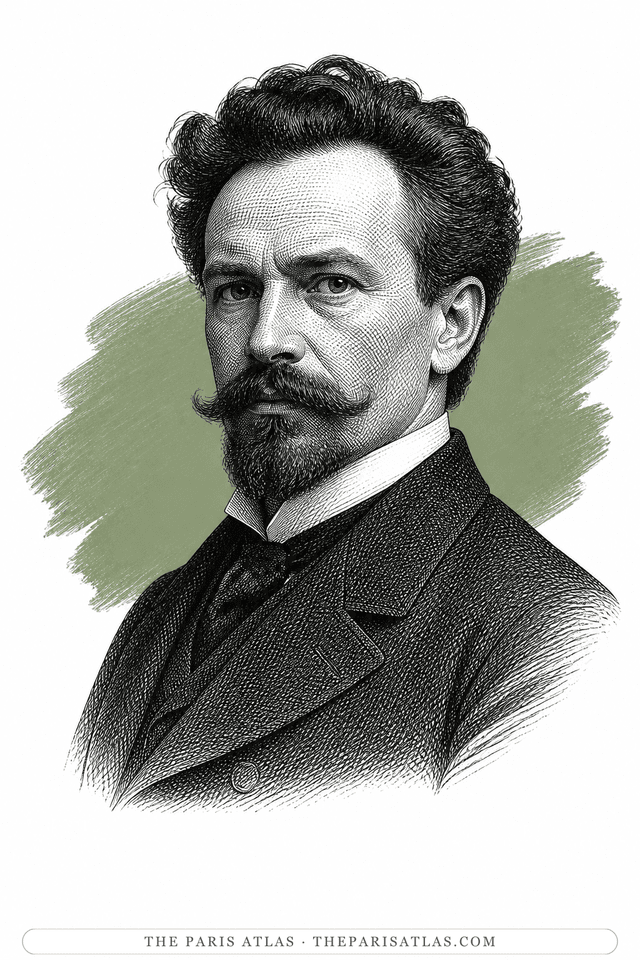
Alphonse Mucha
Czech poster artist whose Gismonda, designed for Sarah Bernhardt over the last week of December 1894, went up on Paris walls on 1 January 1895 and made him famous in days. The six-year Bernhardt contract that followed put his work on every kiosk in the city and gave Art Nouveau its face.
View artist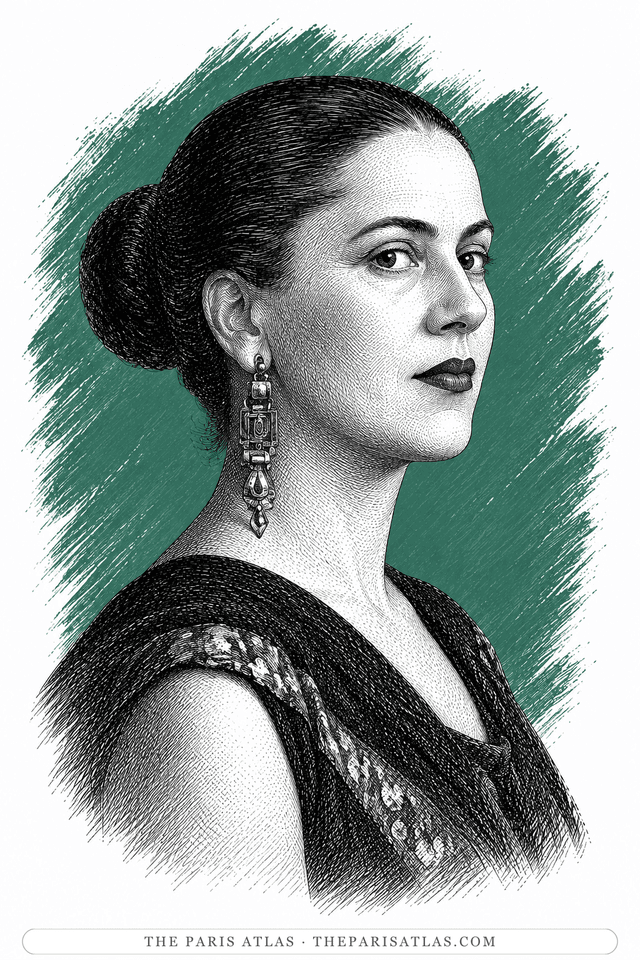
Tarsila do Amaral
Brazilian painter who spent the 1920s moving between São Paulo and Paris, studied Cubism under André Lhote, Albert Gleizes and Fernand Léger, and used what she learned to paint Brazilian towns, railways, plants and bodies. Her 1928 painting Abaporu prompted the manifesto that gave the Anthropophagic movement its name.
View artist
Pierre Bonnard
French painter, printmaker and illustrator whose intimate rooms, Paris streets, gardens and bathing figures transformed everyday life into complex fields of color, memory and perception.
View artist
References
The sources below include collection records, catalogues, scholarly research, and primary materials that informed this page. They document Moulin Rouge: La Goulue, its making, and its place in cultural history.


1Henri de Toulouse-Lautrec, Moulin Rouge, La Goulue, 1891
WebsiteArt Institute of ChicagoUsed forThe holding museum's record, and the reproduction the close-reading views were cropped from.
2Moulin Rouge. La Goulue — Masterpieces under the microscope
WebsiteMusée Toulouse-Lautrec, AlbiUsed forWeb source consulted for documented facts and historical context presented on the Moulin Rouge: La Goulue page.
3Henri de Toulouse-Lautrec, Moulin Rouge: La Goulue, 1891 (32.88.12)
WebsiteThe Metropolitan Museum of ArtUsed forWeb source consulted for documented facts and historical context presented on the Moulin Rouge: La Goulue page.
4Henri de Toulouse-Lautrec, Moulin Rouge, La Goulue, 1891
WebsiteThe Museum of Modern ArtUsed forWeb source consulted for documented facts and historical context presented on the Moulin Rouge: La Goulue page.
5Henri de Toulouse-Lautrec, Moulin Rouge, La Goulue, 1891 (E.223-1921)
WebsiteVictoria and Albert MuseumUsed forWeb source consulted for documented facts and historical context presented on the Moulin Rouge: La Goulue page.

6Toulouse-Lautrec in The Metropolitan Museum of Art
Exhibition catalogueThe Metropolitan Museum of Art, 1996Used forColta Ives on the commission, the Chéret comparison, Thadée Natanson's remark and the family's reaction.
7Toulouse-Lautrec et l'art de l'affiche: communique de presse
WebsiteMusee Toulouse-Lautrec, AlbiUsed forWeb source consulted for documented facts and historical context presented on the Moulin Rouge: La Goulue page.
8History of the Museum — Musée Toulouse-Lautrec, Albi
WebsiteMusée Toulouse-Lautrec, AlbiUsed forFor the 1922 gift from the artist's mother that founded the Albi museum.
9Henri de Toulouse-Lautrec, At the Moulin Rouge, 1892-95 (1928.610)
WebsiteArt Institute of ChicagoUsed forFor Equestrienne hanging at the Moulin Rouge.
These references provide the documented foundation for this work's history and interpretation. Claim-level citations remain attached to the specific claims they support.
 Explore more resources