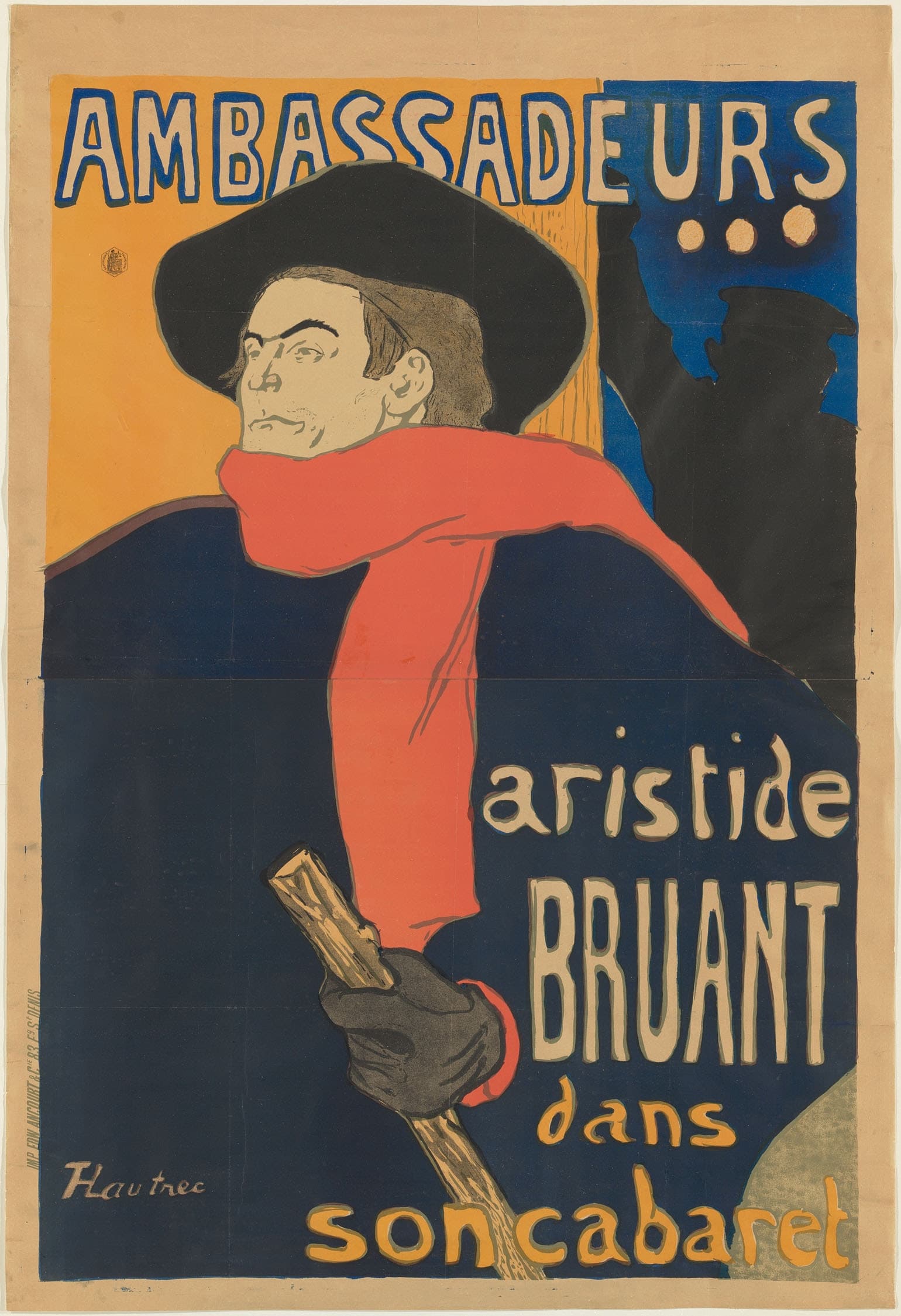
The singer Aristide Bruant looks back over his shoulder in a wide black hat, a dark cape and a red scarf, with a wooden stick in his gloved hand. Henri de Toulouse-Lautrec made the poster in 1892 for Bruant's shows at the Ambassadeurs, a café-concert on the Champs-Élysées. The director disliked it, and Bruant refused to go on stage unless it was used. The Art Institute of Chicago's copy is 1948.450.
Aristide Bruant fills most of the sheet. He is turned away from us with his head twisted back to the left, so we see his face in three-quarter view over his shoulder. He frowns, and his dark eyebrows are drawn in thick strokes.
He wears a wide-brimmed black hat and a long dark blue cape that takes up the whole lower half of the poster. A bright red scarf wraps his neck and hangs down the front of the cape. One hand, in a dark glove, grips a short wooden stick that he used as a cane.
Behind his head is a flat orange background with a strip of grained wood, perhaps a door or a post. At the top right, against a blue background, a black silhouette of a man raises one arm under three pale lights. It's not clear who the man is meant to be.
The word AMBASSADEURS runs across the top in pale letters outlined in blue. Down the right side the poster reads aristide BRUANT dans son cabaret, which means Aristide Bruant in his cabaret.
Who Aristide Bruant was
Aristide Bruant was a singer and songwriter, born in 1851. The Victoria and Albert Museum says he wrote songs in the slang of working-class Paris and made himself the voice of the city's poor. His costume never changed: the broad black hat, the black cape, a red shirt and scarf, and black leather boots.
When Le Chat Noir moved out of 84 boulevard Rochechouart in Montmartre in 1885, Bruant opened his own cabaret, Le Mirliton, in the old rooms. The Victoria and Albert Museum says the main draw of his act was the way he insulted and taunted the audience.
Colta Ives of the Metropolitan Museum of Art writes that Toulouse-Lautrec sat on Le Mirliton's rough benches so often that Bruant sometimes introduced him from the stage. Toulouse-Lautrec drew illustrations for Bruant's magazine, also called Le Mirliton, and covers for his song sheets.
The director did not want it
In 1892 Bruant was at the height of his fame, and the Ambassadeurs invited him to perform. It was one of the café-concerts on the Champs-Élysées, across the city from Montmartre. Bruant insisted that Toulouse-Lautrec design the poster.
The Victoria and Albert Museum says the director of the Ambassadeurs disliked the design because it was so bold and blunt. Bruant said he would not perform unless the poster was used.
The Musée Toulouse-Lautrec in Albi gives Bruant's terms. He wanted two copies hung on each side of the stage, and he wanted Paris covered with them. The Victoria and Albert Museum confirms that the poster went up outside and was also used inside, around the arch of the stage.
Bruant got his way. The Victoria and Albert Museum quotes a complaint from the magazine La Vie Parisienne, taken from Henri Perruchot's biography of Toulouse-Lautrec. The writer grumbled that you could not go anywhere in Paris without coming face to face with Bruant.
Big flat shapes of color
The poster is built from a few large areas of flat color with dark outlines: the black hat, the dark blue cape, the red scarf and the orange wall. There is almost no shading. The Met lists five printing colors, and each needed its own lithographic stone.
Colta Ives links this style to Japanese color woodcuts. Toulouse-Lautrec collected them. Ives writes that Japanese prints of Kabuki actors, with their exaggerated faces and bold costumes, shaped the way he drew the performers of Montmartre.
The printer was Edward Ancourt, whose name runs up the left margin: IMP. EDW. ANCOURT & Cie, 83 faubourg Saint-Denis.
The same design, turned around
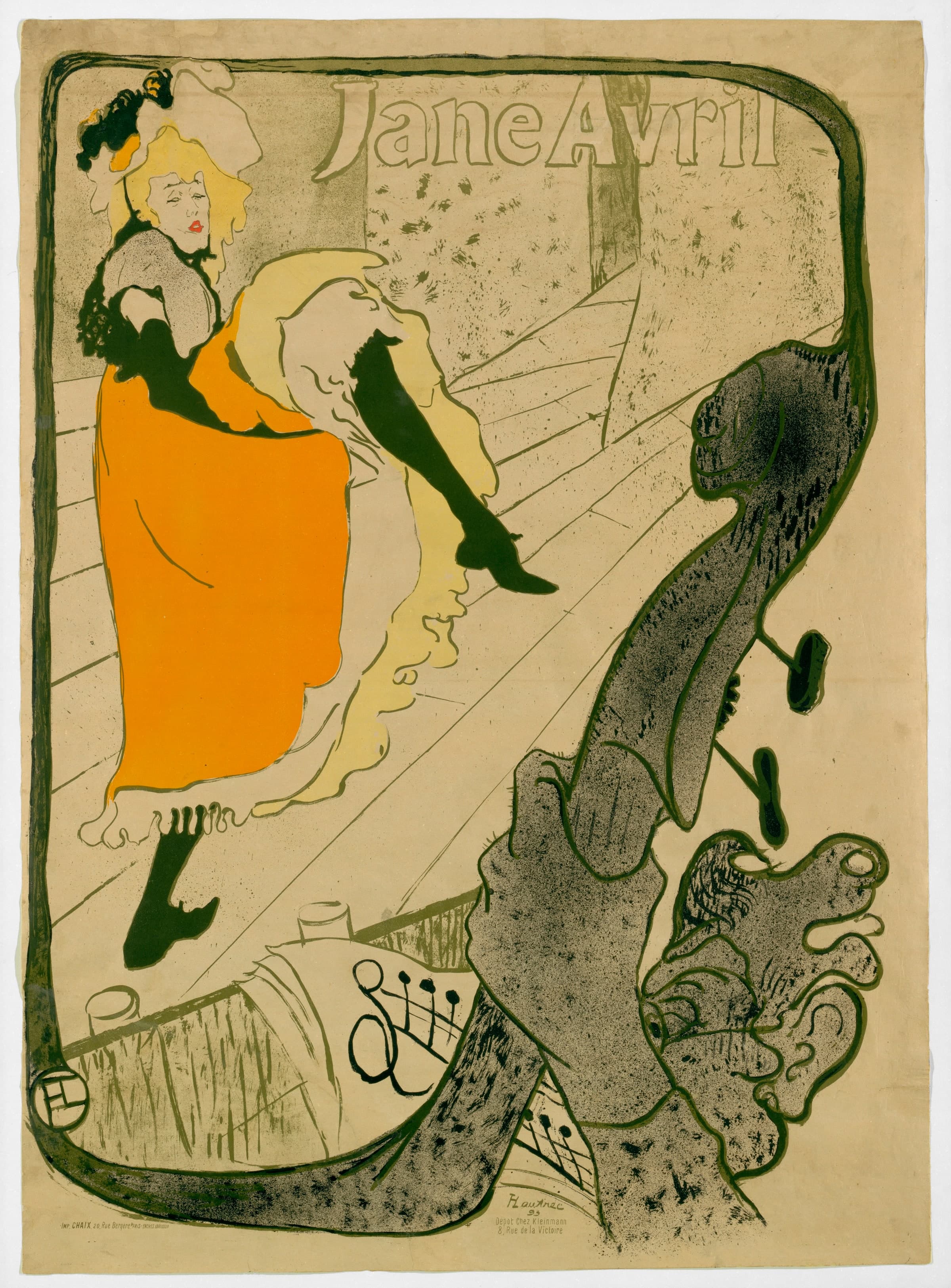
In the same year Toulouse-Lautrec made a second poster for Bruant's shows at the Eldorado, on the boulevard de Strasbourg. The Victoria and Albert Museum describes it as a copy of the Ambassadeurs design. In the Eldorado version Bruant faces the other way, to the right.
Bruant became rich from his act and kept performing in the same style until his death in 1925.
Where the copies are
The Art Institute of Chicago's copy, 1948.450, came with the Mr. and Mrs. Carter H. Harrison Collection. The Metropolitan Museum of Art bought its copy, 32.88.11, in 1932. The Victoria and Albert Museum in London holds E.227-1921 and CIRC.551-1962.
The Musée Toulouse-Lautrec in Albi has a copy given by the artist's mother, Countess Adèle de Toulouse-Lautrec, in 1922. It lists the poster among the museum's masterpieces.
Measurements differ a little between copies. The Art Institute gives 147.2 by 99.9 centimeters, the Met 145.1 by 99, and the Victoria and Albert Museum 134.6 by 94.
Close reading
Reading the work, detail by detail
Aristide Bruant's poster is made of a handful of big flat shapes: a black hat, a blue cape, a red scarf and an orange wall. Looked at closely, it also holds a second figure in the corner, a join across the middle, a stamp, and the printer's name running up the margin.
1.AMBASSADEURS across the top
AMBASSADEURS runs across the top in pale letters with blue outlines. The letters sit half on the orange background and half on the blue. Bruant's black hat pushes up into the word from below.
2.The frown under the hat brim
Bruant looks back over his shoulder to the left. His dark eyebrows are drawn together in a frown, and his mouth is a flat pressed line. Colta Ives describes the knowing scowl Toulouse-Lautrec gave Bruant in his pictures of him. The face is almost all pale paper, with a few gray lines for the nose, cheek and chin.
3.Hair, ear and a strip of wood
His brown hair falls in long strands from under the hat and over his ear. The hair is printed in a grainy brown, unlike the flat colors elsewhere. Behind the hat is a vertical strip of orange with wood grain drawn in, perhaps a door frame or a post.
4.The red scarf
The red scarf wraps his neck and hangs down the front of the cape in one long band. It is the brightest color on the poster. The Victoria and Albert Museum lists a red scarf among the pieces of Bruant's regular costume, along with the hat, cape, red shirt and boots.
5.A gloved hand on a rough stick
A hand in a dark gray glove grips a short, knobbly wooden stick. A red cuff shows at the wrist. The Musée Toulouse-Lautrec in Albi says Bruant used the stick as a cane, and it counts it among his trademark props.
6.A second figure in the corner
In the top right corner, against deep blue, is the black silhouette of a man in a cap raising one arm. Three pale round lights hang above him. It's not clear who he is, whether a stagehand, a spectator or someone in the street.
7.aristide BRUANT dans son cabaret
Bruant's name is lettered straight onto his cape. aristide is in small pale letters, and BRUANT is in tall capitals below it. The words dans son cabaret follow in orange, which means in his cabaret.
8.Where two sheets meet
A faint straight line runs across the cape and the red scarf just below the middle of the poster. It seems to be where two sheets of paper were joined, since the design was too large for one sheet. The line crosses the scarf without any break in the red.
9.A speckled shape at the bottom right
At the bottom right a pale gray-green shape curves in beside the cape, covered in fine speckles. It's not clear what it is, perhaps part of a wall or the edge of the stage. The speckled texture is the only one like it on the poster.
10.A small hexagonal stamp
On the orange at the upper left is a small hexagonal stamp with lettering around its edge. The lettering is too small to read here. It may be a tax stamp or an official mark, but the museums do not describe it.
11.H Lautrec in pale paint
Toulouse-Lautrec signed the poster H Lautrec in tan letters on the dark blue of the cape, low on the left. The signature is in the same pale color as Bruant's name, so it reads as part of the lettering.
12.The printer's name up the margin
Small capitals run up the left margin, sideways to the rest of the poster. They read IMP. EDW. ANCOURT & Cie, 83 faubourg Saint-Denis, the printer and his address. The Victoria and Albert Museum also names Edward Ancourt as the printer.
Timeline
1851
Aristide Bruant is born.
1885
Le Chat Noir moves out of 84 boulevard Rochechouart, and Bruant opens Le Mirliton in its old rooms.
1892
Bruant performs at the Ambassadeurs on the Champs-Élysées. Toulouse-Lautrec designs the poster, the director objects, and Bruant refuses to perform unless it is used.
1892
Toulouse-Lautrec reuses the design, with Bruant facing right, for a poster for the Eldorado on the boulevard de Strasbourg.
1922
Countess Adèle de Toulouse-Lautrec gives a copy to the new museum in Albi.
1925
Aristide Bruant dies.
1932
The Metropolitan Museum of Art buys its copy, 32.88.11.
Where to see it
Art Institute of Chicago
111 South Michigan Avenue, Chicago, IL 60603, United States
The Art Institute of Chicago's record listed the poster as not on view in September 2026. Works on paper are shown only for short periods, so check before a visit.
He is Aristide Bruant, a Paris singer and songwriter who ran his own cabaret, Le Mirliton, in Montmartre. The hat, cape, red scarf and stick were the costume he always wore on stage.
What was the Ambassadeurs?
Les Ambassadeurs was a café-concert on the Champs-Élysées, a place where people ate and drank while watching a stage show. Bruant was invited to perform there in 1892, and the poster advertised his shows.
Why did the director reject the poster?
The Victoria and Albert Museum says he disliked how bold and blunt it was. Bruant said he would not perform unless it was used. The Musée Toulouse-Lautrec says Bruant demanded two copies on each side of the stage and the whole of Paris covered with them.
What does dans son cabaret mean?
It means in his cabaret. The full lettering reads Aristide Bruant dans son cabaret, Aristide Bruant in his cabaret, with AMBASSADEURS across the top.
How many colors is the poster printed in?
Five, according to the Metropolitan Museum of Art and the Victoria and Albert Museum. In color lithography each color is printed from a separate stone.
Where can I see an original?
Copies are held by the Art Institute of Chicago (1948.450), the Metropolitan Museum of Art (32.88.11), the Victoria and Albert Museum in London and the Musée Toulouse-Lautrec in Albi. Posters are shown only now and then, so check the museum's own page before a visit.
In the atlas
What the graph records about this work — every claim carries its citation.
The poster advertised Aristide Bruant's own shows at the Ambassadeurs café-concert in 1892 and names him in its lettering. The Musée Toulouse-Lautrec describes his wide-brimmed hat, red scarf and the stick he used as a cane.
— Ambassadors. Aristide Bruant in his cabaret — Masterpieces under the microscope; Henri de Toulouse-Lautrec, Ambassadeurs: Aristide Bruant, 1892 (E.227-1921), E.227-1921
Explore painters from the same movements and circles.
Alphonse Mucha
Czech poster artist whose Gismonda, designed for Sarah Bernhardt over the last week of December 1894, went up on Paris walls on 1 January 1895 and made him famous in days. The six-year Bernhardt contract that followed put his work on every kiosk in the city and gave Art Nouveau its face.
Brazilian painter who spent the 1920s moving between São Paulo and Paris, studied Cubism under André Lhote, Albert Gleizes and Fernand Léger, and used what she learned to paint Brazilian towns, railways, plants and bodies. Her 1928 painting Abaporu prompted the manifesto that gave the Anthropophagic movement its name.
French painter, printmaker and illustrator whose intimate rooms, Paris streets, gardens and bathing figures transformed everyday life into complex fields of color, memory and perception.
The sources below include collection records, catalogues, scholarly research, and primary materials that informed this page. They document Ambassadeurs: Aristide Bruant, its making, and its place in cultural history.
1Henri de Toulouse-Lautrec, Ambassadeurs: Aristide Bruant, 1892 (1948.450)
Website
Art Institute of Chicago
Used for
The holding museum's record, and the reproduction the close-reading views were cropped from.
These references provide the documented foundation for this work's history and interpretation. Claim-level citations remain attached to the specific claims they support.



 View source