Jane Avril
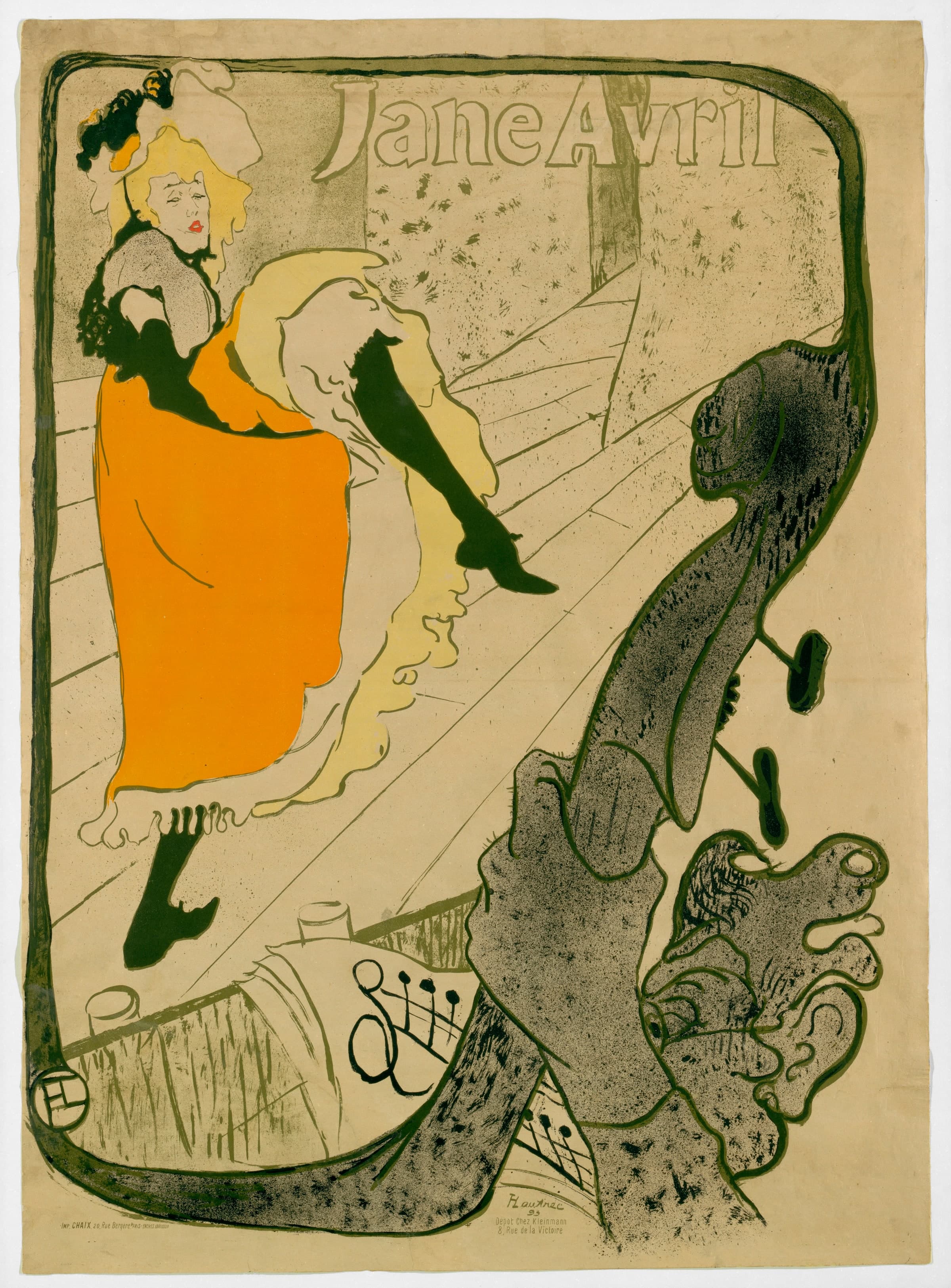
The dancer Jane Avril kicks one leg high in an orange dress on a tilted stage. In front of her, the neck of a double bass and a musician's hairy hand rise out of the orchestra pit. Jane Avril ordered the poster herself in 1893 to advertise her show at the Jardin de Paris, and Henri de Toulouse-Lautrec designed it. The Art Institute of Chicago's copy is 1949.1004.
- 1893
- Color lithograph on tan wove paper
- Art Institute of ChicagoChicago, United States
About Henri de Toulouse-Lautrec
What the poster shows
Jane Avril dances at the upper left of the sheet. She wears an orange dress, black gloves and black stockings, and a hat trimmed with dark feathers sits on her loose blond hair. One leg is kicked high to the right, and pale yellow petticoats froth out under the orange skirt.
Her face is pale, with red lips and heavy, half-closed eyes. The Art Institute of Chicago reads her expression as sad or tired, which does not match the glamour of the nightclub around her.
The stage floor tilts steeply up and away. Behind her is a pale backdrop spattered with dark flecks, perhaps meant as leaves or simply texture.
The lower right half of the poster belongs to the orchestra pit. The scroll and neck of a double bass rise from the bottom of the sheet. A musician's big hand grips the neck, and his head, with bushy hair and a large nose, sits in the bottom right corner. A sheet of music with fat black notes lies in front of him.
Who Jane Avril was
Jane Avril was a dancer in the Paris cafés and dance halls. The Museum of Modern Art says she was diagnosed as a child with chorea, a nerve disorder that causes jerky movements. She found her cure and her career in a wild, high-kicking dance that looked like those movements.
She and Toulouse-Lautrec were friends. The Museum of Modern Art says he portrayed no performer over a longer period, from 1892 to 1899. She was also the only performer he drew offstage as well as on.
Colta Ives of the Metropolitan Museum of Art calls their friendship lasting. Ives writes that hard pasts and shared feelings held it together, though she looked like an unlikely companion for him.
A poster she ordered herself
The Metropolitan Museum of Art says Jane Avril commissioned this print to advertise her show at the Jardin de Paris in 1893. The Museum of Modern Art lists the Jardin de Paris as the poster's publisher.
The Victoria and Albert Museum in London describes the Jardin de Paris as a café-concert hall owned by the owner of the Moulin Rouge. The Musée Toulouse-Lautrec in Albi calls the poster Jardin de Paris: Jane Avril.
The printer was Chaix, at 20 rue Bergère in Paris. Its line runs along the bottom left edge, followed by ENCRES LORILLEUX, which means Lorilleux inks. A second line at the bottom center reads Dépôt chez Kleinmann, 8 rue de la Victoire. It means copies were stocked at Kleinmann's shop at that address.
The dancer and the double bass
The Met points out that her high kick is echoed by the upright thrust of the double bass. The bass is gripped by a musician the poster shows only in part.
The Art Institute notes that her toe points toward the bass player. Next to his rooted bulk, the Art Institute says, she looks as light and quick as a bird.
The Victoria and Albert Museum says Toulouse-Lautrec loved to set beauty beside ugliness, and this poster does it. The graceful dancer sits beside the cartoonish face of the musician, whose hairy knuckles look all the coarser next to her frilly skirts.
A thick olive line runs around the whole design like a frame. At the right it curves down into the scroll of the double bass, and along the bottom it swells into the bass's neck. The frame and the instrument look like one continuous line.
One stone for each color
The Met says Toulouse-Lautrec used several lithographic stones, one for each color: an inky black, an acid orange, yellow and green. The Met's catalogue entry lists five colors in all, as does the Victoria and Albert Museum.
The Victoria and Albert Museum also notes brush and spatter effects. The spatter is the fine speckle of dark dots that fills the bass, the musician and the backdrop.
Colta Ives writes that French posters before the 1890s were printed almost entirely in red, yellow and blue. Toulouse-Lautrec brought in purples, oranges and greens by printing one stone over another.
Not his only Jane Avril poster
Toulouse-Lautrec used the same title again in 1899 for a second Jane Avril poster, which she published herself. That later sheet is much smaller, at 56 by 38 centimeters in the Museum of Modern Art's copy.
She also appears in his Divan Japonais poster of 1893, but there she sits in the audience. The Victoria and Albert Museum points out that this is unusual, since she is shown as a spectator rather than a performer.
Where the copies are
Carter H. Harrison of Chicago gave the Art Institute its copy, 1949.1004, in 1949. The Art Institute catalogues it as the second state, or version, of number 345 in Loys Delteil's catalogue, and as P6 in Wolfgang Wittrock's catalogue of the prints.
The Art Institute showed it in 1979, and in 2005 in Toulouse-Lautrec and Montmartre, an exhibition shared with the National Gallery of Art in Washington. It was shown again in 2009 in Becoming Edvard Munch.
Other copies are at the Metropolitan Museum of Art (32.88.15), the Museum of Modern Art (456.1954), the Victoria and Albert Museum (E.229-1921 and E.705-2000) and the Musée Toulouse-Lautrec in Albi.
Close reading
Reading the work, detail by detail
Jane Avril's poster puts two figures into one frame: the dancer at the top left and a double bass player in the pit at the bottom right. Close up, the poster shows how Henri de Toulouse-Lautrec drew her face and frills, how the frame turns into the instrument, and where the printer and dealer signed off.
1.Jane Avril in outline letters
Jane Avril's name runs across the top in tall letters drawn only as outlines, so the paper shows through them. It is the only large lettering on the poster. Below it, the backdrop is spattered with dark flecks.
2.A tired face with red lips
Her face is pale, with heavy half-closed eyes and a small bright red mouth. Loose blond hair frames it, and a hat trimmed in dark and orange sits on top. The Art Institute of Chicago reads the expression as sad or tired.
3.Black gloves lost in the ruffles
Her arms, in long black gloves, reach down into her skirts. The Art Institute says her arms are lost among the ruffles. The black gloves disappear into the orange and pale yellow. A black stocking cuts up through the frills at the right.
4.The high kick
Her leg kicks high and out to the right in a black stocking and a pointed black shoe. The Art Institute notes that the toe points toward the bass player below. The stage boards run off at a steep angle behind the shoe.
5.Orange skirt, yellow petticoats
The skirt is one flat area of bright orange with almost no marks inside it. Next to it, the pale yellow petticoats are drawn with curling olive lines. The flat orange and the busy frills sit side by side.
6.The foot still on the floor
Under the hem of the skirt, edged with a row of white frills, is the leg she is standing on. It is drawn in solid black down to the shoe. It is the only part of her that touches the stage.
7.The scroll of the double bass
The top of a double bass rises at the right, with its curled scroll and two dark oval tuning pegs. It is printed in dark speckles, so it looks grainy next to the flat orange of the dress. The Met says the bass echoes the upward thrust of her kick.
8.The bass player's hand
A big speckled hand grips the neck of the double bass. The Victoria and Albert Museum points to his hairy knuckles, which look all the coarser next to her frilly dress. The hand is drawn with thick olive outlines.
9.The bass player's head
In the bottom right corner is the bass player's head, drawn as a caricature. He has bushy hair, a big nose and curling outlines for his ear and cheek. The Victoria and Albert Museum calls his features caricatured, set against the dancer's grace.
10.Music on the stand
In the pit is a sheet of music with a big looping black clef and fat black notes. It's drawn quickly, more a sign for music than music anyone could play. The olive edge of the stage runs just above it.
11.The frame turns into the bass
A thick olive line frames the whole design. At the right it curves down and becomes the outline of the double bass scroll. The frame and the instrument look like a single line.
12.Pale shapes at the edge of the stage
Small pale cylinders stand along the front edge of the stage. They may be the shades of footlights, but the poster does not make it clear. The stage boards run away from them at a steep angle.
13.A spattered backdrop
The backdrop behind the stage is pale and scattered with dark flecks and dashes. The Victoria and Albert Museum notes brush and spatter effects on the poster. The flecks may stand for leaves, or they may just be texture.
14.The HTL monogram
In the lower left corner is Toulouse-Lautrec's monogram, the letters HTL linked inside a circle. Colta Ives believes he took the idea from the round seals Japanese artists and publishers stamped on their prints.
15.Signed, dated and stocked at Kleinmann's
Near the bottom center Toulouse-Lautrec signed HLautrec with the date 93 underneath. Below that are two small printed lines: Dépôt chez Kleinmann, 8 rue de la Victoire. That means copies were stocked at Kleinmann's at that address.
16.The printer, Chaix
Along the bottom left edge, under the frame, is the printer's line: Chaix, 20 rue Bergère, Paris. It ends with ENCRES LORILLEUX, which means Lorilleux inks. The Museum of Modern Art also lists Chaix as the printer.
Timeline
1893
Jane Avril commissions the poster for her show at the Jardin de Paris. Chaix prints it.
1893
She also appears in the audience on his Divan Japonais poster.
1899
Toulouse-Lautrec designs a second, smaller Jane Avril poster, published by Jane Avril herself.
1932
The Metropolitan Museum of Art buys its copy, 32.88.15.
1949
Carter H. Harrison gives his copy to the Art Institute of Chicago, 1949.1004.
2005
Shown in Toulouse-Lautrec and Montmartre at the National Gallery of Art in Washington and the Art Institute of Chicago.
Where to see it
Art Institute of Chicago
111 South Michigan Avenue, Chicago, IL 60603, United States
The Art Institute of Chicago's record listed the poster as not on view in September 2026. Works on paper are shown only for short periods, so check before a visit.
Plan your visit on the museum’s official website (opens in a new tab)Frequently asked questions
Who is Jane Avril?
Jane Avril was a Paris dancer and a close friend of Toulouse-Lautrec. The Museum of Modern Art says she had chorea as a child and turned the jerky movements of the illness into a wild, high-kicking dance. He pictured her from 1892 to 1899, more than any other performer.
Who ordered the poster?
Jane Avril did. The Metropolitan Museum of Art says she commissioned it to advertise her show at the Jardin de Paris in 1893.
What is the thing in the bottom right corner?
The neck and scroll of a double bass, held by a musician in the orchestra pit. His hairy hand grips the neck, and his head, with bushy hair and a big nose, is squeezed into the corner.
Why is the year in the web address?
Because Toulouse-Lautrec made two posters called Jane Avril. This is the one from 1893. The second, from 1899, is much smaller and was published by Jane Avril herself.
How many colors is it printed in?
Five, according to the Metropolitan Museum of Art and the Victoria and Albert Museum. Each color was printed from its own lithographic stone.
Where can I see an original?
Copies are held by the Art Institute of Chicago (1949.1004), the Metropolitan Museum of Art (32.88.15) and the Museum of Modern Art (456.1954). The Victoria and Albert Museum in London and the Musée Toulouse-Lautrec in Albi have copies too. Posters are shown only now and then, so check the museum's own page before a visit.
More by Henri de Toulouse-Lautrec
If you like Henri de Toulouse-Lautrec
Explore painters from the same movements and circles.

Alphonse Mucha
Czech poster artist whose Gismonda, designed for Sarah Bernhardt over the last week of December 1894, went up on Paris walls on 1 January 1895 and made him famous in days. The six-year Bernhardt contract that followed put his work on every kiosk in the city and gave Art Nouveau its face.
View artist
Tarsila do Amaral
Brazilian painter who spent the 1920s moving between São Paulo and Paris, studied Cubism under André Lhote, Albert Gleizes and Fernand Léger, and used what she learned to paint Brazilian towns, railways, plants and bodies. Her 1928 painting Abaporu prompted the manifesto that gave the Anthropophagic movement its name.
View artist
Pierre Bonnard
French painter, printmaker and illustrator whose intimate rooms, Paris streets, gardens and bathing figures transformed everyday life into complex fields of color, memory and perception.
View artist
References
The sources below include collection records, catalogues, scholarly research, and primary materials that informed this page. They document Jane Avril, its making, and its place in cultural history.


1Henri de Toulouse-Lautrec, Jane Avril, 1893 (1949.1004)
WebsiteArt Institute of ChicagoUsed forThe holding museum's record, with its description, inscriptions, provenance and exhibition history, and the reproduction the close-reading views were cropped from.
2Henri de Toulouse-Lautrec, Jane Avril, 1893 (32.88.15)
WebsiteThe Metropolitan Museum of ArtUsed forThe Met on the commission, the Jardin de Paris and the printing stones.
3Henri de Toulouse-Lautrec, Jane Avril, 1893 (456.1954)
WebsiteThe Museum of Modern ArtUsed forWeb source consulted for documented facts and historical context presented on the Jane Avril page.
4Henri de Toulouse-Lautrec, Cover for L'Estampe originale, 1893, with its 2014 gallery label
WebsiteThe Museum of Modern ArtUsed forThe Museum of Modern Art's gallery label on Jane Avril's chorea and her friendship with Toulouse-Lautrec.
5Henri de Toulouse-Lautrec, Jane Avril, 1899 (167.1946)
WebsiteThe Museum of Modern ArtUsed forWeb source consulted for documented facts and historical context presented on the Jane Avril page.
6Henri de Toulouse-Lautrec, Jane Avril, 1893 (E.229-1921)
WebsiteVictoria and Albert MuseumUsed forWeb source consulted for documented facts and historical context presented on the Jane Avril page.

7Toulouse-Lautrec in The Metropolitan Museum of Art
Exhibition catalogueThe Metropolitan Museum of Art, 1996Used forColta Ives on the friendship and on the colors of French posters before the 1890s.
8Toulouse-Lautrec et l'art de l'affiche: communique de presse
WebsiteMusee Toulouse-Lautrec, AlbiUsed forWeb source consulted for documented facts and historical context presented on the Jane Avril page.
These references provide the documented foundation for this work's history and interpretation. Claim-level citations remain attached to the specific claims they support.
 Explore more resources