The Paris AtlasCharting the artists, works, and places worth returning to.

In its words

Breathless quotes

12 lines from Jean-Luc Godard’s Breathless (À bout de souffle, 1960), each printed as it is spoken with an English rendering below it, and the published source it was checked against.
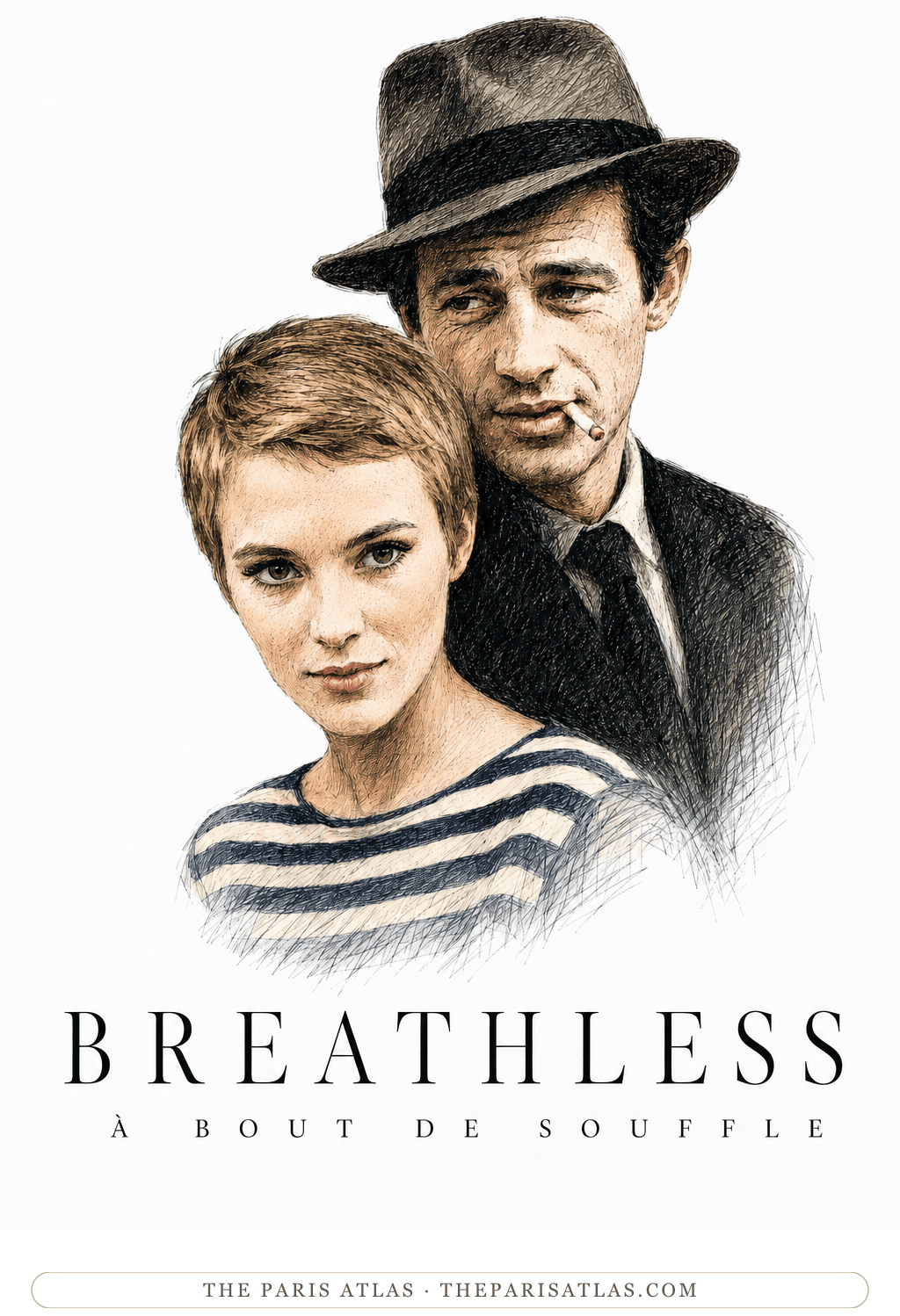
House poster illustration for Breathless: pen-and-ink portraits of Jean Seberg in a striped shirt and Jean-Paul Belmondo in a fedora with a cigarette, hand-colored, above the title in French and English

About Jean-Luc Godard

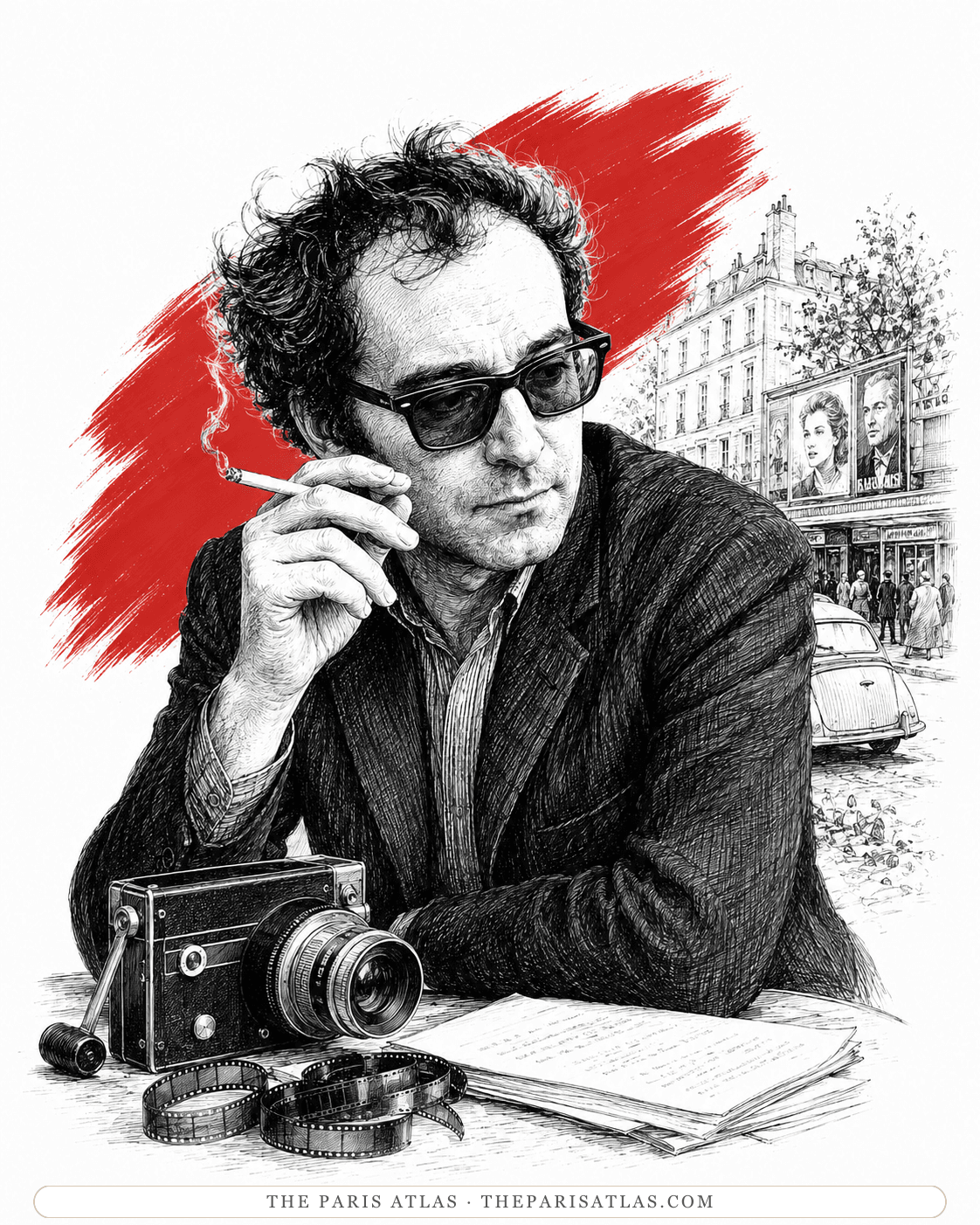
Illustrated portrait of Jean-Luc Godard
To become immortal, and then die.

Devenir immortel, et puis mourir.

The novelist Parvulesco (Jean-Pierre Melville) in Breathless (À bout de souffle, 1960), screenplay by Jean-Luc Godard
The sun is beautiful.

C'est beau le soleil.

Michel Poiccard (Jean-Paul Belmondo) in Breathless (À bout de souffle, 1960), alone at the wheel of the stolen car, pointing a revolver out at the road and making the noise of firing it.
Do you ever think about death? I think about it all the time.

Est-ce que tu penses à la mort quelquefois ? Moi, j'y pense sans arrêt.

Michel Poiccard (Jean-Paul Belmondo) in Breathless (À bout de souffle, 1960), screenplay by Jean-Luc Godard
Between grief and nothing I will take grief.

Entre le chagrin et le néant, je choisis le chagrin.

William Faulkner, The Wild Palms (1939), quoted in Breathless (À bout de souffle, 1960)
Grief is a compromise.

Le chagrin, c'est un compromis.

Michel Poiccard (Jean-Paul Belmondo) in Breathless (À bout de souffle, 1960), screenplay by Jean-Luc Godard
I wanted to see you again to know whether seeing you again would please me.

Je voulais te revoir pour savoir si te revoir me ferait plaisir.

Breathless (À bout de souffle, 1960), screenplay by Jean-Luc Godard
I'd like to know what's behind your face.

Je voudrais savoir ce qu'il y a derrière ton visage.

Breathless (À bout de souffle, 1960), screenplay by Jean-Luc Godard
As in poker, you may as well tell the truth: the others think you're bluffing.

Comme au poker, autant dire la vérité : les autres croient que tu bluffes.

Breathless (À bout de souffle, 1960), screenplay by Jean-Luc Godard
When we talked, I talked about myself and you talked about yourself.

Quand on parlait, je parlais de moi et toi de toi.

Breathless (À bout de souffle, 1960), screenplay by Jean-Luc Godard
I'd like to think about something, but I can't.

Je voudrais penser à quelque chose, mais je n'arrive pas.

Patricia Franchini (Jean Seberg) in Breathless (À bout de souffle, 1960), lying on the bed in the hotel room among the newspapers
Sleep is sad. We're forced to separate. We say “sleeping together,” but it isn't true.

C'est triste le sommeil. On est forcé de se séparer. On dit dormir ensemble, mais c'est pas vrai.

Patricia Franchini (Jean Seberg) in Breathless (À bout de souffle, 1960). She does not get the middle sentence out on her own — Michel finishes the word for her, and she says it again before going on.
What is “dégueulasse”?

Qu'est-ce que c'est, dégueulasse ?

Patricia Franchini (Jean Seberg), the last line of Breathless (À bout de souffle, 1960). Michel says it as he dies, and the inspector tells her the word was meant for her. Dégueulasse means disgusting, and she is asking what it means.

The Friday Letter

One story from the atlas, every Friday.

No algorithms chasing attention. A work, a place, and the connection between them — with the history checked.

One email a week. No spam, no selling your address. Unsubscribe anytime.