The Paris AtlasCharting the artists, works, and places worth returning to.
  • Filmmaker
  • Critic
· French-Swiss · 1930–2022

Jean-Luc Godard

The Cahiers du cinéma critic who became the French New Wave's most recognizable director, then spent six decades taking apart and rebuilding the language of film.

In images

Details

Lived
1930–2022
Born
3 December 1930
Birthplace
Paris
Died
13 September 2022 · aged 91
Place of death
Rolle, Switzerland
Nationality
French-Swiss
Married
Anna Karina · 1961–1965Anne Wiazemsky · m. 1967
Partner
Anne-Marie Miéville · early 1970s–2022
Roles
FilmmakerCritic
Also known as
Hans Lucas

About Jean-Luc Godard

Jean-Luc Godard began by writing criticism about cinema, then discovered how to make cinema itself function as criticism. With Breathless (1960), shot fast and cheap on the streets of Paris, he helped give the French New Wave its most recognizable form; over the following six decades he repeatedly dismantled that form, abandoning commercial filmmaking for revolutionary collectives, celluloid for video, and narrative for collage.

He directed more than a hundred works, and the career divides into distinct lives: the young critic, the New Wave star, the militant of the Dziga Vertov Group, the video experimenter of the Miéville years, and the historian-collagist of Histoire(s) du cinéma. He died at his home in Rolle, Switzerland, in 2022, by assisted suicide, at 91.

Paris made him a filmmaker

Godard was born in Paris on 3 December 1930, to Paul Godard, a Swiss physician, and Odile Monod, the daughter of a wealthy Franco-Swiss Protestant banking family. The family settled in Switzerland when he was a small child, and he spent most of his boyhood and the war years on the Swiss side of Lake Geneva. He was Paris-born but never simply a Parisian director; Switzerland remained his other home, and at the end of his life his only one.

He returned to Paris after the war for the Lycée Buffon and later registered at the Sorbonne for a certificate in ethnology, but his real education happened in the dark. At the Cinémathèque française, where Henri Langlois programmed silent film, Hollywood genre pictures, and new work side by side and out of order, and in the ciné-clubs of the Latin Quarter, he fell in with the young men who would become the Cahiers du cinéma circle: François Truffaut, Éric Rohmer, Jacques Rivette, Claude Chabrol.

Criticism came before filmmaking. In 1950 he helped found the short-lived Gazette du cinéma with Rohmer and Rivette, and from 1952 he published in Cahiers du cinéma, sometimes signing as Hans Lucas. The position he and his colleagues argued — that Hitchcock, Hawks, Nicholas Ray, and Renoir were artists with bodies of work as coherent as any novelist's — seemed eccentric then and has been conventional ever since.

Criticism by other means

Godard did not give up criticism when he picked up a camera; he changed its medium. His films quote and compare other films, interrupt their own stories to analyze them, and treat actors as both characters and cultural images. They mix philosophy, advertisements, paintings, newspapers, and popular music, and they keep asking the critic's questions: what does this image mean, who made it, and what does it carry?

That habit is the continuity beneath a career of ruptures. The subjects, formats, and politics changed drastically; the practice of thinking on screen did not.

Breathless

His first film was industrial. In 1954, while working a labouring job on the Grande Dixence dam in Switzerland, he made the short documentary Opération béton about the construction. Breathless was his first feature, not his first film, and a handful of shorts in the late 1950s bridged the critic and the director.

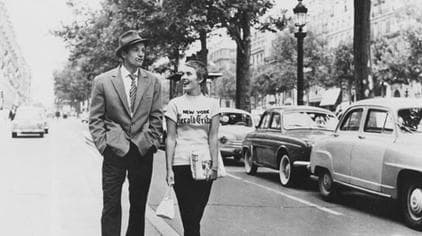
À bout de souffle came together as a New Wave group project: Truffaut supplied the original story idea, Chabrol was credited as technical adviser, and Georges de Beauregard produced. Raoul Coutard's handheld camera let Godard shoot quickly in real Paris streets and interiors in 1959, and Jean-Paul Belmondo and Jean Seberg played out a collision between American crime-movie mythology and contemporary Paris. It opened in 1960 and turned the New Wave into an international event.

The film's jump cuts partly emerged from cutting already-shot scenes down for pace. Godard did not invent the technique; discontinuous editing existed long before him. What he did was refuse to conceal it — the cuts read as decisions, and the film feels immediate, unfinished, and aware of itself. That refusal, more than any single device, is what other filmmakers took from him.

The Karina decade

Godard and the actor Anna Karina married in 1961 and divorced in 1965, and their working partnership is central to both careers. Their features together move through musical comedy, espionage, prostitution, science fiction, and crime:

Godard and Anna Karina at a festival press conference in the mid-1960s, near the end of their marriage and principal collaboration. AP news photograph, used under fair use. (Associated Press · Fair use)
  • Une femme est une femme (1961)
  • Vivre sa vie (1962)
  • Le Petit Soldat (shot in 1960; its Algerian War material kept it from release until 1963)
  • Bande à part (1964)
  • Alphaville (1965)
  • Pierrot le fou (1965)
  • Made in U.S.A. (1966, after the marriage had ended)

The marriage was volatile and the films were not therapy; they were a laboratory both artists worked in. Karina's performances carry their own authorship and their own afterlife, and the changing image of her across these films is one of the defining continuities of Godard's 1960s. She was his collaborator, not the object through which he found a style.

The laboratory of the sixties

Through the mid-1960s Godard worked at a pace few directors have matched, and each film tested something: genre plots interrupted by essays and interviews, characters speaking straight into the camera, sound deliberately detached from image, printed slogans and intertitles inside the frame, editing built on collision rather than seamlessness. His innovation was not one technique. It was the insistence that a film could reveal itself thinking while the viewer watched.

Godard at the Berlin press conference for Masculin féminin (1966); the German-language posters date the appearance. AP news photograph, used under fair use. (Associated Press · Fair use)

The political turn usually dated to 1968 was visible much earlier. Le Petit Soldat put the Algerian War's torture on screen. Vivre sa vie examined prostitution as labor and commodity. Masculin féminin surveyed a generation caught between pop culture and Vietnam-era politics; Two or Three Things I Know About Her treated consumer Paris itself as the subject; La Chinoise rehearsed revolutionary politics in a student apartment a year before the real thing; and Week-end (1967) ended his commercial cinema in an apocalyptic traffic jam. May 1968 was not an overnight conversion. The films had been heading there for years.

May 1968 and the Dziga Vertov Group

In February 1968 Godard joined the protests against the government's attempt to remove Henri Langlois from the Cinémathèque française, and in May he was among the filmmakers — Truffaut beside him — who helped shut down the Cannes festival in solidarity with the national uprising. What followed was a genuine break, not an episode: the director most identified with auteur cinema set out to abolish his own status as an auteur.

Godard in the crowd at Berkeley in 1968 — the year of the Langlois affair, the Cannes shutdown, and the turn from auteur celebrity to militant filmmaking. Photograph: Gary Stevens. (Gary Stevens, via Wikimedia Commons · CC BY 2.0)

From 1968 to 1973 he merged his identity into the Dziga Vertov Group, a collective built with Jean-Pierre Gorin that pursued the idea of making political films politically — collectively produced, often credited to the group rather than any individual, and aimed at analysis rather than entertainment.

The population thinks, learns, struggles, criticises, and transforms itself.

The Dziga Vertov Group's manifesto, on what should happen in front of its films
  • Un film comme les autres (1968)
  • British Sounds (1969)
  • Pravda (1969)
  • Le Vent d'est (1970)
  • Jusqu'à la victoire (1970, unfinished)
  • Luttes en Italie (1971)
  • Vladimir et Rosa (1971)
  • Tout va bien (1972)
  • Letter to Jane (1972)

Tout va bien and its analytical companion Letter to Jane closed the Gorin collaboration in 1972. The militant years permanently altered his ideas about authorship, production, and sound; nothing he made afterward pretends they did not happen.

Miéville, Sonimage, and the video years

In the early 1970s Godard began the personal and artistic partnership with the filmmaker Anne-Marie Miéville that lasted the rest of his life. Together they ran the production company Sonimage, based first in Grenoble, and in 1977 they settled in Rolle, on the Swiss shore of Lake Geneva. Miéville was his interlocutor, editor, co-director, and an independent filmmaker in her own right; the second half of Godard's career does not exist without her, and it was not the work of a solitary genius.

Godard at the 35th Cannes festival, 1982, the year he presented Passion; the festival poster behind him carries the number. AP news photograph, used under fair use. (Associated Press · Fair use)

Video became the workshop. Ici et ailleurs (1976) turned the footage from the abandoned Palestinian film Jusqu'à la victoire into a self-critical essay on their own earlier images; Numéro deux and the television experiments that followed treated video as something cheaper, more domestic, and closer to writing than 35mm production. When Sauve qui peut (la vie) returned him to feature filmmaking in 1980, the lessons came along: slow motion as analysis, sound separated from image, painting and classical music used structurally. Passion, Prénom Carmen — which won the Golden Lion at Venice in 1983 — and Je vous salue, Marie belong to this second cinema.

Histoire(s) du cinéma

Between 1988 and 1998 Godard produced the eight-part video cycle Histoire(s) du cinéma, layering film clips, paintings, photographs, newsreel, music, quotation, and typography into an argument about what cinema recorded — and what it failed to prevent — during the twentieth century. The French title means both "history" and "stories," plural, and the Second World War and the Holocaust stand at its center.

It deserves as much attention as Breathless. MoMA, which holds chapters of the cycle, describes its theme as the death of cinema and the work itself as a requiem — one that set a standard for the future of video — and notes the element of self-portraiture running through it. It is film history and disguised autobiography at once.

Israel, Palestine, and the disputes

Godard was an outspoken supporter of the Palestinian cause from the early 1970s, when he filmed the material for Jusqu'à la victoire, and as late as 2018 he boycotted a French event celebrating Israeli cinema. His statements and images drew serious accusations: when his honorary Academy Award was announced in 2010, the Zionist Organization of America called him a "virulent antisemite." Godard rejected the charge and drew his own distinction — describing his grandfather as "anti-Jew; whereas I am anti-Zionist, he was antisemitic."

The record is genuinely mixed, which is why it has to be stated rather than summarized. The same filmmaker engaged the Holocaust with sustained moral seriousness — he admired Claude Lanzmann's Shoah, debated the ethics of depicting the camps, and made the relationship between historical trauma and the image a central question of his late work. The controversy was never resolved in either direction, and this page does not resolve it.

The last features

The late films kept experimenting. Éloge de l'amour (2001) set 35mm black-and-white against saturated digital video; Film Socialisme (2010) fractured languages and European history into digital shards; Adieu au langage (2014) used stereoscopic 3D in deliberately disobedient ways and shared the Jury Prize at Cannes; and Le Livre d'image (2018) received a Special Palme d'Or, the first in the festival's history. The elderly Godard did not stop innovating technologically; he simply changed technologies.

Godard at the Cannes photocall for Éloge de l'amour (2001), per AP's retrospective. AP news photograph, used under fair use. (Associated Press · Fair use)

The 2010 honorary Oscar measured the distance between the institution and the man: the Academy honored a career built substantially against Hollywood's grammar, and Godard declined to travel to Los Angeles to accept it.

Godard (in the hat) with André S. Labarthe, Alain Fleischer, and Kingsley Ng at Le Fresnoy studio, 2005 — at work on an installation late in life. (Imagesforwikicommons, via Wikimedia Commons · CC BY-SA 3.0)

Rolle, and an ending on his own terms

Godard died at his home in Rolle on 13 September 2022, at 91, by assisted suicide, which is legal in Switzerland. His family's statement said he had been affected by multiple incapacitating illnesses and that he died peacefully, surrounded by loved ones. He was cremated without official ceremony.

Godard in his final decade, at an indoor event around 2010. AP news photograph, used under fair use. (Associated Press · Fair use)

He worked until the end. Scénarios, an eighteen-minute collage he completed the day before his death, premiered at Cannes in 2024. It closes on a self-portrait: Godard on his bed, putting the finishing touches to his film — his last images.

A frame from Scénarios (2024), the eighteen-minute collage Godard completed the day before his death: a black-and-white parkland scene under painted red-and-yellow overlays. Used under fair use. (Frame from Scénarios, via festival-cannes.com · Fair use)

The films: where to start

More than a hundred works resist a list. The honest way in is by era — each one a different filmmaker sharing the name. Fifteen films carry the whole arc; the first era is the easiest door.

  • The New Wave decade (1960–1967) — Vivre sa vie (1962), Le Mépris (1963), Bande à part (1964), Pierrot le fou (1965), Masculin féminin (1966), Two or Three Things I Know About Her (1967), Week-end (1967). Genre plots progressively invaded by essays and politics.
  • The militant years (1968–1973) — the Dziga Vertov Group films, ending with Tout va bien and Letter to Jane (1972). Collective, analytical, deliberately difficult.
  • Video and the second cinema (1974–1987) — Ici et ailleurs (1976), Numéro deux (1975), then the return to features: Sauve qui peut (la vie) (1980), Passion (1982), Prénom Carmen (1983), Je vous salue, Marie (1985).
  • The historian (1988–2018) — Histoire(s) du cinéma (1988–1998), Éloge de l'amour (2001), Film Socialisme (2010), Adieu au langage (2014), Le Livre d'image (2018), and the posthumous Scénarios (2024).

Film pages arrive one at a time, each with its own production history and sources; the links above grow as they land.

Life events

  1. 1930

    Born 3 December in Paris to a Franco-Swiss family; raised largely in Switzerland.

    Encyclopaedia Britannica — Jean-Luc Godard

  2. 1950

    Helps found the Gazette du cinéma with Éric Rohmer and Jacques Rivette.

  3. 1952

    First criticism appears in Cahiers du cinéma.

    Jordan Mintzer, The Hollywood Reporter — Jean-Luc Godard, Enfant Terrible of Modern French Cinema, Dies at 91 (2022)

  4. 1954

    Makes Opération béton, an industrial short about the Grande Dixence dam, where he worked.

    Encyclopaedia Britannica — Jean-Luc Godard

  5. 1959

    Shoots À bout de souffle on the streets of Paris with Raoul Coutard.

  6. 1960

    Breathless opens and makes the New Wave an international event.

    Sam Wigley, BFI — 10 great French New Wave films

  7. 1961

    Marries Anna Karina; Une femme est une femme.

    Ginette Vincendeau, BFI — Jean-Luc Godard obituary: a filmmaker of seismic impact and influence (2022)

  8. 1962

    Vivre sa vie.

    Ginette Vincendeau, BFI — Jean-Luc Godard obituary: a filmmaker of seismic impact and influence (2022)

  9. 1963

    Le Mépris; Le Petit Soldat, held back since 1960 over its Algerian War material, is released.

  10. 1965

    Alphaville and Pierrot le fou; the marriage to Karina ends.

    Godard and Anna Karina at a festival press conference in the mid-1960s, near the end of their marriage and principal collaboration. AP news photograph, used under fair use. (Associated Press)

    Ginette Vincendeau, BFI — Jean-Luc Godard obituary: a filmmaker of seismic impact and influence (2022)

  11. 1967

    La Chinoise and Week-end close his commercial cinema; marries Anne Wiazemsky.

  12. 1968

    Protests the removal of Henri Langlois in February; helps halt the Cannes festival in May; begins the Dziga Vertov Group with Jean-Pierre Gorin.

    Godard at Berkeley, 1968. A second frame from the same appearance. Photograph: Gary Stevens. (Gary Stevens, via Wikimedia Commons)

    Craig Williams, BFI — 5 reasons to grapple with Godard's radical Dziga Vertov Group films (2018)

  13. 1972

    Tout va bien and Letter to Jane end the Gorin collaboration.

    Craig Williams, BFI — 5 reasons to grapple with Godard's radical Dziga Vertov Group films (2018)

  14. 1977

    Settles in Rolle, Switzerland, with Anne-Marie Miéville.

    Jordan Mintzer, The Hollywood Reporter — Jean-Luc Godard, Enfant Terrible of Modern French Cinema, Dies at 91 (2022)

  15. 1980

    Sauve qui peut (la vie) returns him to feature filmmaking.

  16. 1983

    Prénom Carmen wins the Golden Lion at Venice.

  17. 1988–1998

    Produces the eight-part video cycle Histoire(s) du cinéma.

    Ginette Vincendeau, BFI — Jean-Luc Godard obituary: a filmmaker of seismic impact and influence (2022); MoMA — Jean-Luc Godard. Histoire(s) du Cinéma (Chapters 1A and 1B). 1988–89

  18. 2010

    Honorary Academy Award; he does not travel to accept it. The announcement revives the dispute over his statements about Jews, Israel, and Zionism.

    Godard in his final decade, at an indoor event around 2010. AP news photograph, used under fair use. (Associated Press)

    Jordan Mintzer, The Hollywood Reporter — Jean-Luc Godard, Enfant Terrible of Modern French Cinema, Dies at 91 (2022); Andrew Lapin, JTA — Jean-Luc Godard, revolutionary filmmaker who polarized Jews with his Israel and Holocaust commentary, dies at 91 (2022)

  19. 2014

    Adieu au langage shares the Jury Prize at Cannes.

    Festival de Cannes — Jean-Luc Godard

  20. 2018

    Le Livre d'image receives the first Special Palme d'Or in the festival's history.

    Festival de Cannes — Jean-Luc Godard

  21. 2022

    Dies 13 September at home in Rolle, by assisted suicide, at 91.

    Jordan Mintzer, The Hollywood Reporter — Jean-Luc Godard, Enfant Terrible of Modern French Cinema, Dies at 91 (2022)

  22. 2024

    Scénarios, completed the day before his death, premieres at Cannes.

    A frame from Scénarios (2024), the eighteen-minute collage Godard completed the day before his death: a black-and-white parkland scene under painted red-and-yellow overlays. Used under fair use. (Frame from Scénarios, via festival-cannes.com)

    Festival de Cannes — Scénarios

Selected works

Cataloged from the holding institutions' records. Reproductions appear only where the rights are verified.

Cinema

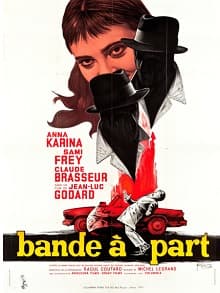
French poster for Bande à part (1964): Anna Karina, Sami Frey, and Claude Brasseur

Archival photograph

Film

Band of Outsiders

1964 · 97-minute feature, black and white

Band of Outsiders is Jean-Luc Godard at his lightest: a crime story drawn from an American pulp novel and played as a game. Two aimless young men, Franz and Arthur, both circling Anna Karina's Odile, talk her into helping them rob the villa where she lives. The plot is almost beside the point. What the film is remembered for are its digressions — the trio dancing the Madison in a café, their record-breaking dash through the Louvre, and a minute of silence in which Godard cuts the soundtrack to nothing. Godard narrates it himself, quoting the gangster pictures it half-imitates. It is the most charming film of his years with Karina.
Jean-Luc Godard, Band of Outsiders, 1964. Image © the rights holder, shown under fair use.

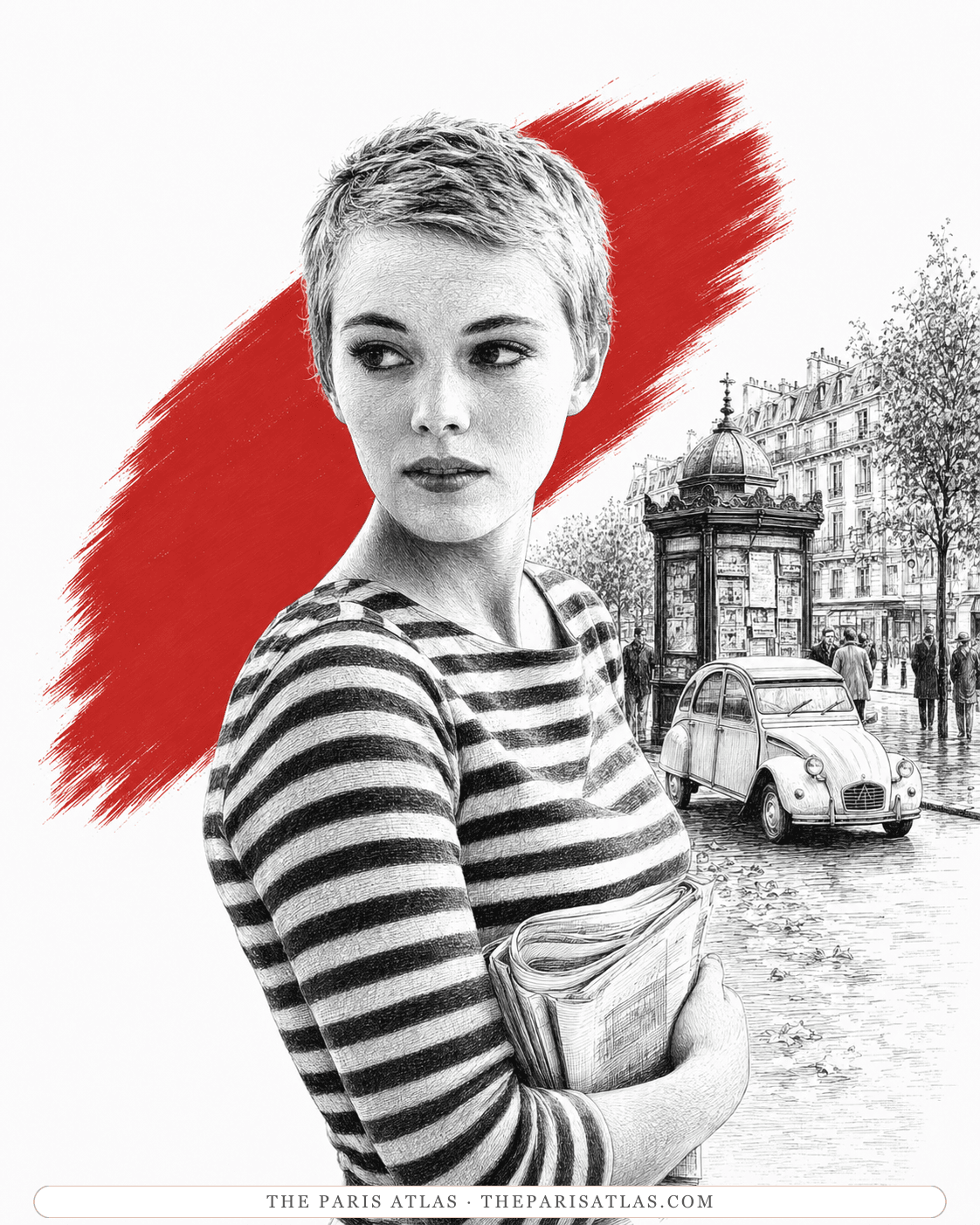
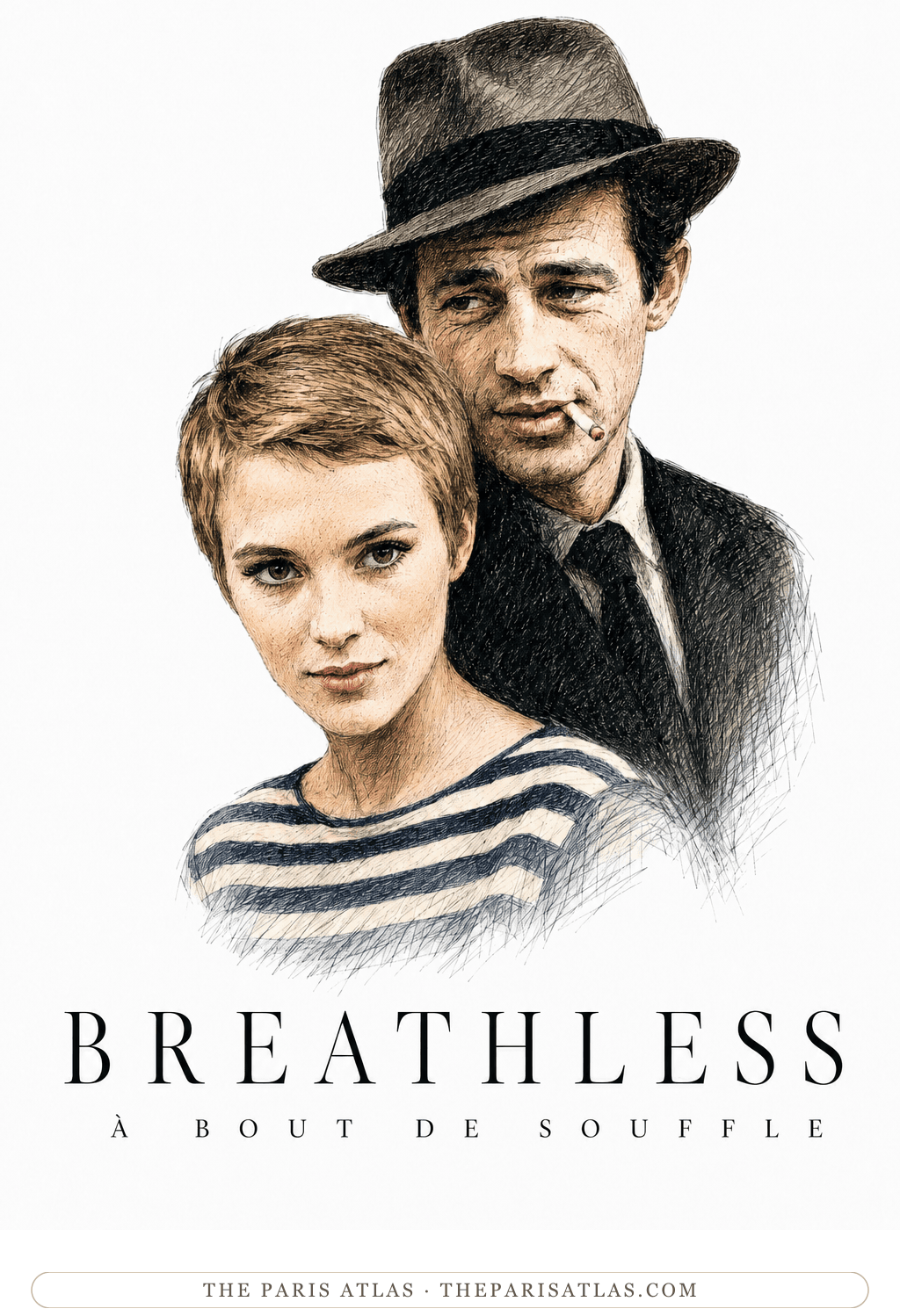
House poster illustration for Breathless: pen-and-ink portraits of Jean Seberg in a striped shirt and Jean-Paul Belmondo in a fedora with a cigarette, hand-colored, above the title in French and English

Editorial illustration

Film

Breathless

1960 · 35 mm feature film

Godard's first feature: a small-time criminal who models himself on Humphrey Bogart shoots a policeman, hides out in Paris with an American student who sells the Herald Tribune, and is betrayed. Shot handheld in real streets in under a month for very little money, and cut with the jumps left showing, it turned the French New Wave into an international event and remains one of the most influential debuts in the history of the medium.

Jean-Luc Godard, Breathless, 1960.

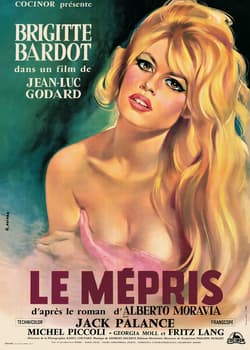
Poster for Contempt (Le Mépris, 1963), Jean-Luc Godard's film with Brigitte Bardot

Archival photograph

Film

Contempt

1963 · About 103 minutes, color — Franscope widescreen

Contempt is Jean-Luc Godard's biggest and most international film: a widescreen color production about the making of a film, and about a marriage falling apart inside it. Michel Piccoli plays a screenwriter hired to rewrite Fritz Lang's adaptation of The Odyssey for a crass American producer; over a single day his wife, played by Brigitte Bardot, comes to feel a contempt for him she cannot explain, after he seems to hand her to the producer. Godard turns the clash of art and money into the film's real subject — a clash he was living out with his own producers, who had financed the picture for Bardot's fame and demanded she appear nude. It is the New Wave's grandest statement on the death of classical cinema.

Jean-Luc Godard, Contempt, 1963. Image © the rights holder, shown under fair use.

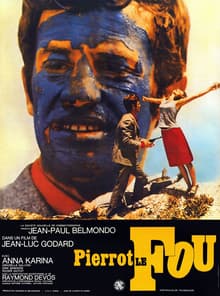
Poster for Pierrot le fou (1965): Jean-Paul Belmondo and Anna Karina against blocks of primary color

Archival photograph

Film

Pierrot le fou

1965 · 110-minute feature, Eastmancolor — widescreen (Techniscope, 2.35:1)

Pierrot le fou is Jean-Luc Godard's tenth feature and one of the summits of his mid-1960s cinema. Jean-Paul Belmondo plays Ferdinand, a bored Paris husband who walks out of a bourgeois party and drives south with Marianne, an old lover played by Anna Karina, into a loose crime plot of gun-runners, stolen cars, and betrayal. Godard films it as collage — blocks of red, white, and blue in Eastmancolor and widescreen, songs, direct address to the camera, and quotations from Rimbaud and pop art — and ends it with Ferdinand's face painted blue and a stick of dynamite. It is the New Wave turning from realism toward the essay and the political film, made as Godard and Karina's own marriage was ending.

Jean-Luc Godard, Pierrot le fou, 1965. Image © the rights holder, shown under fair use.

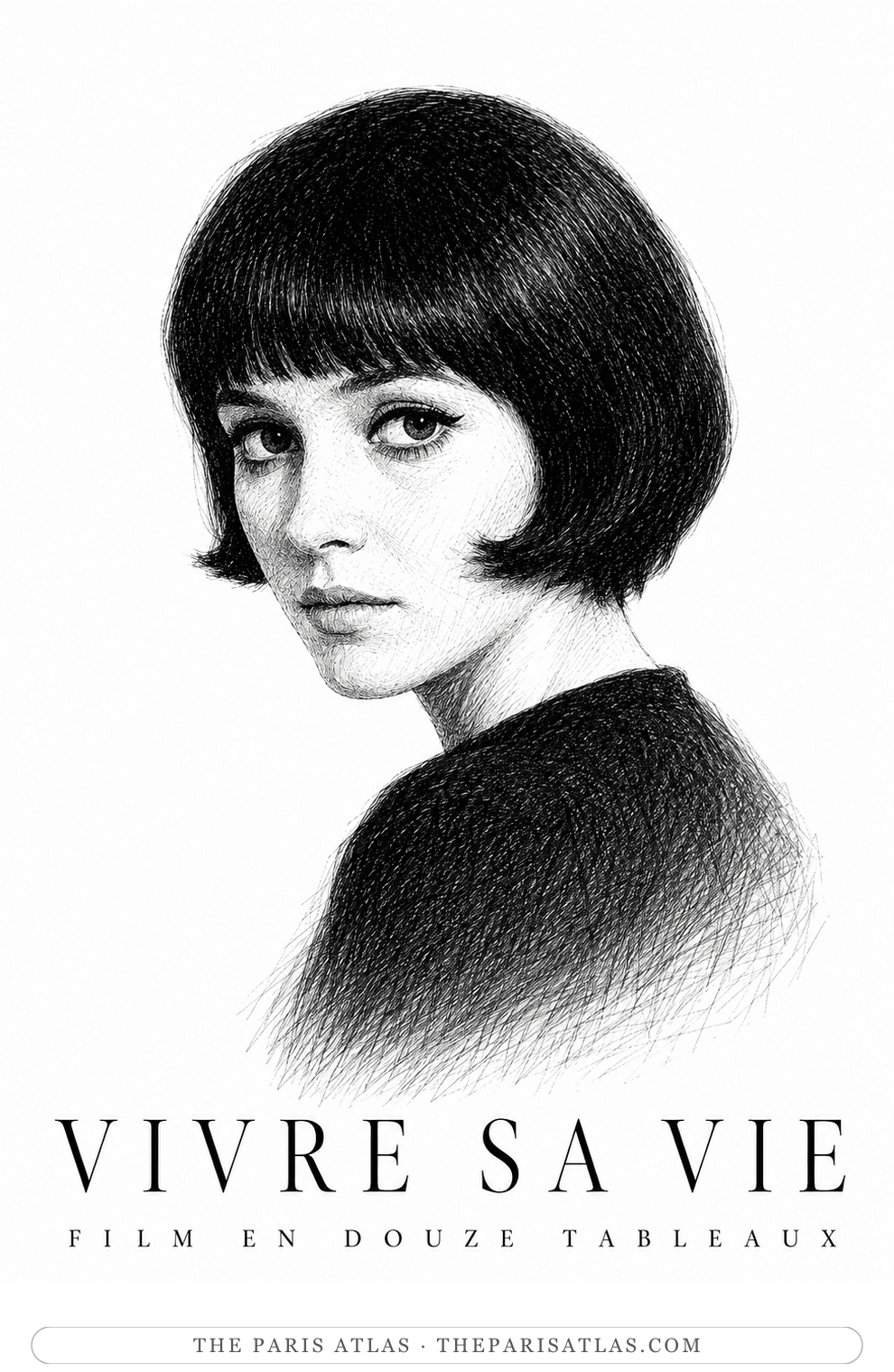
House-illustrated poster for Vivre sa vie (1962): a pen-and-ink portrait of a young woman in Anna Karina's Nana bob, in three-quarter profile, above the title Vivre sa vie — film en douze tableaux

Editorial illustration

Film

Vivre sa vie

1962 · About 85 minutes, black and white — a film in twelve tableaux

Vivre sa vie is Jean-Luc Godard's fourth feature and the fullest of his portraits of Anna Karina, his wife and the face of his early-sixties films. It follows Nana, a young Parisian who leaves her husband to try for a life as an actress and drifts instead into prostitution, told in twelve numbered tableaux, each announced by an intertitle. Godard treats the subject half as story and half as report — a documentary-like account of the trade set beside a cinema visit to Dreyer's Joan of Arc and a café conversation with a real philosopher about language and truth. It is one of the essential films of the New Wave's most personal period.

Jean-Luc Godard, Vivre sa vie, 1962.

People they knew

Documented connections — every one carries its source.

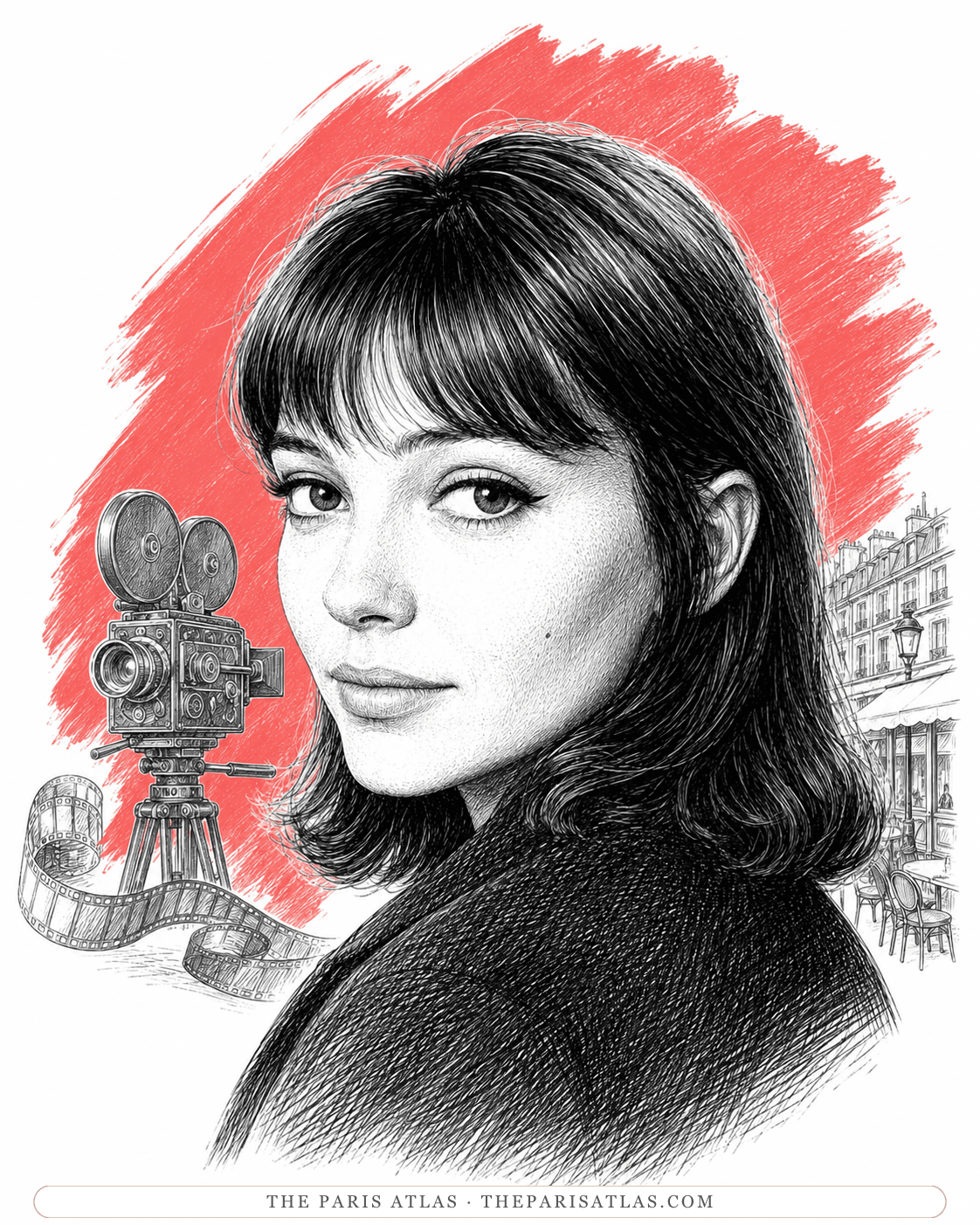
Illustrated portrait of Anna Karina

Anna Karina

  • Actor
  • Singer
  • Filmmaker
  • +1

Married to · 1961–1965

Married in 1961, divorced in 1965. The working partnership ran wider than the marriage: a run of features from Une femme est une femme (1961) to Made in U.S.A. (1966), the last completed after the divorce.

Jordan Mintzer, The Hollywood Reporter — Jean-Luc Godard, Enfant Terrible of Modern French Cinema, Dies at 91 (2022); Ginette Vincendeau, BFI — Jean-Luc Godard obituary: a filmmaker of seismic impact and influence (2022)

Collaborated with · 1960–1966

Seven features in six years: Le Petit Soldat (shot 1960, released 1963), Une femme est une femme (1961), Vivre sa vie (1962), Bande à part (1964), Alphaville and Pierrot le fou (1965), and Made in U.S.A. (1966). The partnership ran wider and longer than the 1961–1965 marriage; Made in U.S.A. was completed after the divorce.

Encyclopaedia Britannica — Anna Karina (Danish-French actress); Jordan Mintzer, The Hollywood Reporter — Jean-Luc Godard, Enfant Terrible of Modern French Cinema, Dies at 91 (2022)

Illustrated portrait of Jean Seberg

Jean Seberg

  • Actor

Collaborated with · 1959–1964

He cast her as Patricia in Breathless — reached through her first husband, François Moreuil, in June 1959 — and she carried the film that made them both. She reprised the character in his segment Le Grand Escroc (1964). She doubted his method during the shoot; the result outlived the doubt.

Encyclopaedia Britannica — Breathless (film by Godard, 1960); Jordan Mintzer, The Hollywood Reporter — Jean-Luc Godard, Enfant Terrible of Modern French Cinema, Dies at 91 (2022)

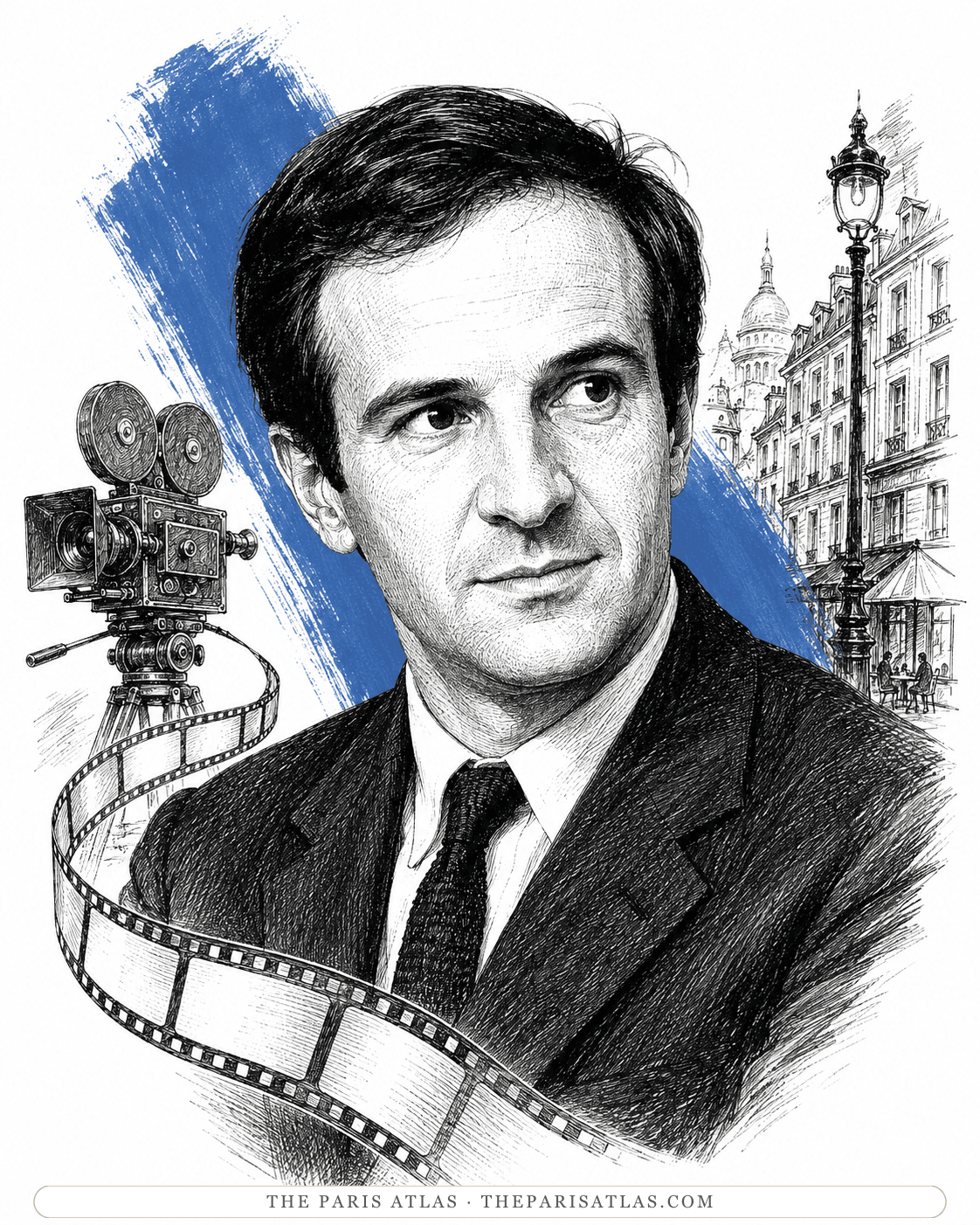
Illustrated portrait of François Truffaut

François Truffaut

  • Filmmaker
  • Critic
  • Actor

Clashed with · 1973

The 1973 letters: Godard attacked Day for Night and its maker's honesty; Truffaut answered at furious length. They never spoke again. The exchange survives in the published correspondence.

The Criterion Collection — Godard vs. Truffaut

Collaborated with · 1959–1968

Cahiers colleagues who became the movement's twin engines: Truffaut supplied Breathless's story and his endorsement got Godard the director's chair; in 1968 they led the Langlois protests together and shut down the Cannes festival side by side.

Nancy Tartaglione, Deadline — How Francois Truffaut and Jean-Luc Godard Brought the Revolution to Cannes in 1968 (2016); Encyclopaedia Britannica — Breathless (film by Godard, 1960)

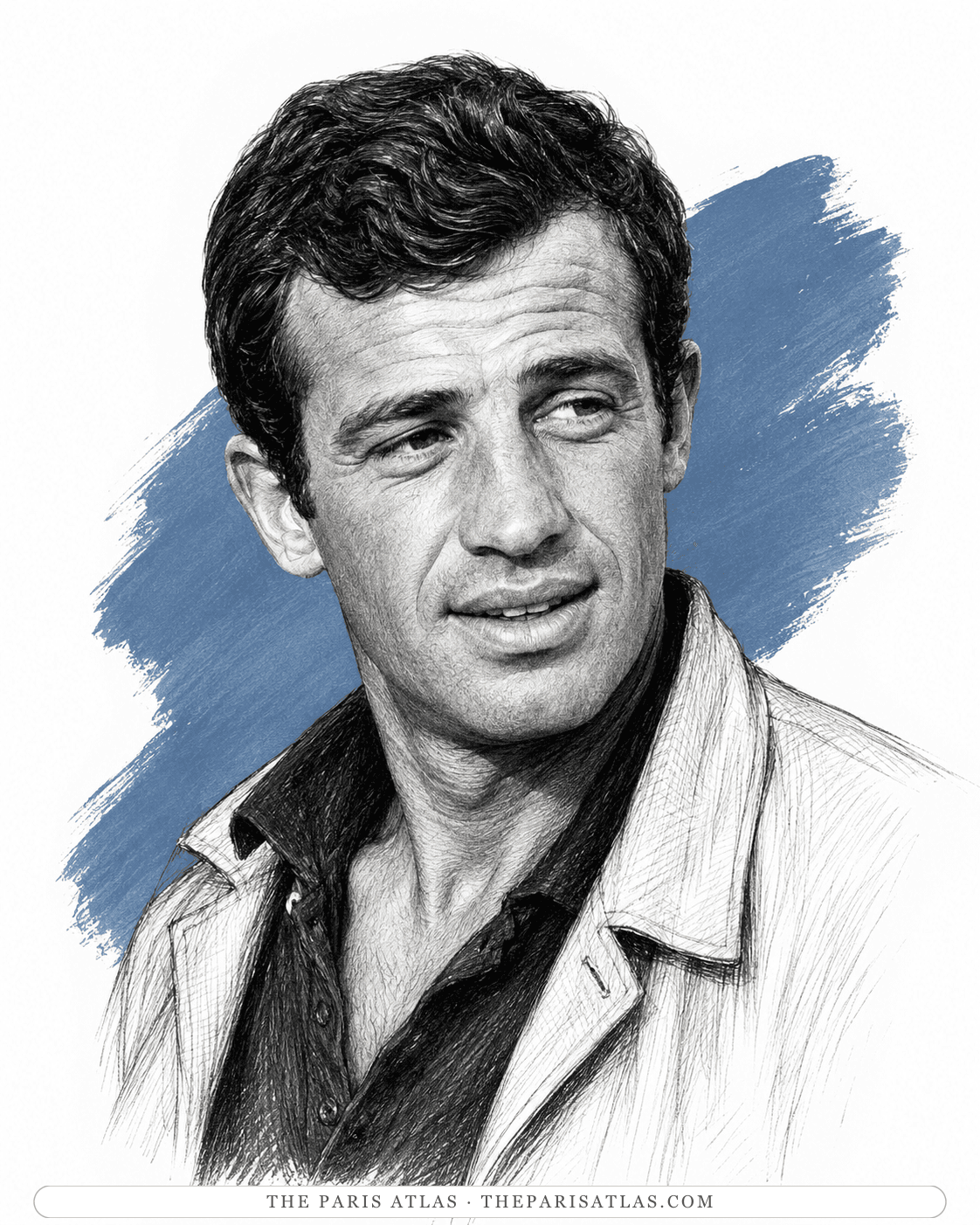
Illustrated portrait of Jean-Paul Belmondo

Jean-Paul Belmondo

  • Actor

Collaborated with · 1960

Godard directed Belmondo in Breathless (1960), the film that made him a star, and again in Pierrot le fou (1965).

The Criterion Collection — Pierrot le fou; Encyclopaedia Britannica — Jean-Luc Godard

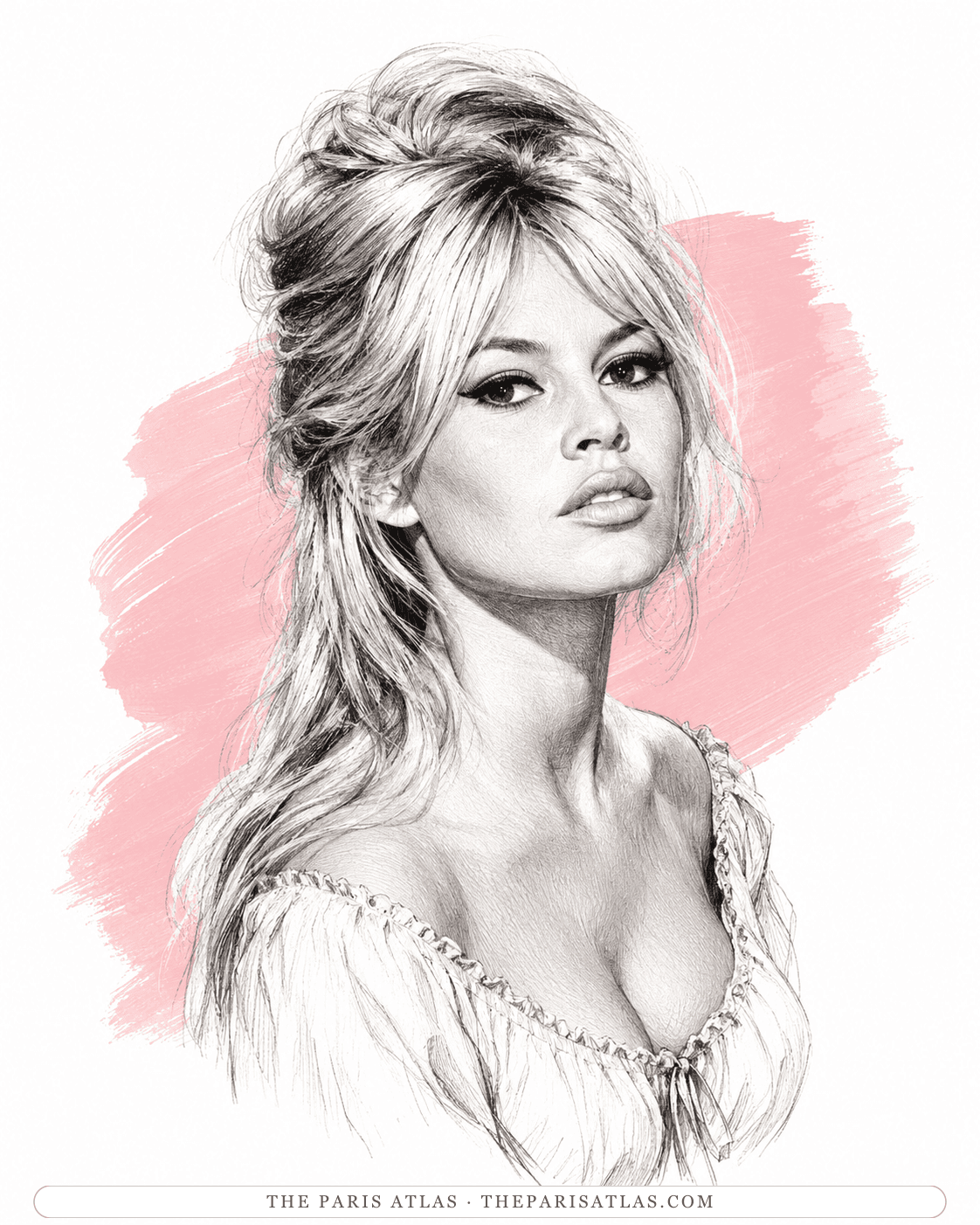
Illustrated portrait of Brigitte Bardot

Brigitte Bardot

  • Actor

Collaborated with · 1963

Godard directed Bardot as Camille in Contempt (1963), building an art film around — and against — her stardom.

The Criterion Collection — Contempt; Encyclopaedia Britannica — Jean-Luc Godard

Illustrated portrait of Claude Chabrol

Claude Chabrol

  • Filmmaker
  • Critic

Collaborated with · 1960

Fellow Cahiers du cinéma critics; Chabrol served as the credited artistic and technical adviser on Godard's debut Breathless (1960).

The Criterion Collection — Le Beau Serge; Encyclopaedia Britannica — New Wave (French film movement)

Illustrated portrait of Éric Rohmer

Éric Rohmer

  • Filmmaker
  • Critic

Collaborated with · 1950

Godard wrote for Rohmer's short-lived journal La Gazette du cinéma in 1950 and acted in Rohmer's early short Présentation, ou Charlotte et son steak. Both were part of the Cahiers du cinéma circle.

Encyclopaedia Britannica — Éric Rohmer; Encyclopaedia Britannica — Cahiers du Cinéma

Illustrated portrait of Jacques Rivette

Jacques Rivette

  • Filmmaker
  • Critic

Collaborated with · 1961

Godard appears in a cameo in Rivette's debut Paris Belongs to Us (1961). Both wrote for Cahiers du cinéma and belonged to the circle of critics who became the New Wave.

Encyclopaedia Britannica — Jacques Rivette; Encyclopaedia Britannica — Cahiers du Cinéma

Illustrated portrait of Raoul Coutard

Raoul Coutard

  • Cinematographer

Collaborated with · 1959–1983

Coutard shot nearly all of Godard's New Wave features, from Breathless in 1959 through Weekend in 1967, and the two worked together again on Passion (1982) and Prénom Carmen (1983). The handheld camera and available light of those films are largely his.

Wikipedia — Raoul Coutard; Encyclopaedia Britannica — Breathless (film by Godard, 1960)

Movements

The artistic and literary currents this life ran through.

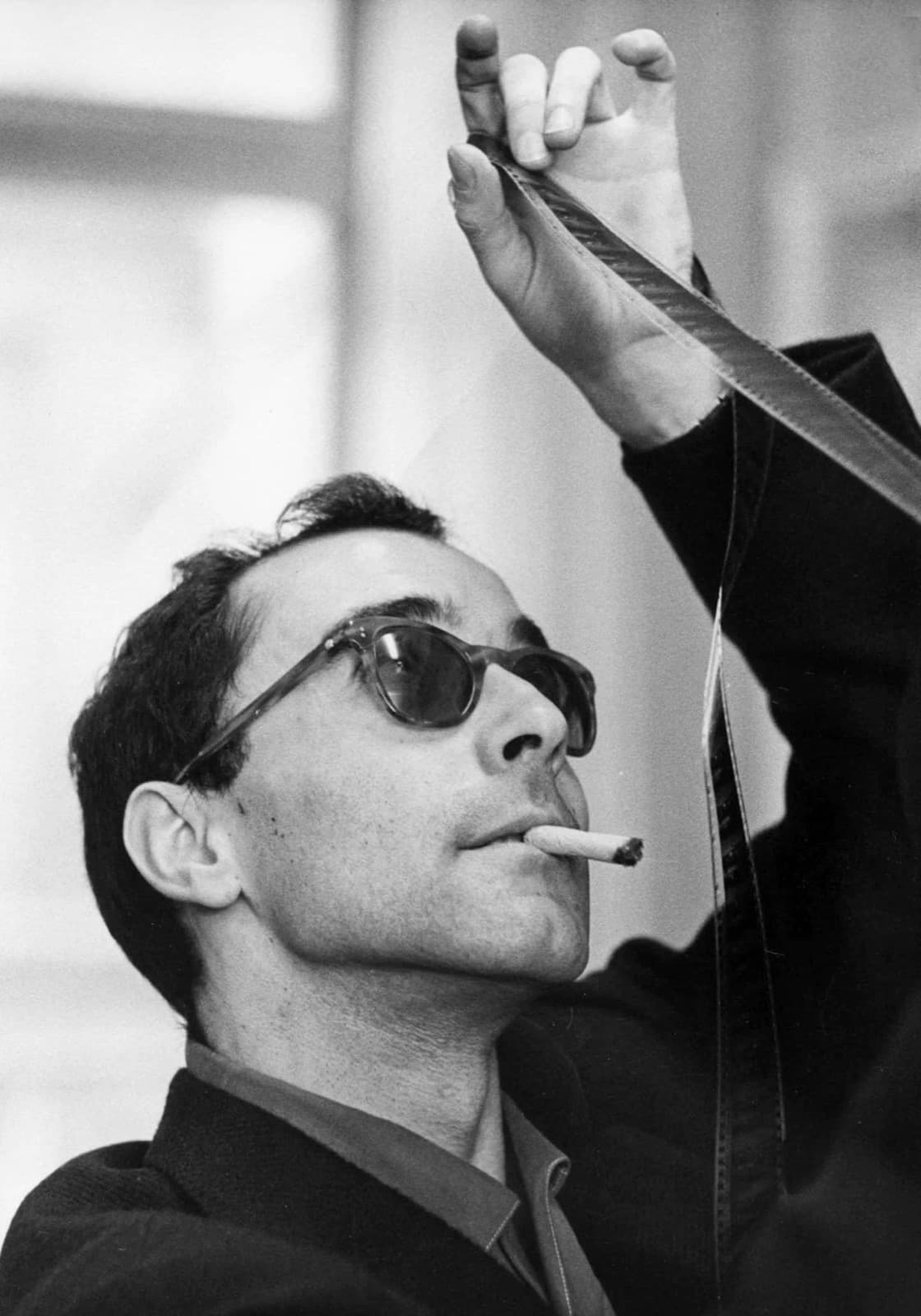
Young Jean-Luc Godard in dark glasses, cigarette in his mouth, holding a strip of film up to the light with both hands

Film movement · c. 1958–1968

The French New Wave

A Cahiers du cinéma critic through the 1950s, Godard became the movement's most recognizable director with Breathless (1960). The end year marks his turn to collective political filmmaking after May 1968, not the end of his career.

Encyclopaedia Britannica — New Wave (French film movement); Sam Wigley, BFI — 10 great French New Wave films

Jean-Luc Godard’s Places

The cataloged places connected to Jean-Luc Godard — through the books, and through the documented record.

Places you can enter today appear first, followed by addresses to see from outside and sites that have vanished.

Organizations

Frequented

Cinémathèque française

His real education: the BFI obituary has the future Cahiers du cinéma circle 'fed on a diet of American films shown at the Cinémathèque'. In 1968 he joined the protests against Langlois's removal.

Ginette Vincendeau, BFI — Jean-Luc Godard obituary: a filmmaker of seismic impact and influence (2022)

Questions about Jean-Luc Godard

Who was Jean-Luc Godard?

A filmmaker (1930–2022), the Cahiers du cinéma critic who became the French New Wave's most recognizable director and then spent six decades taking apart and rebuilding the language of film.

What is Jean-Luc Godard best known for?

Breathless (À bout de souffle, 1960), shot fast and cheap on the streets of Paris, which gave the New Wave its most recognizable form. His later films grew steadily more experimental and political.

What made Breathless so influential?

Its discontinuous editing — jump cuts that made the technique conspicuous and deliberate — and its cheap, handheld, street-shot style, which showed a feature could be made outside the studio system and was imitated everywhere.

Was Godard a film critic first?

Yes. He wrote for Cahiers du cinéma through the 1950s, sometimes signing as Hans Lucas, arguing that directors like Hitchcock and Hawks were artists with coherent bodies of work — before turning to directing himself.

Who was Anna Karina?

The actress who became Godard's defining collaborator and his wife (1961–1965). Together they made a run of features from Une femme est une femme (1961) to Made in U.S.A. (1966).

Why did Godard and Truffaut fall out?

Over letters in 1973, when Godard attacked Truffaut's film Day for Night and its maker's honesty. Truffaut answered at furious length, and the two never spoke again.

Sourced claims

Every connection the graph holds for Jean-Luc, with the evidence behind it.

Associated with · 1959–1968

The French New Wave

A Cahiers du cinéma critic through the 1950s, Godard became the movement's most recognizable director with Breathless (1960). The end year marks his turn to collective political filmmaking after May 1968, not the end of his career.

Encyclopaedia Britannica — New Wave (French film movement); Sam Wigley, BFI — 10 great French New Wave films

Married to · 1961–1965

Anna Karina

Married in 1961, divorced in 1965. The working partnership ran wider than the marriage: a run of features from Une femme est une femme (1961) to Made in U.S.A. (1966), the last completed after the divorce.

Jordan Mintzer, The Hollywood Reporter — Jean-Luc Godard, Enfant Terrible of Modern French Cinema, Dies at 91 (2022); Ginette Vincendeau, BFI — Jean-Luc Godard obituary: a filmmaker of seismic impact and influence (2022)

Lived at

Hôtel de Suède

TCM's production history reports that Godard lived at the hotel after returning from South America in the early 1950s, and chose to shoot the Breathless bedroom scene there for that reason. A single source; recorded as probable until a second establishes it.

TCM — Behind the Camera: Breathless

Frequented

Cinémathèque française

His real education: the BFI obituary has the future Cahiers du cinéma circle 'fed on a diet of American films shown at the Cinémathèque'. In 1968 he joined the protests against Langlois's removal.

Ginette Vincendeau, BFI — Jean-Luc Godard obituary: a filmmaker of seismic impact and influence (2022)

Collaborated with · 1959–1964

Jean Seberg

He cast her as Patricia in Breathless — reached through her first husband, François Moreuil, in June 1959 — and she carried the film that made them both. She reprised the character in his segment Le Grand Escroc (1964). She doubted his method during the shoot; the result outlived the doubt.

Encyclopaedia Britannica — Breathless (film by Godard, 1960); Jordan Mintzer, The Hollywood Reporter — Jean-Luc Godard, Enfant Terrible of Modern French Cinema, Dies at 91 (2022)

Clashed with · 1973

François Truffaut

The 1973 letters: Godard attacked Day for Night and its maker's honesty; Truffaut answered at furious length. They never spoke again. The exchange survives in the published correspondence.

The Criterion Collection — Godard vs. Truffaut

Collaborated with · 1959–1968

François Truffaut

Cahiers colleagues who became the movement's twin engines: Truffaut supplied Breathless's story and his endorsement got Godard the director's chair; in 1968 they led the Langlois protests together and shut down the Cannes festival side by side.

Nancy Tartaglione, Deadline — How Francois Truffaut and Jean-Luc Godard Brought the Revolution to Cannes in 1968 (2016); Encyclopaedia Britannica — Breathless (film by Godard, 1960)

Collaborated with · 1960–1966

Anna Karina

Seven features in six years: Le Petit Soldat (shot 1960, released 1963), Une femme est une femme (1961), Vivre sa vie (1962), Bande à part (1964), Alphaville and Pierrot le fou (1965), and Made in U.S.A. (1966). The partnership ran wider and longer than the 1961–1965 marriage; Made in U.S.A. was completed after the divorce.

Encyclopaedia Britannica — Anna Karina (Danish-French actress); Jordan Mintzer, The Hollywood Reporter — Jean-Luc Godard, Enfant Terrible of Modern French Cinema, Dies at 91 (2022)

Collaborated with · 1960

Jean-Paul Belmondo

Godard directed Belmondo in Breathless (1960), the film that made him a star, and again in Pierrot le fou (1965).

The Criterion Collection — Pierrot le fou; Encyclopaedia Britannica — Jean-Luc Godard

Collaborated with · 1963

Brigitte Bardot

Godard directed Bardot as Camille in Contempt (1963), building an art film around — and against — her stardom.

The Criterion Collection — Contempt; Encyclopaedia Britannica — Jean-Luc Godard

Collaborated with · 1960

Claude Chabrol

Fellow Cahiers du cinéma critics; Chabrol served as the credited artistic and technical adviser on Godard's debut Breathless (1960).

The Criterion Collection — Le Beau Serge; Encyclopaedia Britannica — New Wave (French film movement)

Collaborated with · 1950

Éric Rohmer

Godard wrote for Rohmer's short-lived journal La Gazette du cinéma in 1950 and acted in Rohmer's early short Présentation, ou Charlotte et son steak. Both were part of the Cahiers du cinéma circle.

Encyclopaedia Britannica — Éric Rohmer; Encyclopaedia Britannica — Cahiers du Cinéma

Collaborated with · 1961

Jacques Rivette

Godard appears in a cameo in Rivette's debut Paris Belongs to Us (1961). Both wrote for Cahiers du cinéma and belonged to the circle of critics who became the New Wave.

Encyclopaedia Britannica — Jacques Rivette; Encyclopaedia Britannica — Cahiers du Cinéma

Collaborated with · 1959–1983

Raoul Coutard

Coutard shot nearly all of Godard's New Wave features, from Breathless in 1959 through Weekend in 1967, and the two worked together again on Passion (1982) and Prénom Carmen (1983). The handheld camera and available light of those films are largely his.

Wikipedia — Raoul Coutard; Encyclopaedia Britannica — Breathless (film by Godard, 1960)