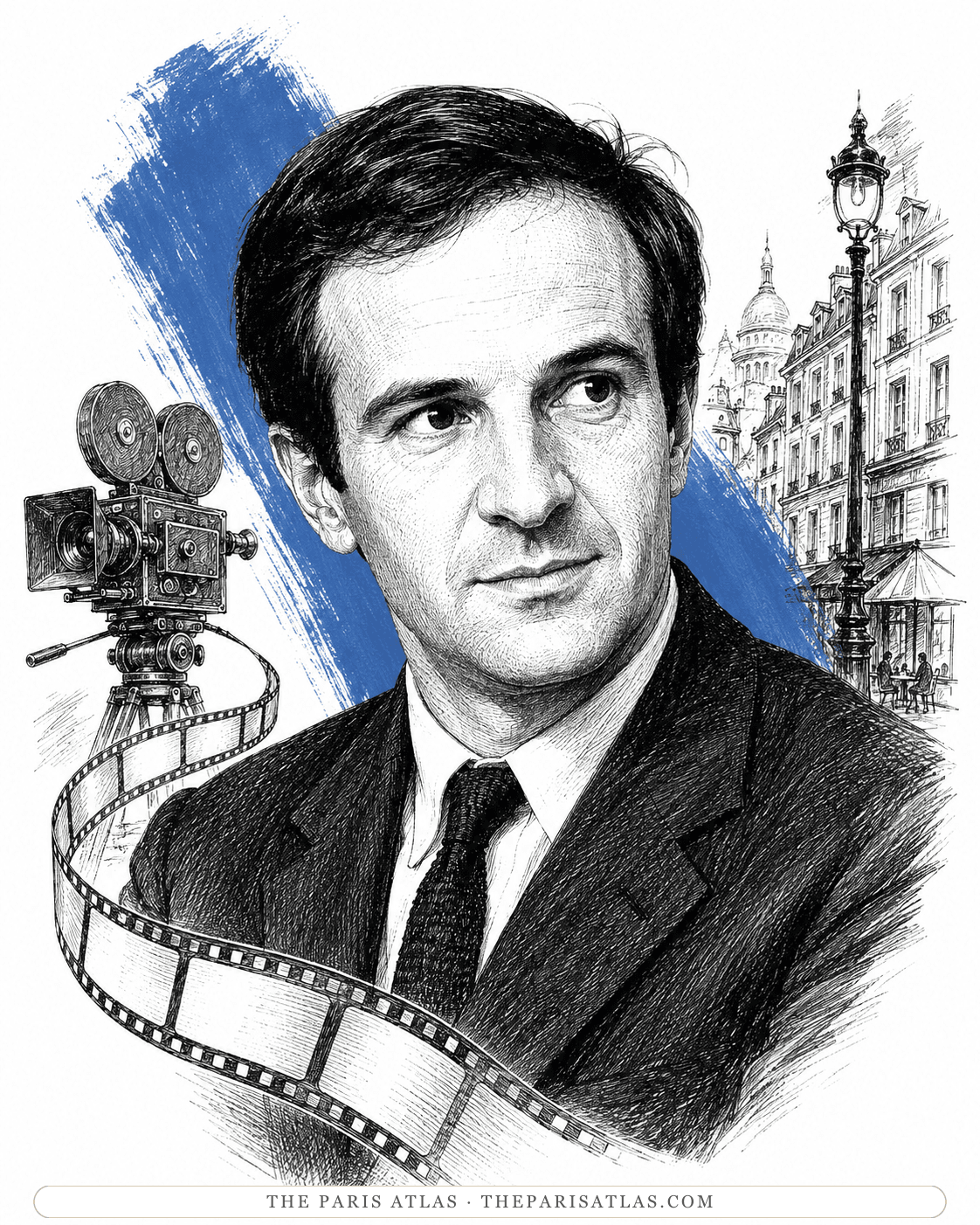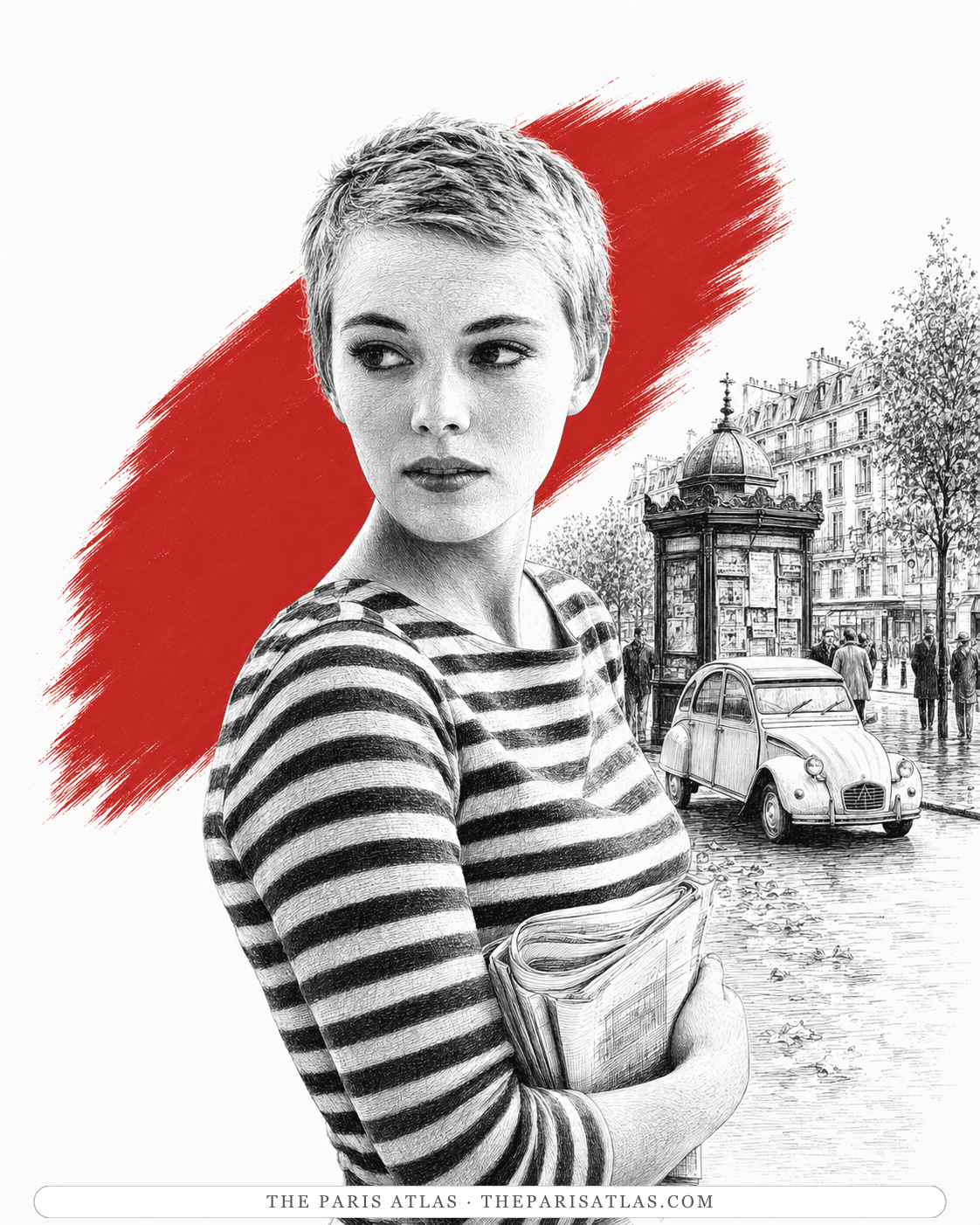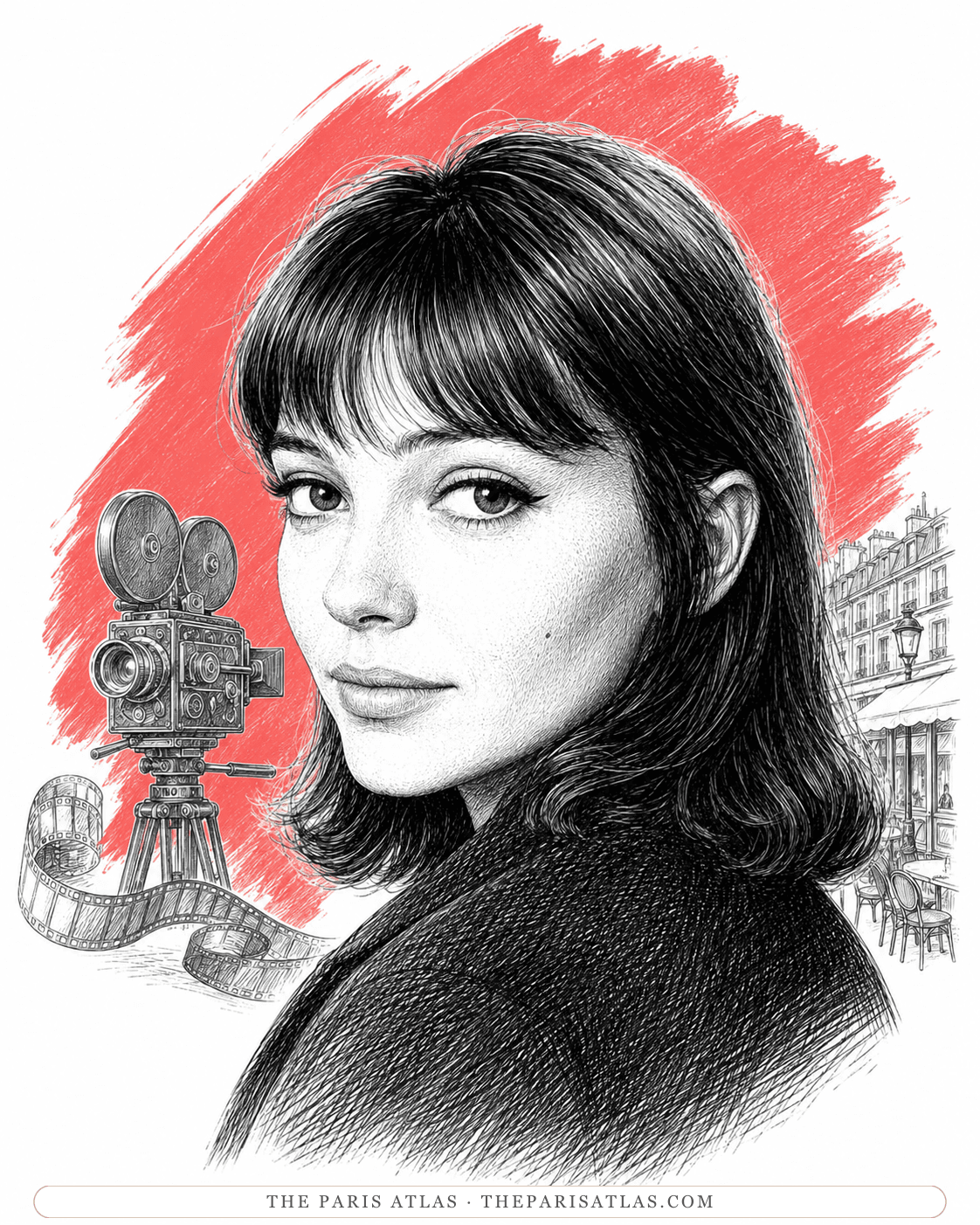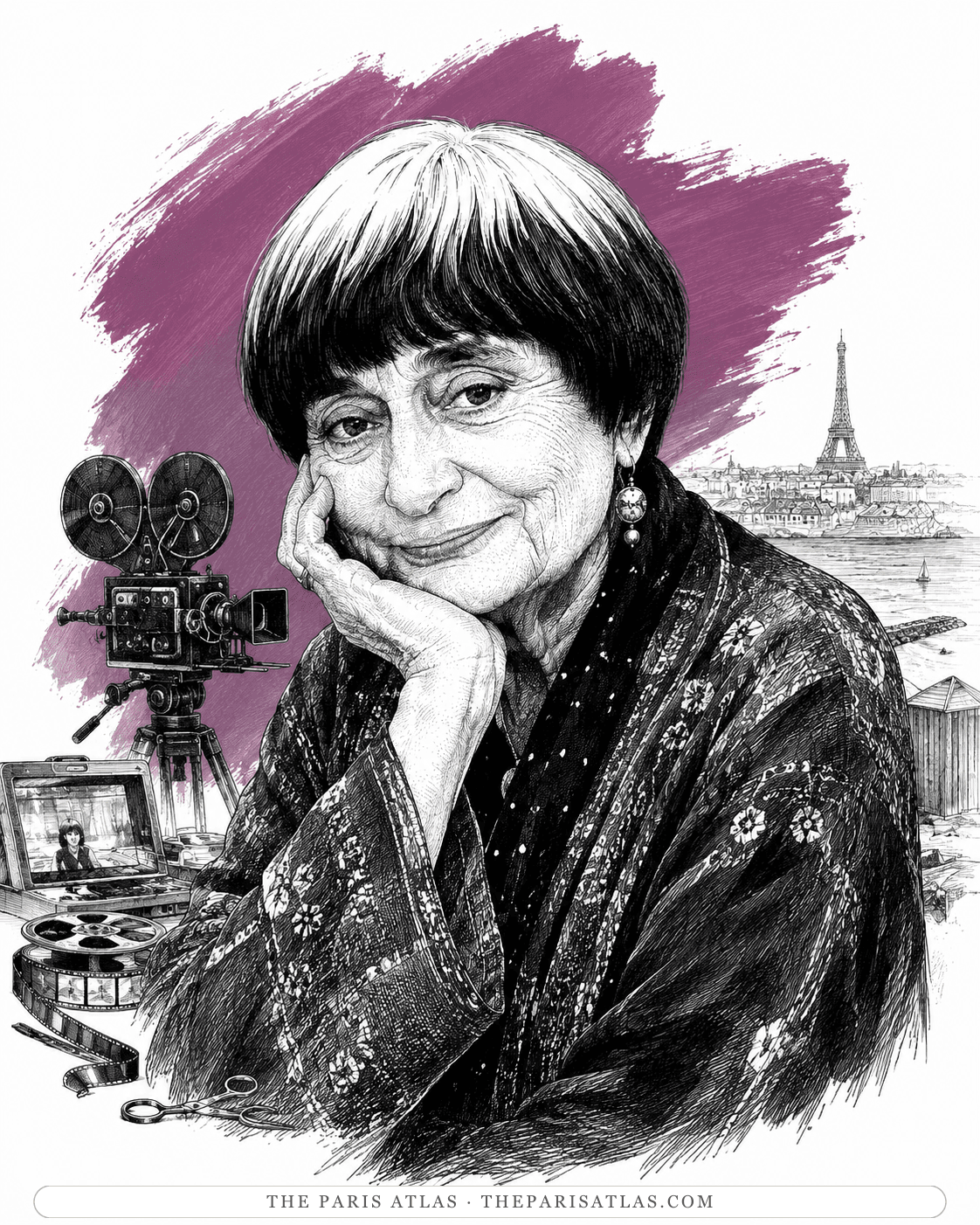
The Paris AtlasCharting the artists, works, and places worth returning to.

Film movement · Paris · c. 1958–1968

The French New Wave

A generation of French critics and outsiders picked up cameras at the end of the 1950s and made features on borrowed money in real streets. Their films rewrote the grammar of the medium.

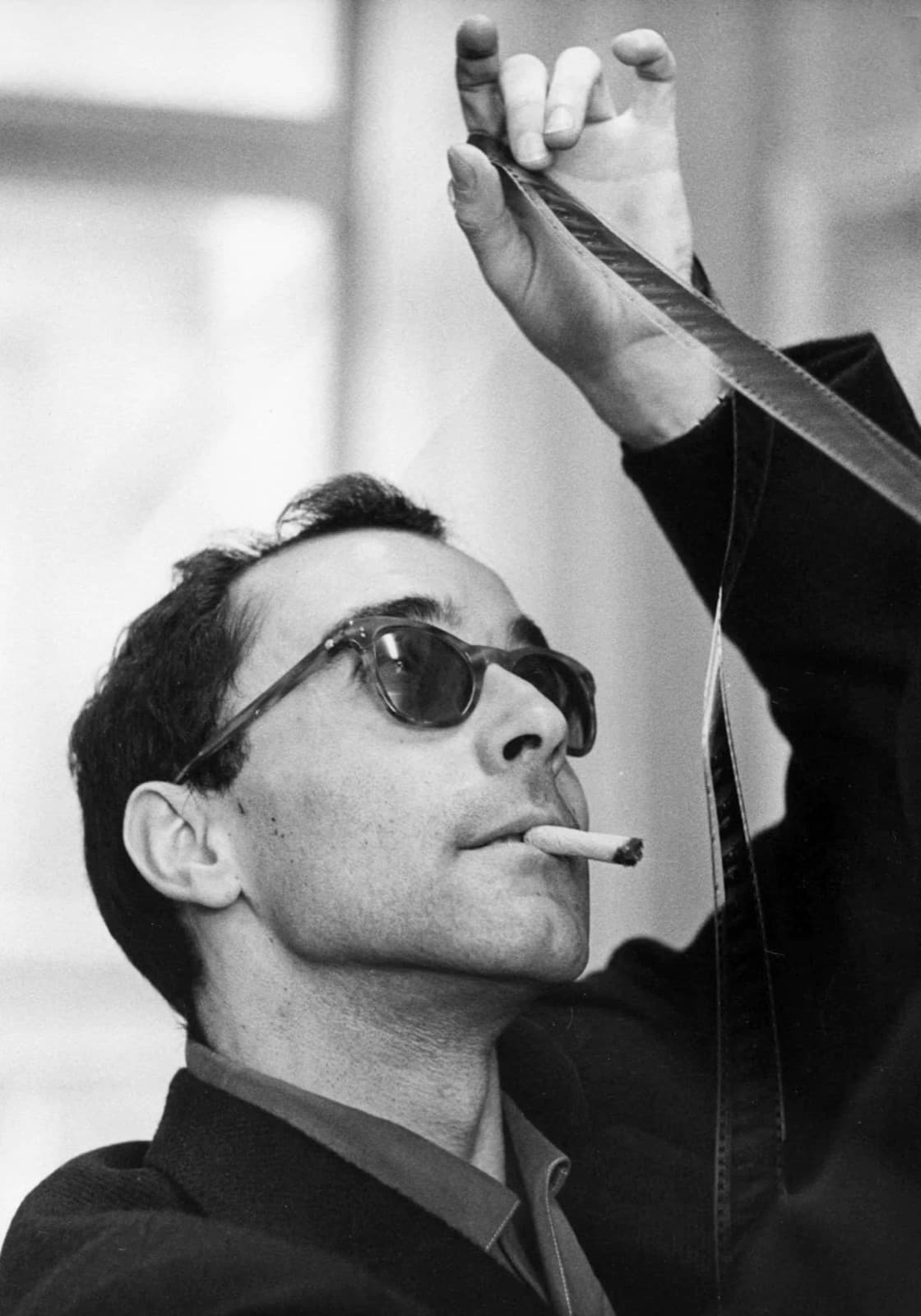
Young Jean-Luc Godard in dark glasses, cigarette in his mouth, holding a strip of film up to the light with both hands
Archival photographGodard reading a strip of film, early 1960s — the movement in one image: a critic examining cinema by hand. Unidentified press photographer; used under fair use.

The critics who picked up cameras

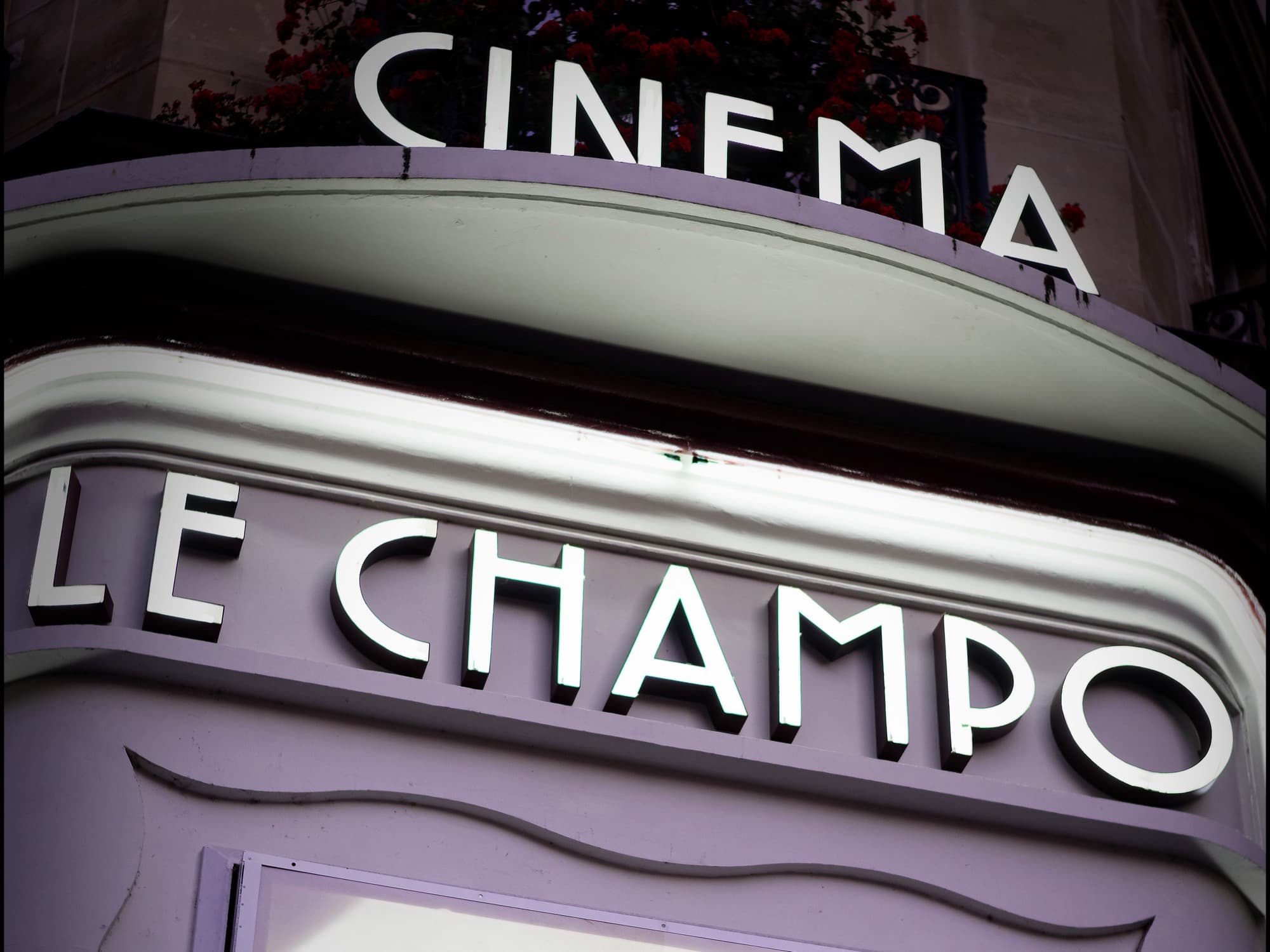
The lit night marquee of Le Champo cinema in the Latin Quarter: CINEMA above, LE CHAMPO in glowing deco letters, red geraniums on the balcony above
PhotographLe Champo, rue des Écoles — the Latin Quarter screen where the generation got its education, still running repertory today. Photo: madras91 (CC BY 2.0), via Wikimedia Commons.

The French New Wave was a burst of first features made by young directors in and around Paris between 1958 and the mid-1960s. Its best-known figures — Jean-Luc Godard, François Truffaut, Claude Chabrol, Éric Rohmer, Jacques Rivette — began as film critics at the magazine Cahiers du cinéma, and their movement carried the habits of criticism into production: strong opinions about what cinema had become, and cheaper, faster ways of making it.

Nouvelle vague means, literally, "new wave." The label began as a journalist's phrase for France's postwar generation and attached itself to its filmmakers. It never described a formal school. There was no manifesto, no membership list, and no single style; what the films shared was independence from the established studios, small budgets, and a belief that a film should carry its director's voice.

1959 made the movement international news, and by about 1965 the collective phenomenon had dissolved into separate careers. The individual careers ran for decades — several of them among the most consequential in the history of the medium.

An education in the dark

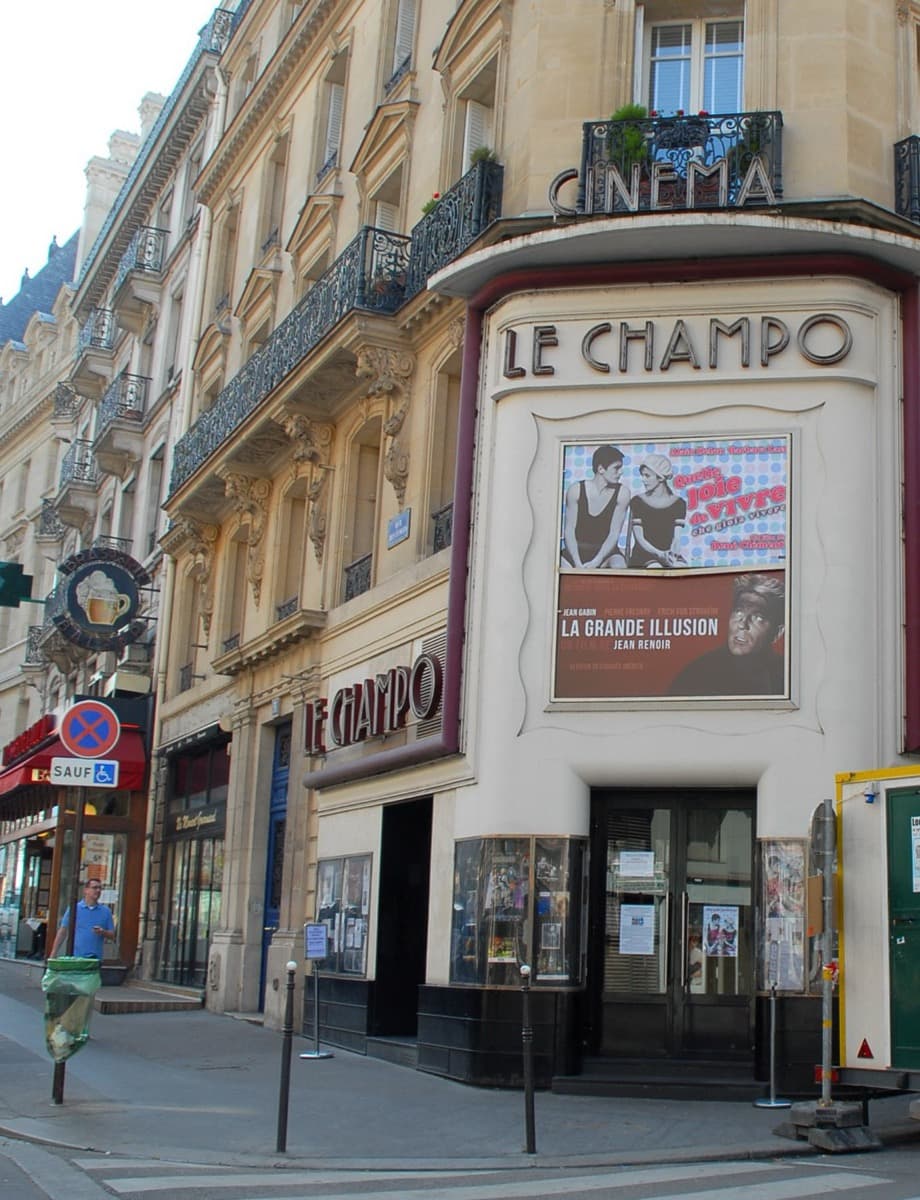
The corner façade of Le Champo cinema by day, a restored-print poster for Jean Renoir's La Grande Illusion on the marquee
PhotographLe Champo by day, playing a restored Grande Illusion — the repertory diet, Renoir included, that raised the Cahiers generation. Photo: Camille Gévaudan (CC BY-SA 3.0), via Wikimedia Commons.

The movement's real origin is a set of Paris screening rooms. At the Cinémathèque française, Henri Langlois programmed silent cinema, Hollywood genre pictures, and new work side by side, out of chronological order, and a generation of regulars absorbed film history as one simultaneous argument. The ciné-clubs of the Latin Quarter did the same on smaller screens.

Cahiers du cinéma, founded in 1951 with the critic André Bazin among its founders, gave that education a printed voice. Its young writers attacked the polished, script-bound French "tradition of quality" — Truffaut's 1954 essay "A Certain Tendency of the French Cinema" is the famous salvo — and argued that a director could be a film's author in the way a novelist is a book's. The position, la politique des auteurs, had a prehistory (Alexandre Astruc's 1948 caméra-stylo essay) and a future (the American critic Andrew Sarris later systematized it as the auteur theory), but its working consequence in Paris was direct: the critics who held it went out and directed.

It followed that Alfred Hitchcock, Howard Hawks, and Nicholas Ray were treated as artists worth a lifetime's study — a judgment that seemed eccentric in the 1950s and standard ever since.

1958–1960

1959: the wave breaks

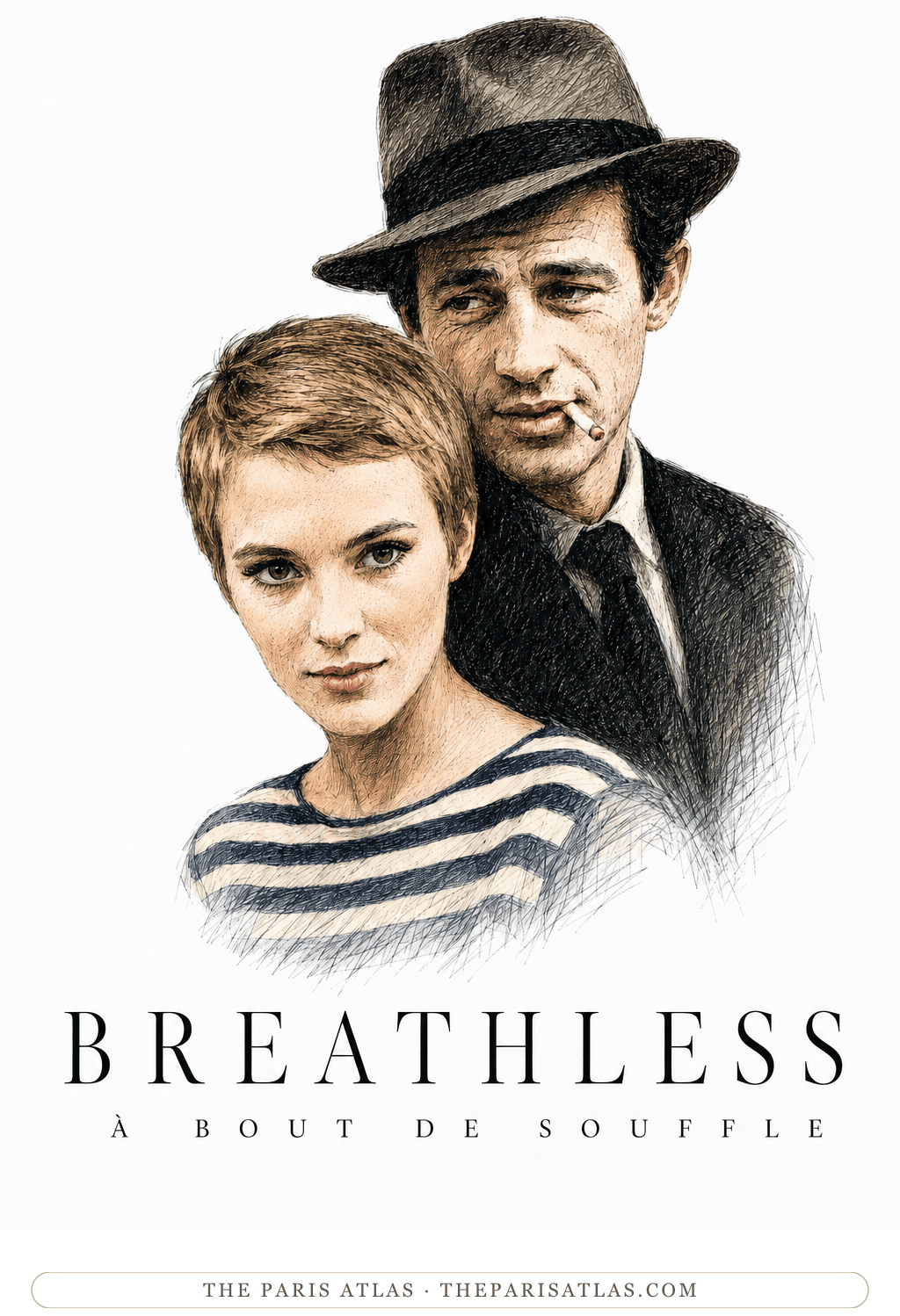
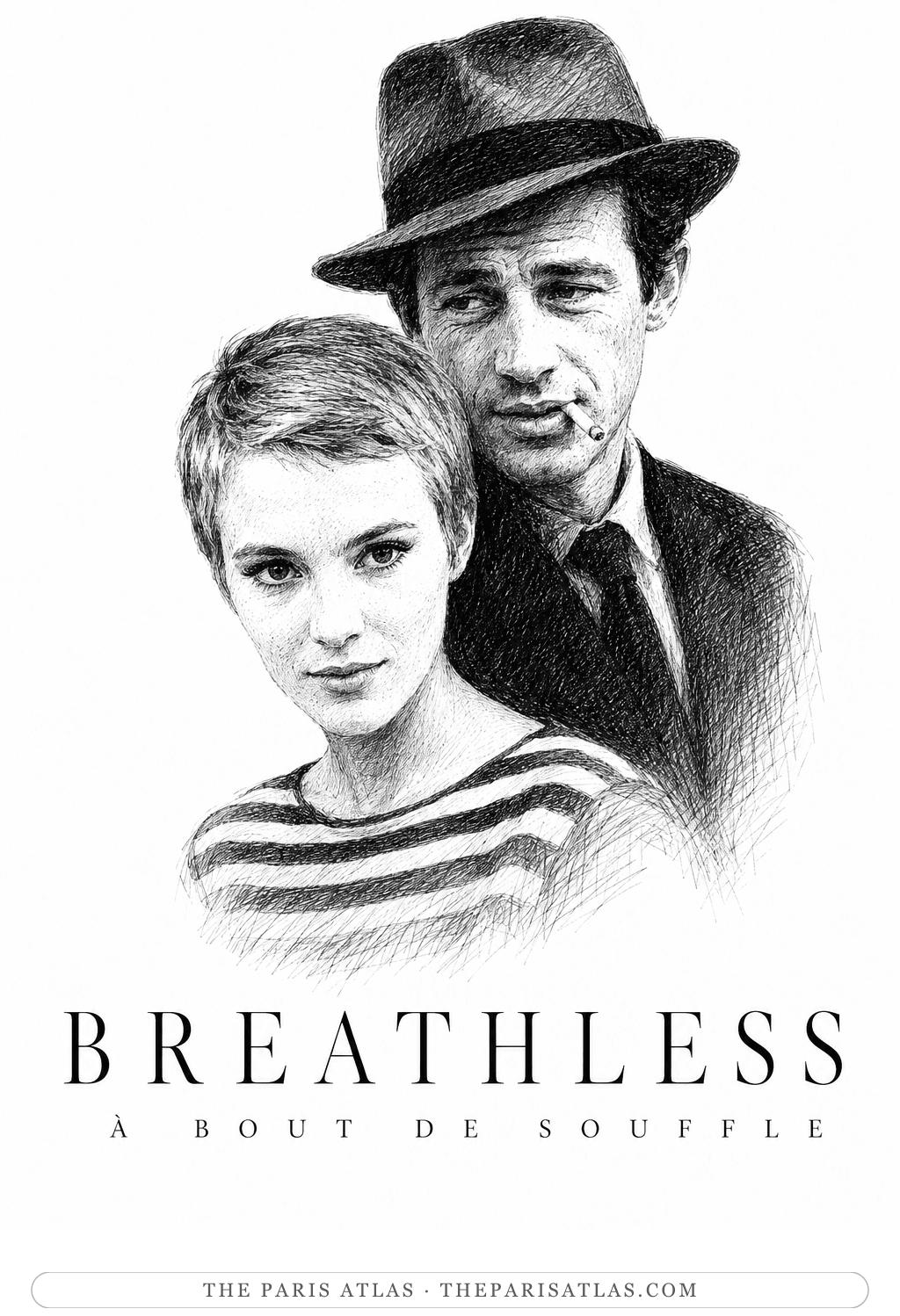
Pen-and-ink house poster for Breathless: Jean Seberg in a striped shirt and Jean-Paul Belmondo in a fedora, above the title in English and French
Editorial illustrationBreathless, the film that turned the movement into a rush — the house poster, drawn for its works page.

Chabrol moved first: Le Beau Serge (1958), financed outside the studio system, is usually counted the movement's first feature. The breakthrough came at Cannes in 1959, where Truffaut — banned from the festival as a critic the year before — won the best director prize for The 400 Blows, and Alain Resnais's Hiroshima mon amour premiered to comparable effect.

Godard shot À bout de souffle (Breathless) on the streets of Paris later that year with cinematographer Raoul Coutard, and its March 1960 opening turned the movement into a rush. The film's discontinuous editing — the jump cuts that arrived partly through cutting long takes down — did not invent the technique, but made it conspicuous, deliberate, and imitated everywhere.

Dozens of directors made first features in the seasons that followed. The wave was not five people; it was a market briefly convinced that youth was bankable.

Two constellations

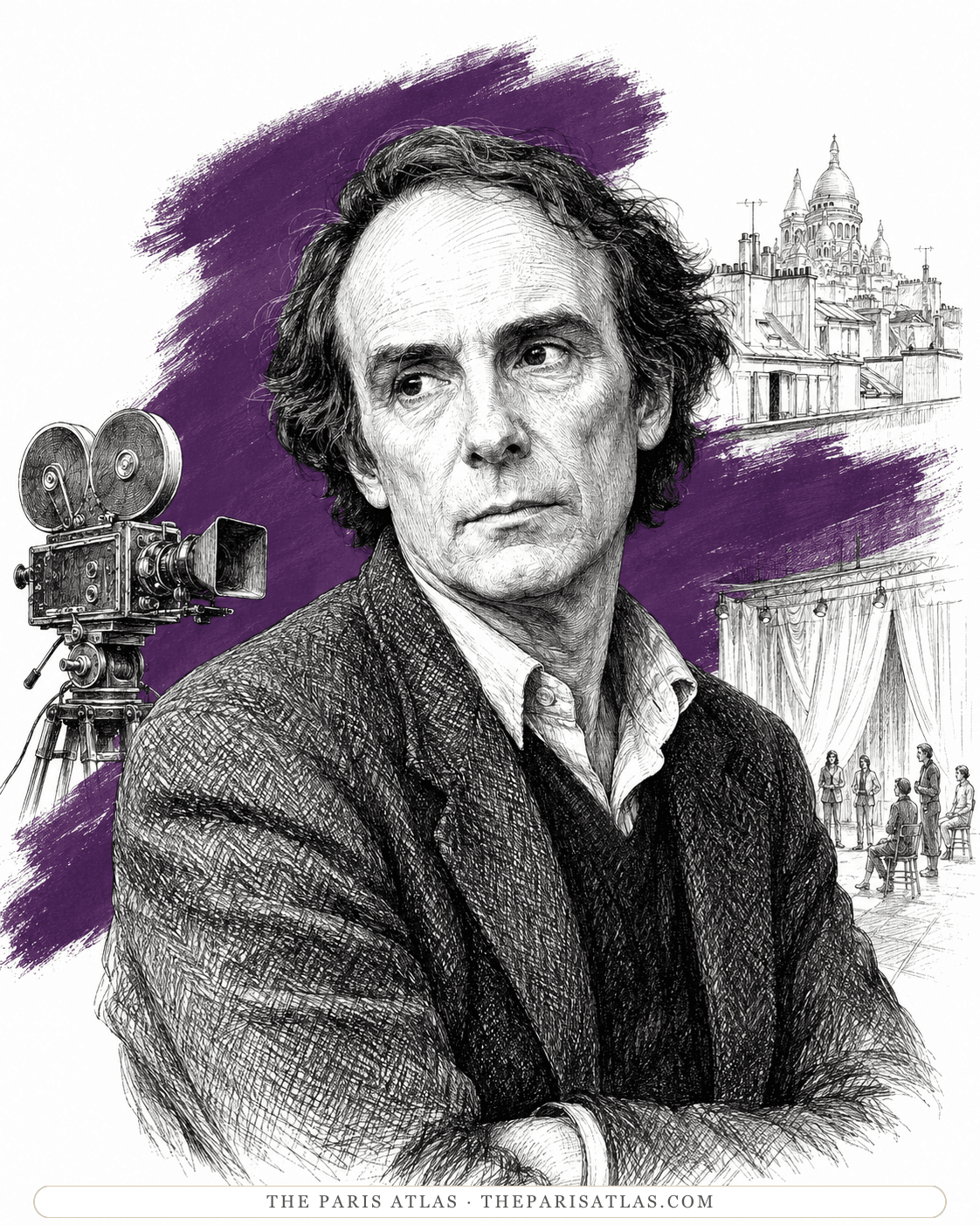
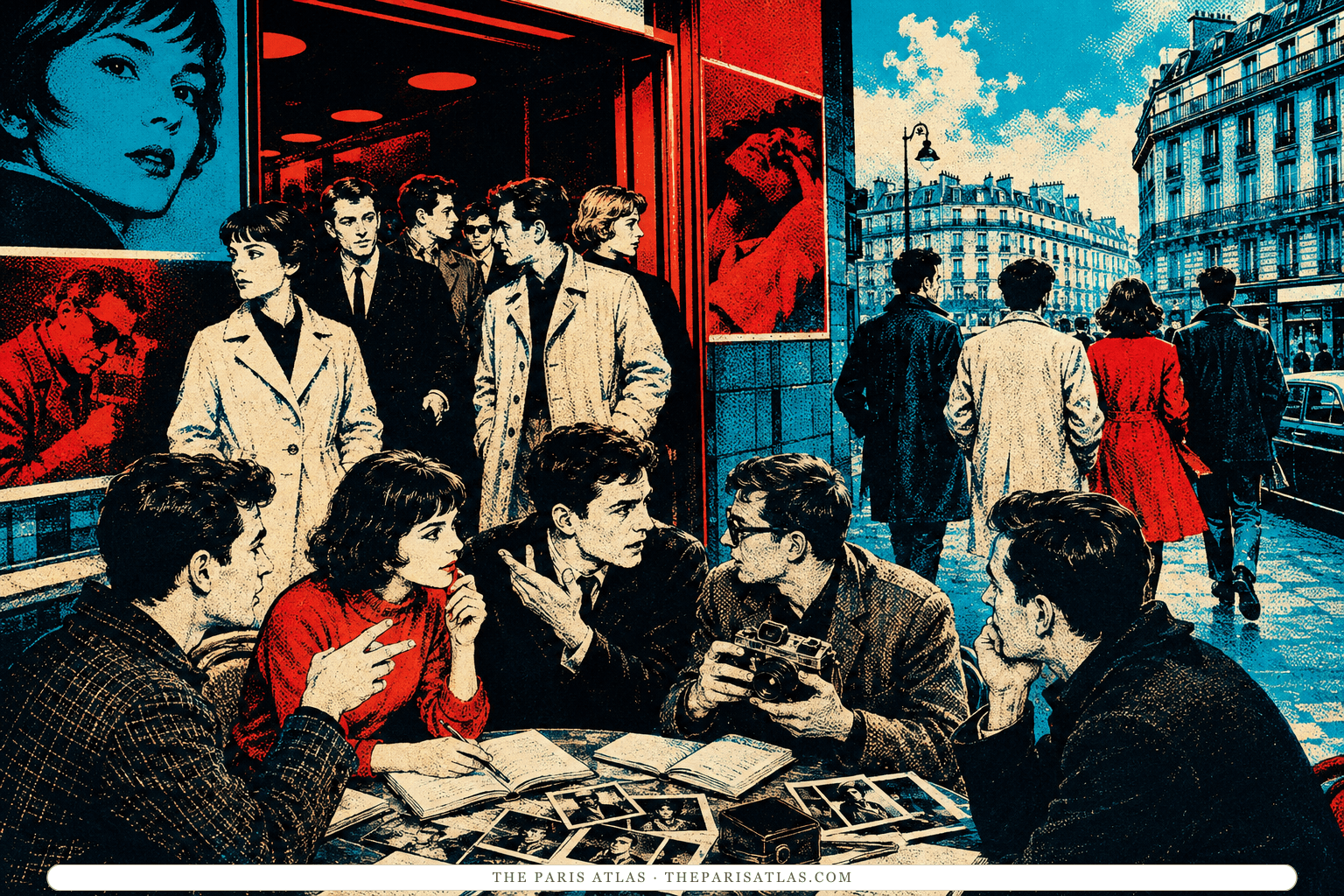
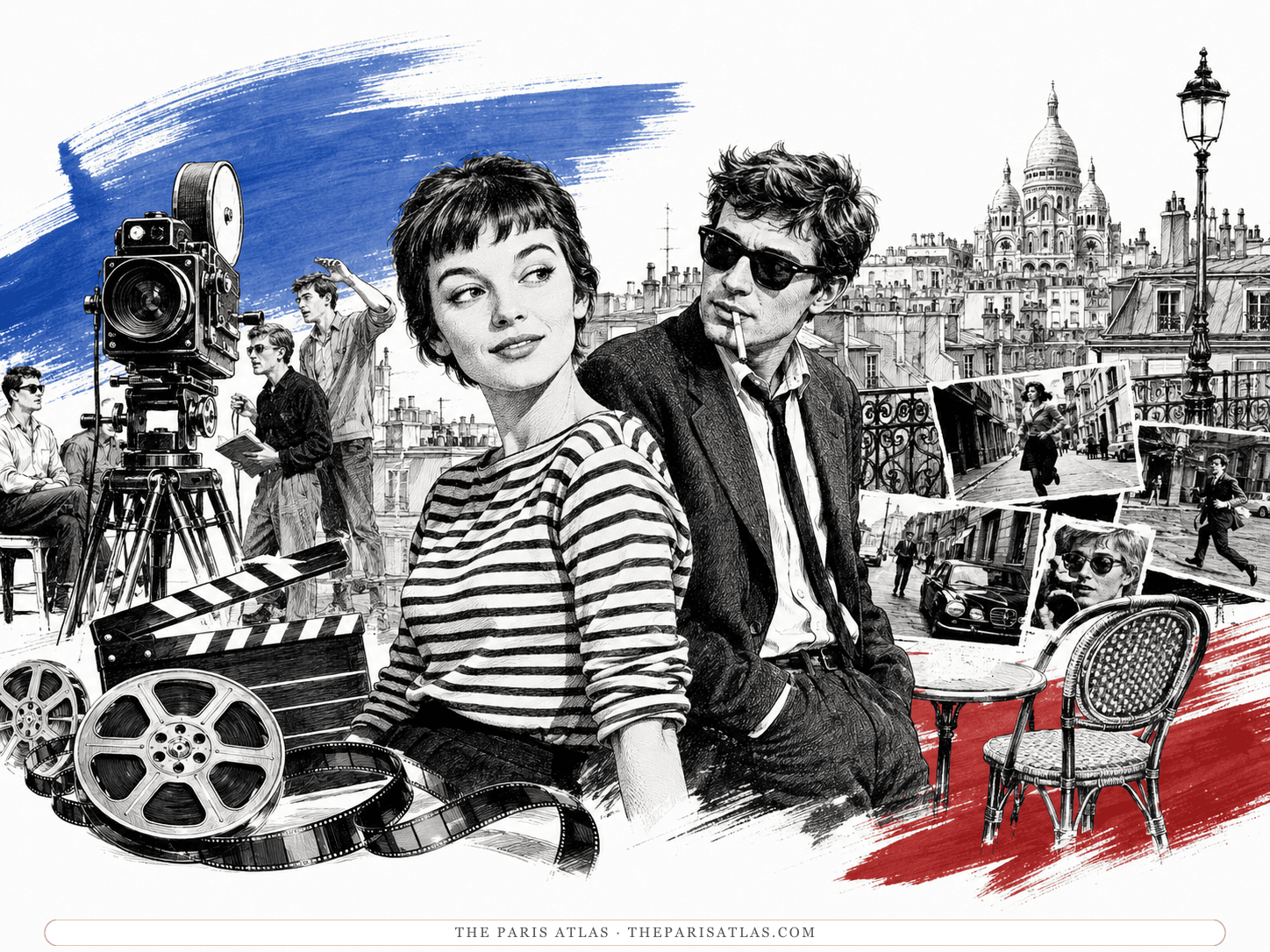
Pen-and-ink illustration of a New Wave shoot: a young woman in a Breton striped top and a young man in dark glasses seated in the foreground while a film crew works a camera behind them, Montmartre rooftops and the Sacré-Cœur beyond, over brushed strokes of blue, white, and red
Editorial illustrationThe movement as a scene: stars in the foreground, crew and camera behind, on a Paris street. House illustration.

The movement is usually mapped as two overlapping groups. The Cahiers critics — Godard, Truffaut, Chabrol, Rohmer, Rivette — were cinephiles first, and their films quote, correct, and argue with the history of the medium, American genre cinema above all.

The Left Bank group — Alain Resnais, Chris Marker, Agnès Varda — came to film from documentary, photography, and writing rather than from criticism, and their work ran more literary and more directly political. Varda's La Pointe Courte (1955) predates every Cahiers feature, which is why she is often called the movement's precursor as well as one of its principals. Jacques Demy, married to Varda, is usually placed with the Left Bank while sharing the Cahiers group's cinephilia.

The boundaries were social, not doctrinal, and membership has been argued about ever since. Figures like Louis Malle and Jean-Pierre Melville sit adjacent — Malle a contemporary working the same streets with the same freedom, Melville an older independent whose methods the younger directors studied.

What the style was

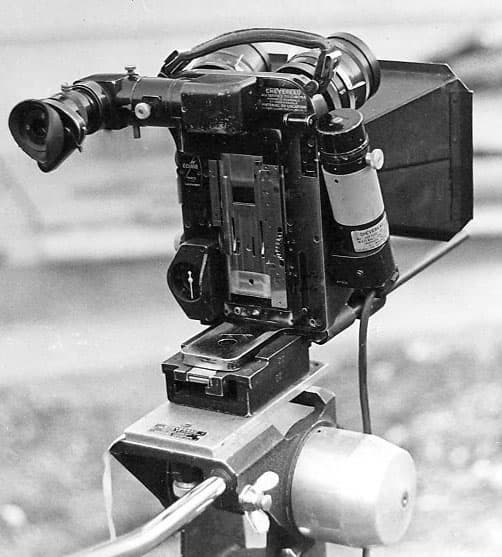
Rear view of an Éclair Cameflex 35 mm camera on a tripod, magazine and viewfinder visible, in black and white
Archival photographThe Éclair Cameflex — the light, loud, shoulder-ready camera Coutard shot Breathless on. It could go anywhere; it could not record sound. Photo: PODZO DI BORGO (CC BY-SA 4.0), via Wikimedia Commons.

The look of the films came from a meeting of conviction and constraint. The directors rejected studio polish on principle and could not have afforded it anyway; postwar advances in lightweight cameras and faster film stock made the alternative practical.

No single toolkit was universal — the films differ more than the textbook summary suggests — but the recurring elements are consistent:

Production

Real locations instead of sets, available light, small crews, short schedules, and small budgets, often raised outside the industry. Casts mixed professionals with newcomers and non-actors.

Camera

Handheld and mobile camerawork, borrowed in part from documentary practice, that let a scene follow its actors through actual streets and rooms.

Editing and address

Discontinuous cutting that shows its seams — jump cuts, abrupt transitions, scenes compressed by ellipsis — and moments in which a film admits it is a film: direct address, quotation, titles inside the image.

After the wave

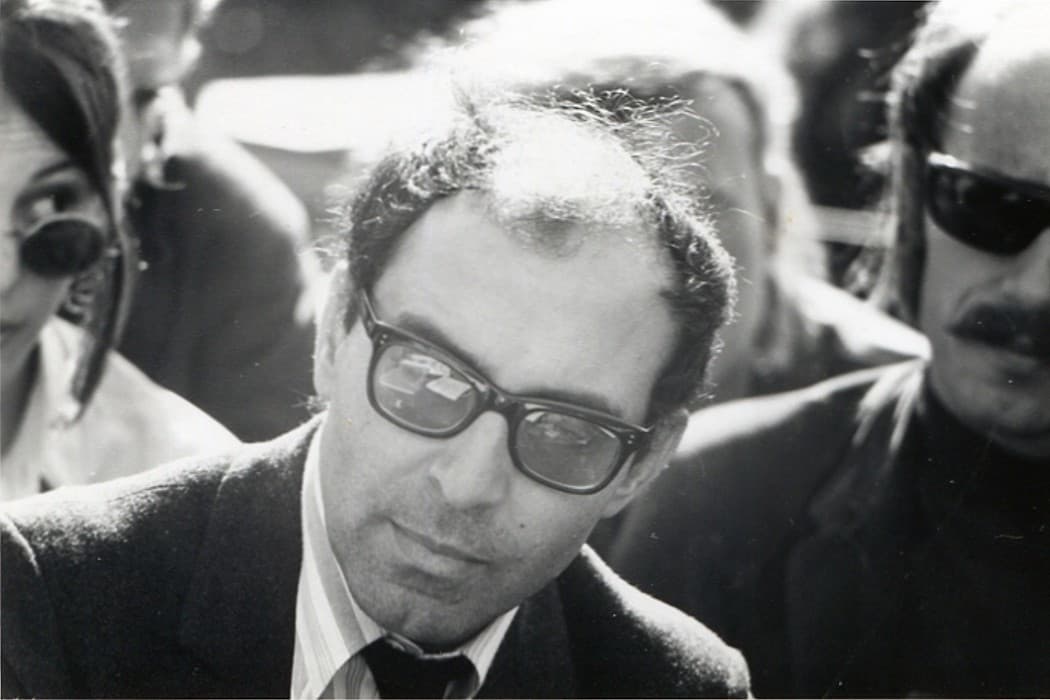
Jean-Luc Godard in dark-framed glasses surrounded by a crowd outdoors at Berkeley in 1968
Archival photographGodard in the crowd at Berkeley, 1968 — the year the movement's directors converged on the Langlois affair and Cannes, and dispersed for good. Photo: Gary Stevens (CC BY 2.0).

As a collective phenomenon the New Wave was over by the mid-1960s; as a set of careers it never stopped. The directors diverged — toward political cinema, toward the essay film, toward long careers of narrative features — and twice in 1968 they converged again in public: in February, when the government's attempt to remove Henri Langlois from the Cinémathèque put filmmakers into the streets, and in May, when Truffaut, Godard, and others helped shut down the Cannes festival in solidarity with the national uprising.

The influence is hard to overstate and easy to misstate. Filmmakers from the New Hollywood generation onward absorbed the movement's methods and its central permission — that a film can be made cheaply, personally, and against the grammar of its moment. Individual lines of influence belong on individual pages, with evidence; the general debt is not in dispute.

In the atlas's catalog

The movement's works cataloged so far, from the holding institutions' records. Reproductions appear only where the rights are verified.

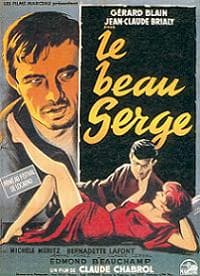
Poster for Le Beau Serge (1958), Claude Chabrol's first feature

Archival photograph

Film

Le Beau Serge

Claude Chabrol · 1958 · 99-minute feature, black and white

Le Beau Serge is Claude Chabrol's first feature, and the first film made by any of the Cahiers du cinéma critics who would become the French New Wave — reaching the screen before Truffaut's The 400 Blows and Godard's Breathless. Chabrol shot it in his own childhood village with money from a family inheritance: a young man recovering from illness returns home to find his once-promising friend Serge sunk into drink and a failing marriage, and sets himself to save him. Location shooting, natural light, a small crew, and independent financing outside the studios made it a template for the movement, and its success let Chabrol help produce his friends' first films.
Claude Chabrol, Le Beau Serge, 1958. Image © the rights holder, shown under fair use.

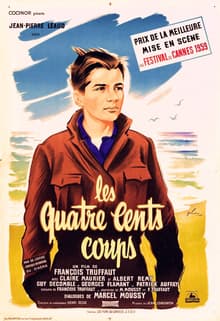
Illustrated French poster for Les Quatre Cents Coups: Antoine in a rust jacket against a pale sea, with a red Cannes prize banner at top

Archival photograph

Film

The 400 Blows

François Truffaut · 1959 · 35 mm feature film in DyaliScope

Truffaut's first feature turned his own neglected Paris childhood into Antoine Doinel: a boy failed by his mother, his school, and the reformatory, played by fourteen-year-old Jean-Pierre Léaud. One year after Cannes banned Truffaut as a critic, it won him the festival's directing prize, drew 4.1 million French admissions, and ended on the most famous freeze-frame in cinema. The New Wave's door opened here.

François Truffaut, The 400 Blows, 1959. Image © the rights holder, shown under fair use.

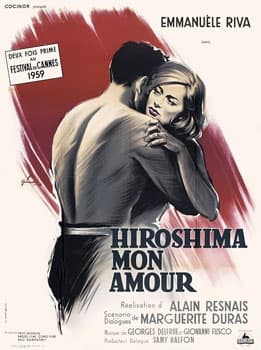
Release poster for Hiroshima mon amour (1959): the title over the intertwined figures of the French actress and the Japanese architect

Archival photograph

Film

Hiroshima mon amour

Alain Resnais · 1959 · 35 mm feature film, black and white

Alain Resnais's first feature, written by the novelist Marguerite Duras, follows a French actress and a Japanese architect through a brief affair in Hiroshima, where she has come to film a picture about peace. Their encounter draws out a wartime memory she has never told: a German lover in Nevers, killed at the Liberation, for which the town shaved her head. Against the destroyed city the film makes memory and forgetting its real subject — and, arriving at Cannes in 1959 alongside the Cahiers directors' debuts, it opened the New Wave's Left Bank wing onto literature and modern time.

Alain Resnais, Hiroshima mon amour, 1959. Image © the rights holder, shown under fair use.

House poster illustration for Breathless: pen-and-ink portraits of Jean Seberg in a striped shirt and Jean-Paul Belmondo in a fedora with a cigarette, hand-colored, above the title in French and English

Editorial illustration

Film

Breathless

Jean-Luc Godard · 1960 · 35 mm feature film

Godard's first feature: a small-time criminal who models himself on Humphrey Bogart shoots a policeman, hides out in Paris with an American student who sells the Herald Tribune, and is betrayed. Shot handheld in real streets in under a month for very little money, and cut with the jumps left showing, it turned the French New Wave into an international event and remains one of the most influential debuts in the history of the medium.

Jean-Luc Godard, Breathless, 1960.

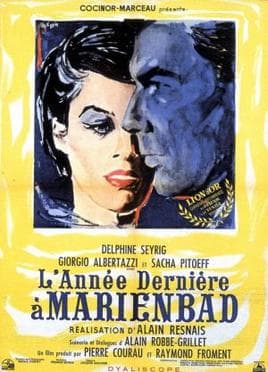
Poster for Last Year at Marienbad (1961): a figure in the baroque hotel's mirrored corridors

Archival photograph

Film

Last Year at Marienbad

Alain Resnais · 1961 · 94-minute feature, black and white — Dyaliscope widescreen

Last Year at Marienbad is Alain Resnais's second feature, written by the nouveau roman novelist Alain Robbe-Grillet. In an enormous baroque hotel, a man tries to persuade a woman that they met the year before — perhaps at Marienbad — began a love affair, and agreed to leave together now. She does not remember, or denies it. The film never confirms whether any of it happened: scenes repeat with changes, the narration contradicts the images, and past, present, and imagination dissolve into one another. With Hiroshima mon amour it is the landmark of the New Wave's Left Bank, and one of the most influential experiments in the history of narrative film.

Alain Resnais, Last Year at Marienbad, 1961. Image © the rights holder, shown under fair use.

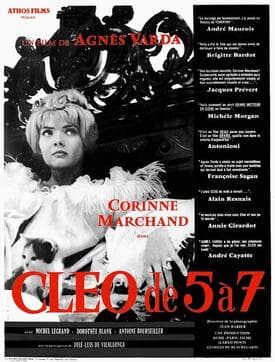
Release poster for Cléo de 5 à 7: Corinne Marchand as Cléo above the film's title, in the 1962 Left Bank release artwork

Archival photograph

Film

Cléo from 5 to 7

Agnès Varda · 1962 · 35 mm feature film, black and white with a colour prologue

Agnès Varda's second feature follows a pop singer through ninety near-real-time minutes of a Paris afternoon as she waits for a medical result that may be cancer. Corinne Marchand's Cléo begins the film as a superstitious beauty watched by everyone and ends it seeing the city — and herself — clearly. A landmark of the Left Bank New Wave and one of the founding films of the female gaze, it is the film most viewers reach Varda through.

Agnès Varda, Cléo from 5 to 7, 1962. Image © the rights holder, shown under fair use.

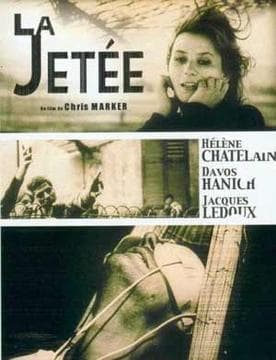
Poster for La Jetée (1962): a woman's face in grainy black and white behind the film's title

Archival photograph

Film

La Jetée

Chris Marker · 1962 · 28-minute short film, black and white — a photo-roman

Chris Marker's La Jetée is a science-fiction film told almost entirely in still photographs. After a Third World War, survivors under a ruined Paris experiment with sending a prisoner through time, choosing him for the strength of one childhood memory: a woman's face on the observation pier at Orly, and a man's death. Twenty-eight minutes long and built from photographs joined by dissolves and a narrator's voice, it is the New Wave's Left Bank sensibility — memory, the still image, the aftermath of catastrophe — pushed to its logical extreme, and the film that later gave Terry Gilliam the premise of 12 Monkeys.

Chris Marker, La Jetée, 1962. Image © the rights holder, shown under fair use.

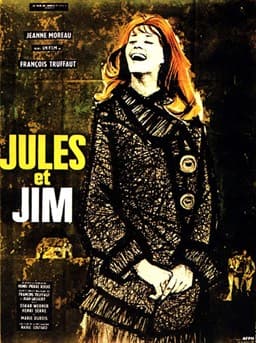
Poster for Jules et Jim (1962): Jeanne Moreau between the two friends

Archival photograph

Film

Jules and Jim

François Truffaut · 1962 · 105-minute feature, black and white — Franscope widescreen

François Truffaut's third feature turns Henri-Pierre Roché's novel into the New Wave's most beloved film. Before the First World War, two inseparable friends — Jules, an Austrian, and Jim, a Frenchman — both fall for Catherine, a willful, unclassifiable woman played by Jeanne Moreau. She marries Jules, takes Jim as a lover with her husband's consent, and holds the three of them in a love triangle that runs across two decades and a war. Truffaut films it with every freedom the movement had won — voiceover, freeze-frames, newsreel footage, sudden shifts from joy to grief — and Moreau's Catherine became one of the defining faces of the New Wave.

François Truffaut, Jules and Jim, 1962. Image © the rights holder, shown under fair use.

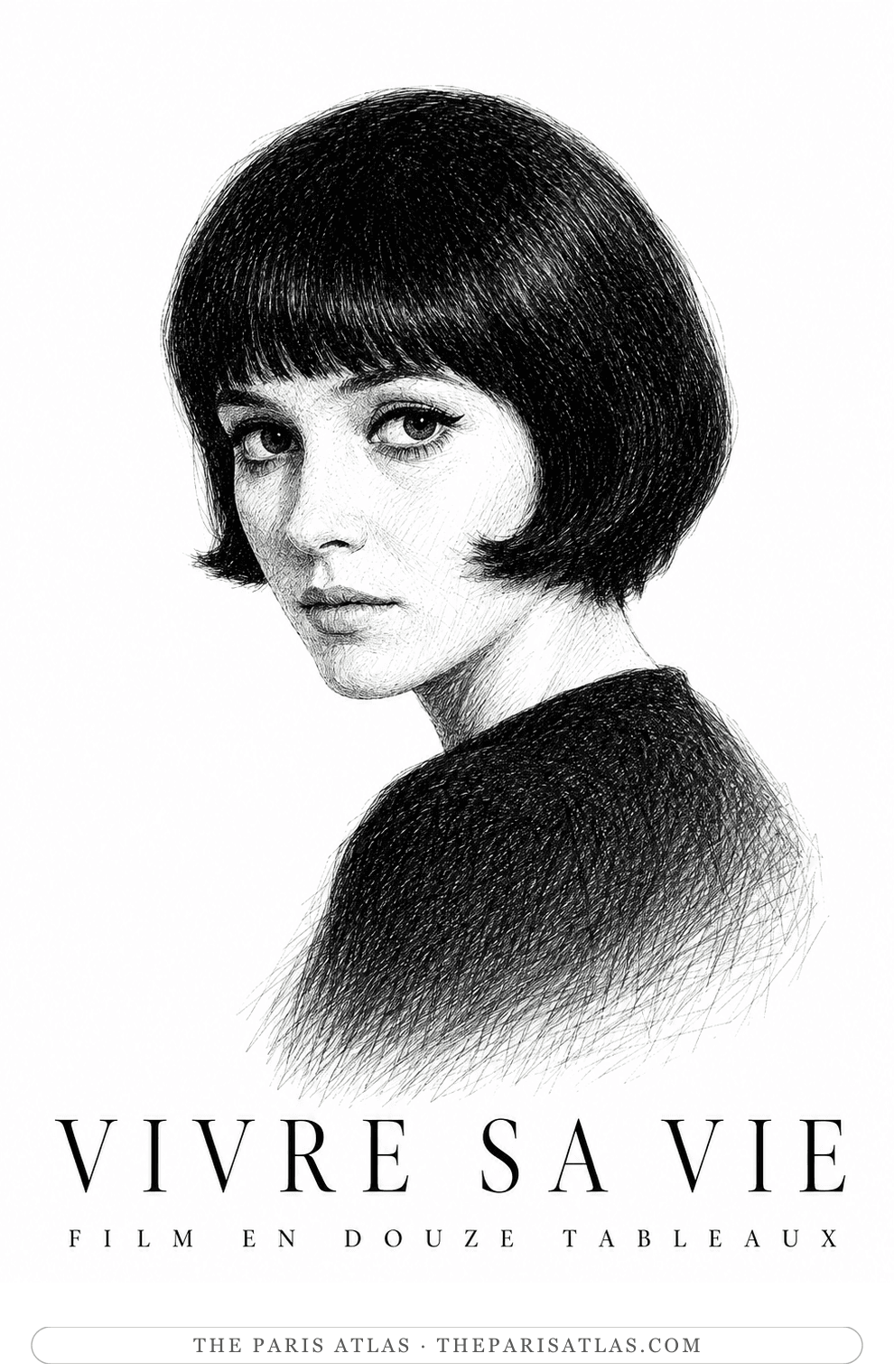
House-illustrated poster for Vivre sa vie (1962): a pen-and-ink portrait of a young woman in Anna Karina's Nana bob, in three-quarter profile, above the title Vivre sa vie — film en douze tableaux

Editorial illustration

Film

Vivre sa vie

Jean-Luc Godard · 1962 · About 85 minutes, black and white — a film in twelve tableaux

Vivre sa vie is Jean-Luc Godard's fourth feature and the fullest of his portraits of Anna Karina, his wife and the face of his early-sixties films. It follows Nana, a young Parisian who leaves her husband to try for a life as an actress and drifts instead into prostitution, told in twelve numbered tableaux, each announced by an intertitle. Godard treats the subject half as story and half as report — a documentary-like account of the trade set beside a cinema visit to Dreyer's Joan of Arc and a café conversation with a real philosopher about language and truth. It is one of the essential films of the New Wave's most personal period.

Jean-Luc Godard, Vivre sa vie, 1962.

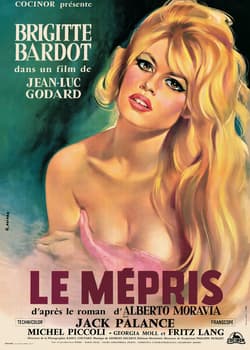
Poster for Contempt (Le Mépris, 1963), Jean-Luc Godard's film with Brigitte Bardot

Archival photograph

Film

Contempt

Jean-Luc Godard · 1963 · About 103 minutes, color — Franscope widescreen

Contempt is Jean-Luc Godard's biggest and most international film: a widescreen color production about the making of a film, and about a marriage falling apart inside it. Michel Piccoli plays a screenwriter hired to rewrite Fritz Lang's adaptation of The Odyssey for a crass American producer; over a single day his wife, played by Brigitte Bardot, comes to feel a contempt for him she cannot explain, after he seems to hand her to the producer. Godard turns the clash of art and money into the film's real subject — a clash he was living out with his own producers, who had financed the picture for Bardot's fame and demanded she appear nude. It is the New Wave's grandest statement on the death of classical cinema.

Jean-Luc Godard, Contempt, 1963. Image © the rights holder, shown under fair use.

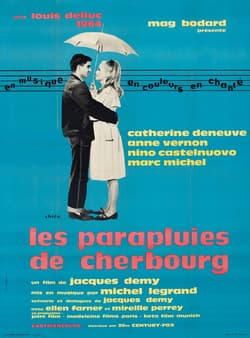
Poster for The Umbrellas of Cherbourg (1964): Catherine Deneuve and Nino Castelnuovo under an umbrella against saturated color

Archival photograph

Film

The Umbrellas of Cherbourg

Jacques Demy · 1964 · 91-minute feature, Eastmancolor — sung throughout

Jacques Demy's The Umbrellas of Cherbourg is a melodrama in which nobody speaks — every line, from a declaration of love to a question about an umbrella, is sung, over a continuous Michel Legrand score. Catherine Deneuve, twenty, plays a shop girl separated from her mechanic sweetheart when he is called up for the Algerian War; pregnant and pressed by her mother, she marries another man, and the two lovers meet again years later by chance. It won the Palme d'Or at Cannes in 1964. Demy belonged to the New Wave's Left Bank, and here he answered the Hollywood musical with a French film in a minor key: saturated color, no dancing, and an ending of quiet realism rather than romance.

Jacques Demy, The Umbrellas of Cherbourg, 1964. Image © the rights holder, shown under fair use.

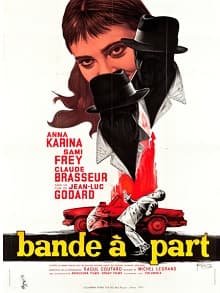
French poster for Bande à part (1964): Anna Karina, Sami Frey, and Claude Brasseur

Archival photograph

Film

Band of Outsiders

Jean-Luc Godard · 1964 · 97-minute feature, black and white

Band of Outsiders is Jean-Luc Godard at his lightest: a crime story drawn from an American pulp novel and played as a game. Two aimless young men, Franz and Arthur, both circling Anna Karina's Odile, talk her into helping them rob the villa where she lives. The plot is almost beside the point. What the film is remembered for are its digressions — the trio dancing the Madison in a café, their record-breaking dash through the Louvre, and a minute of silence in which Godard cuts the soundtrack to nothing. Godard narrates it himself, quoting the gangster pictures it half-imitates. It is the most charming film of his years with Karina.

Jean-Luc Godard, Band of Outsiders, 1964. Image © the rights holder, shown under fair use.

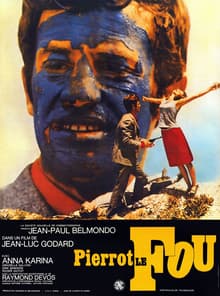
Poster for Pierrot le fou (1965): Jean-Paul Belmondo and Anna Karina against blocks of primary color

Archival photograph

Film

Pierrot le fou

Jean-Luc Godard · 1965 · 110-minute feature, Eastmancolor — widescreen (Techniscope, 2.35:1)

Pierrot le fou is Jean-Luc Godard's tenth feature and one of the summits of his mid-1960s cinema. Jean-Paul Belmondo plays Ferdinand, a bored Paris husband who walks out of a bourgeois party and drives south with Marianne, an old lover played by Anna Karina, into a loose crime plot of gun-runners, stolen cars, and betrayal. Godard films it as collage — blocks of red, white, and blue in Eastmancolor and widescreen, songs, direct address to the camera, and quotations from Rimbaud and pop art — and ends it with Ferdinand's face painted blue and a stick of dynamite. It is the New Wave turning from realism toward the essay and the political film, made as Godard and Karina's own marriage was ending.

Jean-Luc Godard, Pierrot le fou, 1965. Image © the rights holder, shown under fair use.

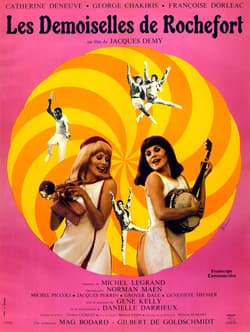
Poster for The Young Girls of Rochefort (1967): Catherine Deneuve and Françoise Dorléac in pastel color

Archival photograph

Film

The Young Girls of Rochefort

Jacques Demy · 1967 · 126-minute feature, Eastmancolor — a song-and-dance musical

The Young Girls of Rochefort is Jacques Demy's love letter to the Hollywood musical. Twin sisters — a dance teacher and a composer, played by the real-life sisters Catherine Deneuve and Françoise Dorléac — dream of love and of leaving their port town for Paris, while a travelling fair, a sailor-painter, and a visiting American composer weave a set of near-miss romances around them. Unlike the sung-through Umbrellas of Cherbourg, this one has spoken dialogue and full song-and-dance numbers, with Gene Kelly himself in the cast and a celebrated Michel Legrand score. It completes Demy's loose trilogy, and beneath its bright surface runs a thread of melancholy.

Jacques Demy, The Young Girls of Rochefort, 1967. Image © the rights holder, shown under fair use.

Follow it through the atlas

Timeline

  1. 1948

    Alexandre Astruc's caméra-stylo essay argues a director can write with the camera.

  2. 1951

    Cahiers du cinéma founded in Paris, André Bazin among its founders.

  3. 1954

    Truffaut's "A Certain Tendency of the French Cinema" attacks the tradition of quality.

  4. 1955

    Agnès Varda shoots La Pointe Courte — the movement's precursor feature.

  5. 1958

    Chabrol's Le Beau Serge, financed outside the studios, opens the run of first features.

  6. 1959

    Cannes: Truffaut wins best director for The 400 Blows; Hiroshima mon amour premieres. Godard shoots Breathless that summer.

  7. 1960

    Breathless opens in Paris in March.

  8. 1962

    Cléo from 5 to 7, Jules and Jim, and La Jetée — the wave at full width.

  9. 1964

    Demy's The Umbrellas of Cherbourg takes the top prize at Cannes.

  10. 1965

    The collective phenomenon has dissolved into separate careers.

  11. 1968

    The Langlois affair in February; in May, New Wave directors help halt the Cannes festival.

The French New Wave: frequently asked questions

What was the French New Wave?

A burst of first features made by young directors in and around Paris between 1958 and the mid-1960s. Many began as critics at the magazine Cahiers du cinéma and carried the habits of criticism into production: small budgets, real locations, and the belief that a film should carry its director's voice. There was no manifesto and no single style.

Who were the main French New Wave directors?

The Cahiers critics — Jean-Luc Godard, François Truffaut, Claude Chabrol, Éric Rohmer, and Jacques Rivette — plus the Left Bank group of Alain Resnais, Chris Marker, and Agnès Varda, who came from documentary, photography, and writing. Varda's La Pointe Courte (1955) predates every Cahiers feature, so she is often called the movement's precursor.

When did the French New Wave start?

Chabrol's Le Beau Serge (1958) is usually counted the first feature, but 1959 made the movement international news: Truffaut won best director at Cannes for The 400 Blows and Resnais's Hiroshima mon amour premiered. Godard shot Breathless that summer, and its March 1960 release turned the movement into a rush. By about 1965 it had dissolved into separate careers.

What does "nouvelle vague" mean?

It means, literally, "new wave." The phrase began as a journalist's label for France's postwar generation and attached itself to the filmmakers. It never described a formal school with a fixed program.

What are the characteristics of French New Wave films?

Real locations instead of sets, available light, small crews and budgets, and casts that mixed professionals with non-actors. The camera was handheld and mobile, borrowed from documentary; the editing showed its seams, with jump cuts and abrupt transitions, and films that admit they are films through direct address and quotation. Breathless made the jump cut conspicuous and widely imitated.

Sources

  • Encyclopaedia Britannica — New Wave (French film movement)
  • Sam Wigley, BFI — 10 great French New Wave films
  • Encyclopaedia Britannica — Cahiers du Cinéma