Associated with · 1962
The French New Wave
A landmark of the movement's Left Bank wing: Chris Marker's photo-roman makes memory, the still image, and the aftermath of catastrophe — the group's signature subjects — its whole method.
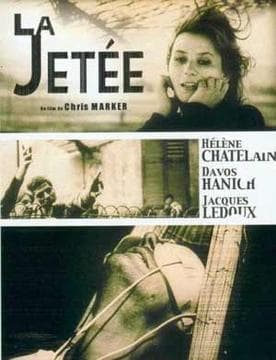
by Chris Marker
Chris Marker's La Jetée is a science-fiction film told almost entirely in still photographs. After a Third World War, survivors under a ruined Paris experiment with sending a prisoner through time, choosing him for the strength of one childhood memory: a woman's face on the observation pier at Orly, and a man's death. Twenty-eight minutes long and built from photographs joined by dissolves and a narrator's voice, it is the New Wave's Left Bank sensibility — memory, the still image, the aftermath of catastrophe — pushed to its logical extreme, and the film that later gave Terry Gilliam the premise of 12 Monkeys.
The photo-roman
La Jetée is built almost entirely from black-and-white still photographs, joined by dissolves, cuts, and fades over a narrator's voice and music. Marker called it a photo-roman — a photo-novel — and shot the images on a stills camera rather than a movie camera. The effect is of memory itself: a sequence of fixed moments the mind returns to, rather than the continuous flow of ordinary film.
There is one exception, and it is the film's most famous instant. In a single brief shot the sleeping Woman opens her eyes and looks at the camera — a few seconds of true motion in a film of frozen frames. After twenty minutes of stillness the movement lands like a held breath released.
A Third World War has left Paris in radioactive ruin. The survivors shelter in the tunnels beneath the Palais de Chaillot, where the victors experiment on prisoners, trying to send them through time in search of food, medicine, and power. The unnamed Man is chosen for a single, unusually vivid memory: as a boy on the observation pier at Orly Airport, he saw the face of a woman, and in the same moment saw a man die.
The scientists use that fixed image to send him into the past, where he meets the Woman from his memory and falls in love across a series of encounters. Having proved the method works, they send him to the future, whose people give him a device to regenerate their broken present. His task done, the experimenters mean to be rid of him.
The people of the future offer to take him in. He asks instead to be returned to the pier at Orly, to the Woman. He arrives and sees her — then sees one of the camp's agents, sent to follow him. As he runs toward her, the agent kills him. In dying he understands what he had witnessed as a child: the man who died on the pier was himself.
Marker belonged to the New Wave's Left Bank group — the cohort around Alain Resnais and Agnès Varda, older and more literary than the Cahiers du cinéma critics, and closer to photography and the modern novel than to genre cinema. Resnais had made memory and the aftermath of catastrophe his subject in Hiroshima mon amour; Marker takes the same materials and strips them to their frame.
By telling a whole story in photographs, La Jetée makes the Left Bank's preoccupations literal. Memory is a still image. History is what survives the disaster. The film is science fiction with almost none of the genre's apparatus — no effects, no spectacle, only faces, a museum, an airport pier, and a voice.
La Jetée won the Prix Jean Vigo in 1963 and has grown into one of the most admired short films ever made, a fixture of the greatest-films polls and of the teaching canon. Its premise — a man sent back to a childhood memory that turns out to be his own death — reached a wide audience again through Terry Gilliam's 12 Monkeys (1995), which credits it as its source.
Marker himself went on to the feature-length essay film Sans Soleil (1983) and kept experimenting with image and memory into his tenth decade. La Jetée remains the compact statement of everything that interested him.
1961
Marker shoots the film in Paris, mostly as still photographs, for Anatole Dauman's Argos Films.
February 1962
La Jetée premieres in France — about 28 minutes, black and white, a science-fiction story told almost entirely in stills.
1963
Awarded the Prix Jean Vigo; enters wider festival circulation.
1983
Marker completes Sans Soleil, the feature essay film that shares La Jetée's concern with memory and the image.
1995
Terry Gilliam's 12 Monkeys is released, drawn from La Jetée and crediting it as its source.
2012
Marker dies in Paris on his ninety-first birthday; La Jetée is by then a standard of the greatest-films polls.
After a Third World War, survivors beneath a ruined Paris send a prisoner through time, choosing him for one vivid childhood memory — a woman's face on the pier at Orly Airport, and a man's death. Sent into the past he meets and loves the woman; returning to the pier at the end, he is shot, and realizes the death he saw as a child was his own. Chris Marker made it in 1962.
Marker built the film almost entirely from black-and-white stills, joined by dissolves and a narrator's voice — he called it a photo-roman, a photo-novel. The frozen images mirror the film's subject, memory, which returns to us as fixed moments rather than continuous motion. There is a single brief passage of real movement, when the sleeping woman opens her eyes.
Yes. Terry Gilliam's 12 Monkeys (1995) takes its premise — a prisoner sent back to a haunting childhood memory that proves to be his own death — from La Jetée, and credits the film as its source.
Yes. It is a landmark of the movement's Left Bank wing — the group around Chris Marker, Alain Resnais, and Agnès Varda — which was older and more literary than the Cahiers du cinéma critics and drew on photography and the novel. Its concern with memory and the aftermath of catastrophe is the Left Bank's signature.
About twenty-eight minutes. It is a short film, not a feature, and it tells a complete science-fiction story in that time using photographs, narration, and music.
La Jetée — trailer
Associated with · 1962
A landmark of the movement's Left Bank wing: Chris Marker's photo-roman makes memory, the still image, and the aftermath of catastrophe — the group's signature subjects — its whole method.
The sources below include collection records, catalogues, scholarly research, and primary materials that informed this page. They document La Jetée, its making, and its place in cultural history.


Web source consulted for documented facts and historical context presented on the La Jetée page.
Web source consulted for documented facts and historical context presented on the La Jetée page.

Official record used to verify names, dates, institutional details, or other factual information on this page.
Contemporary reporting or criticism used to document the historical reception and context of La Jetée.
Web source consulted for documented facts and historical context presented on the La Jetée page.
These references provide the documented foundation for this work's history and interpretation. Claim-level citations remain attached to the specific claims they support.
 Explore more resources