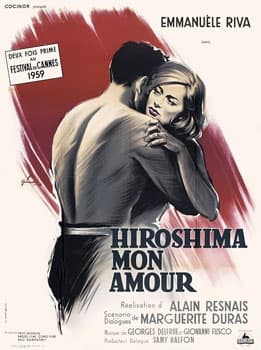
Alain Resnais's first feature, written by the novelist Marguerite Duras, follows a French actress and a Japanese architect through a brief affair in Hiroshima, where she has come to film a picture about peace. Their encounter draws out a wartime memory she has never told: a German lover in Nevers, killed at the Liberation, for which the town shaved her head. Against the destroyed city the film makes memory and forgetting its real subject — and, arriving at Cannes in 1959 alongside the Cahiers directors' debuts, it opened the New Wave's Left Bank wing onto literature and modern time.
Created
1959
Form
35 mm feature film, black and white
Hiroshima and Nevers
One affair, two cities
A French actress has come to Hiroshima to shoot a film about peace. On her last night she begins a brief affair with a Japanese architect. Over a single day and night the encounter opens a memory she has kept from everyone: a love affair, during the Occupation, with a German soldier in her home town of Nevers, who was shot at the Liberation. The town punished her by shaving her head and hiding her in a cellar.
The film cuts between the two cities and the two losses without marking the seams — the man in Hiroshima and the dead soldier in Nevers begin to occupy the same present. It is a love story about the collision of private grief and a public catastrophe, and about how much of either survives being told.
“You saw nothing in Hiroshima”
The film opens on two bodies in close-up, first dusted with what looks like ash, then with sweat, while the woman's voice insists that she has seen Hiroshima — the museum, the newsreels, the survivors — and the man's voice answers, over documentary footage of the aftermath, that she saw nothing. The exchange runs like a refrain: everything, and nothing.
Resnais had trained as an editor and made documentaries, among them Night and Fog on the Nazi camps. Here he turns that method on a fiction: the montage argues that catastrophe cannot be witnessed at second hand, and that memory, not the archive, is where it is carried.
Duras's screenplay
The film began as a commission for a documentary short about the atomic bomb. Resnais found the subject impossible to film directly and asked the novelist Marguerite Duras to write him a fiction instead. Her screenplay — spare, repetitive, closer to a prose poem than to conventional dialogue — became the film's voice, and was published as a book in its own right.
Duras's writing put a major novelist at the source of a New Wave film, and earned an Academy Award nomination for its original screenplay. It is the clearest bridge between the movement and literature: the Left Bank wing worked from the novel, and here the novel is doing the work.
The Left Bank debut
Hiroshima mon amour was Resnais's first feature, and it reached Cannes in 1959 in the same season as François Truffaut's The 400 Blows — the year the New Wave arrived. It was shown out of competition, reportedly to avoid offending the United States, and left as one of the most discussed films of the festival.
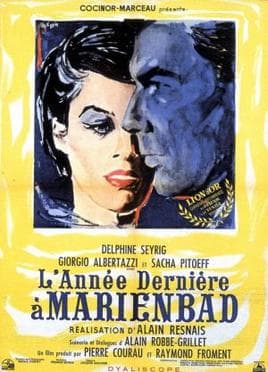
Resnais belonged to the movement's Left Bank group, older and more literary than the Cahiers du cinéma critics, and closer to the modern novel than to genre cinema. With Last Year at Marienbad two years later he pressed further into memory and time. Hiroshima mon amour is where that project begins, and where the New Wave first shows it can carry the weight of history.
Timeline
1958
Resnais is commissioned to make a documentary short about the atomic bomb; finding it impossible, he turns it into a fiction feature and asks Marguerite Duras to write it.
May 1959
Premieres at Cannes, shown out of competition — reportedly to avoid offending the United States — in the season the New Wave breaks.
June 1959
Released in France; Resnais's first feature.
1961
Duras is nominated for the Academy Award for Best Original Screenplay.
2010s–
Restored and re-released; a fixture of the teaching canon of the New Wave and of modernist cinema.
Frequently asked questions
What is Hiroshima mon amour about?
A French actress in Hiroshima to shoot a film about peace has a brief affair with a Japanese architect, which draws out her buried memory of a wartime love affair with a German soldier in Nevers. Alain Resnais directed it in 1959 from a screenplay by Marguerite Duras; its subject is memory, forgetting, and the atomic bomb.
Who directed and wrote Hiroshima mon amour?
Alain Resnais directed it — his first feature film — and the novelist Marguerite Duras wrote the screenplay, which was nominated for an Academy Award and published as a book.
What does the opening “You saw nothing in Hiroshima” mean?
In the opening the woman's voice insists she has seen Hiroshima — its museum, its survivors, its newsreels — and the man's voice answers that she saw nothing. The refrain sets up the film's argument that a catastrophe cannot be truly witnessed second-hand, and that what survives is carried in memory.
Is Hiroshima mon amour a French New Wave film?
Yes. It is a founding film of the movement's Left Bank wing — the group around Resnais, Agnès Varda, and Chris Marker — and premiered at Cannes in 1959, the same season as Truffaut's The 400 Blows.
Why is Hiroshima mon amour important?
It made memory and time the material of modern cinema, brought a major novelist into the New Wave, and stands with Last Year at Marienbad among the works that redefined what a film could do with the past. It is Resnais's debut and one of the movement's Left Bank landmarks.
Related videos
Official uploads only: trailers, performances, and works this one inspired.
A founding film of the movement's Left Bank wing: Alain Resnais's first feature, written by Marguerite Duras, which premiered at Cannes in 1959 alongside the Cahiers directors' debuts and brought memory, time, and the modern novel into the New Wave.
— The Criterion Collection — Hiroshima mon amour; Encyclopaedia Britannica — New Wave (French film movement)
The sources below include collection records, catalogues, scholarly research, and primary materials that informed this page. They document Hiroshima mon amour, its making, and its place in cultural history.
1The Criterion Collection — Hiroshima mon amour
Website
The Criterion Collection
Used for
Web source consulted for documented facts and historical context presented on the Hiroshima mon amour page.
These references provide the documented foundation for this work's history and interpretation. Claim-level citations remain attached to the specific claims they support.


 View source