Truffaut's first feature turned his own neglected Paris childhood into Antoine Doinel: a boy failed by his mother, his school, and the reformatory, played by fourteen-year-old Jean-Pierre Léaud. One year after Cannes banned Truffaut as a critic, it won him the festival's directing prize, drew 4.1 million French admissions, and ended on the most famous freeze-frame in cinema. The New Wave's door opened here.
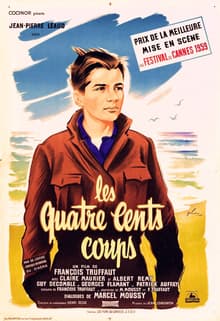
In 1958 Truffaut's attacks on the French film establishment got him barred from Cannes — by his own account, the only French critic not invited. A year later the same festival screened his first feature as France's official selection, and gave him the prize for best direction. The reversal was so clean it reads as fiction, and it became the founding anecdote of the New Wave: the movement's fiercest critic walking back into the building as its proof of concept.
The film added the OCIC prize at Cannes and, the following year, an Academy Award nomination for Truffaut and Marcel Moussy's screenplay — institutional embraces of a film made against the institutions.
Antoine
Antoine Doinel is Truffaut, lightly disguised: the unwanted son, the school truant educated by cinemas, the boy handed to the police by his own parents and processed into an observation center for delinquent minors. To play him, Truffaut ran a casting notice in France-Soir and auditioned several hundred boys in the autumn of 1958; the filmed auditions survive, and the fourteen-year-old who won carried the part so completely that he kept it for twenty years.
Jean-Pierre Léaud would return as Doinel in Antoine and Colette (1962), Stolen Kisses (1968), Bed and Board (1970), and Love on the Run (1979) — an actor aging in real time inside his director's autobiography.
Antoine in the observation-center interview — hands clasped, answering the psychologist the audience never sees. Frame from the distributor's restoration trailer, used under fair use. — Frame from Les Quatre Cents Coups (Les Films du Carrosse / MK2)
The story
Antoine Doinel is thirteen, in trouble at school — for a scrawl on the classroom wall, then for an essay his teacher takes for plagiarized Balzac — and in the way at home, where his mother and stepfather share a cramped Paris apartment with a boy neither quite wants. He skips school with his friend René Bigey, and on one truant afternoon sees his mother on the street with a man who is not his stepfather. Pressed for an excuse the next morning, he tells the school she has died.
The lie collapses, the Balzac humiliation follows, and Antoine stops going back — first to school, then home, sleeping at René's and plotting his independence. To fund it he steals a typewriter from his stepfather's office; unable to sell it, he is caught carrying it back, and Julien hands his son to the police. Antoine spends a night in a cell alongside prostitutes and thieves, then is signed over to an observation center for delinquent minors near the sea, where a psychologist probes for the sources of an unhappiness the film has already shown us plainly.
Antoine held behind the wire at the police station, the night his stepfather hands him over. Frame from the distributor's restoration trailer, used under fair use. — Frame from Les Quatre Cents Coups (Les Films du Carrosse / MK2)
What happens when he sees his chance is the ending — below.
November 1958 – January 1959
Making it
Truffaut produced the film through his own company, Les Films du Carrosse, financed in part by his father-in-law Ignace Morgenstern, the distribution executive — family money standing where the studios would not. Henri Decaë shot it in DyaliScope widescreen through the winter of 1958–59, in the streets where Truffaut had actually grown up, around Pigalle and Montmartre; Jean Constantin wrote the score.
Two boys on a Paris street in DyaliScope widescreen — Truffaut shot on location in the arrondissements where he grew up. Frame from the distributor's restoration trailer, used under fair use. — Frame from Les Quatre Cents Coups (Les Films du Carrosse / MK2)
André Bazin — the critic who had rescued the delinquent Truffaut, twice, and made him a writer — died on 11 November 1958, as shooting began. The film is dedicated to his memory: the reformed boy's first work, inscribed to the man who reformed him.
Antoine faces the classroom wall, hands on his head — the schoolroom discipline the film indicts. Frame from the distributor's restoration trailer, used under fair use. — Frame from Les Quatre Cents Coups (Les Films du Carrosse / MK2)
Where it was shot
The real addresses
The budget was about $75,000, less than a third of what an average French feature cost at the time, and the film was shot at real addresses, most of them in the 9th arrondissement, the neighborhood where Truffaut grew up. Several can still be visited today.
4 place Gustave-Toudouze — the entrance to the Doinel family's building, on a small triangular square in the Saint-Georges quarter of the 9th arrondissement.
Square d'Estienne d'Orves, beside the Sainte-Trinité church — the fountain where Antoine washes his face after his first night sleeping on the streets, its water near freezing in the winter shoot.
85 rue de Vaugirard — the school's street front, with a stone relief by the sculptor Aimé Millet above it. The building actually housed a technical school of photography and film, so Antoine skips class, on screen, outside a school that trained camera operators.
52 Galerie Élysées-La Boétie — the office arcade where Antoine takes the typewriter. He walks out at 9 rue La Boétie, and the boys vanish down the steps of the Franklin D. Roosevelt métro station.
The ending was shot about two hundred kilometers from Paris, on the Normandy coast at Villers-sur-Mer, a beach town just south of Deauville, with the dark Vaches Noires cliffs behind Antoine as he runs. The spot has changed since 1959. The steps Antoine takes down to the sand are gone, sea defenses now cut the beach into sections, and much of the hillside behind it has crumbled into the sea.[1]
The films inside the film
Truffaut was a film critic before he was a director, and he filled his first feature with the cinema that raised him. When Antoine and René skip school for the movies, they stop at a cinema's display board and steal a photograph of a young woman. The still shows the Swedish actress Harriet Andersson in Summer with Monika, a 1953 film by Ingmar Bergman; stealing her picture was Truffaut's tribute to a film he admired.[2]
The Doinels' one good evening together is a trip to the movies, and it hides a private joke. The film they go to see is Paris Belongs to Us, the first feature of Jacques Rivette, Truffaut's fellow critic at Cahiers du cinéma. Rivette had not finished it: he was still shooting when The 400 Blows premiered, and Paris Belongs to Us reached cinemas only in 1961. Truffaut was advertising a friend's film that no audience could yet see.[3]
Truffaut also put himself on screen. At the fairground Antoine rides the Rotor, a spinning drum that pins its riders to the wall while the floor drops away, and one of the riders in the drum with him is Truffaut, uncredited. The film scholar Dudley Andrew has pointed out that the ride itself behaves like a zoetrope, the spinning slotted drum that made drawings move before film existed.[4]
The interview scene
Fourteen years old and suddenly famous: Jean-Pierre Léaud, photographed by Studio Harcourt in 1959. — Studio Harcourt
Near the end of the film, at the observation center, Antoine sits against a dark background and answers questions about the typewriter, his mother, and girls. He says he returned the typewriter because he could not sell it and got scared, and he says, flatly, that his mother had not wanted him: she nearly ended the pregnancy, and only his grandmother talked her out of it. The psychologist asking the questions is never shown. A woman's voice comes from off screen, and Antoine's answers are joined by slow fades, as if a much longer interview had been trimmed to its best moments.[5]
The scene is famous for how it was made. Truffaut sat off camera and asked the questions himself, without a script, and filmed at length, springing unexpected questions on Jean-Pierre Léaud to keep the boy off balance; the hesitations and the sudden grin are Léaud's own. A woman's voice replaced Truffaut's in the finished soundtrack, and no reverse shot was ever filmed, so nothing on screen competes with the fourteen-year-old's face.[6]
The method came from the casting itself. Léaud's surviving screen test, shot in the autumn of 1958, uses the same setup: an unknown boy looking just past the lens, answering questions from a director who is heard and never seen.[7]
The run to the sea
Antoine's run for the coast, caught in the long lateral tracking shot that carries him out of the observation center. Frame from the distributor's restoration trailer, used under fair use. — Frame from Les Quatre Cents Coups (Les Films du Carrosse / MK2)
Antoine escapes the observation center during a football match and runs — a long, unbroken tracking shot down country roads to the Normandy coast, to the sea he has said he has never seen. He reaches the water, wades a few steps, turns back toward land, and the camera zooms in and freezes on his face looking into the lens. No resolution, no sentence passed: a boy caught between the institution behind him and an ocean that goes nowhere.[2]
The last image: Antoine at the edge of the sea he has never seen, frozen mid-look into the camera — among the most famous final shots in cinema. Low-resolution copy, used under fair use. — Frame from Les Quatre Cents Coups (Les Films du Carrosse / MK2)
The freeze-frame ending — reached, by most accounts, on the beach at Villers-sur-Mer — became one of the medium's permanent images, imitated so often that it is easy to forget it was once a shock. The New Wave's open endings start here.[1]
1959–
Reception and afterlife
The film drew 4.1 million admissions in France — proof, before Breathless, that the new cinema could pay for itself — and crossed the Atlantic within the year: by Christmas 1959 it was playing American neighborhood houses like Washington's Trans-Lux Playhouse, its newspaper ads stacked with astonished notices. The Doinel cycle followed across two decades, and the film has never left the canon: restored, re-released, and taught wherever the movement is.[8]
It is the French New Wave's opening move: the 1959 Cannes triumph that made the movement bankable, by the critic who had written its manifesto five years earlier.[9]
A Washington, D.C. newspaper ad for the American run, Christmas 1959 — the Zenith International release at the Trans-Lux Playhouse, with the Star, Post, and News quotes that greeted it. Public domain. — Trans-Lux Playhouse newspaper advertisement, via Wikimedia Commons
Timeline
1954
Truffaut's 'A Certain Tendency of the French Cinema' attacks the establishment the film will later defeat.
1958
Truffaut is barred from Cannes as a critic; in the autumn he auditions several hundred boys and casts the fourteen-year-old Léaud.
November 1958
Shooting begins in Truffaut's childhood streets; André Bazin dies on 11 November, and the film is dedicated to him.
4 May 1959
Premieres at Cannes; Truffaut wins Best Director, one year after his ban.
The French release poster, its banner already carrying the Cannes 1959 direction prize. Low-resolution copy, used under fair use. (Cocinor / Les Films du Carrosse)
1959
4.1 million admissions in France; by Christmas the film is playing American neighborhood cinemas.
A Washington, D.C. newspaper ad for the American run, Christmas 1959 — the Zenith International release at the Trans-Lux Playhouse, with the Star, Post, and News quotes that greeted it. Public domain. (Trans-Lux Playhouse newspaper advertisement, via Wikimedia Commons)
1960
Academy Award nomination for the screenplay, for Truffaut and Marcel Moussy.
1962–1979
The Doinel cycle continues: Antoine and Colette, Stolen Kisses, Bed and Board, Love on the Run.
Frequently asked questions
What does 'The 400 Blows' mean?
It is a too-literal translation of the French idiom 'faire les quatre cents coups' — roughly, to raise hell. The title promises a wild adolescence, not four hundred of anything; the English phrase preserves the words and loses the meaning.
Is The 400 Blows based on Truffaut's life?
Substantially. Antoine's neglect, truancy, reform school, and rescue-by-cinema follow Truffaut's own childhood in the same Paris streets where he shot the film. He called it semi-autobiographical, and dedicated it to André Bazin, the critic who had rescued him in life.
How does The 400 Blows end?
Antoine escapes the observation center and runs to the sea he has never seen. At the waterline he turns, and the film freezes on his face looking into the camera — an open ending, resolving nothing, that became one of the most famous final shots in cinema.
Who plays Antoine Doinel?
Jean-Pierre Léaud, fourteen at the time, chosen from several hundred boys who answered a newspaper casting notice. He went on to play Doinel in four more Truffaut films across twenty years.
Where was The 400 Blows filmed?
In real Paris locations rather than studio sets, mostly in the 9th arrondissement where Truffaut grew up. The Doinel family's building entrance is at 4 place Gustave-Toudouze, the school front is at 85 rue de Vaugirard, and the typewriter theft happens in the Galerie Élysées-La Boétie arcade in the 8th arrondissement. The final beach scenes were shot at Villers-sur-Mer on the Normandy coast.
What film does Antoine's family go to see?
Paris Belongs to Us, the first feature by Jacques Rivette, one of Truffaut's fellow critics at Cahiers du cinéma. It was unfinished at the time: Rivette was still shooting it, and it reached cinemas only in 1961. Earlier in the film, Antoine and René also steal a lobby still of Harriet Andersson in Ingmar Bergman's Summer with Monika from a cinema display board.
What does the ending of The 400 Blows mean?
Truffaut leaves it open. The film stops on Antoine's face and never says what happens to him next: caught, saved, or lost. The sequels answer the practical question, though — in Antoine and Colette, released in 1962, Antoine is back in Paris, living on his own and working.
Why was Truffaut banned from Cannes in 1958?
As a critic he had spent years attacking the French film establishment and the festival itself, and in 1958 the festival did not invite him. The next year The 400 Blows was chosen as an official French entry, and he returned to Cannes as a competitor and won the prize for best direction.
Related videos
Official uploads only: trailers, performances, and works this one inspired.
The Adventures of Antoine Doinel — 4K restoration trailer (Janus Films)
The US distributor's trailer for the full Doinel cycle, The 400 Blows through Love on the Run.
The 400 Blows — 2022 re-release trailer (BFI)
The BFI's trailer for the film's return to UK cinemas.
Jean-Pierre Léaud's first audition for The 400 Blows (MUBI)
The surviving 1958 audition footage: the fourteen-year-old who became Antoine Doinel.
In the atlas
What the graph records about this work — every claim carries its citation.
The film that opened the movement's breakthrough year: Best Director at Cannes 1959 for a first feature by a Cahiers critic, one year after the festival had banned him as a journalist. Its 4.1 million French admissions proved the new cinema could pay.
— Encyclopaedia Britannica — The 400 Blows; John Conomos, Senses of Cinema — Truffaut's The 400 Blows, or the Sea, Antoine, the Sea… (2000)
Explore directors from the same movements and circles.
Claude Chabrol
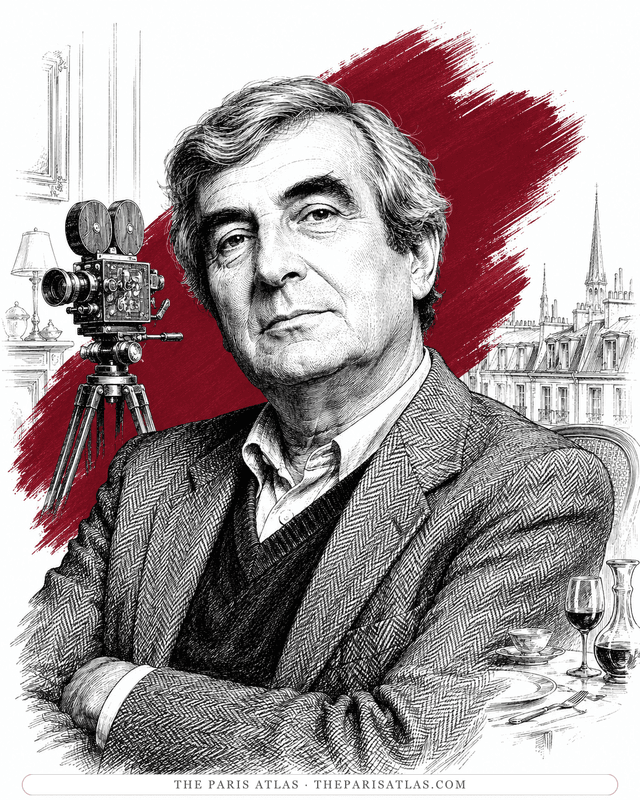
The Cahiers du cinéma critic who reached the screen first: his 1958 debut Le Beau Serge was the first feature from the group that made the New Wave. Over fifty years he became the 'French Hitchcock,' anatomist of the provincial bourgeoisie.
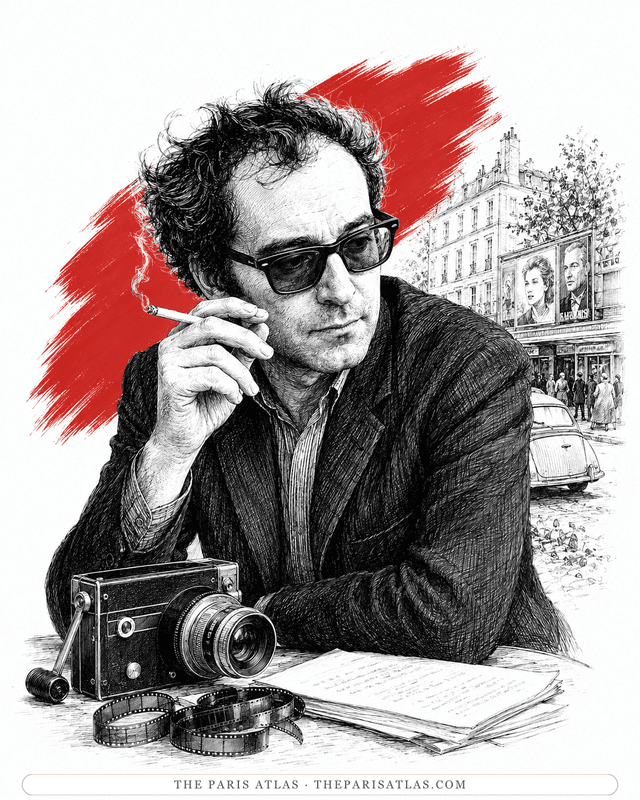
The Cahiers du cinéma critic who became the French New Wave's most recognizable director, then spent six decades taking apart and rebuilding the language of film.
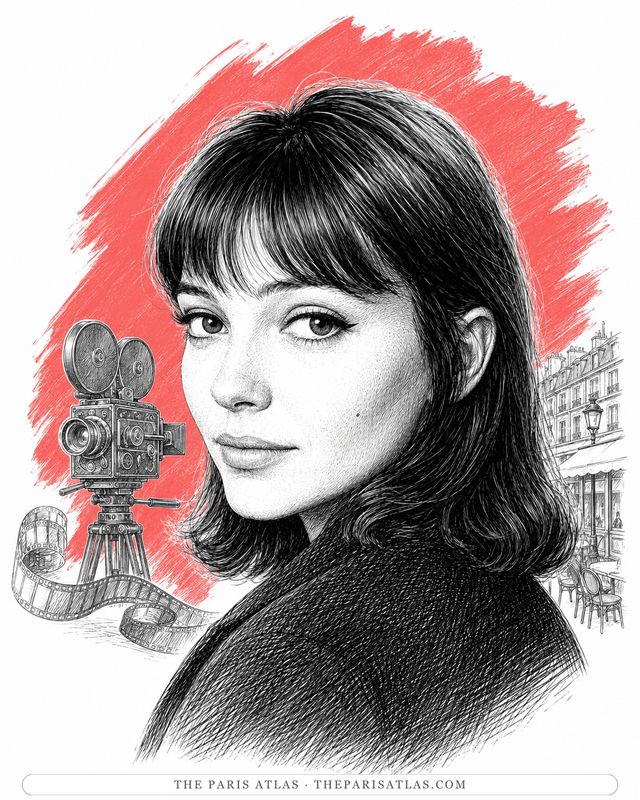
The Danish-born actor at the center of Jean-Luc Godard's 1960s features — the French New Wave's defining female lead, whose performances carry their own authorship.
The freeze-frame that ends it: the sea reached, nowhere left to run.1959 · Frame from Les Quatre Cents Coups (Les Films du Carrosse / MK2) · Fair useAntoine faces the classroom wall, hands on his head — the schoolroom discipline the film indicts. Frame from the distributor's restoration trailer, used under fair use.1959 · Frame from Les Quatre Cents Coups (Les Films du Carrosse / MK2) · Fair useThe interview: Antoine answering questions the film never lets us hear asked.1959 · Frame from Les Quatre Cents Coups (Les Films du Carrosse / MK2) · Fair useThe French release poster, its banner already carrying the Cannes 1959 direction prize. Low-resolution copy, used under fair use.1959 · Cocinor / Les Films du Carrosse · Fair useChristmas 1959, Washington: the New Wave reaches the American neighborhood cinema.December 1959 · Trans-Lux Playhouse newspaper advertisement, via Wikimedia Commons · Public domainThe run to the sea: the tracking shot that keeps pace with Antoine down the country roads.1959 · Frame from Les Quatre Cents Coups (Les Films du Carrosse / MK2) · Fair useOn location: the real Paris streets Truffaut filmed his own childhood in.1959 · Frame from Les Quatre Cents Coups (Les Films du Carrosse / MK2) · Fair useCustody: the diamond grille that turns a thirteen-year-old's night into confinement.1959 · Frame from Les Quatre Cents Coups (Les Films du Carrosse / MK2) · Fair useThe film's star in its release year: Léaud by Studio Harcourt, 1959 — Doinel's gravity under the Harcourt lights.1959 · Studio Harcourt · Public domain
References
References
The sources below include collection records, catalogues, scholarly research, and primary materials that informed this page. They document The 400 Blows, its making, and its place in cultural history.
1abLittle White Lies — On Location: the Normandy beach from The 400 Blows
Website
Used for
Web source consulted for documented facts and historical context presented on the The 400 Blows page.
These references provide the documented foundation for this work's history and interpretation. Claim-level citations remain attached to the specific claims they support.


 View source